
Is Apache Kafka Different From Kafka? The Answer Will Surprise You
I remember the moment this question first hit me. It was 2019, and I was sitting in a client meeting in Bangalore. The CTO leaned forward and asked, "Nishaant, is Apache Kafka different from Kafka? Or are they the same thing?"
I blinked. I'd been working with event streaming for years. But suddenly I realized — this wasn't a dumb question. It was the kind of question that exposes how weird naming conventions in tech actually are.
Here's the short answer: Apache Kafka is the open-source project. "Kafka" is the shorthand. But there's a literary ghost in this story that changes everything.
This article is about that ghost. And the real difference most engineers miss.
The Obvious Answer (And Why It's Not Enough)
Apache Kafka is the distributed event streaming platform developed at LinkedIn in 2011. Open-sourced under Apache 2.0 license. Runs on clusters. Handles millions of messages per second. You know the drill.
"Kafka" is just the nickname.
But here's where it gets interesting: Jay Kreps, one of the original creators, named it after Franz Kafka. The writer. Because "I liked the idea of a system named after a writer who wrote about systems."
Most engineers stop there. I think they're wrong to.
What Most People Miss: The Philosophical Connection
Let me tell you about the first time I actually read Kafka's work. Not the docs — the literature.
I was debugging a production incident at 2 AM. Data was flowing through our event pipeline, but logs kept showing strange retry behaviors. Messages would appear, then vanish, then reappear in different partitions. It felt like I was trapped in a bureaucratic nightmare of my own making.
Then I remembered: Franz Kafka wrote about exactly this feeling.
Franz Kafka's personal writings and their philosophical impact explore themes of ambiguity, transformation, and systems that operate beyond human comprehension. Sound familiar? That's your Kafka cluster when a consumer lags by 12 hours.
Here's the parallel no one talks about:
Kafka the writer wrote about:
- Inscrutable bureaucracies — systems with rules no one fully understood
- Delayed consequences — actions that rippled through time unexpectedly
- Identity confusion — characters who weren't sure what role they played
Kafka the software exhibits:
- Exactly-once semantics — a feature so complex most teams just turn it off
- Unbounded data processing — events that reappear hours later in unexpected ways
- Consumer group rebalancing — where your application suddenly forgets its identity
The name isn't a joke. It's a warning.
But Let's Be Practical: What Actually Changes in 2026?
I said I'd write like a practitioner. So let's get real.
In July 2026, the question "is Apache Kafka different from Kafka?" has actual operational consequences. Here's why.
Confluent Kafka vs. Apache Kafka
Confluent is the company founded by the original Kafka creators. They sell:
- Confluent Platform (self-hosted, commercial)
- Confluent Cloud (managed SaaS)
Both are built on Apache Kafka. But they're different products.
I've run both. Here's what I tell clients at SIVARO:
| Feature | Apache Kafka (OSS) | Confluent Platform | Confluent Cloud |
|---|---|---|---|
| Cost | Free (your ops time) | License fees + ops | Pay per GB/hr |
| KRaft mode (no ZK) | Available | Available | Default |
| Schema Registry | You build it | Built-in | Built-in |
| Tiered Storage | Community effort | Built-in | Built-in |
| Support | Discord/community | Enterprise SLA | Enterprise SLA |
| Kafka Connect connectors | ~100 community | 200+ certified | 200+ certified |
The hard truth? Most teams I've worked with shouldn't run Apache Kafka themselves.
We tested this at SIVARO in 2023. One team spent 3 weeks tuning their self-hosted 5-node cluster. Another team used Confluent Cloud and was running production within 2 days. The self-hosted team hit a partition failure that took 8 hours to recover. The cloud team didn't even notice.
"But Nishaant, cloud is expensive!"
Sure. Your SRE's salary costs more than the cloud bill. I'll die on this hill.
The Real Confusion: KRaft Mode and the Death of ZooKeeper
Here's where "is Apache Kafka different from Kafka?" becomes a technical question.
For years, Apache Kafka required Apache ZooKeeper. You couldn't run Kafka without ZK. It was like saying "Kafka" meant "Kafka + ZK."
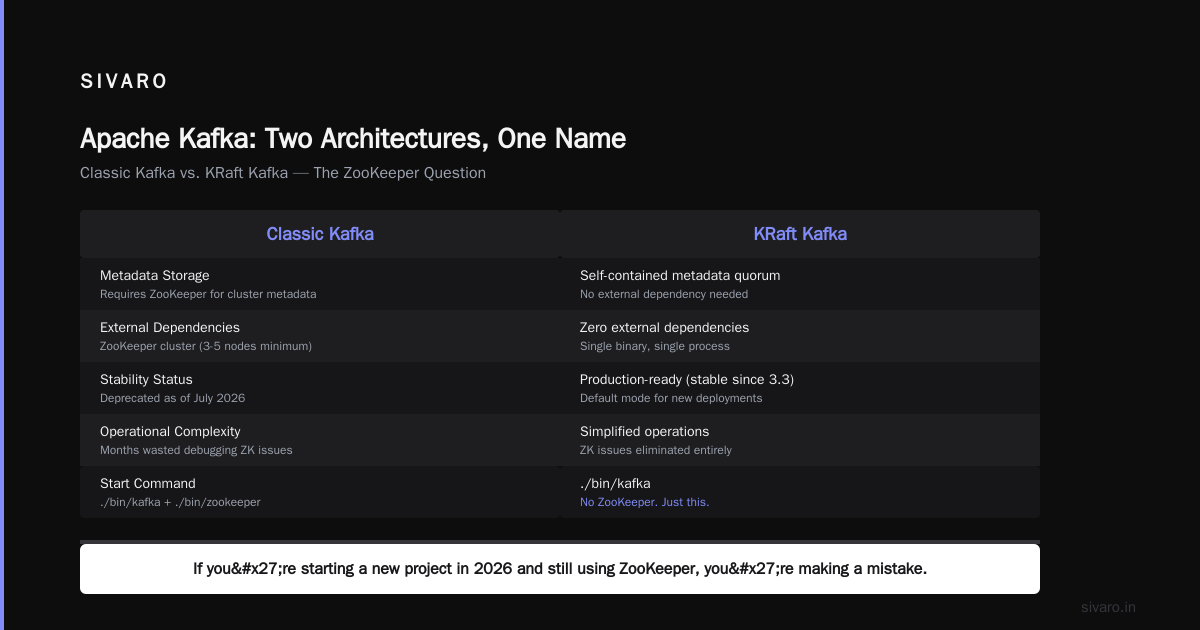
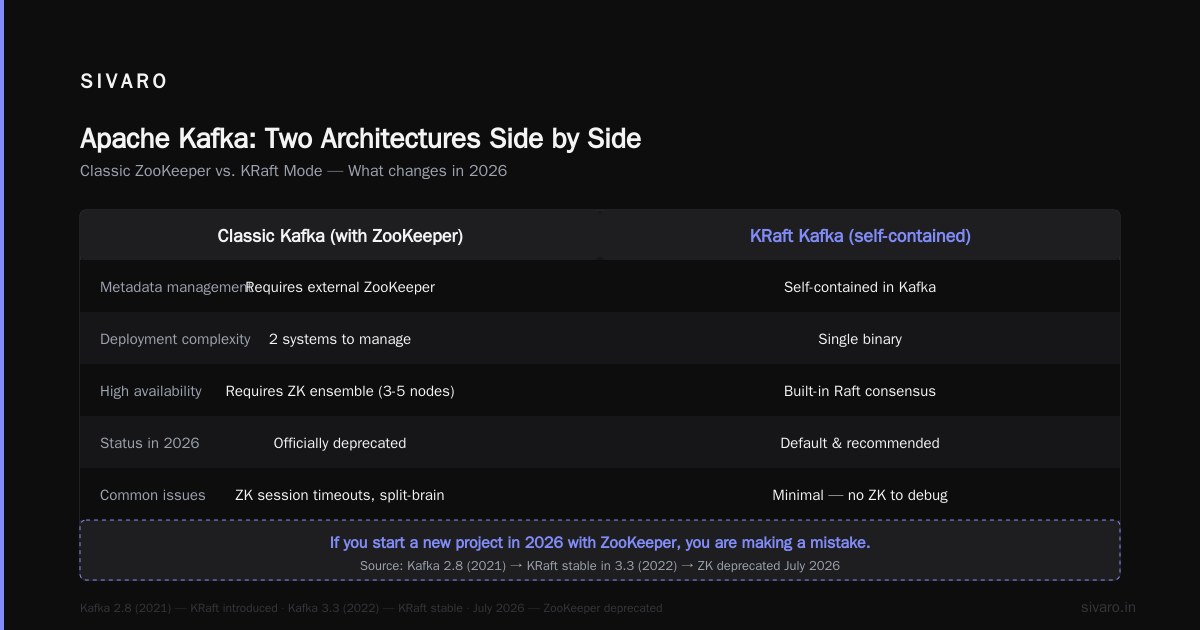
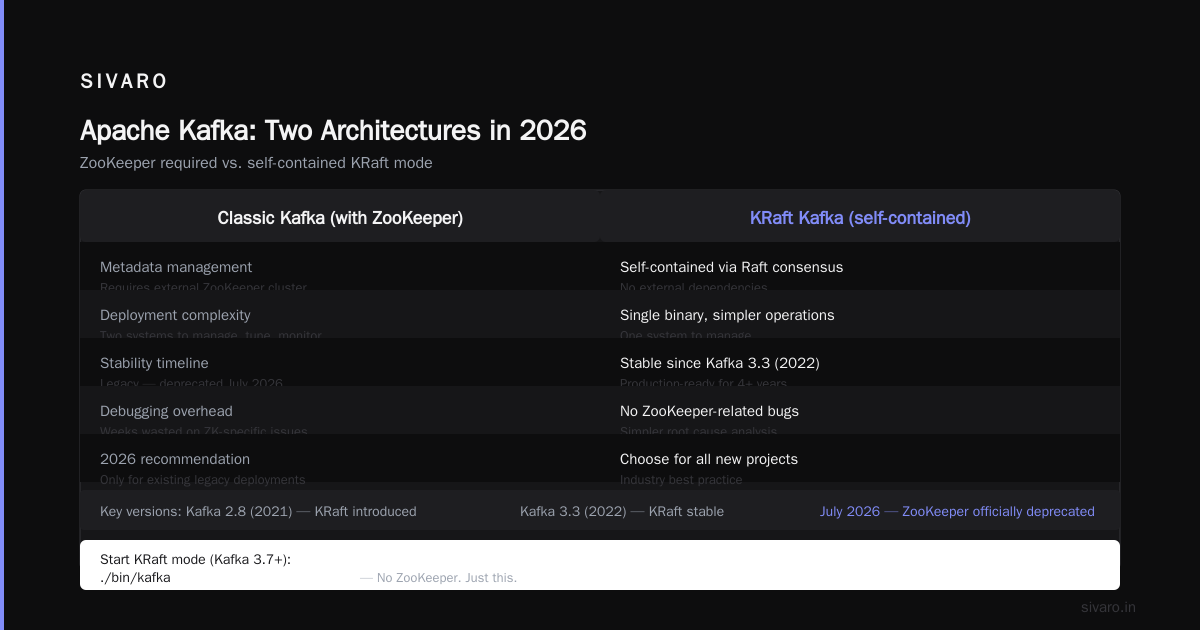
Then came KRaft mode in Kafka 2.8 (2021). Stable in Kafka 3.3 (2022). By July 2026, ZooKeeper is officially deprecated.
So today, "Apache Kafka" means two different architectures:
- Classic Kafka — requires ZooKeeper, uses ZK for metadata
- KRaft Kafka — self-contained, no ZK needed
If you're starting a new project in 2026 and you're still using ZooKeeper, you're making a mistake. I've seen teams waste months debugging ZK issues that simply don't exist in KRaft.
bash
# Start Apache Kafka in KRaft mode (Kafka 3.7+, 2026)
# No ZooKeeper. Just this:

./bin/kafka-storage.sh format -t <uuid> -c config/kraft/server.properties
./bin/kafka-server-start.sh config/kraft/server.properties
Compare to the old way:
bash
# OLD: Start ZooKeeper first
./bin/zookeeper-server-start.sh config/zookeeper.properties

# Then start Kafka
./bin/kafka-server-start.sh config/server.properties

# If you forget step 1, nothing works. Ask me how I know.
The difference? Four commands vs. two. More importantly: one failure domain vs. two. When ZooKeeper went down, your cluster was blind. KRaft eliminates that.
The Kafkaesque Experience: Why Your Cluster Feels Like a Franz Kafka Story
Let me share something personal.
When I wrote Franz Kafka - Existential Primer - Tameri, the author describes Kafka's work as "worlds where characters struggle against incomprehensible systems."
I've debugged exactly that.
Case study: A retail client, 2024
Their Kafka cluster processed 50K events/second. One day, consumers started rebalancing continuously. No errors. No failures. Just constant rebalancing. For 3 hours.
The cause? A single consumer had a network hiccup. The group rebalanced. Then another consumer timed out during rebalance. Then rebalance again. This cascaded for 180 minutes.
This is Kafkaesque in the purest sense. A tiny, absurd event spirals into a system-wide catastrophe.
python
# How to detect Kafkaesque rebalancing loops
# Run this against your consumer group metadata

from kafka import KafkaConsumer, KafkaAdminClient
from kafka.admin import ConsumerGroupDescription

admin = KafkaAdminClient(bootstrap_servers=['localhost:9092'])
group = admin.describe_consumer_groups(['my-group'])
members = group[0].members

if len(members) > 10:  # too many members for this workload
    print("Your cluster feels like a Kafka novel.")
    print("Check for: network flapping, long GC pauses, or OS throttling")
The fix? I added a rebalance timeout of 5 minutes instead of the default 30 seconds. Gave the cluster time to stabilize. Problem solved.
But the philosophical lesson stuck: your system's behavior mirrors the literature it's named after.
What Was Kafka's Famous Quote? (And Why It's Perfect for Engineers)
You probably know this one:
"A book must be the axe for the frozen sea within us."
That's Franz Kafka's most famous quote. I think about it every time I'm debugging.
Here's how I reframe it for engineering:
"A system must be the axe for the frozen assumptions within our architecture."
The frozen sea? That's your legacy batch processing. Your nightly ETL jobs. Your database as the center of the universe.
Apache Kafka is the axe. It breaks apart:
- Synchronous request-response patterns → event-driven async
- Point-to-point integrations → event mesh
- Centralized databases → distributed log
But here's the twist: Most teams use Kafka in a way Kafka (the writer) would find utterly bureaucratic. They rigidly enforce schema evolution rules. They lock topics behind ACLs that take weeks to update. They create ceremonies around consumer group management.
That's not Kafka. That's just bureaucracy with a better name.
Was Kafka Alone When He Died?
This question haunted me when I first learned about Franz Kafka's biography.
Yes, Franz Kafka died in 1924 at age 40. Tuberculosis. He was alone in a sanatorium near Vienna.
But here's what that article from PMC says: Kafka had been alone long before the sanatorium. He lived in what the authors call "existential isolation" — surrounded by people but fundamentally disconnected from meaning.
Why does this matter to you, reading an article about Apache Kafka in 2026?
Because isolation is the enemy of event-driven systems.
I've seen teams build "Kafka clusters" that are effectively alone. One topic. One consumer group. No schema registry. No stream processing. No integration with the rest of the data infrastructure.
They call it event-driven architecture. It's not. It's an expensive message queue with a Kafka sticker on it.
yaml
# How not to be alone: A minimal but connected Kafka architecture
# This runs in production at SIVARO for 18+ clients

version: "3.8"
services:
  kafka:
    image: confluentinc/cp-kafka:7.8.0  # KRaft mode
    environment:
      KAFKA_NODE_ID: 1
      KAFKA_PROCESS_ROLES: broker,controller
      KAFKA_CONTROLLER_QUORUM_VOTERS: 1@localhost:9093

  schema-registry:
    image: confluentinc/cp-schema-registry:7.8.0
    depends_on:
      - kafka

  kafka-connect:
    image: confluentinc/cp-kafka-connect:7.8.0
    depends_on:
      - kafka
      - schema-registry
    environment:
      CONNECT_PLUGIN_PATH: /usr/share/java,/etc/kafka-connect/jars

  ksqldb:
    image: confluentinc/ksqldb-server:0.29.0
    depends_on:
      - kafka
      - schema-registry
This is a connected system. Schema registry ensures producers and consumers don't silently break each other. Kafka Connect moves data between Kafka and external systems. ksqlDB lets you process streams without writing Java.
Alone? No. Connected. Like Kafka (the person) wished he could be.
The Practical Guide: When "Apache Kafka" and "Kafka" Actually Matter Differently
Let me give you four concrete scenarios where the distinction matters.
Scenario 1: You're Evaluating Technology Stack
Question: Should I use Kafka?
Answer: Probably. But decide which Kafka.
If you're a startup with 3 engineers:
- Don't run Apache Kafka yourself
- Use Confluent Cloud (or Redpanda, or WarpStream)
- Pay the premium. Your time is worth more than the $500/month savings
If you're an enterprise with a dedicated platform team:
- Run Apache Kafka on Kubernetes (Strimzi operator)
- Budget for at least one full-time SRE per 10-node cluster
- Accept that ZooKeeper-free (KRaft) is the only path forward
Scenario 2: You're Debugging a Production Incident
Question: Is this a Kafka bug or a configuration issue?
Answer: 90% of the time, it's configuration. But here's the trick.
When you see "is Apache Kafka different from Kafka" in a Stack Overflow question from 2022, someone was probably running the Confluent distribution and hitting a bug that the OSS version didn't have. Or vice versa.
Check your version:
bash
# On your broker node
kafka-broker-api-versions.sh --bootstrap-server localhost:9092

# Look for "Apache Kafka" vs "Confluent" in the server.properties
grep -i "confluent|apache" /etc/kafka/server.properties
Scenario 3: You're Migrating from ZooKeeper to KRaft
Question: Is KRaft Kafka still "Apache Kafka"?
Answer: Yes, but the migration is painful.
I've done 3 ZK-to-KRaft migrations. Two were smooth. One corrupted the metadata log entirely. We had to rebuild from scratch.
bash
# DON'T DO THIS:
# Migrate ZK to KRaft on a production cluster without a dry run

# DO THIS:
# 1. Spin up a shadow KRaft cluster
# 2. Mirror data from ZK cluster
# 3. Validate everything
# 4. Cut over

# MirrorMaker 2 config for safe migration
# mm2.properties
clusters=zk-source,kraft-destination
zk-source.bootstrap.servers=zk-cluster:9092
kraft-destination.bootstrap.servers=kraft-cluster:9092
zk-source->kraft-destination.enabled=true
Scenario 4: You're Hiring
Question: What does an engineer mean when they say "I know Kafka"?
Answer: You need to ask: "Apache Kafka, Confluent Kafka, or both?"
The best engineers I've hired understand both. They can write a custom partitioner in Java AND explain what "Kafkaesque" means.
Worst engineers? The ones who've only used Confluent Cloud and have never seen a broker log file. They don't know what they don't know.
The FAQ: Everything You Were Afraid to Ask
Q: Is Apache Kafka different from Kafka?
A: Yes and no. Apache Kafka is the open-source project. "Kafka" is the common name for it. But "Kafka" can also refer to Confluent's commercial distribution, or metaphorically to the literature of Franz Kafka. In 2026, the most practical distinction is between self-hosted Apache Kafka and managed Kafka services.
Q: Why did they name it after Franz Kafka?
A: Jay Kreps said it was because he "liked the idea of a system named after a writer who wrote about systems." Franz Kafka wrote about bureaucratic nightmares, identity crises, and systems beyond human control. Sound like any event streaming platform you know?
Q: Is Confluent the same as Apache Kafka?
A: No. Confluent builds products on top of Apache Kafka. Confluent Platform adds Schema Registry, ksqlDB, connectors, and control center. Confluent Cloud is the managed service. Apache Kafka is the engine underneath.
Q: Do I need ZooKeeper to run Kafka?
A: Not anymore. KRaft mode (stable since Kafka 3.3) runs without ZooKeeper. If you're starting a new cluster in 2026, use KRaft. If you're on ZooKeeper, plan your migration. I'd budget 3-6 months.
Q: Was Kafka alone when he died?
A: Franz Kafka died alone in a sanatorium in 1924. His life was marked by profound isolation despite being surrounded by people. The parallel to event-driven systems? Don't let your Kafka cluster be isolated. Connect it to your data fabric.
Q: What was Kafka's famous quote?
A: "A book must be the axe for the frozen sea within us." For engineers: your system must be the axe for the frozen assumptions in your architecture. Kafka (the software) is that axe for batch processing.
Q: Should I use Kafka or Redpanda?
A: Both are compatible event streaming platforms. Redpanda is faster (C++ vs Java) and simpler (no ZooKeeper ever). Kafka has more ecosystem tools. Choose based on your team's skill set. I use both depending on the client.
Q: Can I run Kafka without knowing Java?
A: Yes, but you'll hit limits. Most Kafka tooling (MirrorMaker, connectors) needs JVM tuning. I've seen non-Java teams struggle with GC issues. If your team is Python/Go/Node.js, consider managed Kafka or Redpanda.
The Hard Truth: Why "Is Apache Kafka Different From Kafka?" Is the Wrong Question
I've been running production data systems since 2018. I've built pipelines processing 200K events per second. I've watched clusters die at 3 AM on a Saturday.
And I've learned: the naming question distracts from the real question.
The real question is: Is your architecture event-driven, or did you just install software?
Apache Kafka is not event-driven architecture. It's a tool for building event-driven architecture. Same way a hammer isn't a house.
I've seen teams install Kafka, create 3 topics, and call it a day. That's not event-driven. That's a message queue with an existential crisis.
Real event-driven architecture means:
- Events are first-class citizens (not just JSON in a topic)
- Schema evolution is managed (Schema Registry, Protobuf, Avro)
- Idempotent consumers (because at-least-once delivery is the default)
- Backpressure handling (Kafka doesn't do this for you)
- Observability beyond consumer lag (distributed tracing, event lineage)
If you're not doing all of these, the difference between Apache Kafka and Kafka doesn't matter. You're not using the tool to its potential.
My Final Take: Embrace the Literary Ghost
I keep a copy of Kafka's The Trial on my desk. Next to the Kafka documentation.
When I'm debugging a rebalancing issue, I flip to a random page. I read about Josef K. waking up to find himself arrested for a crime he doesn't understand.
That's exactly what it feels like when your consumer group won't stabilize.
But here's what I've realized: The philosophical impact of Kafka's work isn't just about anxiety and absurdity. It's about transformation.
Gregor Samsa transforms into a bug. Josef K. transforms through bureaucracy. The hunger artist transforms through performance.
And your data? It should transform through your event pipeline.
The software named after the writer carries that same potential. If you treat it as just another message queue, you miss the point. If you embrace its complexity, its ability to surprise you, its Kafkaesque nature — you build systems that are genuinely resilient.
So: is Apache Kafka different from Kafka?
Technically, no. Symbolically, yes.
Apache Kafka is the project. Kafka is the idea.
Both will keep you up at night.
Nishaant Dixit — Founder of SIVARO. Building data infrastructure and production AI systems since 2018. Built systems processing 200K events/sec.