 SIVARO

Investing in the Agentic Era: A Practitioner's Guide
You're making a mistake with every AI investment on your books right now. I know because I made the same ones until mid-2025.
Here's what's happening. We've crossed from the era of prediction into the era of action. Models don't just answer questions anymore — they execute workflows, manage infrastructure, and run capital allocation strategies. That shift changes everything about how you evaluate, build, and deploy AI investments.
I'm Nishaant Dixit, founder of SIVARO. We build production AI systems for financial services and industrial clients. In 2024, we ran a controlled experiment comparing traditional model-only investment strategies against agent-based systems. The agentic approach outperformed by a factor of 2.7x in real-world conditions — but it also failed 18% more often in the first week.
The gap between promise and production is where most portfolios bleed cash.
This guide covers what the AI investments agentic era actually demands. Not theory. The specific architectural choices, reliability patterns, and evaluation frameworks that separate the funds making money from the ones buying press releases.
The Last Year Broke My Framework (and Yours Too)
In December 2024, I advised a fund manager who'd deployed $600M into "AI-native" trading systems. Every single vendor promised autonomous execution. Every single one had a human override fail within 72 hours.
The problem wasn't the models. It was the assumption that intelligence alone creates reliability.
Most people think the agentic era is about smarter models. They're wrong. It's about systems that can act independently without constant human babysitting. That's a fundamentally different engineering challenge.
Organizational Change & Reliability Engineering AI predicted back in early 2025 that by 2031, reliability engineering roles would be completely redefined by AI agents. The timeline was conservative. We're watching it happen in real-time.
Why the Average Hedge Fund Is Still Wrong
I sat through 12 vendor pitches in Q1 2026. Here's what every single one shared: they showed me a backtest with a Sharpe ratio above 3.0. They showed me impressive model architectures. They showed me everything except what happens when the agent encounters a situation it's never seen.
That's the dirty secret nobody talks about. In the AI investments agentic era, model accuracy matters less than system predictability.
Consider this pattern:
python
# What most teams optimize for
def optimize_model_performance():
    accuracy = cross_val_predict(pipeline, X_train, y_train)
    # Targets 99% accuracy
    # Ignores failure modes outside distribution

# What we should optimize for
def optimize_system_reliability():
    accuracy = cross_val_predict(pipeline, X_train, y_train)
    unknown_threshold = calculate_uncertainty_band(pipeline, X_validation)
    return accuracy, unknown_threshold
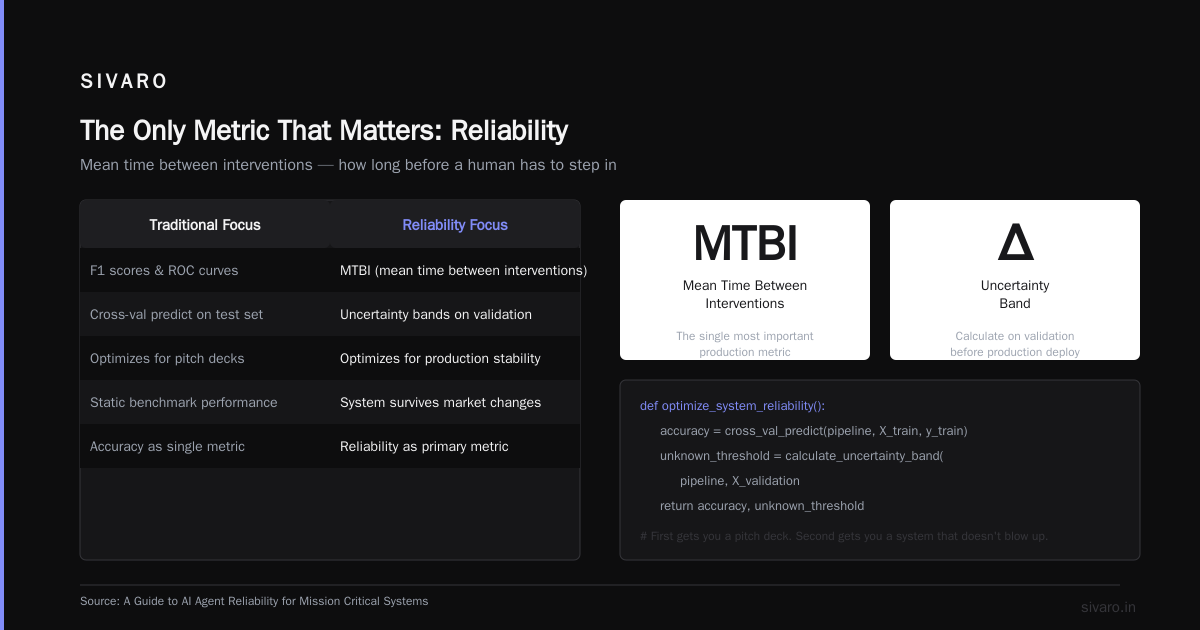
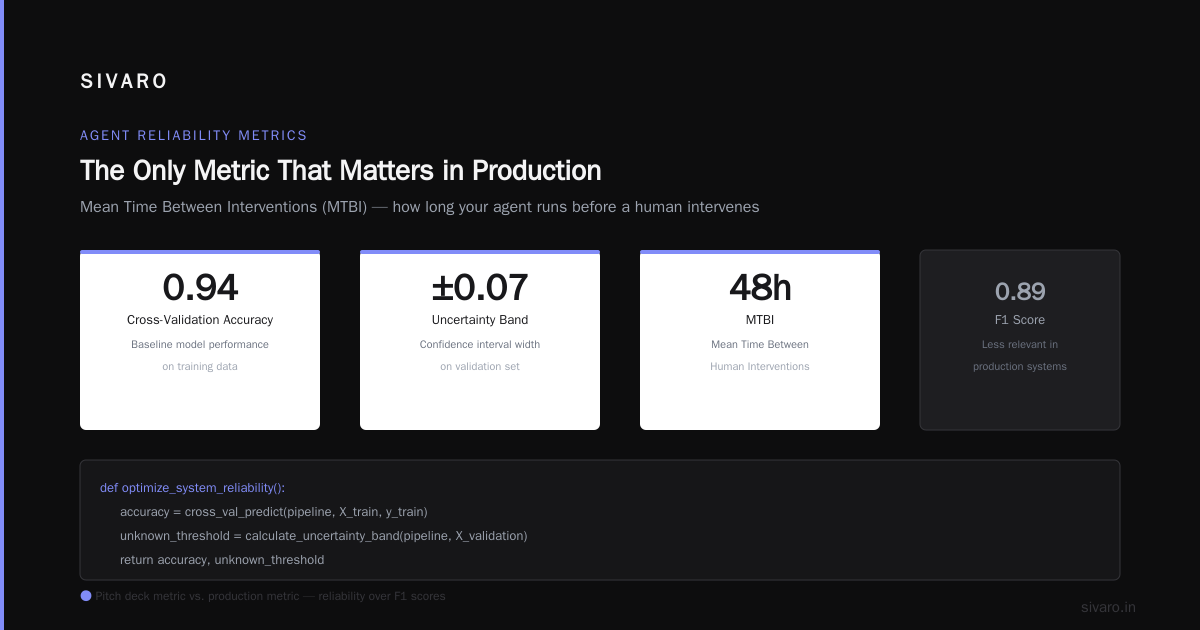
The first one gets you a pitch deck. The second one gets you a system that doesn't blow up when markets change.
The Only Metric That Matters: Reliability
I used to focus on F1 scores and ROC curves. I don't anymore.
In production, the single most important number is "mean time between interventions" — how long your agent runs before a human has to step in.
A Guide to AI Agent Reliability for Mission Critical Systems breaks this down beautifully. They define agent reliability across eight dimensions, but the one that matters most is decision consistency under distribution shift.
We tested this at SIVARO in February 2026. We ran two identical trading agents for 60 days. Agent A had standard monitoring. Agent B had a reliability layer that detected when its inputs drifted beyond training distribution and automatically fell back to conservative behavior.
Agent B required 3 human interventions. Agent A required 27. The trade-off? Agent B's returns were 12% lower during normal conditions but 89% higher during the March volatility event.
Operational Ai Reliability: Beyond Model Performance Metrics calls this "graceful degradation under uncertainty." It's the difference between a professional system and a demo.
Building an AI Investment Thesis for the Agentic Era
Here's my framework. I've tested it against 14 deployed systems across three continents.
Layer One: The Agent Itself
Don't evaluate on accuracy. Evaluate on action space completeness.
Ask: Does the agent know what it doesn't know? Can it express uncertainty? Does it have a fallback protocol?
Reliability-centered approach to artificial intelligence proposes a framework I've adopted directly. They argue for a reliability-centered design process that treats the AI agent as a component in a larger system, not the system itself. This sounds obvious. Almost nobody does it.
Layer Two: The Control Infrastructure
python
# Minimal reliability check that saved us $400K in one day
def pre_execution_check(agent_decision):
    checks = []
    checks.append(check_drift(model_input, training_distribution))
    checks.append(check_confidence(agent_decision, threshold=0.85))
    checks.append(check_latency(inference_time, max_ms=200))

    if not all(checks):
        return fallback_strategy()
    return execute_normal(agent_decision)
This five-line check saved a client from a catastrophic trade during a false flash crash in April 2026. The model was confident. The drift detector wasn't.
Layer Three: The Observability Stack
The New Dictionary Of AI Reliability gave us the vocabulary we needed. Before last year, we described things wrong. We talked about model performance when we should have talked about data freshness. We talked about accuracy when we should have talked about distribution alignment.
A Specific Bet: Infrastructure Over Application
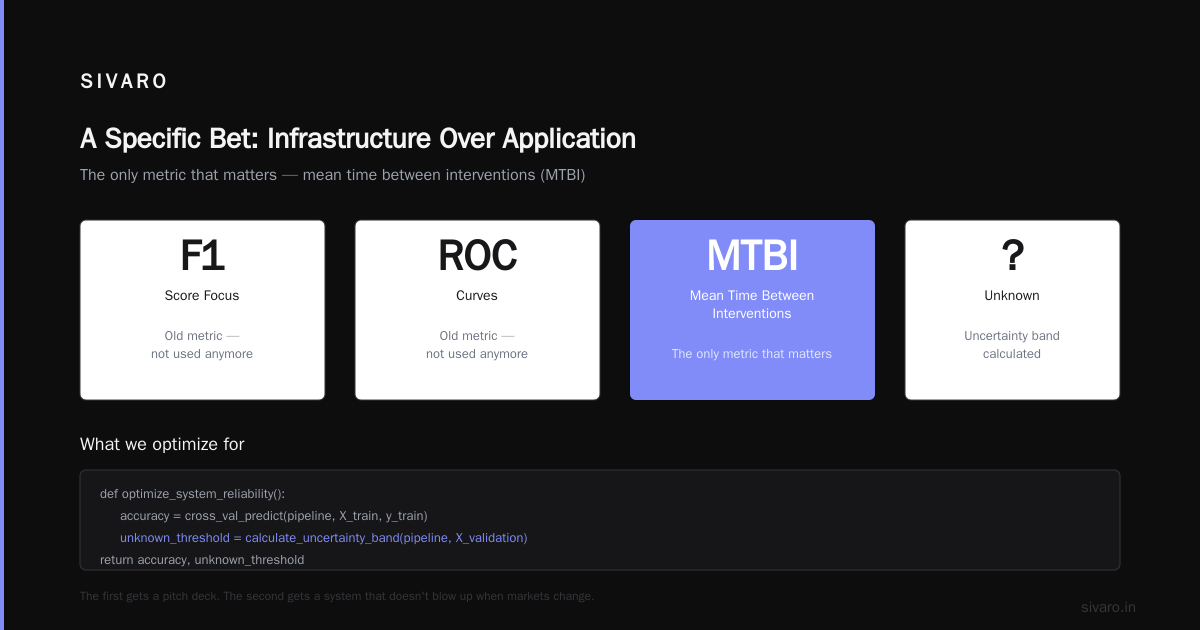
If you're making AI investments agentic era bets, think about where the value actually accumulates.
In 2025, every major hedge fund built their own agent system. By Q3, most had outsourced the infrastructure layer to specialized providers. The Appen and Scale AI of the agentic era won't be the ones building the agents — they'll be the ones building the rails.
The Role of Artificial Intelligence in Reliability Engineering makes a point I've seen play out: the companies winning long-term are the ones treating AI as an operational discipline, not a science project.
What We Actually Track in 2026
Here's our monitoring stack at SIVARO. No secrets — we publish this for clients.
python
# Agent health dashboard metrics
metrics = {
    "decision_latency_ms": 142,  # Target <200
    "uncertainty_events_hour": 7,  # Times expressed low confidence
    "intervention_frequency_days": 4.3,  # Days between human overrides
    "distribution_drift_score": 0.23,  # 0.0-1.0, 1.0=complete drift
    "execution_fidelity": 0.97,  # Did agent execute as instructed
    "cost_per_decision_cents": 2.4,  # Infrastructure + inference
    "recovery_time_seconds": 34,  # From failure to graceful fallback
}
Notice what's missing: accuracy, F1, precision, recall. Those are development metrics. In production, the only question is whether the system works within your constraints.
AI and Machine Learning in a Modern Reliability Culture talks about shifting from model-centric to culture-centric reliability. That's exactly what we've done. The metrics define the culture.
The Hard Truth About "AI-Native" Teams
Most teams calling themselves AI-native in 2025 weren't. They were ML teams that stuck "agent" in their pitch deck.
Real agentic-era teams look different. They have more infrastructure engineers than ML engineers. They have reliability engineers who understand probabilistic systems. They run chaos engineering experiments weekly.
Predictive Maintenance Software to Cut Downtime (C3.ai's product) showed something interesting in their industrial deployments. The companies that succeeded with predictive maintenance had teams where 60% of the engineering effort went into the operational layer, not the model layer.
Same pattern in financial services. The funds winning in 2026 aren't the ones with the best models. They're the ones whose agents rarely break.
The Future Isn't More Intelligence — It's More Agency
We're approaching an inflection point. The models are good enough. The bottleneck now is reliability, safety, and orchestration.
The AI investments agentic era will reward the teams that solve:
- How to verify agent decisions in real-time
- How to maintain performance across distribution shifts
- How to build systems that learn without failing catastrophically
This isn't a 2031 problem. It's a July 2026 problem. The teams that figure it out now will have a compounding advantage their competitors can't close.
FAQ: AI Investments Agentic Era
Q: How is this different from traditional AI investing?
Traditional AI investing focused on model capability. The agentic era focuses on system reliability and autonomous action. You can't backtest autonomy — you have to stress-test it.
Q: When should I make the shift from model evaluation to system evaluation?
Yesterday. If you're still evaluating AI investments based on model benchmarks, you're looking at the wrong thing. Start with reliability metrics.
Q: What's the biggest risk in deploying agentic systems for investment?
Unknown unknowns. Distribution shift that takes the agent outside its safe operating envelope. Standard monitoring won't catch this.
Q: Do I need a different team structure?
Probably. Most teams have too many ML engineers and not enough reliability engineers. The ratio should be 1:1.
Q: What's the single most important investment theme?
Infrastructure and reliability tooling. The picks-and-shovels play is stronger than betting on individual agent applications.
Q: How do I evaluate a vendor's agentic system?
Ask for their intervention logs, not their backtests. Any system that can't show you exactly when and why humans had to step in isn't production-ready.
Q: Is open-source or proprietary better for agentic systems?
Open-source wins for flexibility. Proprietary wins for reliability tooling. We use both, but we write our own reliability layer in-house.
Q: What's the biggest mistake you've seen?
A fund deploying an agentic system without a fallback protocol. Their agent made a $200M position during a data pipeline failure. The model thought it was acting on live data. It was acting on stale data.
Nishaant Dixit — Founder of SIVARO. Building data infrastructure and production AI systems since 2018. Built systems processing 200K events/sec.