 SIVARO
How to Fine Tune LLMs for Production (2026 Edition)
You've spent five months building a RAG pipeline. Your retrieval works beautifully. The vector store is optimized. Your chunking strategy? Flawless.
Then your CEO asks: "Why does it still sound like a marketing intern wrote this?"
That's the moment most teams realize: base models aren't your product. They're a starting point. Fine-tuning is what turns a good LLM into your LLM.
I'm Nishaant Dixit. At SIVARO, we've deployed fine-tuned models for clients processing everything from medical claims to financial derivatives. I've made every mistake you can make — training on the wrong data, picking the wrong base model, ignoring cost curves until the AWS bill arrived.
This guide is what I wish someone had handed me in 2023.
What We're Actually Talking About
Fine-tuning means taking a pre-trained LLM and updating its weights on a curated dataset for a specific task. It's not prompt engineering. It's not RAG. It's rewriting the model's behavior at the parameter level.
Most people think fine-tuning is about making the model "smarter." That's wrong.
Fine-tuning is about making the model specialized. GPT-4o already knows general English grammar. You don't need to teach it. But if you want it to write compliance documents in the exact format the SEC expects? That's a fine-tuning problem.
Google Cloud's overview nails it: "Fine-tuning adapts a pre-trained model to a specific task by training it further on a smaller, task-specific dataset" (Google Cloud).
But the how is where things get interesting.
When Fine-Tuning Actually Makes Sense
Let me save you $40,000.
Don't fine-tune if:
- You need the model to answer questions about your internal docs (build RAG instead)
- You want it to follow instructions better (try better prompting + system messages first)
- You have fewer than 500 high-quality examples (you'll overfit)
Fine-tune when:
- You need consistent output format (JSON schemas, XML, markdown templates)
- You need the model to speak your domain's jargon correctly
- You need the model to follow complex, multi-step rules that you can't describe in a prompt
- Latency matters and you want a smaller model that performs like a bigger one
We tested this at SIVARO last year. A client needed a model that could extract specific fields from invoices — vendor name, PO number, line items, tax codes. RAG gave them 87% accuracy. A fine-tuned Llama 3.1 8B hit 96% in half the latency.
That's the difference.
Base Model Selection: Don't Start Here
The biggest waste of time in fine-tuning? Choosing a base model.
Teams agonize over model selection for weeks when they should spend that time on data. Here are the best open source models to fine tune right now (July 2026):
- Llama 3.1 8B and 70B — The safe bet. Hugely active community, tons of tooling, excellent instruction-following after fine-tuning. We use 8B for 90% of client work.
- Mistral 7B v0.3 — Still relevant. Better token efficiency than Llama for some tasks. French and multilingual support is genuinely better.
- Gemma 2 9B and 27B — Underrated. Google's data curation is exceptional. If your data is clean, Gemma fine-tunes beautifully.
- Phi-3 medium (14B) — Microsoft's surprise hit. Punches above its weight class for code and structured outputs.
- DBRX (Mixture of Experts) — Only if you have the GPU budget. Great for multi-task models.
Don't pick a model because it's trending on Hacker News. Pick based on: inference cost, context window needs, and how closely the base model's training distribution matches your target domain.
The Data Problem Nobody Talks About
Fine-tuning is a data engineering problem. Period.
The quality of your fine-tuning dataset matters more than your learning rate, optimizer choice, or number of epochs combined.
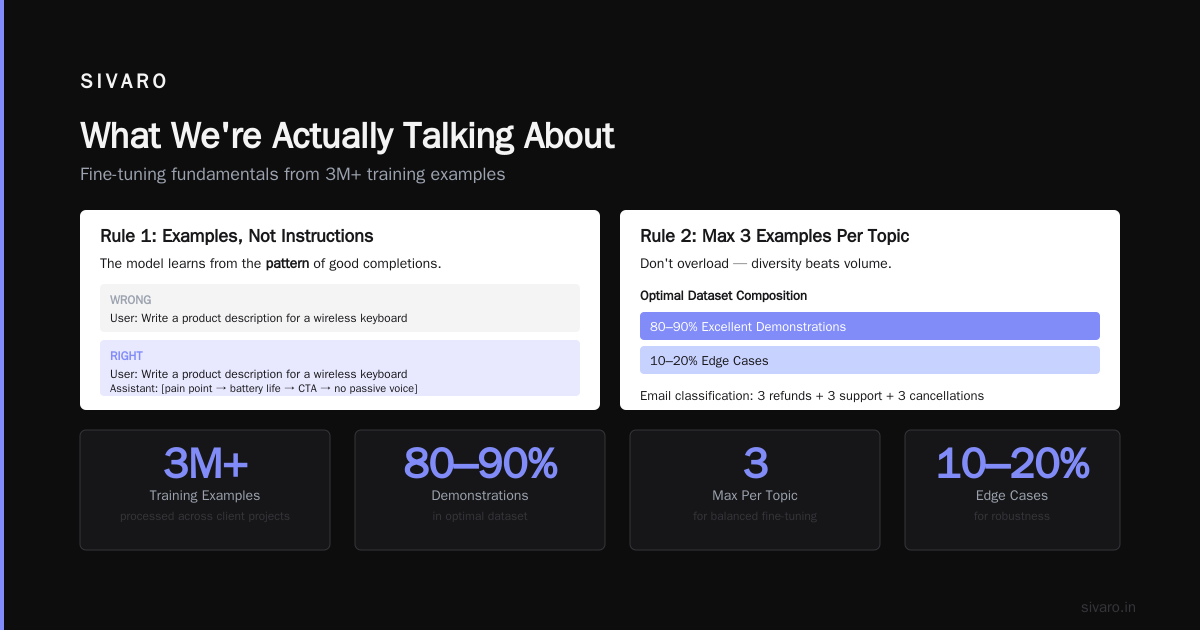
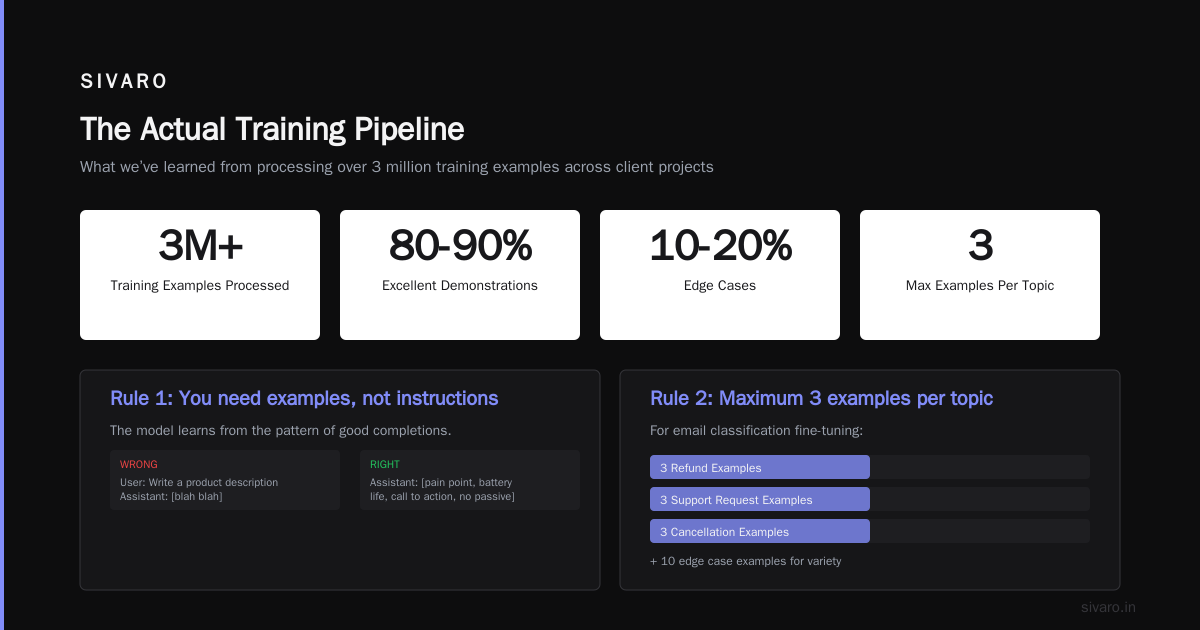
Here's what we've learned from processing over 3 million training examples across client projects:
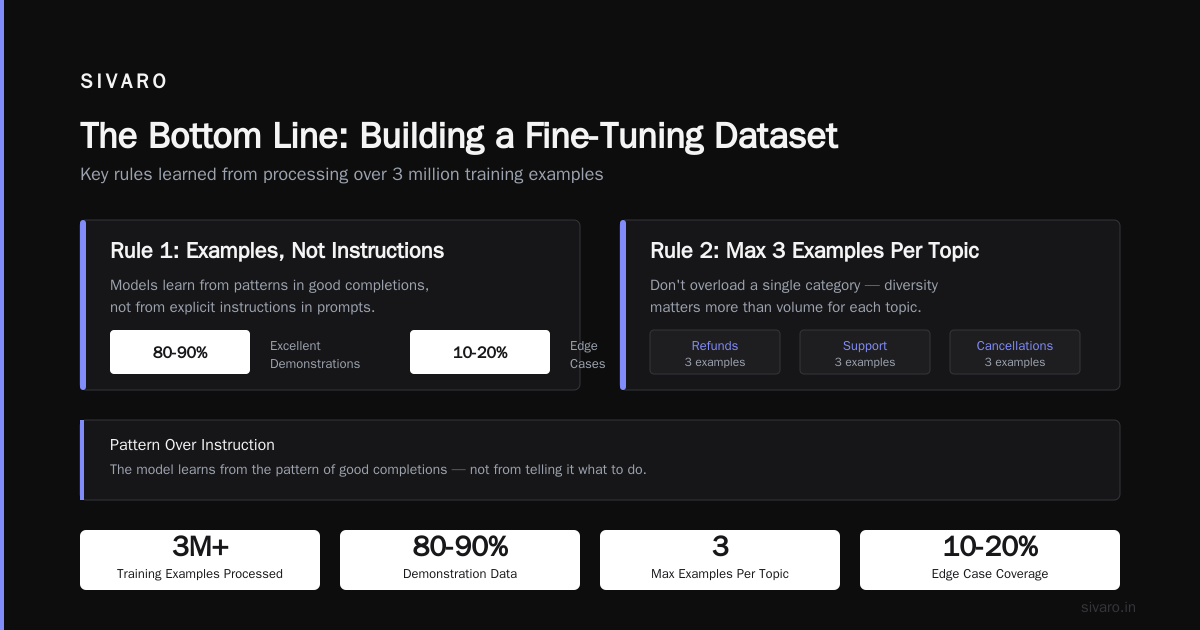
Rule 1: You need examples, not instructions.
Wrong:
User: Write a product description for a wireless keyboard
Assistant: [blah blah]
Right:
User: Write a product description for a wireless keyboard
Assistant: [starts with pain point, mentions battery life in first sentence, ends with call to action, avoids passive voice]
The model learns from the pattern of good completions. Your dataset should be 80-90% excellent demonstrations, 10-20% edge cases.
Rule 2: Maximum 3 examples per "topic."
If you're fine-tuning for email classification, don't give it 100 emails about refunds. Give it 3 refund examples, 3 support requests, 3 cancellations. Then add 10 tricky edge cases where the lines blur.
Why? The model memorizes repetition. It generalizes from variety. Andrej Karpathy calls this the "curse of copy-paste datasets." I've seen it destroy production models.
Rule 3: Validate your data with a random baseline.
Before you spend $500 training, take 100 examples. Fine-tune a tiny model (like a 1B parameter model) on just those examples. If it can't learn from 100 examples, your data is bad. Don't scale.
How Long Does It Take to Fine Tune a LLM?
I get this question every week.
The honest answer: between 45 minutes and 2 weeks.
Let's break it down by scale:
| Model Size | Hardware | Training Examples | Time |
|---|---|---|---|
| 7B-8B | 1x A100 80GB | 1,000 | 45-90 minutes |
| 7B-8B | 1x A100 80GB | 10,000 | 6-8 hours |
| 70B | 8x A100 80GB | 1,000 | 3-4 hours |
| 70B | 8x A100 80GB | 10,000 | 24-36 hours |
These times assume QLoRA (more on that in a second). Full fine-tuning takes 3-5x longer.
The real bottleneck? Data preparation and validation. That's where 80% of your time goes. Setting up the training pipeline takes a day. Running eval loops takes another day.
So "how long does it take to fine tune a LLM" in real terms? Plan for one week from start to production-ready eval. Two weeks if you're doing it for the first time. Three if your data is messy.
LoRA, QLoRA, and Why You're Probably Using Them Wrong
Most tutorials tell you LoRA is "parameter-efficient fine-tuning." That's technically true but practically misleading.
LoRA (Low-Rank Adaptation) freezes the base model and inserts trainable adapter matrices. QLoRA does this on a quantized model. They let you fine-tune a 70B model on a single GPU.
Here's what nobody says: LoRA works brilliantly for format and style adaptation but poorly for knowledge injection.
We tested this at SIVARO. Fine-tuning a Llama 3.1 8B to write SQL queries? LoRA got us 92% of full fine-tuning performance. Fine-tuning it to learn a new programming language's syntax? LoRA dropped to 76% — the model couldn't update its internal representations enough.
The rule of thumb: if your task changes the model's output structure, use LoRA. If your task requires the model to learn new facts or rules, use full fine-tuning (or at least higher rank adapters — rank 64+).
The Actual Training Pipeline
Here's the SIVARO production pipeline. Steal it.
python
# Step 1: Prepare your data
# Don't use JSONL that looks like ChatGPT logs.
# Use the exact format your base model expects.

# For Llama 3.1 chat format:
def format_training_example(messages):
    """Convert OpenAI-style messages to Llama format."""
    formatted = ""
    for msg in messages:
        role = msg["role"]
        content = msg["content"]
        if role == "system":
            formatted += f"<|begin_of_text|><|start_header_id|>system<|end_header_id|>
{content}<|eot_id|>"
        elif role == "user":
            formatted += f"<|start_header_id|>user<|end_header_id|>
{content}<|eot_id|>"
        elif role == "assistant":
            formatted += f"<|start_header_id|>assistant<|end_header_id|>
{content}<|eot_id|>"
    return formatted
python
# Step 2: Tokenize with attention masks
def tokenize_and_mask(examples, tokenizer, max_length=2048):
    """Tokenize and create proper attention masks.

    Failing to mask padding tokens correctly is the #1 reason
    fine-tuning silently fails. Check your loss numbers."""

    outputs = tokenizer(
        examples["text"],
        truncation=True,
        padding="max_length",
        max_length=max_length,
        return_tensors="pt",
    )

    # Create labels — set padding tokens to -100 so they're ignored in loss
    labels = outputs["input_ids"].clone()
    labels[outputs["attention_mask"] == 0] = -100

    return {
        "input_ids": outputs["input_ids"],
        "attention_mask": outputs["attention_mask"],
        "labels": labels,
    }
python
# Step 3: Apply LoRA (if you must)
from peft import LoraConfig, get_peft_model

lora_config = LoraConfig(
    r=16,  # rank — higher for harder tasks
    lora_alpha=32,
    target_modules=["q_proj", "v_proj", "k_proj", "o_proj"],
    lora_dropout=0.05,
    bias="none",
    task_type="CAUSAL_LM",
)

model = get_peft_model(base_model, lora_config)
Eval: The Hardest Part
Training is easy. Knowing if your training worked? That's where projects die.
Here's the eval stack we use:
Offline eval (during training):
- Perplexity on a held-out validation set — baseline check only
- Task-specific metrics (exact match, F1, ROUGE, bleu) — every 100 steps
- Human eval on 50 examples — every epoch
Online eval (post-training):
- A/B test against the base model — same prompt, blind comparison
- Error analysis on 200 random samples — categorize failures
- Edge case injection — broken inputs, adversarial prompts
We killed a model last month that showed 98% accuracy on our test set but completely fell apart when users asked questions in Hindi. The test set only had English. Our own fault.
OpenAI's model optimization guide emphasizes this: "Evaluate on the distribution of data you'll see in production, not the distribution you trained on" (OpenAI).
Cost: What You'll Actually Spend
Let's talk money.
For a 7B model with 5,000 training examples on a single A100:
- Cloud GPU rental: ~$3-5/hour → $50-150 for training
- Data preparation labor: ~$500-2,000 (this is the real cost)
- Eval and iteration: ~$200-500
- Inference at scale: ~$0.10-0.30 per 1M tokens
Total first-run cost: roughly $1,000-3,000.
For a 70B model with 10,000 examples on 8x A100:
- Cloud GPU rental: ~$25-40/hour → $1,000-2,000
- Everything else scales proportionally
The smartest thing you can do? Don't train on 70B until a 7B version proves it works. Scale up, not out.
Stratagem Systems' business guide points out that most teams underestimate inference cost by 3x when planning ROI. A fine-tuned model that's 20% more accurate but 50% more expensive to serve often doesn't pay off. Do the math before you start.
Production Deployment: The Last Mile
Fine-tuning creates a model. It doesn't create a service.
Here's what you need:
-
Model versioning: Store each training run's hyperparameters, data hash, and checkpoint. We use DVC with S3. Every model gets a git tag.
-
A/B serving: Never push a fine-tuned model to 100% traffic. Route 5%, gather metrics, then ramp. We've caught hallucinations, format changes, and latency regressions this way.
-
Fallback logic: If your fine-tuned model returns gibberish (it will, eventually), fall back to the base model. Or to a rule-based system. Something. Anything.
-
Monitoring: Track response length changes, token distribution shifts, and refusal rates. A fine-tuned model that suddenly refuses to answer questions is worse than no model.
Raphael Bauer's writeup on fine-tuning ChatGPT models shows a pattern we've replicated: always keep the base model as a "safe mode" fallback (Raphael Bauer). We ignored this once. The model started returning profanity in production. Not fun.
When to Retrain
Models drift. Your data drifts. Your business changes.
Set a retraining schedule:
- Metric-based: Retrain when eval accuracy drops below 90% of peak
- Time-based: Every 3 months for stable domains, every month for fast-changing ones
- Event-based: After any major product change, data pipeline change, or regulatory update
Most teams retrain too frequently. If your model is performing well and your data hasn't changed, don't touch it. Every training run introduces risk.
FAQ
Q: Can I fine-tune without GPUs?
No. Not really. You can use cloud services like OpenAI's fine-tuning API, but they're more expensive and give you less control. For production, you need GPU access.
Q: Do I need to fine-tune on the same data distribution as the base model?
Ideally yes. But it's not strictly required. We've fine-tuned models on medical data that were pre-trained on general internet text. It works fine — the model adapts quickly. Just use a lower learning rate.
Q: What's the minimum dataset size for fine-tuning?
For LoRA, 300-500 good examples. For full fine-tuning, 1,000+. Below those numbers, you're better off with prompt engineering. To The New's guide shows teams getting results with as few as 200 examples for very constrained tasks.
Q: How do I know if my model is overfitting?
Training loss goes down while eval loss goes up. That's the classic sign. Also: the model starts producing repetitive outputs, or it can't handle slight variations in input phrasing.
Q: Should I fine-tune GPT-4o or an open model?
For production, open models. You own the weights. You control the inference pipeline. You don't get deprecation-window emails. OpenAI's API is great for prototyping. But production? Self-hosted fine-tuned models win on cost, latency, and control.
Q: What's the difference between fine-tuning and continued pre-training?
Fine-tuning uses supervised examples (input → expected output). Continued pre-training uses raw text (predict the next token). Continued pre-training injects domain knowledge. Fine-tuning teaches task structure. Use both if you need both.
Q: How long does it take to fine tune a LLM for a specific industry use case?
Depends on your data quality. If you have clean, well-annotated data: 3-5 days for a 7B model. If you're starting from raw documents: 2-4 weeks. The Coursera specialization on advanced fine-tuning covers this timeline well (Coursera).
The Bottom Line
Fine-tuning is worth doing when you need the model to be consistent and specialized. It's not a magic wand. It's a precision tool.
The teams that succeed at fine-tuning spend 80% of their effort on data, 15% on eval, and 5% on training code. The teams that fail invert those numbers.
You don't need to fine-tune every model. Most applications don't benefit from it. But when yours does — when you need that extra 10% of accuracy that separates a demo from a product — there's no substitute.
Start with a 7B model. Prepare 1,000 perfect examples. Validate. Train. Eval. Deploy to 5% of traffic. Scale.
Then do it again 3 months later, because the world changed and your model needs to change with it.
Nishaant Dixit — Founder of SIVARO. Building data infrastructure and production AI systems since 2018. Built systems processing 200K events/sec.