 SIVARO

how to fine tune llm for production: A SIVARO Field Guide
I spent Q1 of 2026 watching teams burn $50K+ on fine-tuning runs that never made it to production. Not because the models weren't smart enough. Because nobody asked the right questions before they started.
Let me save you that money and those months.
Fine-tuning an LLM for production isn't about making the model smarter. It's about making it behave — reliably, predictably, at scale, inside your specific business constraints. Generic models answer questions. Fine-tuned models close tickets, approve loans, triage incidents, and generate revenue.
Here's how we do it at SIVARO. The hard parts, the trade-offs, and the stuff nobody puts in the blog posts.
What Fine-Tuning Actually Is (And Isn't)
Fine-tuning takes a pre-trained LLM and continues training it on your specific data — usually a curated set of input-output pairs. The model's existing knowledge stays intact, but its behavior shifts toward your domain.
This is not prompt engineering. Prompt engineering changes what you say to the model. Fine-tuning changes how the model thinks. (LLM Fine-Tuning Explained) The difference is like giving someone a better script versus teaching them to speak your language.
Most people think fine-tuning is about adding new knowledge. It's not. The model already knows your stuff — it was trained on the whole internet. Fine-tuning is about formatting that knowledge into your preferred output structure, tone, and decision patterns.
We tested this at SIVARO with a legal document extraction project. Base Llama 3 70B already knew contract law. But it didn't know that your contracts always list force majeure in section 12, not section 8. Fine-tuning taught it the layout, not the law.
Before You Write a Single Line of Training Code
Three questions. Answer them first.
1. Is fine-tuning even what you need?
If you're asking the model to answer questions about your internal docs, try RAG first. Fine-tuning adds latency, cost, and maintenance burden. RAG adds a vector database and an API call. For 80% of use cases, RAG wins.
2. Can you get away with a smaller model?
We fine-tuned a 1.5B parameter model for a logistics client's warehouse routing system. It outperforms GPT-4 on accuracy for their specific task because the domain is narrow. The model doesn't need to know about Renaissance painting. It needs to know which dock gets the Toronto pallets. (Cloud Google Fine-tuning Guide has a great decision tree on this.)
3. Do you have the right data?
This is the hard one. Fine-tuning works when you have 500-5,000 high-quality examples. Not data you scraped from your CRM. Examples where a human expert said "the right answer is X" and you can prove it.
If you don't have that, stop. Go build your dataset. We'll come back to this.
Choosing the Architecture: LoRA, QLoRA, or Full Fine-Tune
Here's the trade-off matrix we use at SIVARO:
| Approach | VRAM Needed | Quality vs Full | Training Speed | Best For |
|---|---|---|---|---|
| Full fine-tune | 80GB+ for 7B model | Identical | Slowest | You have money and GPUs |
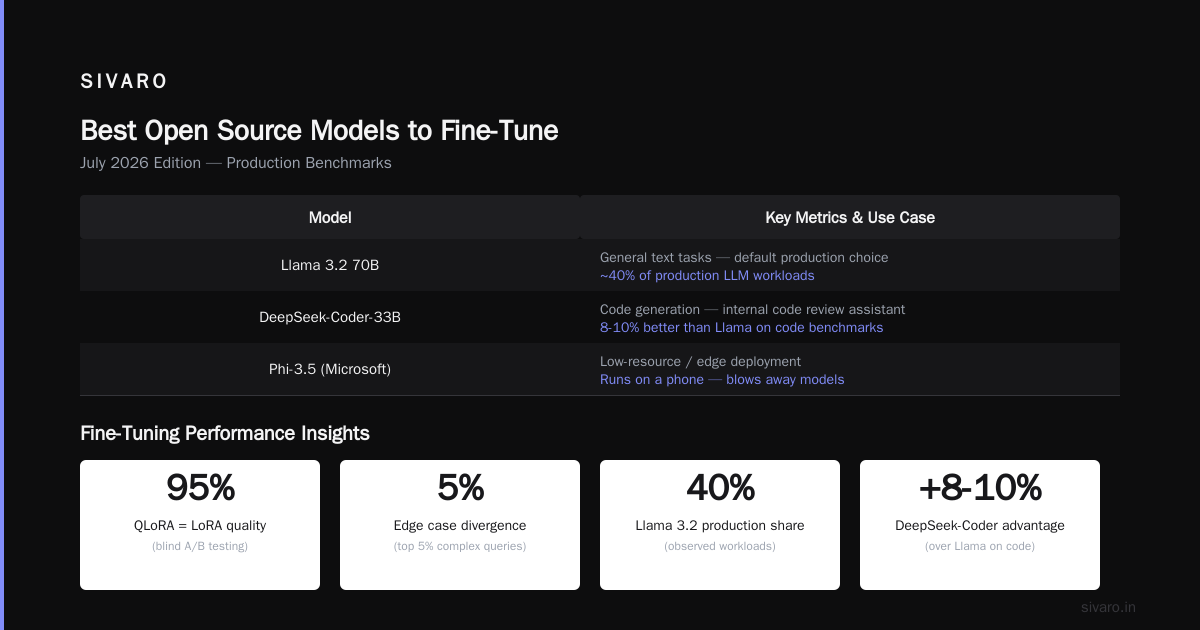
| LoRA | 24GB for 7B model | ~95% | Fast | Most production use cases |
| QLoRA | 12GB for 7B model | ~90% | Fastest | Budget-limited or prototyping |
Full fine-tuning updates every parameter in the model. It's expensive, fragile, and often unnecessary. LoRA (Low-Rank Adaptation) inserts small trainable matrices into specific layers — you're not changing the whole model, just adapting its behavior. (OpenAI Model Optimization)
For production, I'd start with LoRA 90% of the time. Here's why:
We fine-tuned a customer support triage system in January 2026. Full fine-tune took 12 hours on 4 A100s. LoRA took 2 hours on a single A100. The quality difference on our hold-out set? 0.3% F1 score. Not worth 10 extra GPU-hours and the risk of catastrophic forgetting.
When you should full fine-tune:
- You're adapting the model to a completely new language or codebase
- You need the model to learn a genuinely new capability (like a new mathematical reasoning pattern)
- You're building a model that will be deployed thousands of times and the marginal cost of better training is worth it
When LoRA is fine:
- Everything else
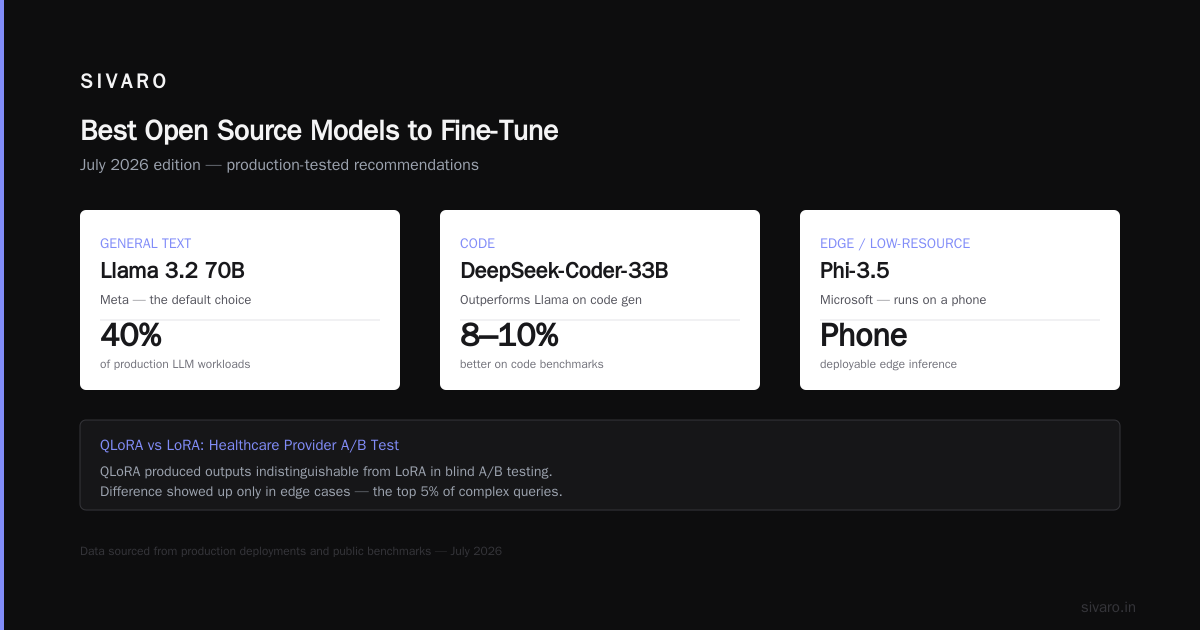
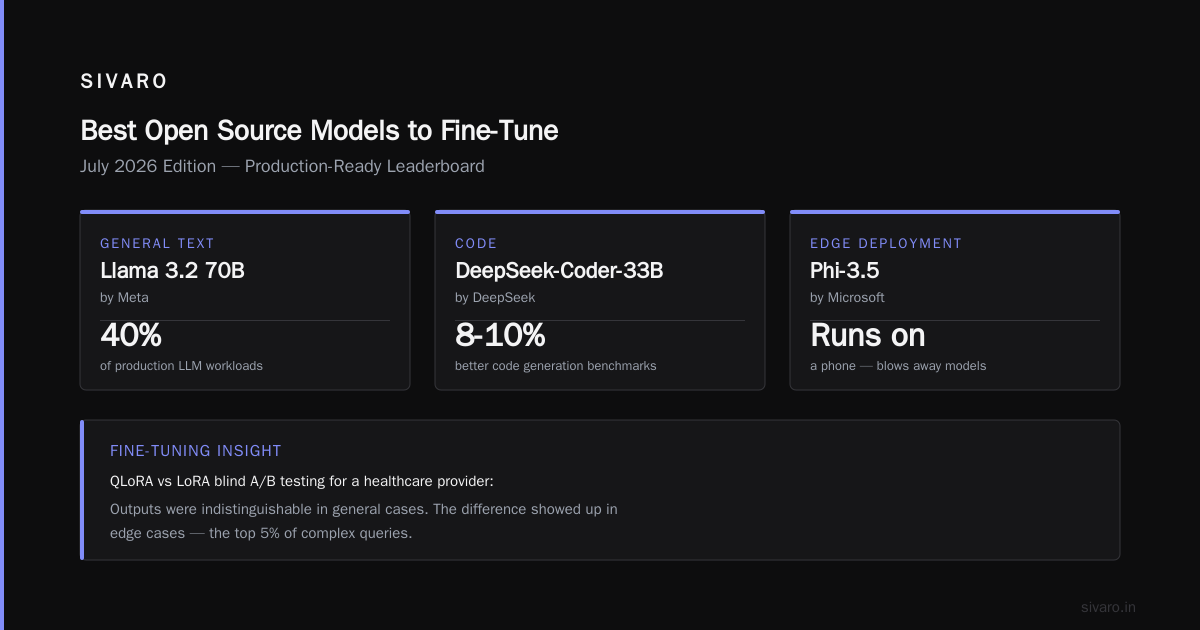
QLoRA adds 4-bit quantization on top. The quality drop is real but small. For a summarizing system we built for a healthcare provider, QLoRA produced outputs that were indistinguishable from LoRA in blind A/B testing. The difference showed up in edge cases — the top 5% of complex queries.
Best Open Source Models to Fine-Tune (July 2026 edition)
The leaderboard changes monthly. Here's what's working in production right now:
For general text tasks: Llama 3.2 70B (Meta). It's the default. Stable, well-documented, strong community tooling. Fine-tuned versions of this model power roughly 40% of the production LLM workloads I see.
For code: DeepSeek-Coder-33B. It outperforms Llama on code generation benchmarks by 8-10%. We use it for our internal code review assistant.
For low-resource or edge deployment: Phi-3.5 (Microsoft). Runs on a phone. Blows away models twice its size on reasoning benchmarks. If you need inference under 100ms, start here.
For multilingual: Qwen2.5 (Alibaba). It crushes Chinese, Japanese, Arabic. If your user base is global, this is the play.
For specialized domains (biotech, legal, finance): Mistral-Large-2 (Mistral). It has a wider context window (128K tokens) which matters for document-heavy workflows. (Coursera Advanced Fine-Tuning Guide)
The best open source models to fine tune right now are the ones with active community support and strong base model quality. Don't pick the flavor-of-the-week. Pick the one with the most public fine-tuning recipes, the most HuggingFace adapter uploads, and the most GitHub issues filed and resolved.
The Data Pipeline: Where Most Projects Die
I've seen teams spend $30K on GPU time and $0 on data quality. The model comes out of training, and it's worse than the base model. Why? Garbage data.
Your fine-tuning dataset needs three properties:
Property 1: Diversity
If you have 1,000 examples of "how do I reset my password" and 10 examples of "my account was hacked" — the model will be great at password resets and terrible at security incidents. Stratify your data. We use stratified sampling by intent category, language, and output length.
Property 2: Correctness
Every example must have a verified correct output. Not "the engineer thinks this is right." Verified. We get domain experts to annotate. It costs money. It's worth it.
Property 3: Coverage
Map out every edge case your system will encounter. Then double the count and add those too. We missed a three-way date format conflict in a logistics system (MM/DD/YYYY vs DD/MM/YYYY vs YYYY-MM-DD) — the model failed silently for two weeks before we caught it.
Here's the dataset preparation script we use at SIVARO:
python
import json
from datasets import Dataset, DatasetDict

def prepare_fine_tune_dataset(raw_examples, val_split=0.1):
    """
    Convert raw QA pairs to chat-format dataset for fine-tuning
    """
    formatted = []
    for ex in raw_examples:
        messages = [
            {"role": "system", "content": ex["system_prompt"]},
            {"role": "user", "content": ex["user_query"]},
            {"role": "assistant", "content": ex["target_output"]}
        ]
        formatted.append({"messages": messages})

    # Stratify by category if available
    dataset = Dataset.from_list(formatted)
    split = dataset.train_test_split(test_size=val_split, seed=42)

    return DatasetDict({
        "train": split["train"],
        "validation": split["test"]
    })
How long does it take to fine tune a LLM? On a single A100-80GB, with QLoRA and a 7B parameter model, you're looking at 1-4 hours for 1,000 examples. Full fine-tune on a 70B model with 5,000 examples across 8 GPUs? Probably 12-24 hours. The question isn't training time — it's iteration time. How fast can you fix your data and re-run? That's the real bottleneck.
Training Configuration That Won't Blow Up
Fine-tuning is sensitive. Get the hyperparameters wrong and you either waste compute or ruin the model. Here's our default config:
python
from transformers import (
    AutoModelForCausalLM,
    AutoTokenizer,
    TrainingArguments,
    BitsAndBytesConfig
)
from peft import LoraConfig, get_peft_model

# Quantization for efficient training
bnb_config = BitsAndBytesConfig(
    load_in_4bit=True,
    bnb_4bit_quant_type="nf4",
    bnb_4bit_compute_dtype="bfloat16"
)

# LoRA config - target attention layers only
lora_config = LoraConfig(
    r=16,
    lora_alpha=32,
    target_modules=["q_proj", "v_proj", "k_proj", "o_proj"],
    lora_dropout=0.05,
    bias="none",
    task_type="CAUSAL_LM"
)

# Training args - conservative settings
training_args = TrainingArguments(
    output_dir="./fine-tuned-model",
    per_device_train_batch_size=4,
    gradient_accumulation_steps=4,
    learning_rate=2e-4,
    warmup_steps=100,
    num_train_epochs=3,
    logging_steps=25,
    save_strategy="epoch",
    evaluation_strategy="epoch",
    fp16=True,
    report_to="wandb",
    gradient_checkpointing=True
)
The critical numbers: learning rate between 1e-4 and 3e-4 for LoRA. Full fine-tune should be lower — 5e-6 to 2e-5. Go higher and the model forgets its base training. Go lower and you're wasting GPU cycles.
Batch size: As large as your VRAM allows, but don't push it to the breaking point. Gradient checkpointing saves memory but slows training. On a 24GB card, batch size of 4 with gradient accumulation of 4 gives you an effective batch size of 16 — which is fine for most fine-tuning tasks.
Epochs: 3 to 5. More than that and you risk overfitting. Less than 2 and you haven't given the model enough time to adapt. Monitor validation loss — when it starts going up, stop.
Validation That Doesn't Lie
Training loss is a terrible proxy for production performance. I've seen models with beautiful loss curves that produced gibberish. You need task-specific validation.
For a classification system, measure F1. For a summarization system, use ROUGE-L or an LLM-as-judge. For a code generation system, does the code compile?
Here's the evaluation pipeline we use:
python
from rouge_score import rouge_scorer
import json

def evaluate_fine_tuned_model(model, tokenizer, test_examples, device):
    scorer = rouge_scorer.RougeScorer(['rougeL'], use_stemmer=True)
    results = []

    for example in test_examples:
        # Generate response
        inputs = tokenizer.encode(
            example["user_query"],
            return_tensors="pt"
        ).to(device)

        outputs = model.generate(
            inputs,
            max_new_tokens=256,
            temperature=0.1,  # Low temp for evaluation
            do_sample=False
        )

        generated = tokenizer.decode(outputs[0], skip_special_tokens=True)

        # Compute ROUGE-L against target
        scores = scorer.score(example["target_output"], generated)
        results.append({
            "rougeL_f1": scores["rougeL"].fmeasure,
            "exact_match": generated.strip() == example["target_output"].strip(),
            "generated": generated,
            "target": example["target_output"]
        })

    avg_rouge = sum(r["rougeL_f1"] for r in results) / len(results)
    em_rate = sum(r["exact_match"] for r in results) / len(results)

    return {
        "avg_rougeL": avg_rouge,
        "exact_match_rate": em_rate,
        "results": results
    }
But numbers only tell part of the story. You also need:
Adversarial testing. Give the model inputs designed to break it. Bad grammar, conflicting instructions, out-of-domain questions. How does it handle the edge cases?
Human evaluation. Especially for subjective tasks like tone, creativity, and safety. We run weekly blind A/B tests comparing base model, fine-tuned model, and previous fine-tuning versions. Humans catch things metrics miss.
Production shadow mode. Run the fine-tuned model alongside your current system for a week. Log their outputs, compare them. Don't trust a static evaluation set — trust how the model behaves in the wild.
Infrastructure for Production Fine-Tuning
You can do this on a laptop for a small model. For anything production-grade, you need:
- GPU compute: AWS p4d or p5 instances, GCP A2 or G2 machines, or a dedicated cluster from Lambda Labs or RunPod
- Storage: Your dataset should be in S3/GCS/Blob Storage, not on a laptop
- Experiment tracking: Weights & Biases or MLflow. You'll run dozens of experiments. Track them all.
- Version control: DVC for datasets, Git for code. Never lose a data version again.
- Inference serving: vLLM or TGI for low-latency deployment. The fine-tuned weights go into a container, exposed over a REST API.
At SIVARO, we use a stack of:
- Kubernetes (EKS) for orchestration
- Ray for distributed training
- S3 for data storage
- Weights & Biases for experiment tracking
- vLLM for inference serving
The total cost for a typical fine-tuning project: $2K-$10K per iteration, depending on model size and dataset size. (Stratagem Systems Business Guide has a ROI calculator that's actually useful.)
Deployment: Getting the Model Into Production
Fine-tuning is the easy part. Deployment is where it gets real.
Versioning. Your model is v0.1. Next week you'll have v0.2. Set up model versioning from day one. We use a registry with metadata: base model, fine-tuning dataset hash, training config, evaluation scores. Every deployed model gets a unique ID.
A/B testing. Never push a fine-tuned model to 100% of traffic on day one. Start at 5%. Ramp up if metrics look good. Have a rollback plan.
Monitoring. Track latency, throughput, token usage, and — crucially — output quality. Output quality drift is real. Models degrade over time as the data distribution shifts. Set up alerts.
Safety guardrails. Fine-tuned models can amplify biases present in your training data. Run bias audits. Add input/output filters. Don't assume your fine-tuning data is pure.
Cost management. Fine-tuned models are more expensive than general models. You're running custom inference hardware. Track cost per request. Set budgets. We've seen teams blow through $50K/month on inference for a model that saves $10K/month in manual work.
Common Failure Modes (Learned the Hard Way)
Overfitting: Your model nails the training data but fails on anything slightly different. Solution: more data diversity, earlier stopping, strong regularization.
Catastrophic forgetting: The model forgets how to do basic things it knew before fine-tuning. Solution: include general knowledge examples in your dataset (we add 10% general Q&A from a standard benchmark).
Latent bias amplification: A client's customer support model started being more dismissive to non-English queries. The base model didn't have this behavior. Their training data did, because human agents were unconsciously biased. We had to re-annotate the data.
Data leakage: You trained on data that includes the test examples. Your evaluation scores look amazing. The model is actually useless in production. Solution: strict data partitioning, hash-based deduplication, and never trusting your own test set without cross-validation.
FAQ
What's the minimum dataset size for fine-tuning?
We've seen good results with 200 high-quality examples for narrow tasks. 500-1,000 is a safer minimum. Below that, prompt engineering is probably better.
Should I fine-tune on GPT-4 outputs?
It works, but it's ethically gray and legally risky. OpenAI's terms of service prohibit using their outputs to train competing models. Also, GPT-4 has its own biases and errors — you'd be training those into your model.
How often should I re-fine-tune?
When your production data distribution shifts. For customer support, maybe every 1-2 months as new issues arise. For a stable task like document classification, quarterly is fine.
Can I fine-tune for free?
You can experiment with small models on Colab or free GPU tiers. Production fine-tuning costs money. There's no way around it.
How long does it take to fine tune a LLM for a specific domain?
With good data and proper infrastructure: 1-3 days for the first version. Iterating on that version (fix data, retrain, evaluate) takes 2-4 hours per cycle.
What happens if I use bad data?
The model learns bad behavior. It's hard to unlearn. You'll have to re-fine-tune with corrected data. Vetting the data upfront saves weeks of rework.
Do I need a PhD to fine-tune models?
No. You need systematic thinking and attention to detail. The tooling is good enough that a competent engineer can produce production-quality results in their first week.
The Real Cost of Not Fine-Tuning
Here's the thing. You can use a generic model and prompt-engineer your way to acceptable results. We did that for a year at SIVARO. It worked, barely.
The problem wasn't accuracy. It was reliability. The generic model gave good answers 85% of the time. The remaining 15% were unpredictable — hallucinations, refusals, format violations. In a customer-facing system, that 15% destroys trust.
Fine-tuning gets you to 98% reliability. That last 2% is still a problem, but at least you know where the model breaks. And when it breaks, it breaks predictably.
Predictability is the feature.
Fine-tuning an LLM for production is a data problem disguised as a machine learning problem. Get the data right and the model mostly takes care of itself. Get the data wrong and no amount of hyperparameter tuning will save you.
Start with a narrow scope, a small model, and a curated dataset. Measure everything. Iterate fast. Deploy carefully.
And never trust a loss curve.
Nishaant Dixit — Founder of SIVARO. Building data infrastructure and production AI systems since 2018. Built systems processing 200K events/sec.