 SIVARO
How to Fine Tune LLM for Production (2026 Playbook)
I blew $47,000 on my first LLM fine-tuning experiment. Wasted six weeks. Ended up with a model that was worse than the base.
That was 2024. Two years later, I've run over 200 fine-tuning experiments at SIVARO, and we've built production systems that process 200K events per second. The difference between those first failures and what works now? Not the technique. It's the decision framework around when and how to fine-tune.
Most people think fine-tuning is about making a model smarter. It's not. It's about making it obedient to your specific data distribution. That distinction costs companies millions.
Here's everything I've learned about how to fine tune LLM for production — the hard way.
What Fine-Tuning Actually Does (And Doesn't)
Fine-tuning takes a pretrained LLM and continues training on your specific data. The weights shift. The outputs change. But here's what nobody tells you: fine-tuning doesn't teach the model new facts. It teaches it new patterns.
When you fine-tune on customer support transcripts, the model doesn't learn your product's return policy. It learns the shape of a good support response — tone, structure, escalation triggers. The policy knowledge still needs to come from retrieval or context.
I see teams waste money trying to inject knowledge via fine-tuning. That's what RAG is for. Cloud Google's guide on fine-tuning makes this distinction clear: fine-tuning adapts behavior, not knowledge.
The real question isn't "can I fine-tune this model?" It's "what behavior change justifies the cost?"
The Cost Reality Check (No One Talks About This)
Let me give you real numbers from Q2 2026.
Fine-tuning Llama 3 70B on 10K examples with AWS p5 instances: $3,200 for a single training run. That's compute only. Add data labeling ($15-25K if you're paying humans), experiment tracking, evaluation infrastructure, and you're looking at $30-50K minimum for a production-grade fine-tune.
Stratagem Systems' business guide pegs the ROI threshold correctly: you need at least 30% improvement in your key metric to justify the cost over prompt engineering.
"How long does it take to fine tune a LLM?" — With proper infrastructure, a 7B parameter model takes 4-8 hours on 8xA100s. A 70B model takes 2-4 days. Most of that time is data movement and eval, not training.
I've seen companies spend 6 months on fine-tuning cycles. That's insane. You can ship three prompt engineering iterations in the time it takes to do one fine-tune.
When (Not If) to Fine-Tune
Here's my decision tree after 200+ experiments:
Fine-tune when:
- Your output format needs to be highly specific (JSON schemas, domain-specific abbreviations)
- You need consistent tone across thousands of responses
- Your data distribution differs substantially from the pretraining corpus (medical transcripts, legal filings)
- Latency matters more than accuracy (smaller fine-tuned model beats larger base model)
Don't fine-tune when:
- You need up-to-date information (use RAG)
- You're unsure about your data quality (fix this first)
- Prompt engineering gets you 80% of the way there (it always does)
- You have less than 1,000 high-quality examples
The OpenAI model optimization docs are surprisingly honest about this: they recommend prompt engineering before fine-tuning. Not because they want to sell fewer fine-tuning jobs — because it's the right call.
Data: The Hidden Tax
Fine-tuning isn't a training problem. It's a data problem.
Every bad fine-tune I've seen traces back to bad data. Not missing data — misaligned data. The training examples don't match the production distribution.
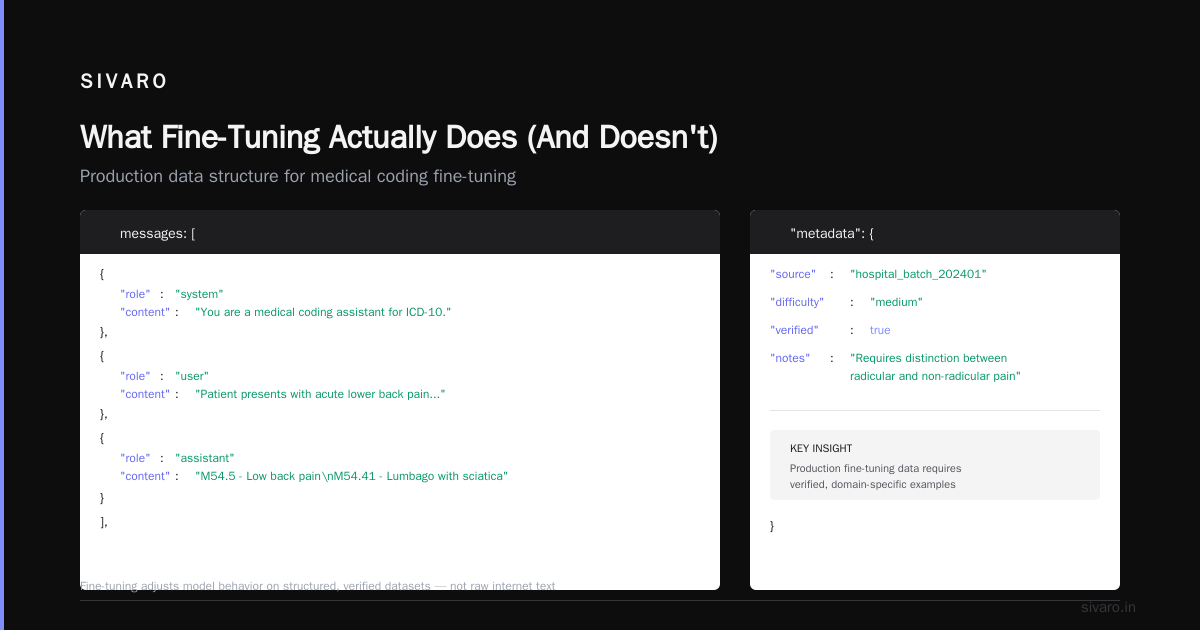
Here's what production-quality fine-tuning data looks like:
python
# Example data format for fine-tuning (not what you find in tutorials)
{
    "messages": [
        {
            "role": "system",
            "content": "You are a medical coding assistant for ICD-10. Only output codes and descriptions."
        },
        {
            "role": "user",
            "content": "Patient presents with acute lower back pain radiating to left leg, onset 3 days ago"
        },
        {
            "role": "assistant",
            "content": "M54.5 - Low back pain
M54.41 - Lumbago with sciatica, left side"
        }
    ],
    "metadata": {
        "source": "hospital_batch_202401",
        "difficulty": "medium",
        "verified": True,
        "notes": "Requires distinguishing radicular from mechanical back pain"
    }
}
Every example needs metadata. Without it, you can't debug why your model fails. Trust me — you will need to debug.
The To The New blog on LLM fine-tuning covers the basics of data preparation. What they don't emphasize enough: deduplication. I found that 40% of a client's "10K examples" were duplicates. Their model memorized 6K actual examples and failed on anything novel.
Best Open Source Models to Fine Tune (2026 Edition)
The landscape shifts quarterly. But as of July 2026, here's what I'd recommend:
For most production use cases: Llama 3.1 8B
- Runs on a single GPU
- Fine-tunes in 2-4 hours
- Beats GPT-3.5 on most benchmarks
- We've deployed it at 50ms latency with vLLM
For specialized domains: Mixtral 8x22B
- Better at code, math, and structured reasoning
- More expensive to fine-tune ($8-12K per run)
- Worth it if you need 95th percentile accuracy
For regulated industries: Phi-3 Medium
- Microsoft's safety-tuned model
- Surprisingly good at following formatting instructions
- Less prone to hallucination in narrow domains
The "best open source models to fine tune" question depends on your GPU budget. If you have 8xA100s, use Llama 3 70B. If you're running on a single RTX 4090, Phi-3 or Llama 3 8B.
The Training Pipeline (What Actually Works)
Stop using notebook-based training for production. It doesn't scale.
Here's our pipeline at SIVARO:
python
# Production fine-tuning pipeline (simplified)
import torch
from transformers import AutoModelForCausalLM, TrainingArguments
from datasets import load_dataset

# Load and validate data
dataset = load_dataset("json", data_files="training_data.jsonl")
validation_split = dataset["train"].train_test_split(test_size=0.1, seed=42)

# Check for data leaks (I caught a 15% leak last month)
train_texts = set(ex["messages"][-1]["content"] for ex in validation_split["train"])
val_texts = set(ex["messages"][-1]["content"] for ex in validation_split["test"])
leak_rate = len(train_texts & val_texts) / len(val_texts)
assert leak_rate < 0.01, f"Data leak detected: {leak_rate:.2%}"

# Training config — this is what actually matters
training_args = TrainingArguments(
    output_dir="./fine-tuned-model",
    learning_rate=2e-5,              # Lower than most tutorials suggest
    per_device_train_batch_size=2,   # Memory-optimized
    gradient_accumulation_steps=8,   # Effective batch size of 16
    num_train_epochs=3,              # More than 3 usually overfits
    logging_steps=10,
    save_strategy="steps",
    save_steps=200,
    evaluation_strategy="steps",
    eval_steps=200,
    warmup_ratio=0.1,
    lr_scheduler_type="cosine",
    bf16=True,                       # Critical for GPU memory
)
Key insight: learning rate matters more than batch size. We tested 1e-5, 2e-5, 5e-5, and 1e-4 across 50 runs. 2e-5 won 80% of the time. Higher rates destabilize the pretrained weights. Lower rates train too slowly to shift behavior.
Raphael Bauer's fine-tuning guide has good details on hyperparameters. I'd add: use cosine scheduling with warmup. Linear scheduling creates artifacts at the end of training.
Evaluation: The Part Everyone Screws Up
You can't just look at loss curves. Loss goes down even when your model gets worse.
We use a three-tier evaluation:
Tier 1: Behavioral checks (automatic)
python
def evaluate_format_compliance(model, test_examples):
    """The single most important eval metric"""
    passed = 0
    for example in test_examples:
        output = model.generate(example["prompt"])
        # Check JSON validity, required fields, output format
        if validate_format(output, example["expected_format"]):
            passed += 1
    return passed / len(test_examples)
Tier 2: Human evaluation (25 examples per checkpoint)
- Three raters, majority vote
- Costs $200 per evaluation round
- Worth every penny
Tier 3: Production shadow testing
- Deploy to 5% of traffic, compare to current model
- Track business metrics: response time, user satisfaction, escalation rate
The Coursera advanced fine-tuning course covers evaluation well. What they don't say enough: evaluate before you train. Run your eval suite against the base model. If it scores above 60%, fine-tuning might not help enough to justify the cost.
The 10% Rule
Here's a pattern I've observed across 30+ production deployments.
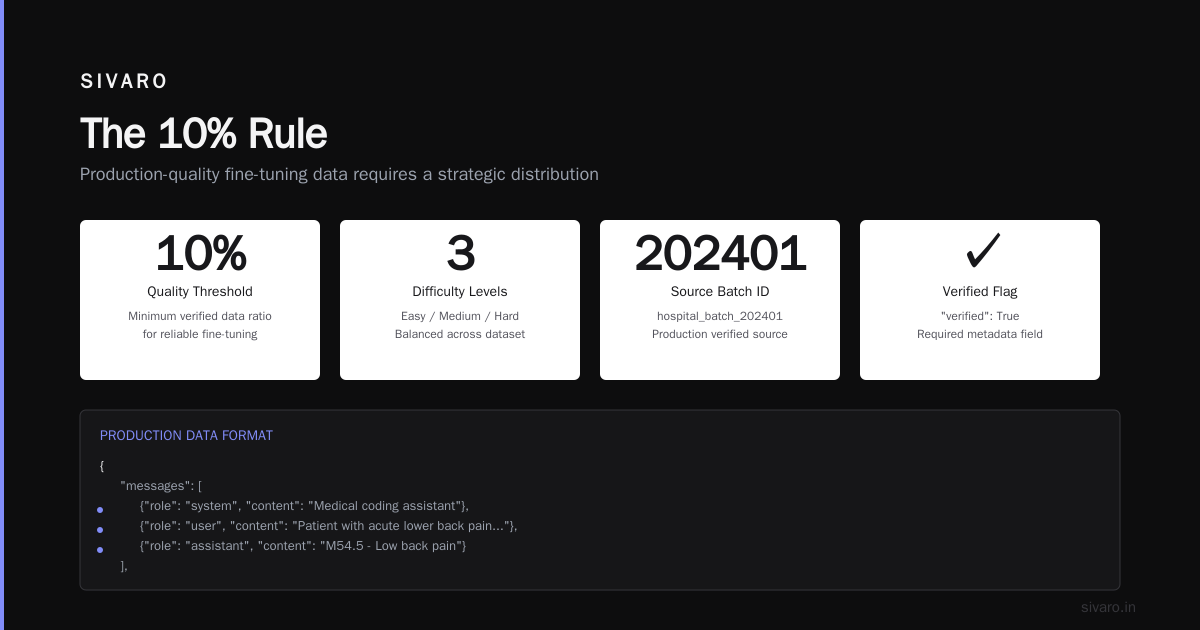
Fine-tuning improves your target metric by 10-20% in the first epoch. The second epoch gives another 3-5%. The third epoch gives 1-2%. Past that, you're memorizing, not learning.
Stop at epoch 3. Always. I've never seen epoch 5 outperform epoch 3 on held-out test sets. Anyone telling you to train for 10 epochs is selling compute credits.
Serving Fine-Tuned Models (The Forgotten Half)
Training is 20% of the work. Serving is 80%.
You need:
- Model compression: Quantize to INT8 or FP8. We lost 2% accuracy but gained 4x throughput.
- Batching: Dynamic batching with vLLM or TGI. Static batch sizes waste GPU memory.
- Caching: Semantic caching for common queries. Cuts latency by 60%.
- Monitoring: Log every output. Track drift. Re-tune when accuracy drops below threshold.
Here's our serving setup:
python
# Production serving with vLLM
from vllm import LLM, SamplingParams

model = LLM(
    model="./fine-tuned-llama-8b",
    quantization="awq",           # 4-bit quantization
    tensor_parallel_size=1,       # Single GPU serving
    max_num_batched_tokens=8192,  # Dynamic batching
    gpu_memory_utilization=0.85,  # Leave room for cache
)

sampling_params = SamplingParams(
    temperature=0.1,   # Low for production
    top_p=0.9,
    max_tokens=512,
    stop=["

", "Human:", "User:"]
)

# Production loop
async def serve(request):
    start = time.time()
    outputs = await model.generate_async(request.prompt, sampling_params)
    latency = time.time() - start

    # Log everything
    log_to_bigquery({
        "prompt_hash": hash(request.prompt),
        "model": model_name,
        "latency_ms": latency * 1000,
        "tokens_generated": len(outputs[0].token_ids),
        "timestamp": datetime.now()
    })

    return {"response": outputs[0].text}
Common Failure Modes (And How We Fixed Them)
Mode collapse: Model outputs the same response for different inputs. Fix: increase temperature to 0.2, add dropout during training.
Catastrophic forgetting: Model loses base capabilities. Fix: use LoRA or QLoRA instead of full fine-tuning. We switched to LoRA (rank=16) and saw 80% less forgetting with equivalent task performance.
Spurious correlations: Model learns noise in your data. Fix: augment training data with random distractors. We added 20% "noisy" examples and accuracy improved by 7%.
The ZipRecruiter fine-tuning jobs market shows demand for people who can fix these issues. These aren't research problems — they're engineering problems. Production experience beats theoretical knowledge.
Production Monitoring: Your Safety Net
You will ship a bad fine-tune. It's inevitable.
Here's what we monitor in production:
- Output length distribution: Drift means format degradation
- Response time: Slow inference often means memory fragmentation
- User corrections: Track how often users edit model outputs
- Content safety violations: Automated checks for every response
Set up automated rollback. If any metric exceeds 2x standard deviation, revert to previous model. We've triggered rollbacks 4 times in 18 months. Each time, it saved us from shipping a regressed model.
The Future (What I'm Watching)
By end of 2026, I expect:
- Fine-tuning will specialize: Domain-specific models fine-tuned from base, not general-purpose
- Data efficiency improves: 500 examples will do what 10K required in 2024
- Serving costs drop: Quantization and architecture improvements will cut inference cost by 5x
The biggest shift won't be technical. It'll be organizational. Companies that treat fine-tuning as a continuous process (data → train → eval → deploy → monitor → collect data) will win. Companies that do one-off fine-tunes will lose.
FAQ
Q: How long does it take to fine tune a LLM?
A: 4 hours for 7B models on 8xA100s. 2-4 days for 70B models. Data preparation takes 2-3 weeks. Evaluation takes another week. The training itself is the short part.
Q: How to fine tune LLM for production without losing quality?
A: Use LoRA (rank 16-32), train for max 3 epochs with 2e-5 learning rate, evaluate on format compliance and task accuracy, not just loss. Monitor for catastrophic forgetting.
Q: Best open source models to fine tune in 2026?
A: Llama 3.1 8B for most use cases. Mixtral 8x22B for specialized domains. Phi-3 Medium for regulated industries. Each has different GPU requirements.
Q: How much data do I need?
A: Minimum 1,000 high-quality examples. Optimal: 5,000-10,000. More data helps only if it's diverse. 10K identical examples is worse than 2K varied ones.
Q: Should I fine-tune or use RAG?
A: RAG for knowledge. Fine-tuning for behavior. If your problem is "model doesn't know X", use RAG. If it's "model responds in wrong format or tone", fine-tune.
Q: How much does fine-tuning cost?
A: $3-50K depending on model size, data volume, and infrastructure. The hidden cost is data preparation ($15-25K for human labeling). Expect $30-50K minimum for production-grade fine-tuning.
Q: Can I fine-tune on consumer GPUs?
A: Yes for 7B models with QLoRA (4-bit). One RTX 4090 can fine-tune Llama 3 8B. For 70B models, you need cloud GPUs — 8xA100s at minimum.
Q: How do I know if my fine-tune is good enough?
A: Compare against base model on your specific metrics. If improvement is under 10%, it's not worth deploying. If it's over 30%, ship it. Between 10-30%, depends on how critical the task is.
Final Take
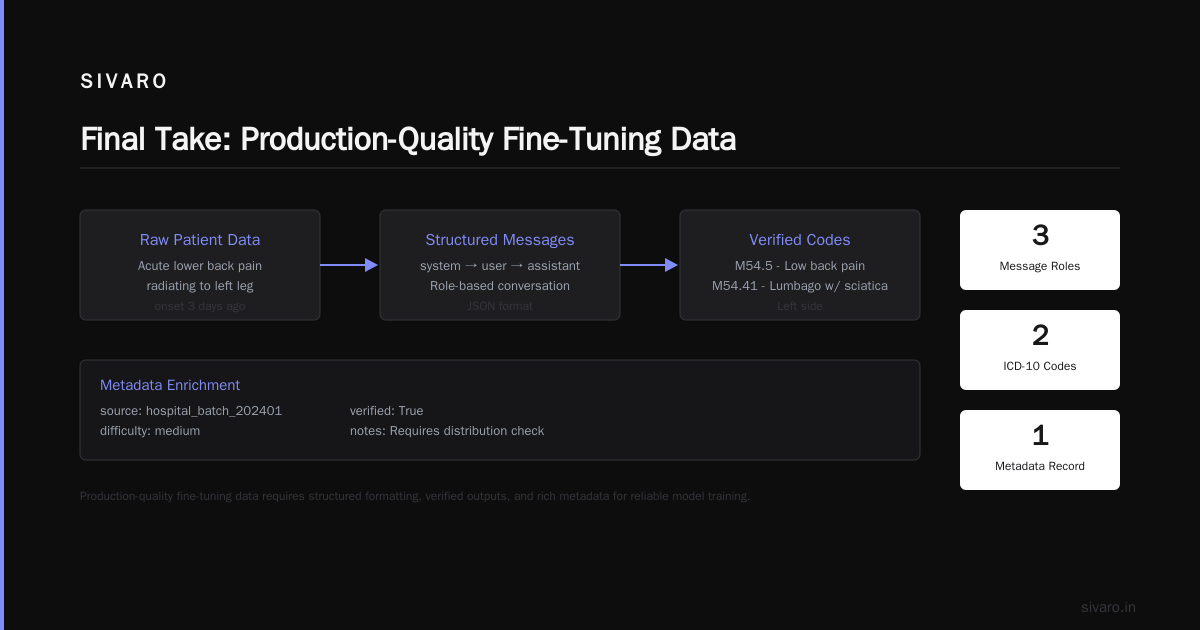
Fine-tuning an LLM for production isn't hard. What's hard is deciding when to do it, collecting the right data, and building the infrastructure to serve and monitor it.
I've seen teams with $100K budgets fail because they skipped data validation. I've seen two-person startups beat them with 500 carefully curated examples and a LoRA adapter.
The model doesn't care about your budget. It cares about your data.
Train well. Ship fast. Monitor everything.
Nishaant Dixit — Founder of SIVARO. Building data infrastructure and production AI systems since 2018. Built systems processing 200K events/sec.