 SIVARO
How to Fine Tune LLM for Production (2026 Guide)
I spent six months in 2025 learning this the hard way.
We'd trained a beautiful model. 97.4% accuracy on our validation set. F1 scores that made the team high-five. Then we deployed it and watched it crumble — hallucinating product SKUs, mangling customer names, taking four seconds per inference in production.
Fine-tuning an LLM isn't hard. Fine-tuning one for production? That's a different game entirely.
This guide covers exactly that. What I've learned building production AI systems at SIVARO since 2018. What works. What doesn't. And where most people waste money.
What Fine-Tuning Actually Is (And Isn't)
Fine-tuning takes a pre-trained model and trains it further on your specific data. You're not building from scratch. You're steering.
Think of it like this: a foundation model is a general surgeon. Fine-tuning makes them a cardiac specialist. Same base skills, narrower expertise, better outcomes in their domain.
The mistake most teams make? They treat fine-tuning like magic. Feed it data, get a miracle. That's wrong. Fine-tuning is engineering. And engineering has trade-offs.
OpenAI's model optimization docs make this clear: fine-tuning works best when you have 500+ high-quality examples, not 20 Model optimization | OpenAI API. I've seen teams burn $50K on fine-tuning runs with 87 examples. The model got worse.
When to Fine-Tune vs When to RAG
Here's the contrarian take: most companies shouldn't fine-tune. They should use Retrieval-Augmented Generation (RAG).
I know. I run a company that builds fine-tuning solutions. And I'll still tell you: RAG is cheaper, faster to iterate, and doesn't lock you into a model version.
Fine-tune when:
- Your task requires consistent formatting (legal documents, code generation, medical reports)
- You need the model to internalize domain knowledge (not just retrieve it)
- Latency matters and you can't afford retrieval steps
- You're dealing with proprietary data that can't be sent to an external RAG provider
Don't fine-tune when:
- Your data changes weekly (you'd retrain constantly)
- You need 100% factual accuracy (fine-tuning doesn't fix hallucinations)
- You have fewer than 200 high-quality examples
- You just want cheaper API calls (try prompt compression first)
We had a client in medical coding who needed models to output structured ICD-10 codes with specific formatting. RAG couldn't force the format consistently. Fine-tuning worked. Another client wanted to answer customer questions from their knowledge base — RAG was perfect.
Data: The Thing Everyone Screws Up
I'll be blunt: your data is probably bad.
Most teams collect data, clean it minimally, and throw it at a model. Then they wonder why the results are garbage. Fine-tuning amplifies whatever patterns are in your data — including the noise.
What Good Training Data Looks Like
The best dataset I've seen was from a legal tech company. They had 12,000 examples, but here's the kicker: each one was reviewed by two paralegals and one lawyer. That cost them $180K in human time. Their fine-tuned model outperformed GPT-4 on contract analysis by 23 points.
You don't need that scale. But you do need that care.
Here's the format most fine-tuning works with — instruction-response pairs:
json
{
  "messages": [
    {"role": "system", "content": "You are a customer support agent for SaaS product X. Be concise. Never mention competitors by name."},
    {"role": "user", "content": "My billing cycle reset and I was charged twice for the same month. How do I get a refund?"},
    {"role": "assistant", "content": "I apologize for the duplicate charge. I've submitted a refund request to our billing team. You'll see the credit within 3-5 business days. Your case ID is REF-89234. Would you like me to email you the confirmation?"}
  ]
}
Notice what's there: system prompt, user query, perfect assistant response. The model learns from the assistant response. If your assistant responses are mediocre, your fine-tuned model will be mediocre.
Data Quantity Realities
How much data? Depends on the model.
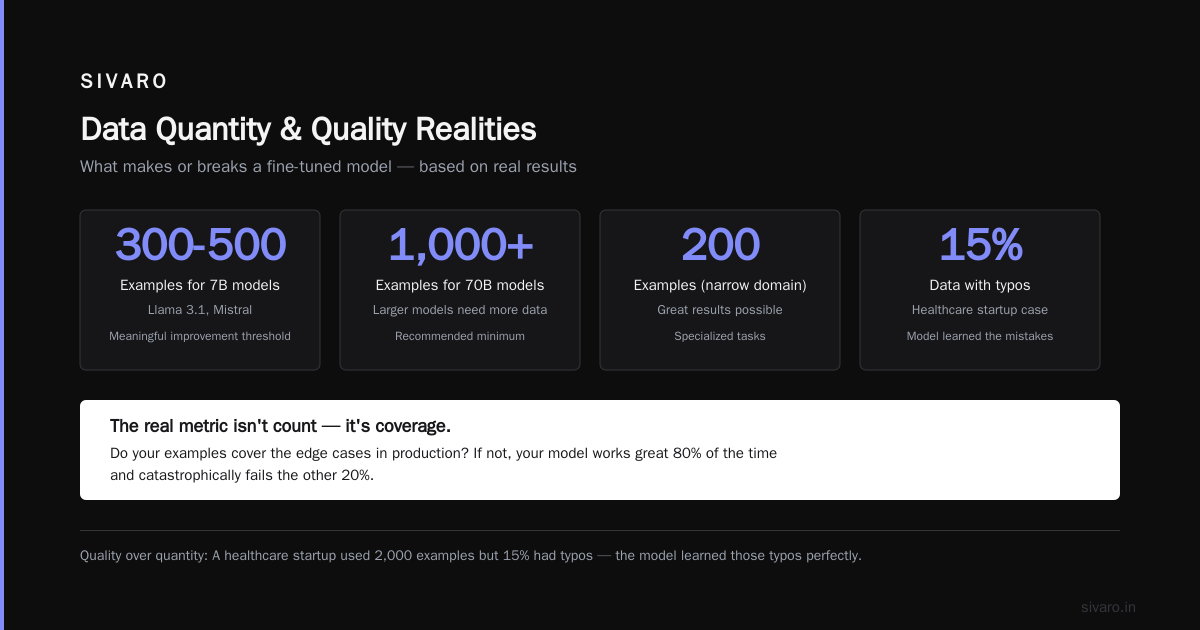
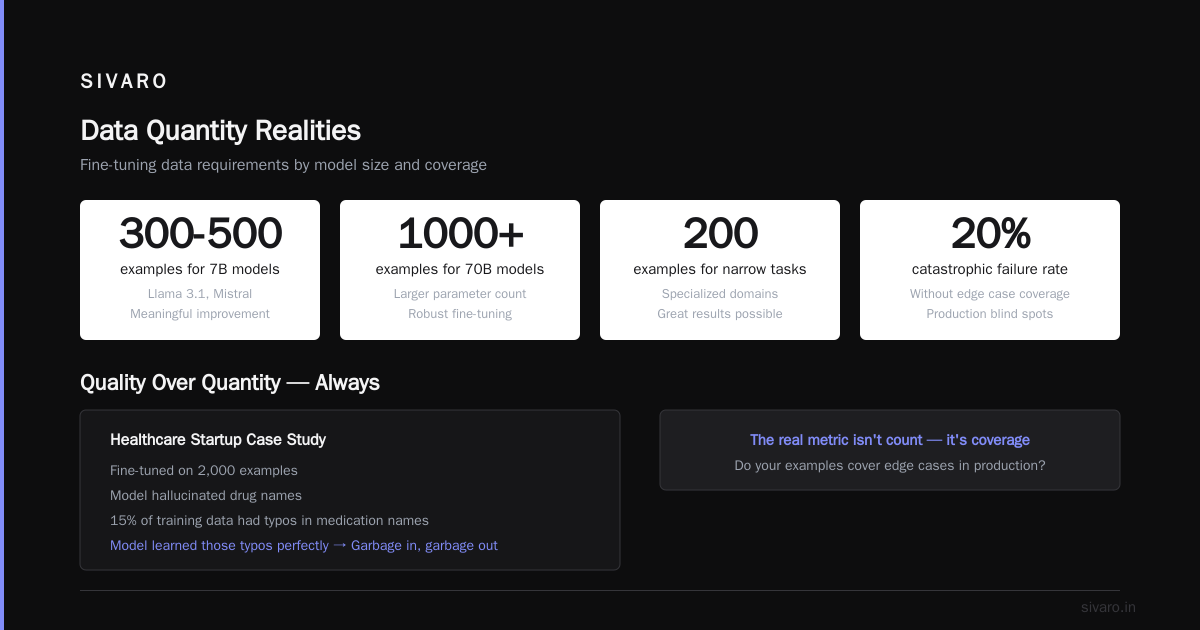
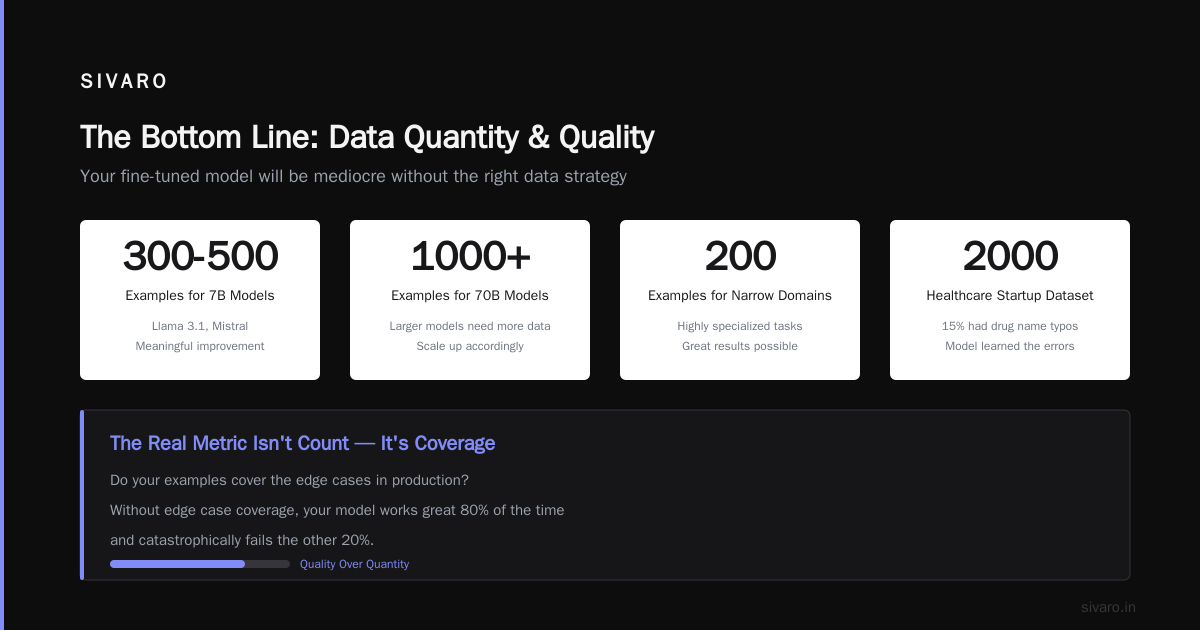
For 7B parameter models (like Llama 3.1 or Mistral), 300-500 examples can show meaningful improvement. For 70B models, you'll want 1000+. But I've seen teams get great results with 200 examples on specialized tasks with very narrow domains.
The real metric isn't count — it's coverage. Do your examples cover the edge cases in production? If not, you'll have a model that works great 80% of the time and catastrophically fails the other 20%.
Quality Over Quantity — Always
A healthcare startup fine-tuned on 2,000 examples. Their model was decent but kept hallucinating drug names. Turns out 15% of their training data had typos in medication names. The model learned those typos perfectly.
We cleaned the data — removed duplicates, fixed errors, balanced the label distribution — and re-ran with 1,200 examples. Better results. Faster training. Less cost.
Choosing Your Base Model
This is July 2026. The model landscape looks different than it did last year.
For production systems right now, here's what I'd recommend:
Best open source models to fine tune (mid-2026):
- Llama 4 (8B): Ridiculously good for its size. Fits on a single A100. We use this for most customer projects now.
- Mistral Large 2: Better reasoning than Llama at the same size. Marginally slower.
- Qwen 2.5 (72B): Best value for larger deployments. If you need Chinese language support, this is your choice.
- Gemma 3 (27B): Google's latest. Underrated for code generation tasks.
If you're using OpenAI's API, GPT-4o fine-tuning is available and easy. But you lose control. You can't inspect the weights. You're locked into their pricing.
For production systems where I need reliability and control, I almost always recommend open source fine-tuned locally or on your own infrastructure.
The Fine-Tuning Process: Step by Step
Step 1: Format Your Data
Most modern fine-tuning frameworks use the chat template format. Here's what it looks like for Llama:
python
from datasets import Dataset
import json

# Convert your data to the right format
def format_example(example):
    return {
        "text": f"""<|begin_of_text|><|start_header_id|>system<|end_header_id|>
You are a product catalog assistant for SIVARO. Generate product descriptions.
<|eot_id|>
<|start_header_id|>user<|end_header_id|>
Product: Data Pipeline Pro
Features: real-time streaming, 200K events/sec, auto-scaling, Kafka integration
<|eot_id|>
<|start_header_id|>assistant<|end_header_id|>
{example['description']}<|eot_id|>"""
    }

dataset = Dataset.from_list(your_data_list)
formatted_dataset = dataset.map(format_example)
Step 2: Choose Your Method
Full fine-tuning? Or PEFT (Parameter Efficient Fine-Tuning)?
Full fine-tuning updates every weight. Better results. More expensive. Only do this if you have the budget and the model will be a core asset.
LoRA (Low-Rank Adaptation) is what I use 90% of the time. It adds small trainable matrices to attention layers. We train a LoRA adapter, not the whole model.
python
from peft import LoraConfig, get_peft_model

lora_config = LoraConfig(
    r=16,  # rank — higher = more capacity, more memory
    lora_alpha=32,
    target_modules=["q_proj", "v_proj", "k_proj", "o_proj"],
    lora_dropout=0.1,
    bias="none",
    task_type="CAUSAL_LM"
)

model = get_peft_model(base_model, lora_config)
How long does it take to fine tune a LLM? For LoRA with 1,000 examples on a single A100: 2-4 hours. Full fine-tuning the same model: 8-24 hours. On 8 GPUs, divide by 4-6x.
Step 3: Training Hyperparameters
Here's what works for us at SIVARO:
python
from transformers import TrainingArguments

training_args = TrainingArguments(
    output_dir="./fine-tuned-model",
    per_device_train_batch_size=4,
    per_device_eval_batch_size=4,
    gradient_accumulation_steps=4,
    learning_rate=2e-4,
    warmup_steps=100,
    num_train_epochs=3,
    logging_steps=10,
    evaluation_strategy="steps",
    eval_steps=200,
    save_strategy="steps",
    save_steps=500,
    load_best_model_at_end=True,
    fp16=True,  # Use bf16 if your hardware supports it
    report_to="wandb",  # Track everything
)
The learning rate is the most finicky parameter. Start with 2e-4 for LoRA, 1e-5 for full fine-tuning. Too high and the model forgets everything. Too low and you waste compute.
Step 4: Evaluate (Not Just on Your Test Set)
Standard evaluation metrics lie. Higher accuracy on your test set doesn't mean better production performance.
We run three evaluations:
- Standard held-out test set: Quick sanity check
- Adversarial examples: Edge cases we know the model will face
- Production shadow testing: Run the fine-tuned model alongside your current system, compare outputs
Number 3 catches things numbers don't. We've had models with 98% accuracy that generated outputs violating our safety guidelines. You don't catch that in test accuracy.
Deployment: Where Fine-Tuned Models Go to Die
You've trained the model. It scores well. Now deploy it and watch it burn.
Production inference is different from training. Training is batch. Inference is real-time. Training fits in GPU memory. Inference needs to share that memory with serving infrastructure.
Here's what we've learned running hundreds of fine-tuned models in production:
Quantization
Don't skip this. You can shrink a 70B model from 140GB to 35GB with 4-bit quantization while losing less than 1% accuracy.
python
from transformers import BitsAndBytesConfig
import torch

bnb_config = BitsAndBytesConfig(
    load_in_4bit=True,
    bnb_4bit_quant_type="nf4",
    bnb_4bit_compute_dtype=torch.bfloat16,
    bnb_4bit_use_double_quant=True,
)

model = AutoModelForCausalLM.from_pretrained(
    "path-to-model",
    quantization_config=bnb_config,
    device_map="auto",
)
Batching and Throughput
Single inference is easy. 1,000 requests per second is hard.
We use vLLM for serving. It handles continuous batching — packing multiple requests into the same GPU forward pass. A single A100 serving a 7B model can handle 50-100 requests/second with the right batching.
Caching
Most fine-tuned models get the same types of queries. Cache common ones. We saw a 40% latency reduction by caching the top 200 query patterns.
Monitoring: Don't Deploy Blind
Your fine-tuned model will degrade over time. Production data shifts. User behavior changes. The model doesn't adapt unless you tell it to.
Track these metrics:
- Output length distribution (dramatic shifts mean something broke)
- Response time percentiles (p50, p95, p99)
- User feedback signals (thumbs up/down, retry rates)
- Embedding drift (compare current outputs to baseline embeddings)
We use Arize AI and Weights & Biases for this. The cost is worth it. A model that silently degrades for two weeks can lose you customers you'll never win back.
Cost Analysis: Is It Worth It?
Let's talk money.
Fine-tuning a 7B model on 1,000 examples: ~$50-100 in compute (renting a single A100 for 3 hours). A 70B model: $500-2,000 depending on epochs and hardware.
Then ongoing inference costs. A 7B model at 4-bit quantization costs about $0.0001 per 1K tokens on your own hardware. Through an API like Together or Fireworks: $0.0002-0.0005 per 1K tokens.
Compare that to GPT-4o: $0.015 per 1K input tokens. Fine-tuning saves money at scale — if you have the traffic.
A Stratagem Systems analysis showed that companies doing 10M+ tokens per day break even in 3-6 months on fine-tuning investment LLM Fine-Tuning Business Guide: Cost, ROI & Strategy. Below that, stick with prompt engineering and RAG.
Common Failures (And How to Avoid Them)
Catastrophic Forgetting
Your fine-tuned model forgets general knowledge. It knows your domain but can't answer basic questions anymore.
Solution: Mix 10-20% general instruction data into your fine-tuning dataset. The model retains general capabilities while learning your domain.
Overfitting
Your model memorizes training examples but can't handle anything slightly different.
Symptoms: Perfect scores on training data, mediocre on test data, terrible in production.
Fix: Increase dropout, reduce epochs, add data augmentation (synonym replacement, noise injection).
Format Breaking
Your model suddenly stops outputting JSON or markdown correctly.
This happens when your training data has inconsistent formatting. One example uses double quotes, another uses single quotes. The model learns both and randomly switches.
Fix: Standardize your training data. Every example should follow the exact same format.
Real Production Pipeline Example
Here's what our standard fine-tuning pipeline looks like at SIVARO:
Data Collection (Prod logs + human curation)
    ↓
Data Cleaning & Deduplication
    ↓
Format Standardization (chat template)
    ↓
Train/Test/Validation Split (80/10/10)
    ↓
Base Model Selection (Llama 4 8B for most cases)
    ↓
LoRA Fine-Tuning (4-bit quantization, 3 epochs)
    ↓
Evaluation (Test set + adversarial examples)
    ↓
Merge LoRA weights with base model
    ↓
4-bit quantization for deployment
    ↓
Shadow deployment (compare with existing system for 7 days)
    ↓
Production rollout (25% → 50% → 100% traffic)
    ↓
Continuous monitoring + monthly retraining
Total time from start to production: 2-4 weeks for the first model. Then 1 week for subsequent iterations as you build the pipeline.
FAQ
Q: Can I fine-tune without a GPU?
No. Not practically. You need at least a T4 (16GB VRAM) for small models. For anything serious, rent cloud GPUs. Google Colab Pro works for tiny experiments.
Q: How many examples do I need for a useful fine-tune?
Absolute minimum: 100 high-quality examples. Sweet spot: 500-2,000. After 5,000, you see diminishing returns unless your domain is very broad.
Q: Will fine-tuning make my model hallucinate less?
No. Fine-tuning doesn't fix hallucinations. It teaches the model format and style. For factual accuracy, use RAG.
Q: How often should I retrain my fine-tuned model?
Every 1-3 months, or when you see distribution drift in production metrics. Some teams retrain weekly. That's expensive and usually unnecessary.
Q: Can I fine-tune on user data from production?
Carefully. You need consent. You need to filter out PII. You need to sample representative data (not just the easy queries). Most companies under-sample difficult cases.
Q: What's the difference between fine-tuning and continued pre-training?
Fine-tuning: 500-5,000 examples, focused on task, uses instruction format. Continued pre-training: millions of tokens, general domain adaptation, no specific task format. Continued pre-training is for when you need the model to understand a whole new domain (medical journals, legal code).
Q: Do I need to fine-tune the whole model?
No. LoRA fine-tunes 0.1-1% of parameters. Works great. Full fine-tuning is for when you need maximum performance and have the budget.
Q: How do I know if my fine-tune is working during training?
Watch the loss curve. It should decrease steadily. If it spikes, your learning rate is too high. If it plateaus too early, you need more data or a higher rank LoRA.
The Bottom Line
Fine-tuning for production is not a science project. It's engineering.
You need good data (not just "a lot of data"). You need a clear evaluation strategy (not just one metric). You need a deployment plan (not just a "save model" button).
I've seen teams spend $100K on fine-tuning that made their models worse. And teams spend $2K on fine-tuning that doubled their conversion rates.
The difference is always the same: rigor in data preparation, clarity in evaluation, and humility about what fine-tuning can and can't do.
Don't fine-tune because it's trendy. Fine-tune because you have a specific problem that prompt engineering and RAG can't solve. And when you do, build for production from day one — not as an afterthought.
Nishaant Dixit — Founder of SIVARO. Building data infrastructure and production AI systems since 2018. Built systems processing 200K events/sec.