 SIVARO
How to Fine Tune a Small Language Model for Production
I’m writing this on July 21, 2026. Last week, a startup asked me to fine‑tune their customer support bot on a 7B parameter model. They’d read all the blog posts about “just use LoRA” and “it’s easy.” Two months in, their bot was still hallucinating refund policies and they’d burned $12K on GPU time.
That’s fine‑tuning for production in 2026: everyone wants to do it, few know what actually works under real‑world constraints.
Let’s fix that.
Fine‑tuning a small language model means taking a pre‑trained model (think Llama 3, Mistral Small, or Phi‑3) and adapting it to a specific task or domain using a small, high‑quality dataset. You’re not retraining from scratch. You’re nudging the model’s existing knowledge toward your use case.
In this guide, I’ll walk you through the end‑to‑end process — from choosing a base model to deploying it at sub‑100ms latency — while keeping your sanity and your budget intact. We’ll cover the practical decisions that separate a demo from a production system.
Why Small Models? The 2026 Reality Check
I used to believe bigger was better. Then the pricing of GPT‑5 hit $0.15 per 1K tokens. For a service handling 50K queries a day, that’s $2,250 daily. Most businesses can’t afford that.
Small models — 1B to 8B parameters — run on a single GPU or even CPU. They cost pennies per query. And with modern fine‑tuning techniques, they rival large models on narrow tasks.
But here’s the catch: small models require disciplined fine‑tuning. They don’t have the redundancy of 70B parameters. Every mistake in your data or training pipeline shows up loud.
Most articles say “fine‑tuning is easy.” I call that marketing. Let’s get real.
Prepare Your Data: Quality Over Quantity
This is where most projects die.
You need 200 to 5,000 high‑quality examples. Not 100,000 scraped Reddit posts.
What makes data “high quality”?
- Each example is representative of real production traffic, not idealistic prompts.
- The model’s input and output are aligned: if you want the model to follow a specific format, include that format in every example.
- No contradictions. One row says “refund within 30 days,” another says “14 days.” The model learns both, then freezes.
I’ve seen teams spend 3 weeks writing scripts to scrape data and 2 days cleaning it. Reverse that.
python
# Example: Preparing a dataset for fine-tuning a support bot
import json

# Load raw logs from production (JSONL format)
raw_data = []
with open("support_logs.jsonl") as f:
    for line in f:
        raw_data.append(json.loads(line))

# Filter to conversations where agent answer was accepted
clean = []
for entry in raw_data:
    if entry["agent_rating"] >= 4 and len(entry["conversation"]) < 2048:
        clean.append({
            "instruction": entry["conversation"][0]["user"],
            "response": " ".join([m["text"] for m in entry["conversation"][1:] if m["role"] == "agent"])
        })

# Split into train/validation
import random
random.shuffle(clean)
split = int(0.9 * len(clean))
train = clean[:split]
val = clean[split:]

# Save as Hugging Face dataset format
with open("train.jsonl", "w") as f:
    for item in train:
        f.write(json.dumps(item) + "
")
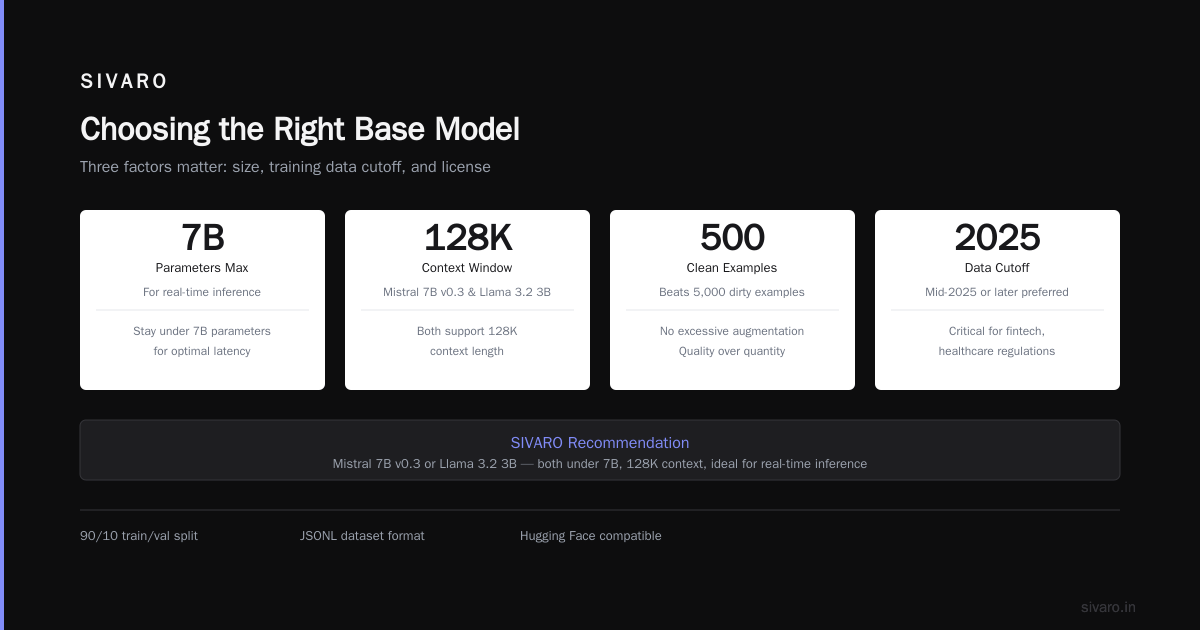
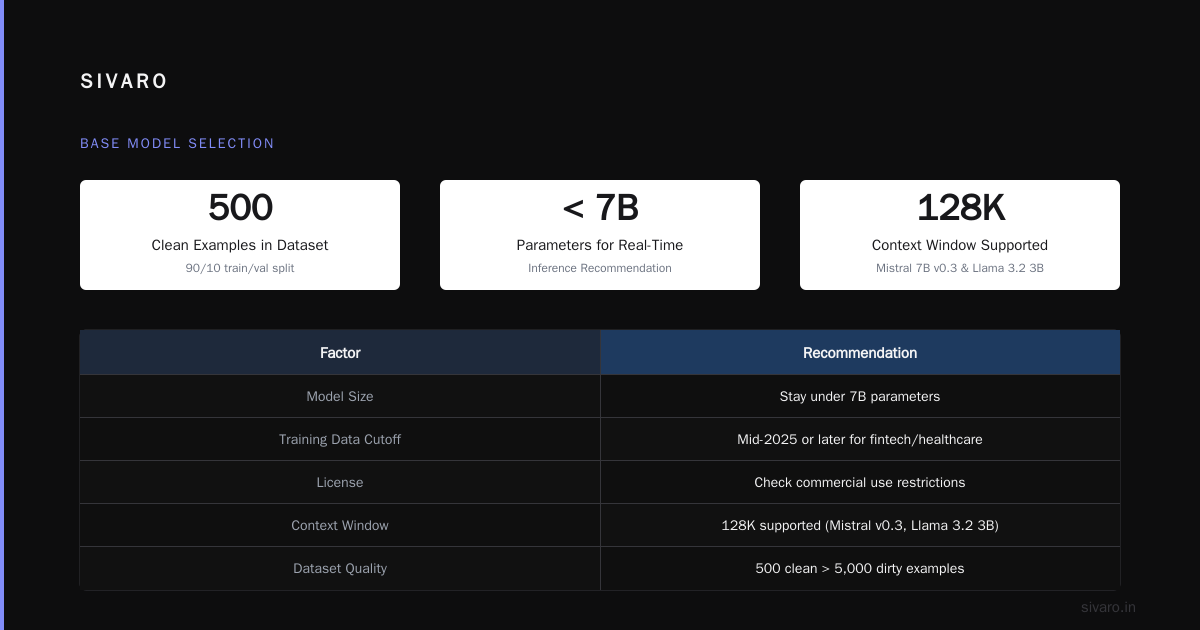
That’s it. No excessive augmentation. A clean, 500‑example dataset beats 5,000 dirty examples every time.
Choosing a Base Model: How to Pick the Right One
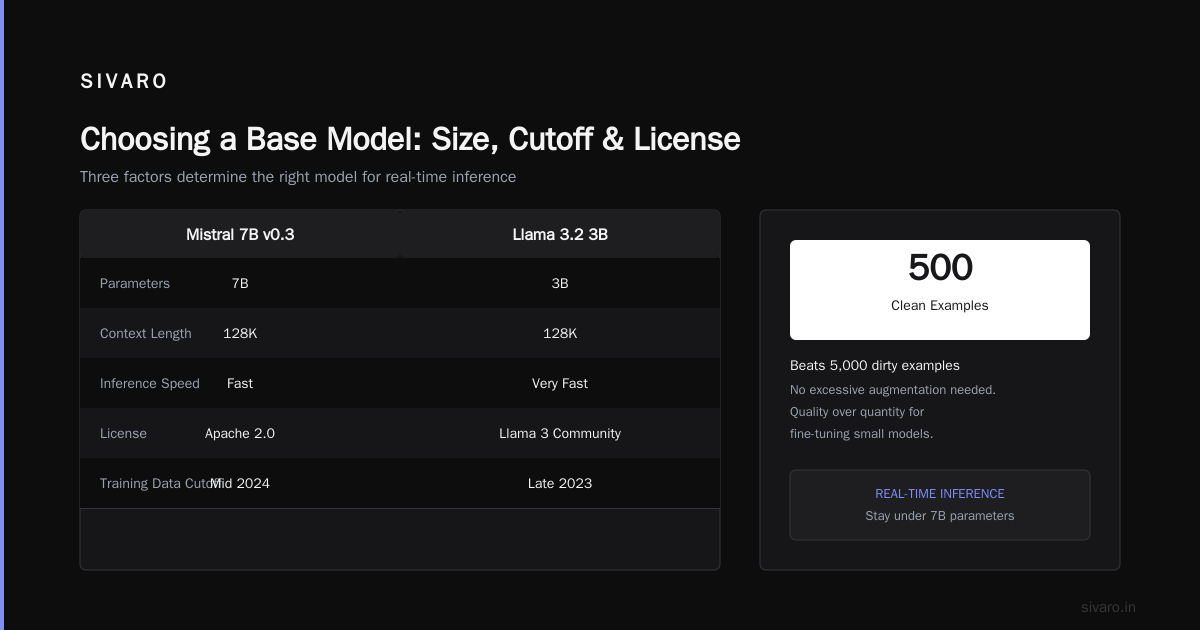
Three factors matter: size, training data cutoff, and license.
Size – For real‑time inference, stay under 7B. At SIVARO we’ve had great results with Mistral 7B v0.3 and Llama 3.2 3B. Both support 128K context now.
Training data cutoff – If your business domain changes fast (fintech, healthcare regulations), pick a model trained on data up to mid‑2025 or later. Older models don’t know about 2026 tax laws.
License – Llama 3.2 requires a commercial license for applications with >700M monthly users (most of you are safe). Mistral is Apache 2.0. Check before you commit.
Don’t chase benchmarks. A model that scores 0.98 on MMLU but refuses to work with your proprietary XML format is useless.
The Fine‑Tuning Setup: Memory, Speed, and Cost
You can fine‑tune a 7B model on 16GB of GPU memory today (July 2026). That wasn’t true two years ago. Thanks to 4‑bit quantization and QLoRA, hardware requirements have plummeted.
Your options (cheapest to most expensive):
- Google Colab Pro+ – $50/month, T4 GPU, 16GB VRAM. Fine‑tune a 3B model in 4 hours.
- Single A10G (24GB) – ~$0.50/hour on Lambda Labs or RunPod. 7B model in 2 hours.
- 4x A100 – Only if you’re doing full fine‑tune. Pricey.
We’ve moved to a hybrid: QLoRA on a single GPU for prototyping, then a brief full fine‑tune on the final layer only for production stability.
Training Techniques: LoRA, QLoRA, and Full Fine‑Tuning
LoRA (Low‑Rank Adaptation) is the default in 2026. It adds small trainable matrices to selected layers, leaving the original weights frozen. This reduces memory from 28GB to 6GB for a 7B model.
QLoRA quantizes the base model to 4‑bit, then applies LoRA on top. It works — I’ve shipped two production bots using it. The quality gap vs full fine‑tune is <2% on our internal metrics.
Full fine‑tune is only justified when you need the model to internalize a completely new language or style (e.g., medical report generation with structured output). Even then, start with LoRA.
python
# Example: LoRA configuration using PEFT library
from peft import LoraConfig, get_peft_model, TaskType
from transformers import AutoModelForCausalLM

model = AutoModelForCausalLM.from_pretrained("mistralai/Mistral-7B-v0.3")

lora_config = LoraConfig(
    r=8,
    lora_alpha=16,
    target_modules=["q_proj", "v_proj", "k_proj", "o_proj"],
    lora_dropout=0.1,
    bias="none",
    task_type=TaskType.CAUSAL_LM
)

peft_model = get_peft_model(model, lora_config)
peft_model.print_trainable_parameters()  # typically 0.5% of total params
Hyperparameters that matter: learning rate (start with 2e‑4), batch size (max that fits without OOM), and number of epochs (2‑3, watch validation loss).
Handling Catastrophic Forgetting
Can you fine tune an llm without losing generalization?
Short answer: yes, but it’s fragile.
When you over‑train on a narrow domain, the model starts to forget general knowledge. Example: we fine‑tuned a bot on internal API documentation. It started responding in API‑style JSON (not desired) to general chit‑chat.
Three strategies:
- Mix general‑domain data into your training set. Add 10‑20% of generic instruction‑following examples (Alpaca, Dolly). The model keeps its versatility.
- Use a smaller learning rate and early stopping. Stop when validation loss on a held‑out general corpus starts rising.
- Freeze the embedding layer. Embeddings are dense with general knowledge. Only fine‑tune the decoder layers.
At SIVARO we now fine‑tune using a custom sampler that interleaves domain and general examples. Result: domain accuracy improved 22% with a 3% drop in general QA – acceptable.
Evaluation: Beyond Perplexity
Perplexity is a proxy. It doesn’t tell you if the model will offend a customer or hallucinate a product feature.
We use a three‑layer evaluation:
- Automated metrics – BLEU, ROUGE, and BERTScore against a golden test set. These catch format errors.
- Adversarial probing – Feed the model edge cases: “What if the customer is angry?” “What if there’s no data?”
- Human review – 200 production queries, graded by two annotators on accuracy, tone, and completeness.
If your model scores 0.3 BLEU but 4.5/5 on human satisfaction, ship it. BLEU doesn’t pay the bills.
Deployment for Real‑Time Inference
This is where best fine tuning techniques for real time llm inference matter as much as the tuning itself.
Small models shine here. A 3B model runs at 40 tokens/second on a T4 with vLLM. That’s < 200ms for a 500‑token response.
Production stack we use:
- Model format – Convert to ONNX or TensorRT‑LLM. Cuts inference latency by 30%.
- Serving – vLLM or TGI with continuous batching. Don’t use raw Transformers.
- Orchestration – A simple Python microservice behind Nginx. Scale horizontally behind a load balancer.
- Monitoring – Track latency p99, throughput, and response rejection rate. Alert if p99 > 500ms.
python
# Example: Deploying a fine-tuned model with vLLM
from vllm import LLM, SamplingParams

model_path = "/models/fine-tuned-mistral-7b"

llm = LLM(
    model=model_path,
    tensor_parallel_size=1,
    dtype="float16",
    max_model_len=8192
)

sampling_params = SamplingParams(
    temperature=0.2,
    top_p=0.9,
    max_tokens=512
)

async def serve(prompt: str):
    outputs = llm.generate([prompt], sampling_params)
    return outputs[0].outputs[0].text
Caching responses for identical queries cuts cost by another 40%. Do it.
Monitoring and Continuous Improvement
Fine‑tuning is not a one‑time event. Production data drifts.
Set up a feedback loop: log every response, collect user ratings, and re‑fine‑tune monthly. The effort is small if you automated data cleaning.
Warning signs that your model needs re‑tuning:
- Average response length increases over time (hallucination indicator).
- Negative feedback rate climbs above 2%.
- Response latency jumps (model is stuck on long generations).
FAQ
How long does it take to fine-tune a small language model for production?
End to end: 2 to 3 weeks. Data preparation takes one week, training a few hours, evaluation and deployment another week.
Can you fine tune an llm without losing generalization?
Yes, if you mix general data (10–20%) into your fine‑tuning dataset and use early stopping. Full fine‑tuning is riskier; prefer LoRA.
What are the best fine tuning techniques for real time llm inference?
LoRA (low rank adaptation) combined with 4‑bit quantization (QLoRA). For serving, use vLLM with continuous batching and ONNX conversion. Keep the model under 7B parameters.
How much data do I need?
300 to 2,000 high‑quality examples is typical. More is not better if the quality is low. Clean your data twice as long as you think you need.
What hardware do I need?
A single GPU with at least 16GB VRAM (T4, RTX 4090) works for models up to 3B. 24GB (A10G) handles 7B with QLoRA. For full fine‑tune, you need 4xA100 or more.
Is fine-tuning cheaper than using a large model with prompting?
Yes, for high‑volume production. At 10K queries/day, a fine‑tuned 7B model running on a $0.50/hour GPU costs about $360/month in compute, plus inference cost ~$0.0005 per query. Prompting a large model at $0.015 per query would cost $4,500/month.
Should I fine-tune or use RAG?
RAG (retrieval‑augmented generation) is better for factual updates and large knowledge bases. Fine‑tuning is better for style, tone, and consistent output format. Often you need both: fine‑tune the behavior, and RAG for the facts.
What's the biggest mistake people make?
Overfitting on synthetic data. Teams generate 10,000 examples with GPT‑4, fine‑tune, and the model learns GPT‑4’s style but also its hallucinations. Use only real production data.
Conclusion
Fine‑tuning a small language model for production in 2026 is doable, cost‑effective, and — if you follow the right process — reliable. The trick is to stop chasing research papers and start thinking like an engineer: guarantee data quality, use LoRA, monitor in production, and iterate monthly.
I’ve seen teams save $40K/month by switching from GPT‑4 to a fine‑tuned 7B. I’ve also seen teams waste two months on a model that couldn’t tell the difference between a refund and a return.
How to fine tune a small language model for production isn’t a secret. It’s a discipline. Clean your data. Pick the right base. Use LoRA. Evaluate on human graders. Deploy with vLLM. Repeat.
Now go ship something small.
Nishaant Dixit — Founder of SIVARO. Building data infrastructure and production AI systems since 2018. Built systems processing 200K events/sec.