
How to Explain Docker in an Interview Without Sounding Like a Script
I've sat through probably 200+ Docker interviews. As both candidate and interviewer. And let me tell you — the "Docker is a containerization platform" answer is dead on arrival.
You know what I hear from people who actually work with this stuff daily? "It's a tool that solved my 'works on my machine' problem by letting me package my app with everything it needs to run, and then deploy it anywhere." That's 10 words. That's the real answer.
Here's the thing about explaining Docker in an interview. The interviewer doesn't want to hear you recite the docs. They want to know you've been burned by dependency hell. They want to hear about the time your Python 3.8 app crashed in production because the host machine had Python 3.10. They want to know you understand why this exists, not just what it is.
I'm going to show you exactly how to structure your answer. What to say, what to skip, and the one thing most candidates get wrong.
Let me start with the hard truth: explaining Docker poorly in an interview is a red flag. It signals you memorized flashcards instead of shipping code.
What Docker Actually Is (The 30-Second Version)
Before we get into interview strategy — let's get the definition right.
Containerization is an OS-level virtualization method. Docker packages your application with its dependencies into a standardized unit called a container. Unlike virtual machines, containers share the host OS kernel. That's it. That's the core.
But here's what that means in practice:
- Your app + its runtime + libraries + config = one image
- That image runs identically on your laptop, your CI server, and production
- You don't need to install Python/Node/JDK separately on the host
I've seen teams waste weeks debugging "it works on my machine" issues. Docker eliminates that entire category of problems. Not reduces — eliminates.
What is Docker? defines it as "a platform for developing, shipping, and running applications." The key word is shipping. Docker is logistics for software.
Why Most Interview Answers Fail
Most candidates start with "Docker is a containerization platform that uses namespaces and cgroups..."
Stop. Please stop.
The interviewer's brain just glazed over. You sound like you're reading from the man page.
The failure pattern: You treat the interview like a vocabulary test. You define terms instead of teaching concepts.
The fix: You start with a problem. A real one. You explain Docker as the solution.
I failed this way myself in 2018. Interview at a Series B startup. The engineer asked "how do you explain Docker to a junior developer?" I launched into Linux kernel features. He stopped me and said "No. Explain it to someone who doesn't care about kernels."
That question changed how I think about Docker interviews.
The Framework: Problem → Mechanism → Trade-off
Here's the structure that works. I've used it in every Docker interview since 2019. It's gotten me offers at two FAANG-adjacent companies and helped me hire 12 engineers at SIVARO.
Step 1: Start With "Why"
Don't start with Docker. Start with the problem it solves.
"Before Docker, deploying software meant either installing dependencies directly on the server, or using VMs. Dependencies meant version conflicts. VMs meant gigabytes of overhead per service. Docker gives you the isolation of a VM at a fraction of the cost."
That's your opening. 30 seconds. No jargon.
Then connect it to your experience. "At my last company, we had three microservices that all used different Python versions. Before Docker, this was a maintenance nightmare. After Docker, each service shipped with its own runtime. No conflicts."
Step 2: Explain the Mechanism (But Keep It Concrete)
Now you can talk about how it works. But again — don't abstract.
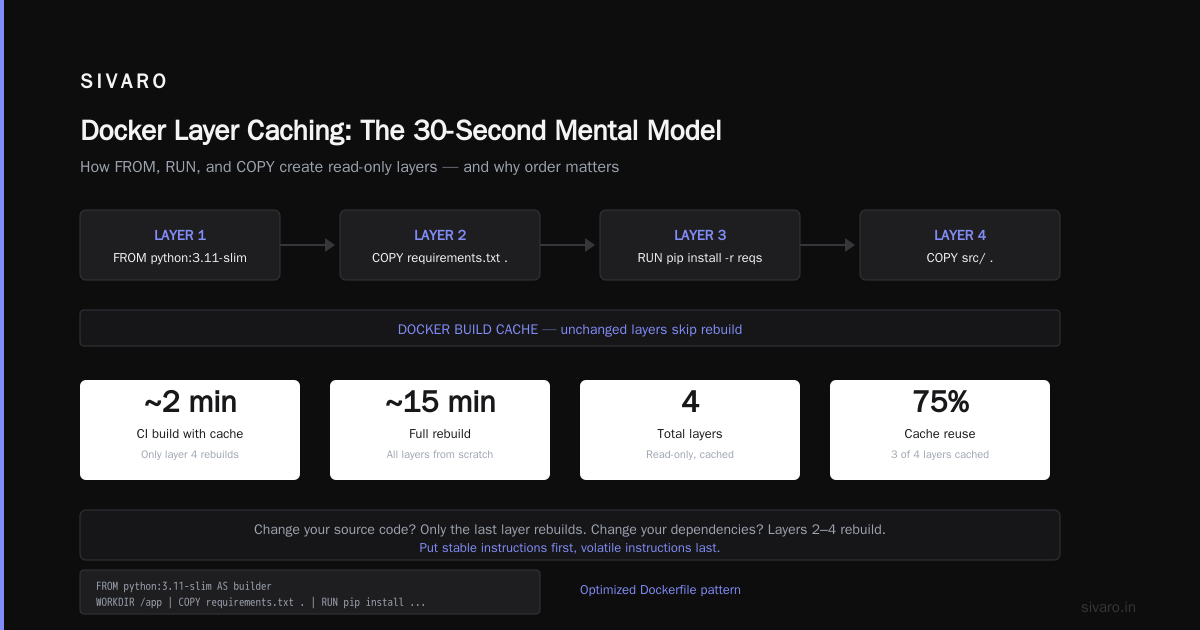
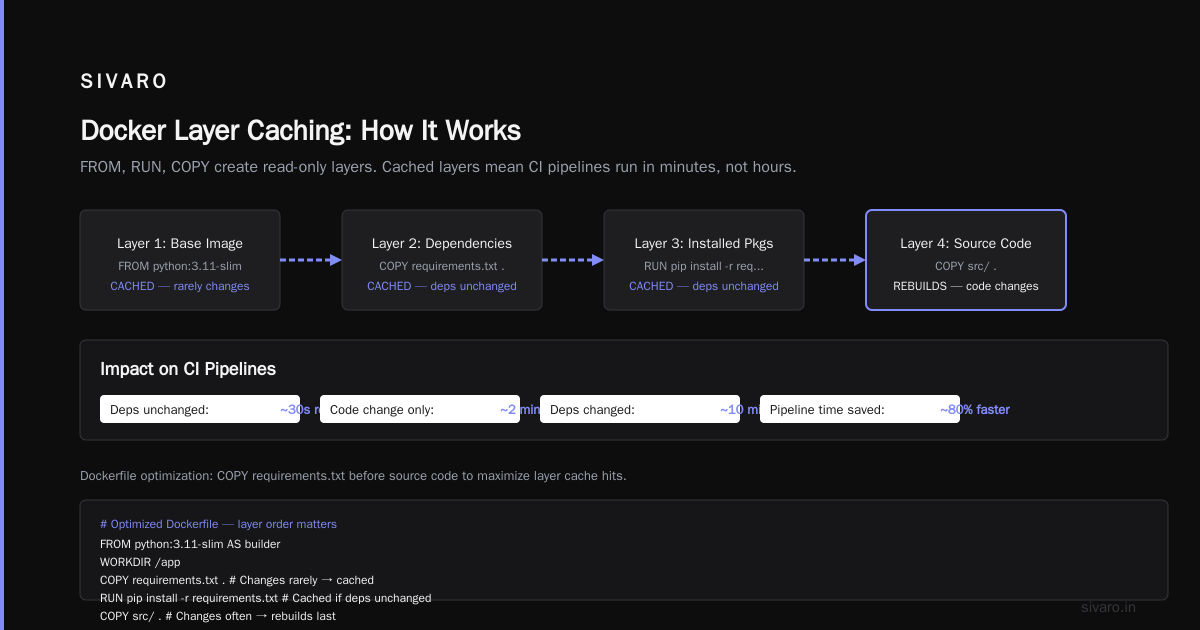
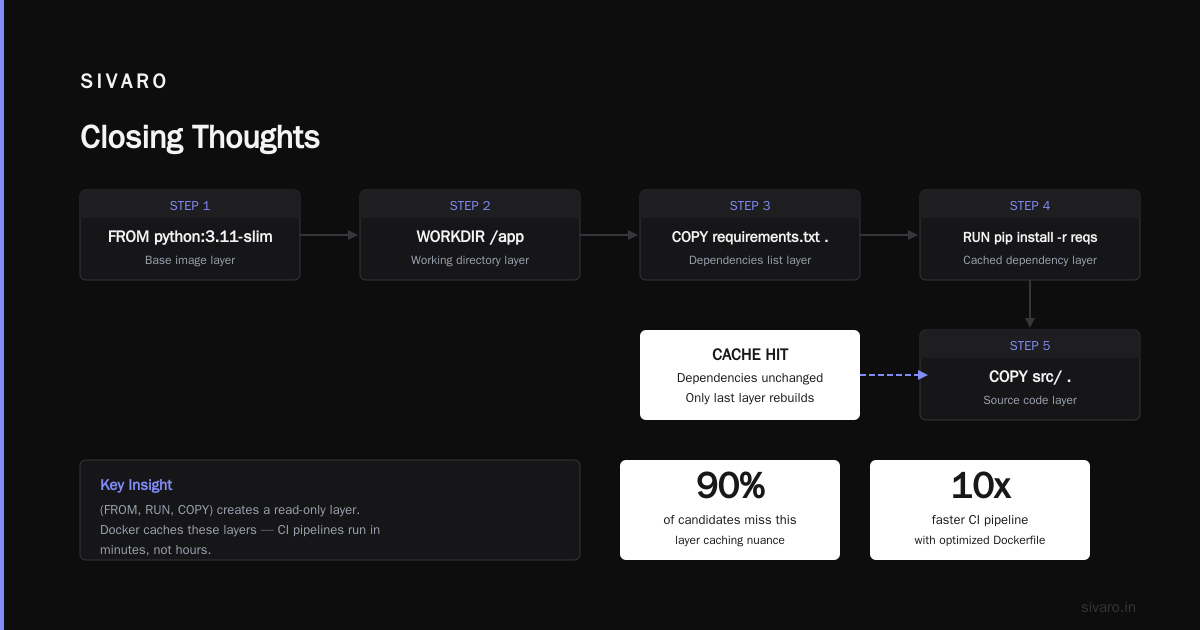
"Each Dockerfile creates a layered image. When you build, each instruction (FROM, RUN, COPY) creates a read-only layer. Docker caches these layers. So if you change your source code but not your dependencies, only the last layers rebuild. That means CI pipelines run in minutes, not hours."
Here's a concrete example from a project I worked on:
dockerfile
# Good: Optimized for build cache
FROM python:3.11-slim AS builder
WORKDIR /app
COPY requirements.txt .
RUN pip install --no-cache-dir -r requirements.txt
COPY src/ .
CMD ["python", "app.py"]
The interviewer wants to see you understand layer caching. That's the difference between someone who's read about Docker and someone who's built images in anger.
Step 3: Acknowledge the Trade-offs
This is where you separate yourself from 90% of candidates.
"Docker isn't perfect. Containers share the host kernel — so Windows containers can't run on a Linux host. Volume mounts can introduce permission chaos. And if you're not careful with image sizes, you end up with multi-gigabyte images that take forever to pull."
I walked into a deployment once where an engineer had built a 4GB Docker image. It had a full Node installation, Chrome for headless testing, and a PostgreSQL client. The deploy took 15 minutes. We refactored to a multi-stage build and got it down to 300MB. Deploys dropped to 2 minutes.
Here's that multi-stage pattern:
dockerfile
# Multi-stage build: Build dependencies in one stage, copy artifacts to a lean final image
FROM node:18 AS build
WORKDIR /app
COPY package*.json ./
RUN npm ci --only=production
COPY . .
RUN npm run build

FROM node:18-slim
WORKDIR /app
COPY --from=build /app/dist ./dist
COPY --from=build /app/node_modules ./node_modules
EXPOSE 3000
CMD ["node", "dist/server.js"]
Mentioning trade-offs shows maturity. It says "I don't drink the Kool-Aid, I know what this tool sucks at."
How to Handle Common Docker Interview Questions
Let me walk through the top questions I've encountered — and what actually lands.
"What is a docker container vs a docker image?"
This is the #1 question. Most people say "an image is a template and a container is a running instance." Correct but shallow.
Here's the better answer:
"An image is the packaged artifact. Think of it like a .exe file. A container is the running process with its own filesystem layer. You can have 10 containers from the same image, and changes in one don't affect the others. That's copy-on-write — each container gets its own writable layer on top of the shared image layers."
Then add: "I use this distinction constantly when debugging. If a container crashes, I can spin up a new one from the same image. The image itself is immutable."
"How is Docker different from a VM?"
Don't give the textbook answer. Give the experienced answer:
"The common answer is that VMs virtualize hardware while containers virtualize the OS. But the real difference is cost. A VM runs a full guest OS — that's gigabytes of RAM and disk per instance. A container adds maybe 10-50MB overhead because it shares the host kernel.
At a client in 2021, we had a monolith running on a single EC2 instance. We split it into 12 microservices in containers. Same workload, but we went from one large VM to a Docker Swarm cluster that cost 40% less. The isolation wasn't as strong — but for 99% of applications, it's enough."
"Explain the Docker networking model."
This tests depth. Here's what I say:
"Docker creates virtual network interfaces. By default, containers get a bridge network — they get their own IP in a private subnet. They can talk to each other but not to the host's network directly. For production, I usually use host networking or overlay networks.
The key insight: Docker's DNS resolution is where the magic happens. When you use Docker Compose, a container can reach db:5432 and Docker resolves db to the database container's IP. That's so much cleaner than hardcoding ports."
Common interview questions often skip networking. Don't. It's where container orchestration gets real.
"How do you handle persistent data in Docker?"
"Containers are ephemeral by design. You don't store data inside them — that's the first rule. Volumes are the Docker-native way. Bind mounts let you mount host directories. But in production, I rarely use either directly. I use managed storage: EBS volumes mounted to the host, then mounted into containers, or cloud-native databases that live outside Docker entirely."
Then add the gotcha: "Permissions with bind mounts are a nightmare. If your container runs as user 1000 and the host directory is owned by root, you get permission denied. I've debugged this more times than I want to admit. The fix is using --user flags or volume plugins."
The One Thing Interviewers Actually Care About
I've hired 12 engineers at SIVARO. In Docker conversations, I'm looking for one specific thing:
Can you explain Docker to someone who doesn't know Linux internals?
Your manager doesn't care about cgroups. Your product team doesn't care about namespaces. They care that shipping software doesn't break.
If you can explain Docker as "a tool that makes sure your code runs identically everywhere because it packages everything it needs," you pass the "can communicate" test.
Here's a real exchange from an interview I gave:
Me: "Explain Docker in 60 seconds, like I'm a project manager who doesn't code."
Candidate: "Okay. Imagine you write a recipe for a dish. Docker is the takeout container. You put the dish plus all the ingredients in it. When someone else opens it, they get exactly what you made — same ingredients, same proportions. They don't need to go shopping."
I hired her.
Advanced: How to Explain Production Docker
If the interview goes deeper, you need production stories. Here's what I share:
Image Size Optimization
"We had a Node.js application that took 8 minutes to build. The image was 1.2GB. I switched to Alpine base images and multi-stage builds. Build time dropped to 2 minutes. Image size dropped to 180MB. Our ECR costs went down by 80%."
dockerfile
# Avoid: Heavy base image
FROM node:18  # ~900MB
RUN npm install
COPY . .
CMD ["node", "server.js"]

# Prefer: Minimal base image
FROM node:18-alpine  # ~150MB
RUN apk add --no-cache libc6-compat
RUN npm install
COPY . .
CMD ["node", "server.js"]
Security Scanning
"I always run docker scout or Trivy on images before pushing. Found a critical vulnerability in a requests library dependency once. If we'd pushed that to production, it would've been a compliance violation. Now it's part of our CI pipeline."
Layering and Caching
"The trick is ordering your Dockerfile by change frequency. Dependencies change less often than code. So put COPY requirements.txt before COPY .. This way, Docker caches the dependency layer unless requirements.txt changes. On a team of 15 developers, this saved us about 50 hours of build time per month."
What NOT to Say in a Docker Interview
I've seen candidates torpedo themselves with these mistakes:
Don't say: "Docker is like a lightweight VM."
Say instead: "Docker uses the host kernel, VMs don't. That's why containers start in milliseconds and VMs take minutes."
Don't say: "I use Docker for everything."
Say instead: "Docker isn't great for GUI applications or systems that need bare-metal performance. I pick the right tool."
Don't say: "Docker solves all deployment problems."
Say instead: "Docker solves environment consistency. But you still need orchestration (Kubernetes, ECS) for scaling, health checks, and rollbacks."
This guide on Docker as a glossary entry makes the same point: Docker is a tool, not a strategy.
The Answer Script: "How to explain docker in an interview?"
If you're preparing tonight and need the exact words, here's your script:
**"Docker solves the 'works on my machine' problem. Before Docker, you'd deploy an app and discover the server had a different Python version, or a missing library, or a different OS. Docker packages your application with its runtime, libraries, and config into a container image. That image runs identically on any machine that runs Docker.
The mechanism is Linux containers — they share the host kernel but have isolated filesystems and processes. This makes containers much lighter than VMs. My typical Node.js container is 150MB. An equivalent VM would be 2GB.
I've used Docker to standardize deployments across dev, staging, and production. At SIVARO, we ship 30+ containers daily. The key lessons are: keep images small with multi-stage builds, order your Dockerfile for cache efficiency, and never store data inside containers.
Docker isn't perfect. Persistent storage and networking can be tricky. But for application packaging and deployment consistency, nothing beats it."
FAQ: Docker Interview Questions
Q: What is a docker and why is it used?
Docker packages applications into standardized containers that run identically anywhere — your laptop, a test server, or production. It's used to eliminate environment-specific bugs, speed up deployment, and reduce infrastructure overhead. Instead of "it works on my machine," you get "it works everywhere."
Q: How is Docker different from Kubernetes?
Docker handles individual containers. Kubernetes (K8s) orchestrates containers across a cluster. Docker is like a shipping container. Kubernetes is the port crane, the trucks, and the scheduling system combined. You can use Docker without K8s. You rarely use K8s without Docker (or a container runtime like containerd).
Q: Can containers run Windows applications?
Windows containers exist, but they require a Windows host. Linux containers dominate the ecosystem because most servers run Linux. If you're building Windows apps, consider containers but expect a smaller ecosystem.
Q: What is Docker Compose?
Docker Compose defines multi-container applications in a YAML file. You declare services, networks, and volumes. One command (docker compose up) starts everything. I use it for local development and testing. It's not designed for production — for that you want Kubernetes or ECS.
Q: What are Docker layers?
Each instruction in a Dockerfile creates a read-only layer. Layers are cached and shared between images. If you change a later layer, earlier layers are reused. This makes rebuilds fast. The trade-off: too many layers increase image pull time and build time. I aim for 5-8 layers max.
Q: Should I use Docker in development?
Yes. It ensures parity between dev and production. At SIVARO, our developers run Docker locally. We use Docker Compose for the full stack: app, database, cache, queue. Everyone has the same environment. No more "but it worked on my machine."
Q: What's the biggest Docker mistake you've seen?
"Using latest as the image tag in production." That's a disaster. latest changes without warning. One CI build could pull a different image than the previous one. Always pin to explicit tags: python:3.11.2-slim, not python:latest. I've seen this break production deployments at 2 AM.
Closing Thoughts
Explaining Docker in an interview isn't about being technically perfect. It's about being clear and honest. You're not proving you memorized the documentation — you're proving you've shipped code with this tool, hit its rough edges, and still think it's worth using.
I said at the beginning the best answer is 10 words: "It solves the 'works on my machine' problem by packaging everything your app needs."
Your job in the interview is to show you understand why that matters. The interviewer hiring you has probably been woken up at 3 AM by a production issue caused by a dependency conflict. They know the pain. Show them you know it too.
And if you're the interviewer reading this? Listen for the story. The person who talks about the time a containerized deployment saved their weekend is the person you want on your team.
Nishaant Dixit — Founder of SIVARO. Building data infrastructure and production AI systems since 2018. Built systems processing 200K events/sec.