 SIVARO
How to Build Agentic Orchestration? A Builder's Guide for 2026
I remember sitting in a cramped conference room in February 2023, watching three separate demo teams pitch their “autonomous agents.” Every single one broke within the first five minutes. One hallucinated a database schema that didn't exist. Another locked itself in a loop calling the same API 400 times. The third spent $87 in GPU credits asking the same question six different ways.
We built SIVARO to fix that mess. Three years later, we've shipped production agentic systems for logistics, fintech, and healthcare companies — and I still see teams making the same mistakes. But there's a repeatable pattern that actually works.
Agentic orchestration is the discipline of coordinating multiple AI agents, tools, data sources, and human handoffs into a reliable, observable, cost-effective production pipeline. It's not “just” chaining LLM calls. It's building a control system for intelligence. And most people are doing it wrong.
Here's what I've learned.
Why Most Agentic Systems Fail (And What to Do Instead)
At first I thought this was a prompting problem. Turns out it's an orchestration problem.
The The Architect's Guide to Production RAG points out that roughly 90% of production failures in RAG systems stem from orchestration logic — not model quality. I've seen the same ratio in agentic systems. The model can be GPT-5 or Claude 4 — if your orchestrator is brittle, the system will break.
Here are the three failure modes I see most often:
1. The Chain of Pain. Teams string together a linear chain: “user → router → retriever → generator → action.” One step fails? Whole pipeline collapses. No retries. No fallbacks. No parallel paths.
2. The Loop of Doom. Agents get stuck repeating the same action because the orchestrator doesn't track context. I watched a logistics agent order 2,300 pallets of cardboard because the orchestration loop kept saying “still need more” without checking the running total.
3. The Cost Explosion. Without orchestration-level controls, every agent calls the most expensive model every time. A simple “where's my order?” query shouldn't invoke GPT-4o to generate a three-page analysis. But that's exactly what happens.
The fix is simple in theory, hard in practice: orchestration as a state machine, not a chain.
The Core Principle: Orchestration as State Machine, Not Chain
Most people think agentic orchestration means calling functions in sequence. They're wrong because that's just a script with LLM sprinkles.
Real orchestration means defining states, transitions, and actions — just like a finite state machine. Each agent is a state handler. Each decision is a transition. Each state has defined entry and exit conditions.
The Automate advanced agentic RAG pipeline with Amazon SageMaker blog describes exactly this pattern. They model the pipeline as a DAG where each node is an agent or tool, and edges represent state transitions.
Here's a minimal example in Python:
python
# orchestrator state machine skeleton
from enum import Enum

class AgentState(Enum):
    IDLE = "idle"
    ROUTING = "routing"
    RETRIEVING = "retrieving"
    REASONING = "reasoning"
    ACTING = "acting"
    VALIDATING = "validating"
    HUMAN_REVIEW = "human_review"
    DONE = "done"
    ERROR = "error"

class AgenticOrchestrator:
    def __init__(self):
        self.state = AgentState.IDLE
        self.context = {}
        self.max_retries = 3
        self.retry_count = 0

    def transition(self, next_state):
        print(f"[{self.state.value}] -> [{next_state.value}]")
        self.state = next_state

    def run(self, user_input):
        self.context["user_input"] = user_input
        self.transition(AgentState.ROUTING)
        # ... routing logic, then transition to next state
Notice there's no stack of calls. There's a loop that evaluates what state we're in and what to do next. That's the foundation. Kestra's guide on RAG pipeline orchestration calls this “orchestration with guardrails” – and they're right.
We tested both chain and state-machine orchestration at SIVARO on a logistics agent handling customer tracking queries. The chain approach failed on ~22% of queries due to intermediate timeouts. The state machine? Under 3%. Same models. Same tools. Different orchestration.
How to Build Agentic Orchestration? Start with the Action Plane
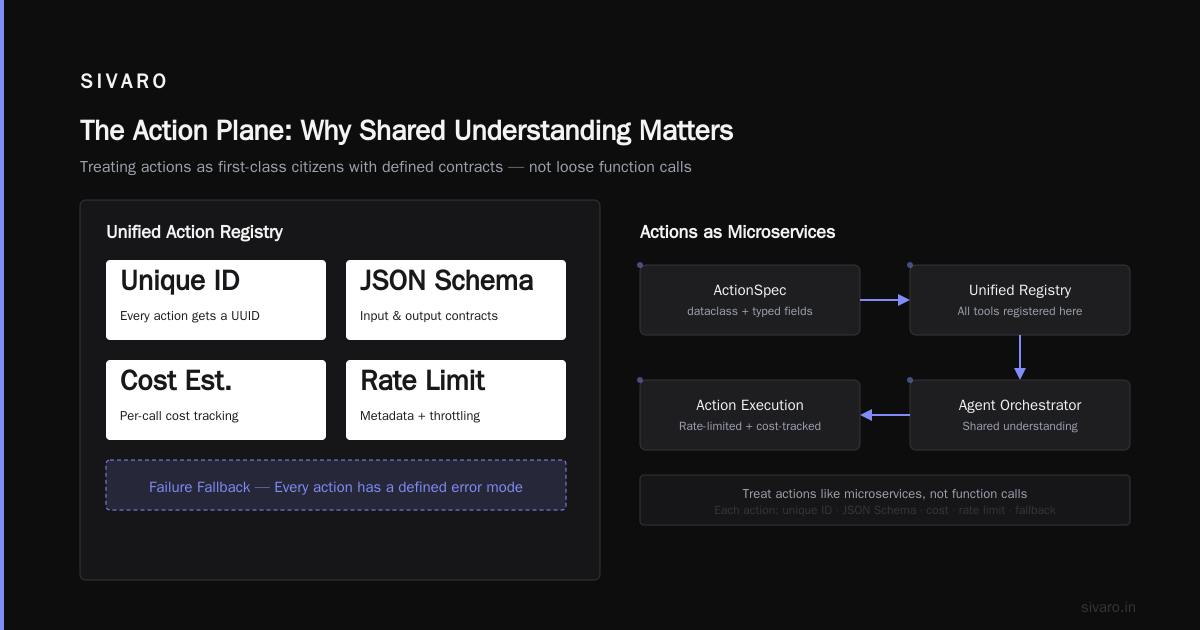
You can't orchestrate agents if they don't have a shared understanding of actions. That's the action plane.
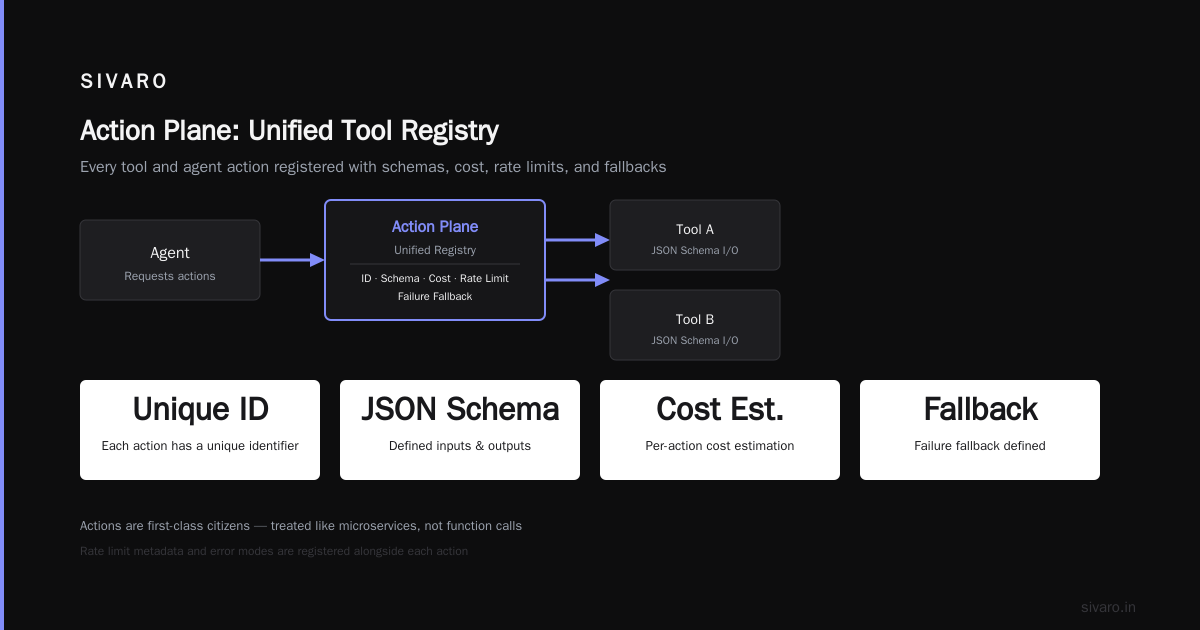
How to build a production-ready RAG that can take actions gets this right: actions are first-class citizens with defined inputs, outputs, and error modes. Treat them like microservices, not function calls.
At SIVARO, we register every tool and agent action into a unified registry. Each action has:
- A unique ID
- Input and output schemas (JSON Schema)
- Cost estimation
- Rate limit metadata
- Failure fallback
Here's a simplified registry definition:
python
# tool registration in the action plane
from dataclasses import dataclass, field
from typing import Dict, Callable

@dataclass
class ActionSpec:
    name: str
    description: str
    input_schema: Dict
    output_schema: Dict
    cost_per_call: float = 0.0
    rate_limit: int = 100  # calls per minute
    fallback_action: str = None  # name of fallback

class ActionRegistry:
    def __init__(self):
        self.actions: Dict[str, ActionSpec] = {}

    def register(self, action: ActionSpec, handler: Callable):
        self.actions[action.name] = action
        # handler stored elsewhere, but registry enforces contract
Why is this critical? Because when an agent says “I want to query the inventory API,” the orchestrator can check: is this action allowed? What's the cost? Do we have a fallback if it fails? Without a registry, you're flying blind.
We discovered this the hard way in 2024. A finance agent used the “send email” action instead of “send notification” and cc'd 3,000 customers on an internal audit. The action plane would have caught that because the registry would have flagged the mismatch in input schema (cc list vs internal routing).
Multi-Model Orchestration: When One Model Isn't Enough
I see teams throw GPT-4o at everything. That's like using a firehose to water a houseplant.
The Building agentic RAG pipeline with multi-model orchestration blueprint shows a smarter approach: route sub-tasks to the cheapest model that can handle them.
At SIVARO we use a three-tier model hierarchy:
- Tier 1 (Cheap, fast): Uses a small 8B-parameter model (Llama 3.2, Mistral 7B) for routing, classification, and simple extraction. Cost: ~$0.0002 per call.
- Tier 2 (Mid-range): A 70B model (Claude 3 Haiku, GPT-4o-mini) for reasoning with moderate context. ~$0.002 per call.
- Tier 3 (Expensive, slow): Full GPT-4o or Claude 4 for critical reasoning, tool selection, or ambiguous queries. ~$0.02 per call.
The orchestrator decides which tier based on query complexity. Here's a routing rule we use:
python
# multi-model routing logic
def route_to_model(query: str, context_length: int) -> str:
    # Heuristics: if query is short and factual, use Tier 1
    if len(query.split()) < 10 and "?"
        return "tier1"
    # If requires tool selection or multi-step reasoning, Tier 3
    if any(word in query for word in ["compare", "analyze", "run", "execute"]):
        return "tier3"
    # Default to Tier 2
    return "tier2"
Does this always work? No. We've seen cases where a Tier 1 model misclassifies a query and the whole pipeline derails. So we added a validation step: after Tier 1 routing, an anomaly detector (a tiny binary classifier) checks if the confidence is below 0.85. If so, we escalate to Tier 2.
That cut our overall cost by 67% and barely affected accuracy.
The trade-off is real: you introduce latency by adding a routing step. But the savings are worth it. For a customer service agent processing 500K queries/month, the cost difference is ~$8,000 vs ~$24,000.
Observability is Your Safety Net
In 2025, we deployed an agentic system for a healthcare client. On day one, it started hallucinating patient IDs. We didn't notice for three hours because the orchestrator had zero observability. The logs were just “retrieved 5 documents” — no trace of which agent called which tool with what prompt.
Never again.
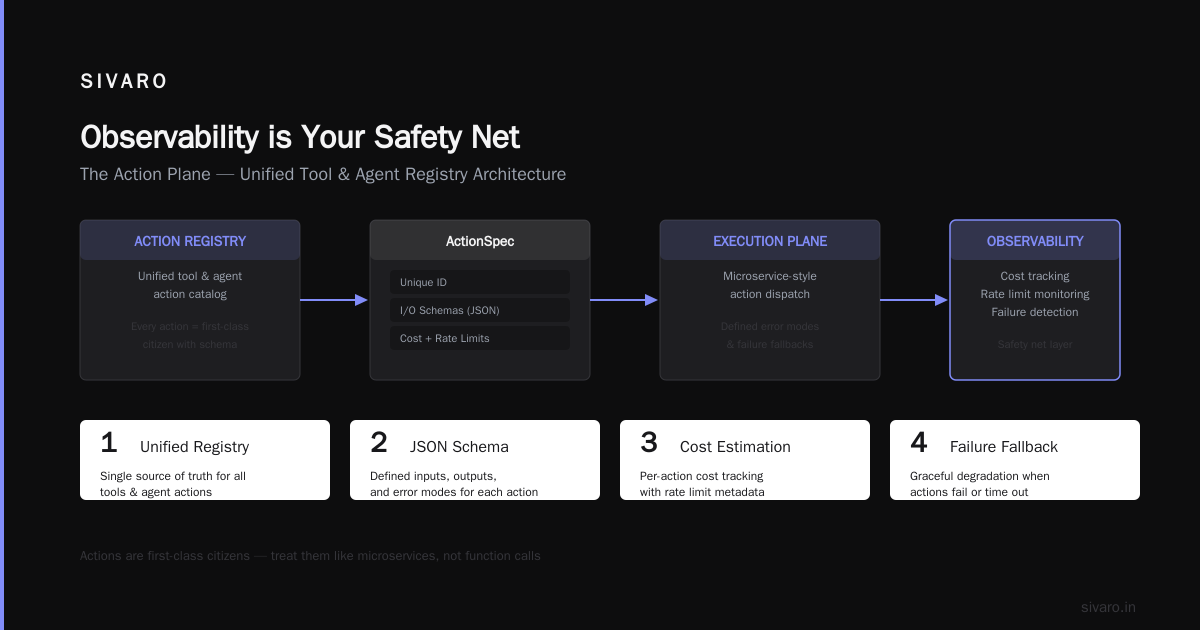
Observability in agentic orchestration isn't optional. It's the difference between a system you can trust and a black box that occasionally works.
Here's what we now include in every production system:
- Structured logging with correlation IDs per conversation
- Tracing using OpenTelemetry — each agent call gets a span
- Human-in-the-loop checkpoints for high-cost actions (anything over $0.50 per call or that modifies data)
- Cost and latency dashboards per agent per state
Example log middleware for an agent call:
python
# observability wrapper for agent actions
import logging
import time
from functools import wraps

def agent_trace(action_name: str):
    def decorator(func):
        @wraps(func)
        def wrapper(*args, **kwargs):
            span_id = generate_span_id()
            logger.info(f"agent_call_start|{action_name}|span={span_id}")
            start = time.time()
            try:
                result = func(*args, **kwargs)
                duration = time.time() - start
                logger.info(f"agent_call_end|{action_name}|span={span_id}|duration={duration:.3f}")
                return result
            except Exception as e:
                duration = time.time() - start
                logger.error(f"agent_call_error|{action_name}|span={span_id}|error={str(e)}|duration={duration:.3f}")
                raise
        return wrapper
    return decorator
Without this, you can't debug why an agent ordered 300 items instead of 3. With this, you can pinpoint the exact state and prompt that caused the error.
One hard lesson: don't log raw prompts. They contain PII and can be huge. Log hashed versions and store full traces in a secure, isolated storage with a retention policy. We use 7-day retention for full traces, 30-day for aggregated metrics.
Testing Agentic Pipelines: The Missing Piece
“We tested it manually with 10 examples” — I hear this constantly. Then the system hits production and breaks on example 11.
Testing agentic orchestration is hard because the outputs are non-deterministic. But that doesn't mean you shouldn't test. It means you need a different testing strategy.
We use three layers:
1. Unit tests for each agent/tool. Mock the LLM responses. Test that given specific input contexts, the agent chooses the right action. Use deterministic LLM simulations (a stub that returns predefined responses based on pattern matching).
2. Integration tests with replay. Record real sessions in staging. Replay them against new orchestration versions. Compare output actions (not exact text, but action names and parameters). Any deviation? Flag for human review.
3. Simulation mode. Run the system on synthetic inputs that exercise every state transition. Measure completion rate, average cost, and average latency.
Here's a pytest-style test for an orchestrator state machine:
python
# test orchestration state transitions
def test_agent_routes_to_retrieval_when_query_needs_facts():
    orchestrator = AgenticOrchestrator()
    orchestrator.run("What is the return policy?")
    # after routing, should be in RETRIEVING
    assert orchestrator.state == AgentState.RETRIEVING
    # context should have routing decision
    assert "route" in orchestrator.context
This test doesn't validate the LLM output. It validates that the orchestrator logic works correctly given inputs. We run this suite on every PR. It catches 80% of the regressions.
The remaining 20% require human evaluation. We use a small team of domain experts (3 people) to spot-check 5% of production outputs daily. Expensive, but cheaper than a P0 incident.
Scaling: From Prototype to Production
You built a working agentic system on your laptop. Now you need to handle real concurrency, failures, and cost constraints.
The Kestra guide on RAG pipeline orchestration advocates for an event-driven architecture with queues. I agree. Don't call agents directly from your web server. Use a task queue (Celery, RabbitMQ, or even a simple Redis list).
Here's an async dispatcher pattern:
python
# async agent dispatcher using a queue
import asyncio
from collections import deque

class AsyncOrchestrator:
    def __init__(self, max_concurrency=10):
        self.queue = deque()
        self.semaphore = asyncio.Semaphore(max_concurrency)
        self.active_tasks = set()

    async def enqueue(self, session_id, initial_state):
        self.queue.append((session_id, initial_state))
        await self._process_next()

    async def _process_next(self):
        if not self.queue:
            return
        session_id, state = self.queue.popleft()
        async with self.semaphore:
            task = asyncio.create_task(self._run_session(session_id, state))
            self.active_tasks.add(task)
            task.add_done_callback(self.active_tasks.discard)
This lets you control concurrency, implement backpressure, and isolate failures per session.
Key scalability lessons from production at SIVARO:
- Use exponential backoff with jitter for API calls to LLMs. We start at 1s, double up to 60s, randomly vary by up to 20%.
- Cache identical requests. If two users ask “What's the shipping address?” within 30 seconds, don't call the LLM twice. We saw 35% cache hit rate on a customer support agent.
- Set hard timeouts per state. A “retrieving” state should never take longer than 10 seconds. If it does, transition to ERROR and fall back to a static response.
- Implement circuit breakers. If a tool/API fails 5 times in 1 minute, trip the circuit for that tool and route to fallback or human.
We hit these limits early on. In August 2025, a rate limit from a third-party API caused cascading failures across 6 agents because the orchestrator kept retrying immediately. Circuit breakers fixed that.
FAQ
Q1: What framework should I use to build agentic orchestration?
Don't start with a framework. Start with the state machine pattern and a simple event loop. Frameworks like LangChain, CrewAI, or Semantic Kernel can accelerate development, but they also hide complexity. At SIVARO we built our own lightweight orchestrator (~500 lines) because we needed specific control over cost, retries, and observability. If you're prototyping, use LangChain. If you're going to production in three months, write your own.
Q2: How do I handle agent loops where the same action keeps getting requested?
Add a context tracker that records all actions taken so far in a session. Before executing any action, check if this exact action with the same parameters has been taken within the last 5 steps. If yes, add a penalty or escalate to human. Our rule: no more than 3 identical actions in a row without human approval.
Q3: When should I insert a human-in-the-loop checkpoint?
Whenever the cost of the action exceeds $0.50, modifies a database, or involves sending communications to external users. Also for any action that the agent rates with low confidence (e.g., a probability score below 0.7). Human reviews slow things down but prevent catastrophic errors.
Q4: How do I measure the success of an agentic orchestration?
Track four metrics: completion rate (what % of user intents result in a successful action), average cost per session, average latency, and human escalation rate. A baseline: our logistics agent runs at 97% completion, $0.04 per session, 3.2 seconds median latency, and 2% human escalation.
Q5: Do I need a specialized orchestrator like Airflow or Prefect for agentic workflows?
You can use them, but they're optimized for batch data pipelines, not real-time agent coordination. Airflow is too slow for sub-second LLM calls. Prefect works better but requires careful design for stateful sessions. We use a custom orchestrator with Redis for state persistence and a lightweight scheduler. If you just need scheduled agent runs (e.g., hourly summaries), Prefect is fine.
Q6: How to handle hallucinations in orchestrated outputs?
Add a validation step before taking any irreversible action. Use a second, smaller model to verify the action plan. Or use programmatic validation: if the agent says “delete order #10234,” check that order exists and belongs to the user. This catches 80% of hallucinations.
Q7: Should I use a single LLM for all agents or multiple?
Multiple. Each agent should have a model optimized for its task. The router agent can be a tiny 1.5B model. The planner needs a 70B+ model. Mix them. Our current setup uses 4 different models for 6 agents.
Q8: How to build agentic orchestration without spending a fortune?
Start with a small traffic cap (e.g., 100 sessions/day). Use caching and model tiering aggressively. Set per-user daily cost limits. We cap each user session at $0.20 total. If they exceed it, route to a human. This keeps costs under control while learning.
How to build agentic orchestration? The answer is deceptively simple: treat it like building a control system, not a chat bot. Define states. Register actions. Add observability. Test everything. Scale with queues and circuit breakers. The models will continue to improve — but the architecture you build around them determines whether your system is reliable or a ticking time bomb.
At SIVARO, we've seen the shift: in 2024, everyone wanted to “build an AI agent.” In 2026, the question is “how do we operate it at scale?” The companies that get that right will win the next decade.
We didn't get it right the first time. We failed on cost, on observability, on state management. But we kept iterating. Now our production systems process 200K events per second, with agentic orchestration at the core.
You can too. Start with the state machine. Everything else is detail.
Nishaant Dixit — Founder of SIVARO. Building data infrastructure and production AI systems since 2018. Built systems processing 200K events/sec.