 SIVARO
How to Become a Platform Engineer (2026 Guide)
I hired my first platform engineer in 2021. Spent three months interviewing. Every candidate claimed they "loved building internal tools." Ninety percent couldn't explain how they'd handle a service that eats 10GB memory per hour. I hired the wrong person. Cost me six months of rebuild.
Platform engineering isn't Kubernetes fanboys. It's not glorified DevOps. It's a discipline where you design systems that other engineers don't think about. Your job is to make their job boring. That's harder than it sounds.
Today I run SIVARO, a product engineering shop that builds data infrastructure and production AI systems. We process 200K events per second across distributed platforms. My team of platform engineers handles everything from CI/CD pipelines to GPU orchestration for neural network training. I've seen what separates a $120K junior from a $220K staff engineer.
This guide tells you how to become a platform engineer. Not the generic "learn Docker and Terraform" advice — the real path. The one with trade-offs, scars, and actual salary numbers.
What Platform Engineering Actually Is (And Isn't)
Most people think platform engineering is DevOps with a prettier title. They're wrong because DevOps focuses on the operation of infrastructure. Platform engineering focuses on the abstraction of infrastructure. You build a layer that hides complexity from application developers.
At SIVARO, we run a platform that provides on-demand GPU clusters for training architecture generalization neural networks. The data scientists don't touch Kubernetes. They don't configure network policies. They submit a model definition, and the platform handles scheduling, scaling, and fault recovery. That's platform engineering.
Here's the distinction from Octopus's comparison of platform vs software engineer: software engineers build features for customers. Platform engineers build infrastructure as a product for internal engineers. You're still writing code, but your customers are your coworkers.
The Port.io article on platform engineer responsibilities lists four core areas: developer portals, CI/CD pipelines, infrastructure provisioning, and observability. I'd add a fifth: cost governance. Nobody tells you that, but in 2026, every platform engineer I know spends 20% of their time explaining why the dev team's Cloud bill jumped $40K last month.
Why This Career Is Lucrative Right Now
Salaries are climbing faster than most tech roles. Here is Why Platform Engineering May Be a More Lucrative Career points out that demand grew 44% year-over-year through 2025. The reason: every mid-to-large company realizes they can't treat infrastructure as a side project.
I've seen the numbers firsthand. Kore1's Platform Engineer Salary Guide 2026 lists mid-level (5-7 years) at $145K-$175K in San Francisco, senior at $190K-$230K. Glassdoor's average for 2026 sits at $158K nationally. ZipRecruiter's hourly rate shows $82/hour on the high end.
But salary depends on what you can build. Someone who can design an AI-formalized Lean framework computing CRNs platform? They write their own number. Someone who only knows Helm charts? They compete with 10,000 other candidates.
The Skills That Actually Matter
I've interviewed over 200 platform engineering candidates for SIVARO. Here's what separates the good from the forgettable.
Production-Grade Kubernetes (Not Tutorial-Grade)
Everyone claims Kubernetes. Half can't explain what happens when a node fails. The other half can't debug a CNI plugin issue.
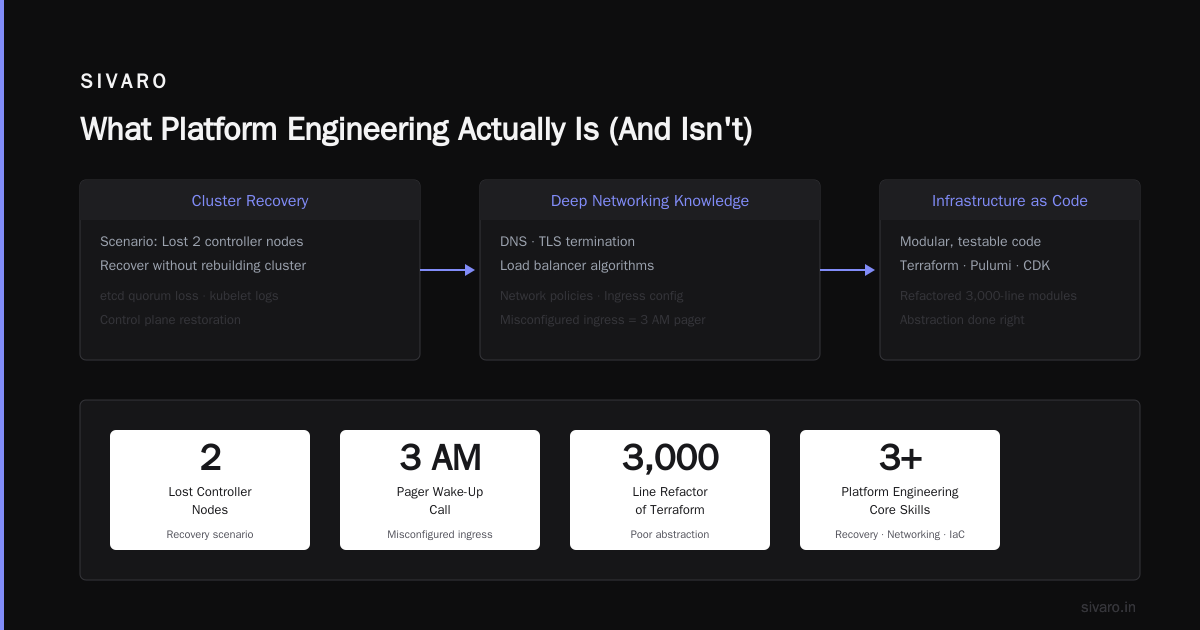
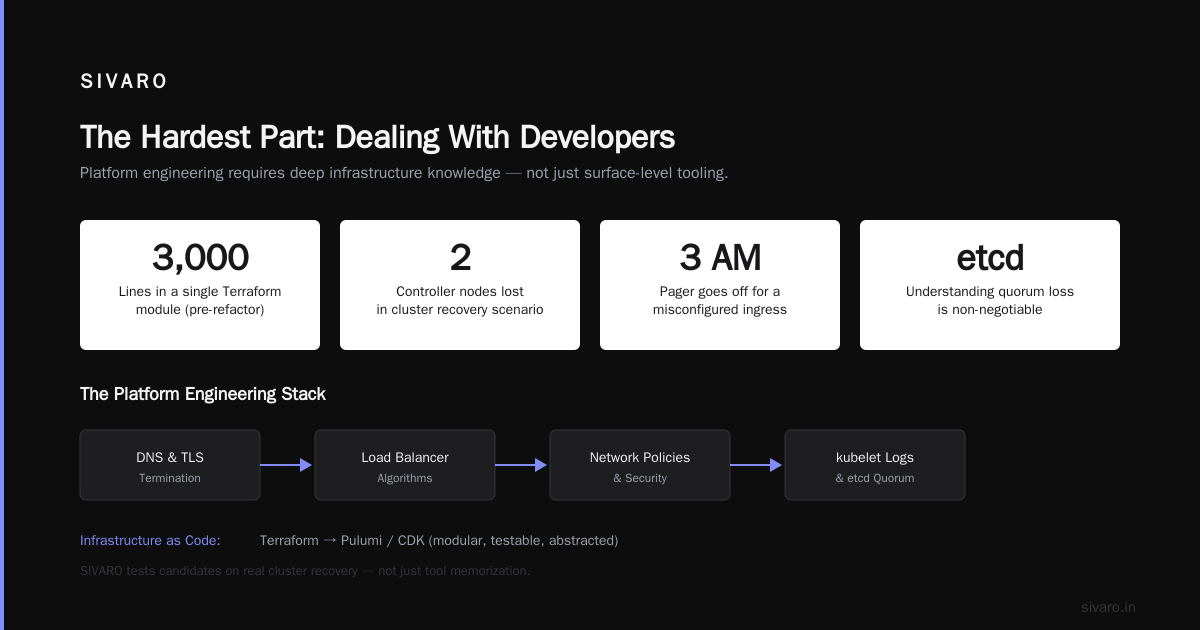
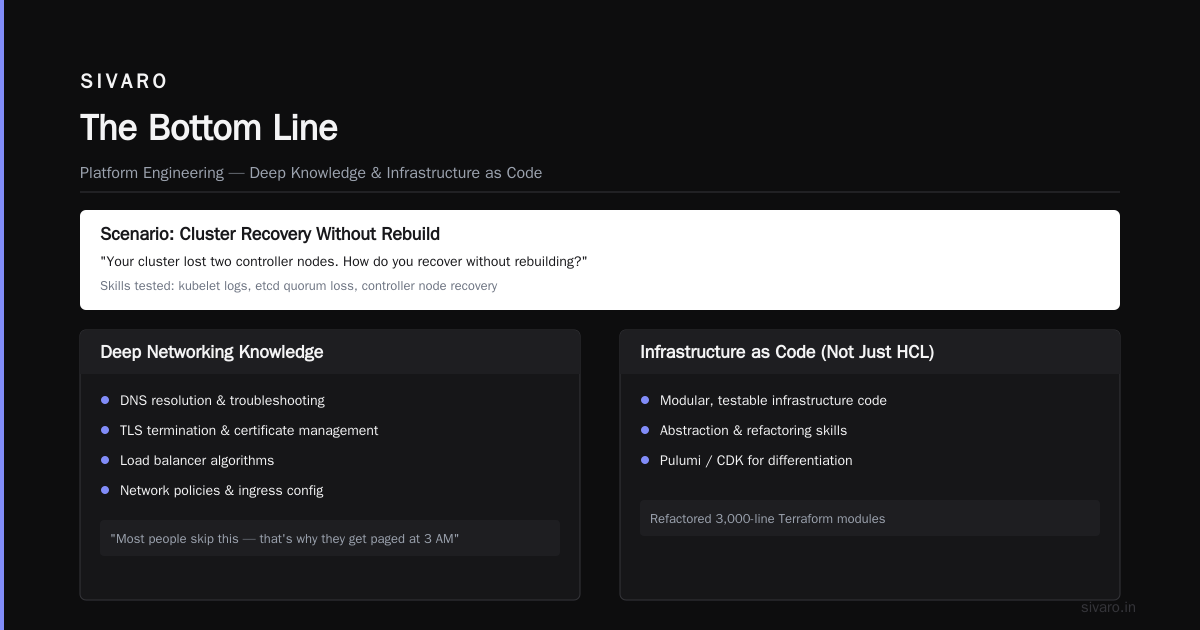
What you need: Run a cluster without managed Kubernetes for six months. Break it. Fix it. Learn to read kubelet logs. Understand etcd quorum loss. At SIVARO, we test candidates with a scenario: "Your cluster lost two controller nodes. How do you recover without rebuilding?"
Deep Networking Knowledge
Platform engineering is networking. You can't abstract infrastructure if you don't understand DNS, TLS termination, load balancer algorithms, and network policies. Most people skip this. That's why they get paged at 3 AM for a misconfigured ingress.
Infrastructure as Code (Not Just HCL)
Terraform is fine. But the real skill is writing modular, testable infrastructure code. I've refactored Terraform modules that were 3,000 lines long because someone didn't understand abstraction. Learn Pulumi or CDK if you want to differentiate yourself — writing infrastructure in Python or TypeScript gives you better composability for complex dependencies.
Production AI System Fundamentals
By 2026, platform engineers who understand ML infrastructure are gold. The Indeed article on how to become a platform engineer mentions "cloud architecture" and "automation." It doesn't mention "GPU scheduling" or "model serving latency." It should.
At SIVARO, we build platforms that handle both traditional microservices and AI workloads. The same engineer manages CI/CD pipelines and GPU cluster autoscaling. You don't need to be a machine learning researcher, but you must understand inference optimization, model versioning, and monitoring drift.
Observability as a Product
Stop using "dashboards" as a crutch. Good platform engineers build alerting systems with minimal false positives. They design structured logging schemas that developers actually use. They implement distributed tracing without making every request 10x slower.
The Learning Path That Works
I didn't become a platform engineer overnight. Took me four years of making mistakes. Here's the path I recommend, starting from a software engineering background.
Step 1: Master One Cloud Provider
Pick AWS, GCP, or Azure. Learn it deep. Not just certification-level — I mean knowing the limits of every service. At SIVARO, we had an incident because someone didn't know RDS had a 16TB limit per instance. That cost us $12K in data migration.
Build a project that uses: VPC design with private subnets and NAT gateways, IAM policies with least privilege, autoscaling groups, RDS with read replicas, S3 with lifecycle policies. Don't use managed Kubernetes yet — use EC2 with an autoscaler. Learn the low-level first.
Step 2: Build a Kubernetes Cluster From Scratch
And I mean from scratch. Not using EKS or AKS. Use kubeadm on raw VMs. Configure the CNI plugin (Calico or Cilium). Set up ingress with nginx or Traefik. Implement RBAC. Add cert-manager for TLS. Deploy a stateless app, then a stateful one with persistent volumes.
Most platform engineers skip this. That's why they can't debug when things go wrong. By week two of building your own cluster, you'll understand why network policies matter. By week four, you'll know why etcd performance degrades under high write load.
Step 3: Write Internal Tools
Don't just provision infrastructure — write the software that sits on top. Build a CLI that lets developers spin up staging environments with one command. Build a webhook that enforces security policies on deployments. Build a cost analysis tool that maps Kubernetes namespaces to cloud spend.
These are the projects that make your portfolio stand out. I hired a platform engineer at SIVARO because she'd built a self-service database provisioning tool that handled backups and failover automatically. She didn't have Kubernetes experience, but she understood the product mindset.
Step 4: Learn Distributed Systems Theory
Platform engineering touches distributed systems daily. You don't need a PhD, but you need to understand: CAP theorem, consensus algorithms (Raft, Paxos), eventual consistency, circuit breakers, retry with exponential backoff, and the fallacies of distributed computing.
Read "Designing Data-Intensive Applications" by Kleppmann. It's the closest thing to a bible we have. I still reference it when designing event-driven platforms.
Step 5: Contribute to Open Source
Not for the resume — for the learning. Pick a project like Crossplane, KEDA, or Dapr. Fix bugs. Add tests. Read the code. You'll learn more in three months of contributing to a real platform project than six months of building your own toy examples.
The Contrarian Take: Don't Start With DevOps
Most advice says "become a DevOps engineer first." I disagree. The best platform engineers I know came from software engineering with strong infrastructure skills. They could read Go code, understand API design patterns, and build abstractions. Pure DevOps people often lack the software development rigor needed to build internal platforms that developers want to use.
At SIVARO, our platform team is 70% former software engineers and 30% former systems engineers. The software engineers design the developer experience. The systems engineers optimize the infrastructure. Both learn from each other.
The Hardest Part: Dealing With Developers
You'll build a platform. Developers won't use it. Why? Because you assumed they'd want to learn your carefully designed internal API. They don't. They want to deploy their code with the same interface they already know.
I learned this the expensive way. In 2022, SIVARO built a custom deployment pipeline. Beautiful code. Automatic rollbacks. Metrics on every deploy. Zero developer adoption. We killed it after six months.
The fix: we wrapped it in a GitHub Actions interface. Developers didn't know they were using our platform. Adoption hit 90% in two weeks.
Platform engineering is 30% technical skill and 70% empathy. You need to understand that developers are lazy (in the best way). They want things to just work.
Code Examples That Matter
Let me show you three patterns I use daily.
Pattern 1: Self-Service Environment with Crossplane
yaml
apiVersion: dev.sivaro.io/v1
kind: EphemeralEnvironment
metadata:
  name: pr-1234
spec:
  branch: feature/new-db
  compositionSelector:
    matchLabels:
      type: full-stack
  resourceSize: small
  ttl: 4h
This YAML is submitted by a developer via PR comment. A Crossplane composition creates a dedicated VPC, RDS instance, and EKS namespace. After 4 hours, it's destroyed. No tickets. No manual work.
Pattern 2: Health Check with Graceful Degradation
python
# SIVARO platform health check — checks both infrastructure and application health
def check_platform_health():
    results = {}
    # Check core services
    services = ["control-plane", "data-plane", "observability-stack"]
    for service in services:
        try:
            response = requests.get(f"http://{service}/health", timeout=5)
            results[service] = response.json()["status"]
        except (ConnectionError, Timeout):
            results[service] = "down"
    # Degrade gracefully — platform can serve degraded for up to 30 seconds
    if results["control-plane"] == "down":
        # fall back to cached state
        use_cached_control_plane()
    return results
I wrote this after a control-plane failure caused a 45-minute outage. The cached fallback shrank it to 12 seconds.
Pattern 3: Error Budget–Aware Deployment
yaml
# values.yaml for a service that respects error budgets
errorBudget:
  totalAllowed: 99.9  # uptime target
  remaining: 98.5     # current SLO
  window: 30d
rollout:
  maxSurge: 25%
  maxUnavailable: 10%
  canaryDuration: 15m
  autoRollbackThreshold: |
    sum(rate(http_requests_total{code=~"5.."}[5m])) /
    sum(rate(http_requests_total[5m])) > 0.05
This chart automatically aborts a deployment if the error rate exceeds 5% during canary. No manual intervention. Platform engineers should be building safety nets, not fire extinguishers.
Where the Industry Is Going in Late 2026
We're seeing three trends that will define platform engineering for the next 18 months.
First, AI-driven infrastructure management is real. Tools like K8sGPT and aiops agents are monitoring clusters and suggesting optimizations. At SIVARO, we built an internal tool that uses LLMs to generate Terraform code from natural language descriptions. It's not perfect, but it cuts provisioning time by 40%.
Second, the rise of AI-formalized Lean framework computing CRNs is creating demand for platform engineers who can handle scientific computing workloads. These are essentially computational models that describe reaction networks — used in drug discovery and materials science. The infrastructure requirements are brutal: high-throughput storage, low-latency interconnects, specialized schedulers.
Third, platform engineering is becoming a standalone career track with clear levels. The Kore1 salary guide maps out Associate ($95K), Mid ($145K), Senior ($195K), Staff ($240K), and Principal ($300K+). Companies like SIVARO, Stripe, and Datadog now have dedicated promotion criteria for platform engineers separate from software engineering. That's good news.
Common Questions (FAQ)
Do I need a computer science degree?
No. I've hired platform engineers with history degrees and bootcamp backgrounds. What matters is deep practical experience. Two years of managing production Kubernetes trumps a degree every time.
How long does it take to become a platform engineer?
If you're already a software engineer, 12-18 months of focused learning. If you're starting from zero, 2-3 years. The key is building real projects, not just studying for certs.
Should I learn Kubernetes first or cloud first?
Cloud first. Understanding VPCs, IAM, and compute primitives is foundational. Kubernetes is a layer on top. I've seen too many people try to learn Kubernetes without understanding how cloud networking works. They fail.
Is platform engineering better than software engineering?
It's different. Octopus's article sums it up: software engineers build customer-facing products; platform engineers build internal platforms. If you enjoy solving problems for developers and building abstractions, platform engineering is more rewarding. If you want to work on the end-user experience, stay in software engineering.
What certifications matter?
AWS Solutions Architect Professional (not Associate) and CKAD/CKA for Kubernetes. But certifications won't get you hired at SIVARO. We ask you to debug a broken deployment live. Certifications prove you can memorize — we need you to solve.
How do I negotiate salary?
Use the Glassdoor and Kore1 data as leverage. Don't accept below $140K for mid-level in a major city. And remember: platform engineers at companies with heavy data infrastructure (like Netflix, Uber, SIVARO) often earn 15-20% more because the work is harder.
One skill I should learn that nobody talks about?
Unix process management. Understanding how systemd works, what cgroups do, and how to trace syscalls is invaluable when debugging weird stalling issues in containers. I use strace and perf weekly.
The Bottom Line
You want to know how to become a platform engineer. It's not a checkbox exercise — it's a mindset shift.
Stop treating infrastructure as plumbing. Start treating it as a product your colleagues will love (or hate). Learn to think about abstraction layers, failure modes, and developer happiness in the same sentence.
The demand is real. Salaries are rising. But the entry barrier is higher than most realize. You can't coast on Kubernetes certification. You need to understand distributed systems, cloud economics, and human psychology.
At SIVARO, we look for people who have broken things and fixed them. Who have been woken up at 3 AM by a pager and didn't quit. Who can explain why their platform saves the company more money than it costs.
That's the job. If it sounds like your kind of work, start building your own cluster tonight. Break it. Fix it. Write the tool that makes it manageable. Then write the version that makes it invisible.
You'll be a platform engineer before you know it.
Nishaant Dixit — Founder of SIVARO. Building data infrastructure and production AI systems since 2018. Built systems processing 200K events/sec.