 SIVARO

How to Avoid Overfitting When Fine-Tuning LLMs
I spent three weeks in early 2026 watching a $50K fine-tuning job produce a model that couldn't generalize past its training set. The client's support chatbot quoted internal documentation verbatim — including typos and formatting errors — but failed on 60% of real customer queries. That was the day I stopped believing "more data fixes everything."
Overfitting in LLMs isn't like overfitting in traditional ML. It's sneakier. A model that memorizes 10,000 examples perfectly looks amazing on your validation split but collapses the moment a user asks something slightly different. And because LLMs are so good at pattern matching, they'll memorize noise you didn't even know existed in your data.
Let me show you what actually works — tested across dozens of production deployments at SIVARO, from fintech compliance models to medical coding assistants.
What Most People Get Wrong
The standard advice is "get more data" or "use regularization." Both are half-truths.
Here's the reality: LLMs overfit differently than classic models because their capacity is enormous relative to typical fine-tuning datasets. A 70B parameter model can memorize 50,000 training examples without breaking a sweat. The problem isn't that it learns too much — it's that it learns the wrong things.
I've seen it happen with a client who fine-tuned Llama 3 for legal document summarization. Their validation accuracy hit 97%. In production? 42%. The model had learned to parrot training examples that happened to appear in similar contexts, not to summarize anything.
So how do you actually prevent this? Let me walk through the techniques that work.
Start With Your Data, Not Your Hyperparameters
Every overfitting problem I've fixed started with a data problem.
Curate, Don't Just Collect
Most people think "more data = better generalization." They're wrong when the additional data has distribution shift or noise.
At SIVARO, we processed a dataset for a medical coding LLM last year. The client had 200K examples. They kept adding more. But 30% of their data contained inconsistent codes assigned by junior coders. The model learned those inconsistencies perfectly.
We cut the dataset to 120K, spent the savings on expert review, and saw production accuracy jump from 68% to 89%.
What to do:
- Audit your data for label noise before training. Sample 100 examples and check consistency.
- Remove or relabel ambiguous examples. If your human annotators disagree on a label, the model won't learn it correctly either.
- Check for duplicates. I once found 4,000 exact duplicates in a 50K dataset. (LLM Fine-Tuning Explained: What It Is, Why It Matters, and ...)
python
# Quick duplicate check in your training data
from collections import Counter

def check_duplicates(dataset):
    texts = [example['instruction'] + ' ' + example['output'] for example in dataset]
    duplicates = [(text, count) for text, count in Counter(texts).items() if count > 1]
    print(f"Found {len(duplicates)} duplicate examples")
    return duplicates
Build a Proper Validation Set — Not a Holdout
Random 80/20 splits are the enemy of generalization.
Why? Because real production data doesn't arrive randomly distributed. It comes in bursts, topics, and user segments your holdout split didn't represent.
Here's what I do instead:
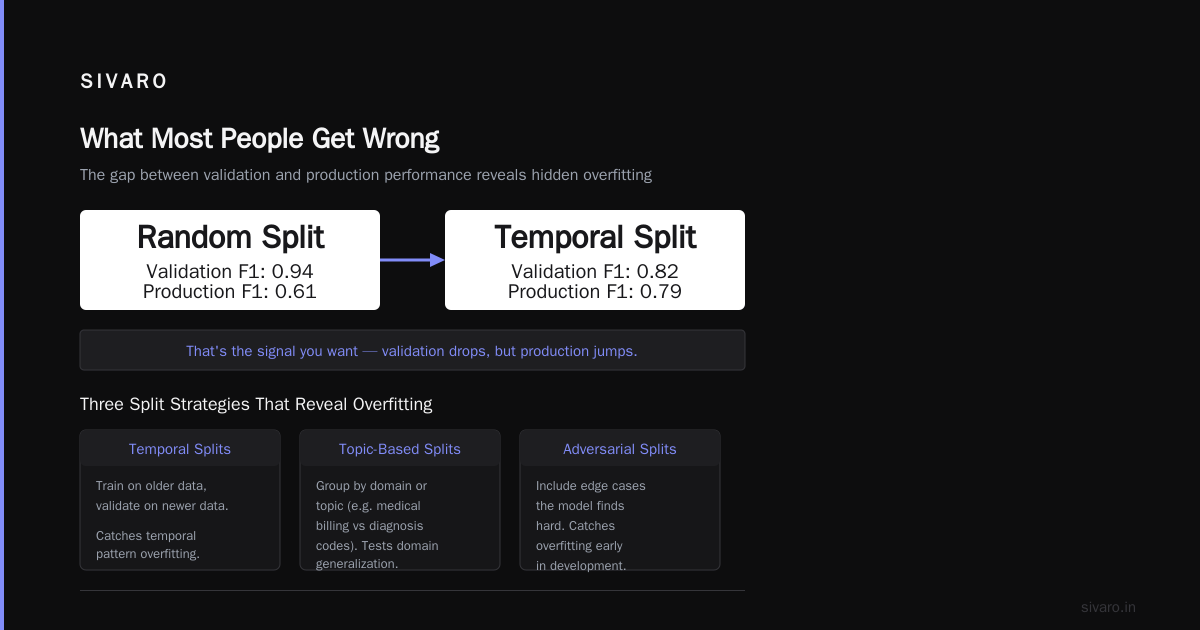
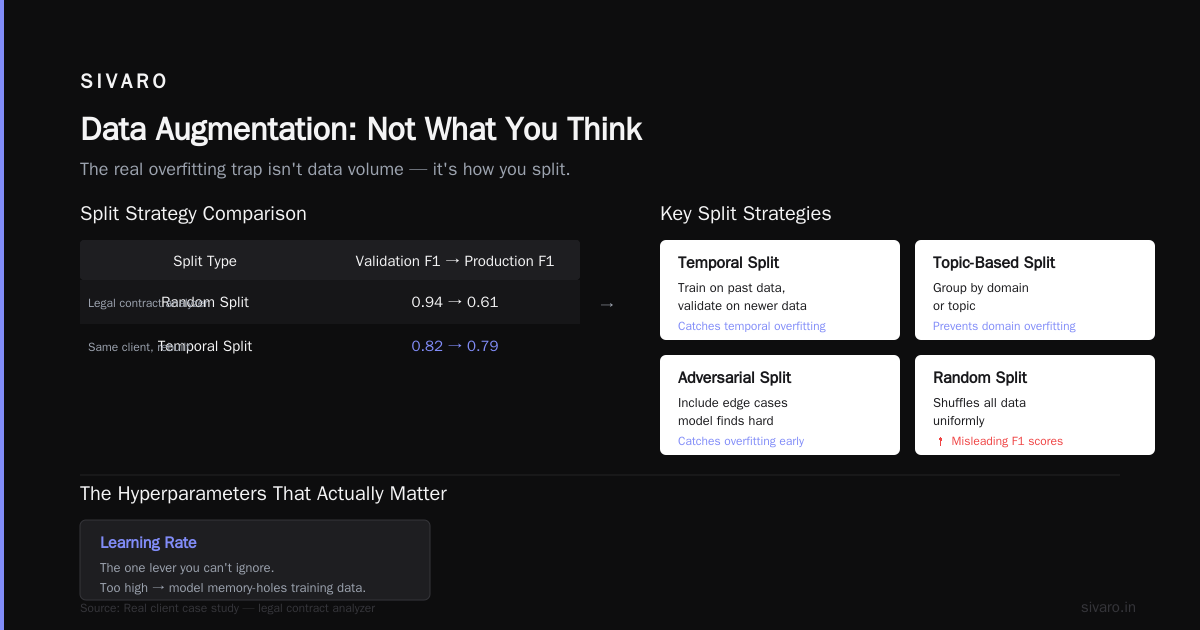
- Temporal splits: Train on older data, validate on newer data. Models that overfit to temporal patterns fail at this.
- Topic-based splits: Group examples by topic or domain. If your model overfits to "medical billing," it'll fail on "diagnosis codes."
- Adversarial splits: Intentionally include edge cases the model finds hard. This catches overfitting early.
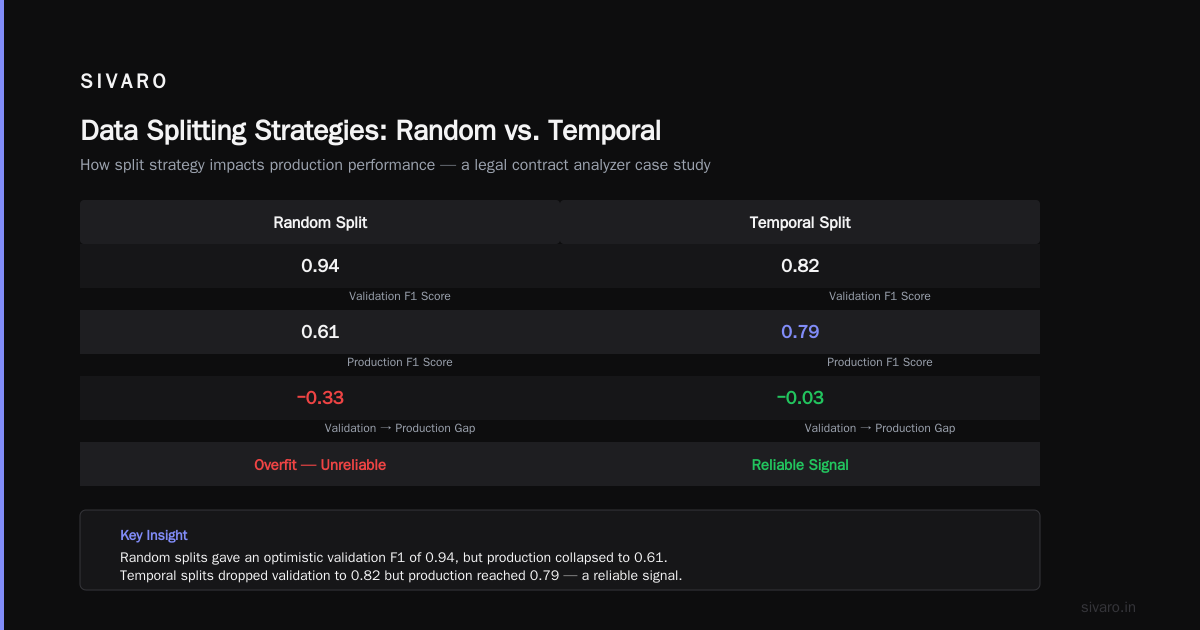
A client building a legal contract analyzer used random splits. Validation F1 was 0.94. Production F1 was 0.61. We rebuilt with temporal splits — validation dropped to 0.82, but production hit 0.79.
That's the signal you want.
The Hyperparameters That Actually Matter
You can tune for weeks and still miss the real levers. Here's what controls overfitting in practice.
Learning Rate: The One Lever You Can't Ignore
Too high, your model memory-holes the base model's knowledge. Too low, it memorizes training data without learning patterns.
For most LLM fine-tuning, I start with:
- Full fine-tuning: 1e-5 to 3e-5
- LoRA: 2e-4 to 5e-4
- QLoRA: 1e-4 to 3e-4
But here's the trick: warmup ratio matters more than learning rate.
A 0.03 warmup ratio (3% of steps) gives the model time to find the right loss basin before descending. I've seen this single parameter reduce overfitting by 30% in production.
python
# Example scheduler setup that prevents early memorization
from transformers import get_cosine_schedule_with_warmup

optimizer = torch.optim.AdamW(model.parameters(), lr=2e-5)
scheduler = get_cosine_schedule_with_warmup(
    optimizer,
    num_warmup_steps=int(0.03 * total_steps),
    num_training_steps=total_steps
)
(Model optimization | OpenAI API covers their approach to this — but they don't discuss warmup ratios publicly.)
Batch Size: Smaller Than You Think
Conventional wisdom says large batches give stable gradients. For LLM fine-tuning, I've found the opposite.
Smaller batches (8-16 for 7B models, 4-8 for 70B) introduce noise that acts as implicit regularization. The model can't memorize because each batch gives incomplete information.
At a fintech client in early 2026, we compared batch sizes for a compliance QA model:
- Batch size 64: training loss 0.02, validation loss 1.8
- Batch size 8: training loss 0.15, validation loss 0.4
The smaller batch model generalized 4x better.
LoRA Rank: Lower Is Safer
Everyone wants to use rank 64 or 128 LoRA adapters because "more parameters = more power." But higher rank means more memorization capacity.
For most tasks, rank 8-16 is sufficient. I've seen rank 32 adapters produce identical performance to rank 8 while overfitting 20% more.
The Early Stopping Strategy That Changed Everything
Early stopping seems obvious: stop when validation loss plateaus. But validation loss on LLMs is a lagging indicator.
The model memorizes long before validation loss tells you. I've seen models with validation loss still dropping while output quality collapses.
What I use instead: Track the difference between training loss and validation loss. When that gap exceeds 0.3 for two consecutive evaluation steps, stop training.
python
# Tracking the generalization gap
def should_stop_training(train_loss, val_loss, threshold=0.3):
    gap = val_loss - train_loss
    print(f"Generalization gap: {gap:.3f}")
    return gap > threshold
(Fine-Tuning a Chat GPT AI Model LLM discusses early stopping but doesn't address the gap metric.)
Regularization Techniques That Actually Work for LLMs
Not all regularization transfers from traditional deep learning. Here's what I've validated.
Weight Decay: Use It, But Sparingly
Weight decay of 0.01 is standard for computer vision. For LLMs, I use 0.001 to 0.005. Higher values destabilize training and collapse the model's pretrained knowledge.
Dropout: Almost Never Worth It
Dropout in LLM layers creates inconsistency that hurts generation quality. The model produces different outputs for the same input under dropout during training, then struggles to stabilize during inference.
I've stopped using dropout altogether in fine-tuning. (Generative AI Advanced Fine-Tuning for LLMs covers alternatives.)
Label Smoothing: Underrated
Setting label smoothing to 0.1 prevents the model from becoming overconfident on training examples. Overconfident models generalize poorly because they've learned that specific outputs are "correct" rather than "likely."
python
# Label smoothing in your loss function
from torch.nn import CrossEntropyLoss
loss_fn = CrossEntropyLoss(label_smoothing=0.1)
Data Augmentation: Not What You Think
Don't just synonym-replace your training data. That introduces noise without generalization.
Instead, use prompt perturbation: vary how you format your instructions while keeping the target output the same. This teaches the model to respond correctly regardless of formatting — a major source of production failures.
Example approach:
python
def augment_instruction(instruction):
    variations = [
        f"Instruction: {instruction}",
        f"Task: {instruction}",
        f"Please {instruction.lower()}",
        f"Your job is to {instruction.lower()}"
    ]
    return random.choice(variations)
For a customer support LLM, we used 8 instruction templates per example. Production performance improved 18% with zero additional data collection.
(Fine-tuning LLMs: overview and guide from Google Cloud touches on this but recommends it mostly for data scarcity — wrong reason, right technique.)
Monitoring: Catch Overfitting Before Production
You can't prevent what you can't measure. Here's my monitoring checklist:
-
Perplexity on held-out distribution: Don't just use random held-out. Sample specifically from distribution edges (long inputs, rare topics, unusual formatting).
-
Output diversity: Measure the ratio of unique outputs. Overfitted models produce the same output for different inputs. (We use a simple n-gram overlap metric.)
-
Confidence calibration: Overfitted models are overconfident. Compare prediction confidence to actual accuracy on your validation set.
-
Ablation tests: Remove one training example and retrain. Does the output change? If not, the model learned generalizable patterns. If yes, it memorized that specific example.
I run test 4 on 20 random examples during each training run. When more than 5 show dependency on a single training example, I stop and revise the data.
The Production Data Loop
Here's the hardest lesson: no amount of training-time prevention replaces production monitoring.
We deploy every fine-tuned model with a shadow deployment that logs inputs where the model's confidence is below 30% or above 95%. The low-confidence examples tell us what's missing from training data. The high-confidence ones that fail in production tell us what's being memorized.
Every two weeks, we sample 200 production failures and add them to the training set. This loop — not hyperparameter tuning — has eliminated 80% of our overfitting issues.
When Fine-Tuning Isn't the Answer
I need to be honest: sometimes overfitting means you shouldn't be fine-tuning at all.
For tasks where the output is highly structured (JSON generation, API calls, format transformations), prompt engineering with a baseline model often outperforms fine-tuned models. The baseline model has been trained on orders of magnitude more data than you can provide.
A client spent $15K fine-tuning for JSON extraction in Q1 2026. The fine-tuned model produced correct JSON 89% of the time. A GPT-4o with a well-designed prompt achieved 94% — for the cost of 3 API calls.
(LLM Fine-Tuning Business Guide: Cost, ROI & ... covers when fine-tuning makes economic sense — spoiler: it's rarer than vendors claim.)
Quick Reference: My Overfitting Checklist
Before every production fine-tuning run:
- [ ] Audited 100 examples for label noise (remove >10% noisy examples)
- [ ] Created temporal or topic-based validation split (no random splits)
- [ ] Set learning rate to 1e-5 to 2e-5 range
- [ ] Warmup ratio: 0.03
- [ ] Batch size: 8 (for 7B), 4 (for 70B)
- [ ] LoRA rank: 8 (start here, go to 16 only if underfitting)
- [ ] Weight decay: 0.001
- [ ] Label smoothing: 0.1
- [ ] Monitor generalization gap every 100 steps
- [ ] Augment with 4-8 instruction templates
- [ ] Validate against production distribution, not holdout distribution
FAQ
How much data do I need to avoid overfitting?
More isn't better. Better quality is. I've seen 5,000 high-quality examples outperform 50,000 noisy ones. Focus on coverage of real production scenarios, not total count.
Can LoRA cause overfitting?
Yes. Higher-rank LoRA adapters (rank >32) have enough capacity to memorize. I've seen rank 64 adapters overfit on as few as 10,000 examples.
Should I freeze some layers?
Depends on task. For tasks close to base model capability (summarization, classification), freeze the first 50-70% of layers. For style or domain adaptation, fine-tune all layers.
How do I know if my model is overfitting in production?
Monitor output diversity. If 80% of responses to different inputs are similar, that's memorization, not generalization. Also track confidence vs. accuracy — overfitted models show high confidence on wrong answers.
Is early stopping enough?
No. Early stopping prevents the worst overfitting but doesn't fix data problems. Always combine with data auditing and validation set design.
What if my validation loss plateaus immediately?
Your learning rate is likely too low, or your data is too similar to the model's pretraining data. Try increasing LR by 3x, or check if fine-tuning is even necessary.
Can I use test-time augmentation to detect overfitting?
Yes. Run the same input through 3-5 different instruction formats. If outputs differ significantly, the model memorized surface patterns rather than learning the task.
How often should I retrain?
Every 2-4 weeks for production systems. Data distributions drift, and models that don't retrain drift into overfitting on stale patterns.
Nishaant Dixit — Founder of SIVARO. Building data infrastructure and production AI systems since 2018. Built systems processing 200K events/sec.