 SIVARO
How Much Is a GPU Cluster? The Real Cost of Production AI Infrastructure in 2026
You ask "how much is a GPU cluster?" and I'll give you a number. But the number will be wrong. Not because I'm dodging — because the range is wider than most people realize. I've seen a four-node setup for $150,000 and a production cluster that ate $85 million before the first model trained. Both were justified. The difference isn't the hardware. It's what you actually need to do.
A GPU cluster is a group of servers networked together, each packing multiple GPUs, storage, and high-speed interconnects, designed to run massive parallel workloads — training LLMs, running inference at scale, scientific simulations. GPU Cluster Explained gives the textbook definition. I'll give you the real one: it's a machine that turns electricity and capital into intelligence, and it's easy to get wrong.
By the end of this, you'll know how to estimate your own cost, where the hidden traps are, and why buying a cluster in 2026 is very different from 2024. Let's start with the question everyone leads with.
The Short Answer (and Why It's Misleading)
$500,000 to $100 million. There. Now let's trash that number.
Most people hear "GPU cluster" and picture an 8x H100 node. That's a single server. A cluster is multiple nodes interconnected. The cost scales with node count, interconnect choice, storage, power, cooling, and — this is the one everyone forgets — the team to keep it running.
In 2026, NVIDIA's B200 GPUs are the hot commodity. But supply is still tight. Wait times stretch 12-18 months for large orders. The secondary market for H100s has cooled — you can grab an H100 SXM for around $20,000 now, down from $35,000 at the peak in 2024. B200s? Try $40,000+ per unit if you can get allocation. Best GPUs For Building High-Performance HPC Clusters from AceCloud shows the latest pricing trends — it's worth bookmarking.
So the short answer is useless without context. Let's build the real answer.
Breaking Down the Line Items
GPUs: The Obvious Cost
A standard compute node in 2026 holds 4 or 8 GPUs. NVIDIA's HGX B200 baseboard pairs 8 B200 GPUs with 800GB/s NVLink bandwidth. That's roughly $320,000 in GPUs alone per node — at retail pricing, assuming you can get it.
But you never pay retail. OEM pricing through Dell, HPE, or Supermicro usually knocks 10-20% off. Volume discounts for 100+ nodes can push 30%. And if you're okay with used H100s, you can build a cluster for half the price — just be ready for shorter warranty and higher failure rates.
Network: The Invisible Bottleneck
InfiniBand NDR400 (400 Gbps) is standard for training clusters. A single HDR or NDR switch runs $50,000-$200,000 depending on port count. For a 64-node cluster, you're looking at $300k-$500k in networking alone.
Most people think they can use standard Ethernet. They're wrong. GPU Behavior on a Large HPC Cluster showed that AllReduce performance degrades by 40% when using 100GbE vs InfiniBand. In production, that's your training time doubling. I've seen teams burn months trying to "optimize around" cheap networking. It doesn't work.
Alternatives? NVIDIA's Spectrum-X Ethernet with adaptive routing is closing the gap. But it's still InfiniBand for serious clusters.
Storage: The Silent Budget Killer
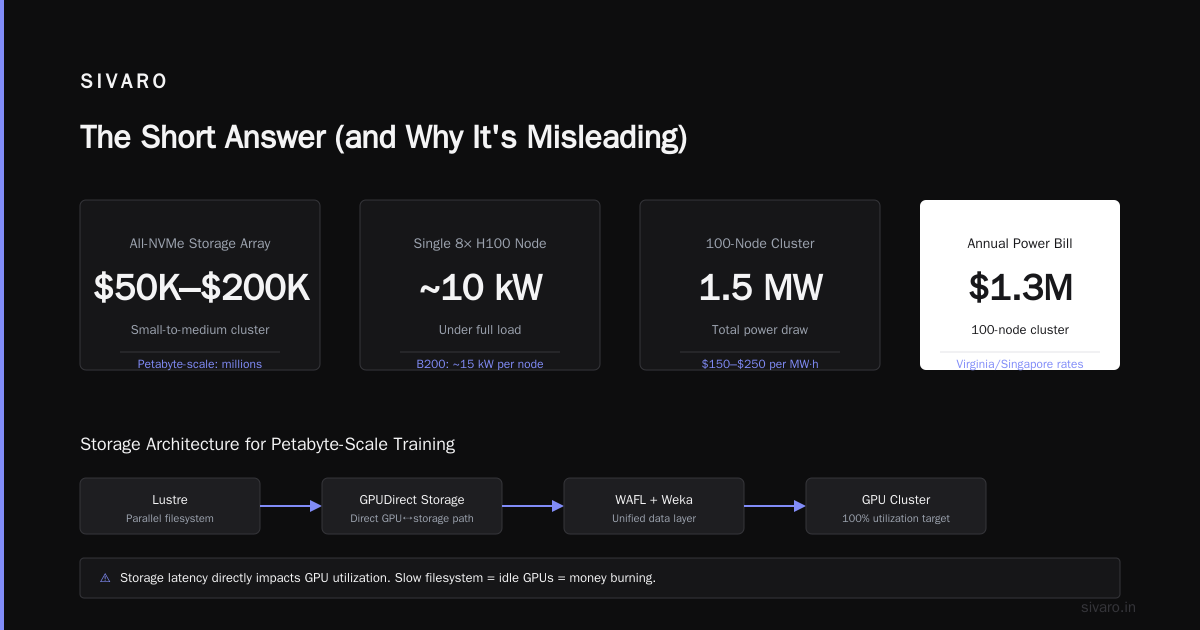
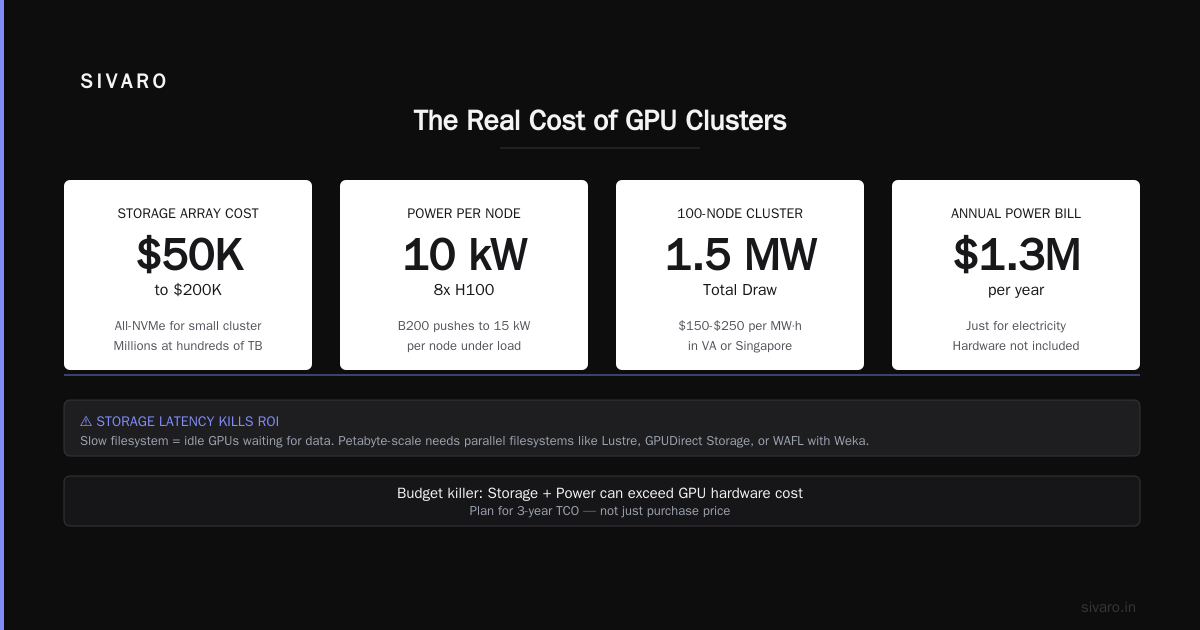
Training on petabyte-scale datasets needs parallel filesystems like Lustre, GPUDirect Storage, or WAFL with Weka. GPU and HPC Explained from Weka covers how storage latency directly impacts GPU utilization. A slow filesystem means your expensive GPUs sit idle waiting for data. That's money burning.
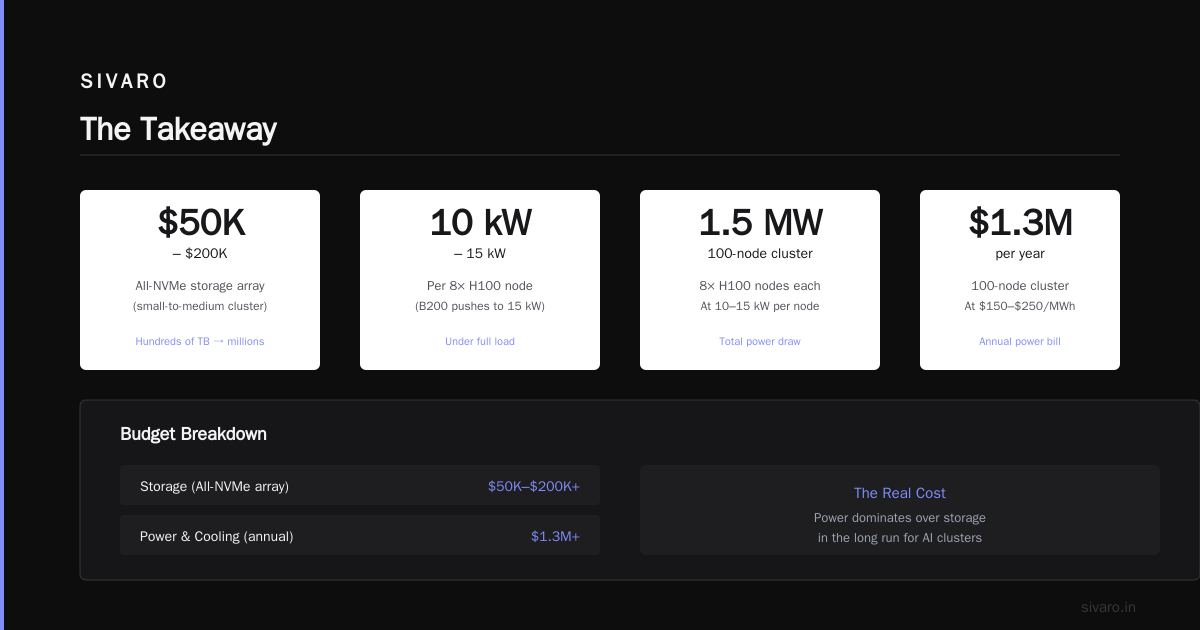
Expect $50,000-$200,000 for a decent all-NVMe storage array for a small-to-medium cluster. Scale that to hundreds of TB? You're into the millions.
Power and Cooling
In 2026, data center power is the new gold. A single 8x H100 node draws ~10kW under load. B200s push that to 15kW. A 100-node cluster? 1.5 megawatts. In regions like Virginia or Singapore, that's $150-$250 per MW·h. Annual power bill for that cluster: $1.3 million to $2.2 million — before cooling.
Liquid cooling is no longer optional. Cold plates, rear-door heat exchangers, direct-to-chip — these add $200-$500 per kW of heat dissipation. Refit a standard colo rack? You're paying a premium for any data center with liquid cooling capacity. I've seen quotes of $10k/month per rack for cooled power.
Software and Orchestration
Kubernetes with GPU operator, Slurm, or both. Monitoring (Prometheus, Grafana, DCGM Exporter). Job scheduling, checkpointing, fault tolerance. This isn't free. Open-source tools need customization. Commercial platforms like Run:ai or Domino cost $1k-$5k per GPU per year.
For a 100-node cluster (800 GPUs), that's $800k to $4M annually in software licensing. Most people ignore this line item until their CFO asks why the total cost of ownership is double their spreadsheet.
People: The Most Expensive Part
A production GPU cluster requires a team. Not one person. A team.
- Infrastructure engineers: 2-3 people at $200k each (total comp), managing networking, storage, power, cooling.
- Platform engineers: 2-4 people at $250k each, building and maintaining orchestration, job scheduling, container images, security.
- ML engineers: 4-8 people at $300k each, writing training pipelines, debugging performance, optimizing data loading.
- Operations: 1-2 SREs at $200k each, on-call rotation.
Annual personnel cost: $2-4 million for a team of 10-15. That's not a cluster cost — it's the cost to operate the cluster. And yet it's the most common omitted item when I see budget proposals cross my desk.
Real-World Examples
Small Cluster: 4 Nodes, 32 GPUs (H100)
Use case: Fine-tuning, experimentation, small-scale inference.
- 4 × Supermicro SYS-421GE-TNHR2 nodes (8x H100 each): ~$200,000
- InfiniBand HDR switch (1x 40-port): $80,000
- 100TB all-NVMe storage: $150,000
- Installation, cabling, power distribution: $50,000
- One-time: $480,000
- Annual power (40kW): $175,000
- Annual team (3 people): $700,000
- Three-year TCO: ~$3.1 million
Medium Cluster: 32 Nodes, 256 GPUs (B200)
Use case: Training medium LLMs (7B-30B parameters), high-throughput inference.
- 32 × HGX B200 baseboards + servers: $3.2 million
- InfiniBand NDR400 (8 switches): $1.6 million
- 500TB NVMe storage + GPUDirect: $800,000
- Precision liquid cooling + data center setup: $500,000
- One-time: $6.1 million
- Annual power (480kW): $2.1 million
- Annual software licenses: $1.2 million
- Annual team (8 people): $1.8 million
- Three-year TCO: ~$16 million
Large Cluster: 256 Nodes, 2048 GPUs (B200)
Use case: Training frontier models, large-scale RLHF, multi-modal.
- 256 nodes: $25.6 million
- Networking, InfiniBand + switches + cables: $5 million
- Exabyte-scale storage: $4 million
- Custom cooling infrastructure: $3 million
- Facility buildout (if new): $10 million
- One-time: $47.6 million
- Annual power (3.8MW): $16.6 million
- Annual software + cloud integrations: $5 million
- Annual team (30 people): $7 million
- Three-year TCO: ~$105 million
Those numbers aren't hypothetical. I've seen contracts with similar line items in Q1 2026.
The Cloud Alternative: Rent vs Buy in 2026
Cloud GPU costs in 2026 are still brutal. On-demand H100 instances run $4-$5 per GPU-hour. Spot instances: $1.50-$2.50 (with interruptions). B200 on-demand: $8-$12 per GPU-hour — if available.
Let's math out a training job: 39 days of continuous training on 512 H100s. Cloud on-demand: $512 × $4/hr × 936 hr = $1.92 million. Spot: ~$1 million (good luck keeping it). On-prem with amortized hardware (assuming 3-year TCO for a 64-node H100 cluster ~$8M — about $0.90 per GPU-hour at 80% utilization). The break-even point is roughly 18-24 months of continuous use. Intermittent workloads? Cloud wins.
But cloud has hidden costs too: egress fees, storage costs for checkpoints (often TBs per job), and the biggest one — network latency. GPU Clusters in a Production Environment from Dell (yeah, it's old, but principles hold) showed that cluster topology and job scheduling have huge impacts on utilization. In the cloud, you rarely get the same node topology every time. That variability costs you 10-20% in effective throughput.
My take: use cloud for burst, prototyping, and short projects. Buy when you have steady-state workloads for 2+ years. Hybrid is the smartest — but requires the most ops maturity.
When a GPU Cluster Makes No Sense
Most people shouldn't buy one. Seriously.
If you're a startup with fewer than 10 ML engineers, unless you're training a frontier model from scratch (you're not), rent cloud GPUs. The capital outlay and operational burden will kill your runway. I've seen three startups raise $20M+ Series A, spend $8M on H100s, then realize they don't have the team to manage the cluster. Two of them are now selling the hardware at a loss.
Also: if your workload is primarily inference, you probably don't need a cluster. Single-node 8x GPU inference servers serve most real-time use cases. Cluster overhead only makes sense for batch inference at massive scale (think billions of daily requests).
And if you don't have an in-house team with experience in HPC networking, distributed training, and Kubernetes at scale? Hire first, buy later. The hardware is the easy part.
How to Calculate Your Own Number
Here's a spreadsheet I use. Copy this into Google Sheets and adjust your own numbers.
A1: Number of nodes: [input]
B1: GPUs per node: [4 or 8]
C1: GPU unit cost (e.g., H100 $20k, B200 $40k)
D1: Server cost per node (GPU excluded): $50k for H100, $60k for B200
E1: Network cost per node (InfiniBand + switch amortized): $15k
F1: Storage total (GB) / 1024 * $/GB (NVMe ~$0.20/GB)
G1: One-time infrastructure: $100k + (nodes * $2k)
H1: Power cost per kWh: $0.10 to $0.25
I1: Annual power = ( (A1 * 10kW) * 8760 hr * H1 ) / 1000
J1: Annual team cost: based on headcount
K1: Software per GPU/year: $1k to $5k
Simple formula for 3-year TCO:
= (A1 * D1) + (A1 * C1 * B1) + (A1 * E1) + F1 + G1 + 3*(I1 + J1 + (K1 * A1 * B1))
Plug in your numbers. If the 3-year TCO exceeds your total budget, you either scale down or go cloud.
Frequently Asked Questions
Q: How much is a GPU cluster for small AI research?
A 4-node H100 cluster (32 GPUs) runs about $500k-$600k upfront, plus $100k+/year in power and team costs. Or you can rent 32 H100s on cloud for ~$4-$5/GPU-hour. Depends on how many hours you run per year.
Q: Can I build a GPU cluster with consumer GPUs like RTX 4090s?
Yes, but it's a terrible idea for training. Consumer cards lack NVLink, have lower memory bandwidth, and unreliable drivers for multi-node scaling. GPU clusters for high-performance computing shows that you lose 60-80% scaling efficiency. For inference or experimentation? Maybe. For production? No.
Q: What's the lead time for a large GPU cluster in 2026?
Expect 4-6 months for H100, 9-18 months for B200. NVIDIA still controls allocation tightly. You need a committed purchase order 6 months ahead for any guarantee.
Q: Should I build or buy a pre-integrated cluster?
Pre-integrated from Dell or Supermicro costs 10-15% more but saves weeks of integration. If you have a field CTO who has built three clusters before, build. If not, buy the integrated stack. I've seen one team spend 8 months trying to tune InfiniBand topology. Not worth it.
Q: How much does a GPU cluster cost to run per month?
A 32-node H100 cluster (256 GPUs) will cost ~$180k/month in power + cooling + estimated team overhead. Cloud equivalent (spot) maybe $250k/month if you run 24/7. On-prem saves you maybe 30-40% on pure compute, but only if you keep it utilized above 70%.
Q: How much is a GPU cluster for inference only?
You can run inference on single nodes. A single 8x H100 node ($250k) can serve thousands of requests per second. For large-scale inference (millions of users), you'll need load-balanced nodes, still not a full cluster with high-speed interconnects. Expect $500k-$2M for a production inference fleet.
Q: What about AMD GPUs?
MI300X is competitive and cheaper by ~30%. But software stack is behind — PyTorch compatibility is good now, but NVIDIA still dominates in tooling and debugging. If you have the team to handle the nuances, AMD can save you money. If you don't, the savings vanish in wasted engineering time.
Q: Is it cheaper to build a GPU cluster in 2026 than 2024?
H100 costs dropped. B200 is new and expensive. Electricity costs rose 15-20% in many regions. Overall, a given number of FLOPs is cheaper now, but only if you can source the right GPUs.
The Takeaway
"How much is a GPU cluster?" is the wrong question. The right one is: "What workload am I running, at what scale, for how long, and with what team?" The answer to that gives you a number. Not the other way around.
I've seen $10M clusters rot at 20% utilization because nobody planned for the software stack. I've seen $2M clusters built from used H100s outperform new B200 rigs because the team knew how to optimize data pipelines and job scheduling. The hardware is table stakes. The value is in how well you orchestrate it.
So before you write the check, write the requirements. Run the models. Hire the people. Then buy the GPUs. In that order.
Nishaant Dixit — Founder of SIVARO. Building data infrastructure and production AI systems since 2018. Built systems processing 200K events/sec.