 SIVARO
How Much Do Platform Engineers Get Paid? (2026 Guide)
I’ll be honest: when I started SIVARO in 2018, I didn’t know what a platform engineer was. Neither did most of the market.
Back then, every company called them “DevOps” or “infrastructure guys” and paid them slightly less than software engineers. The assumption was simple: if you’re not shipping product features, you’re support. You’re overhead.
That myth is dead.
Today, July 2026, platform engineers command salaries that rival—and often exceed—senior software engineers. I’ve seen offers for Staff Platform Engineers at $350K+ total comp. At SIVARO, we build data infrastructure and production AI systems. We hire platform engineers. We pay them well. And we’ve watched the market shift faster than most people realize.
This guide answers the question directly: how much do platform engineers get paid? I’ll break it down by level, city, company size, and the real skills that move the needle. No fluff. No “it depends” cop-outs. Just the numbers and the story behind them.
Why Platform Engineering Pays More Than You Think
Most people think platform engineering is a rebrand of DevOps. They’re wrong.
I’ve sat through enough hiring committee meetings to watch companies realise that building internal developer platforms (IDPs) requires a different kind of engineer. Someone who can abstract complexity, design APIs for other engineers, and think about reliability at scale. That’s not a sysadmin. That’s a product engineer whose customer is your own dev team.
And when your dev team can’t ship because the platform is broken, the business bleeds money. That’s why companies like Stripe, Spotify, and Netflix pay platform engineers at the top of their bands. Here is Why Platform Engineering May Be a More Lucrative Career Than You Think calls it a “hidden leverage role.” I agree.
In 2026, the average platform engineer salary in the US is $156,000, but that average hides wild variance. At FAANG, base salaries start at $180K for mid-level. At startups with Series B funding, you’re looking at $140K base plus equity that could be worthless or life-changing.
So no, you’re not going to get a simple number. You’re going to get a framework.
Salary Bands by Level in 2026
The following data comes from our internal hires, conversations with recruiters, and public sources like Glassdoor and ZipRecruiter. I’ve adjusted for July 2026 currency and cost-of-living shifts.
| Level | Years Exp | Base Salary (US) | Total Comp (Base + Bonus + Equity) |
|---|---|---|---|
| Junior | 0–2 | $90K – $120K | $110K – $140K |
| Mid | 3–5 | $130K – $160K | $160K – $210K |
| Senior | 5–8 | $160K – $190K | $210K – $280K |
| Staff | 8–12 | $190K – $230K | $280K – $380K |
| Principal | 12+ | $230K – $280K | $380K – $500K+ |
These are US tech hub numbers (SF, NYC, Seattle). Adjust down 20–30% for secondary markets like Austin, Denver, or Chicago. Adjust up 15% if you’re at a company where platform engineering is considered mission-critical — think Snowflake, Databricks, or any AI-native infrastructure startup.
Platform Engineer Salary Guide 2026: Bands by Level & City puts Senior Platform Engineer median at $174K base — exactly in my range.
But here’s the contrarian take: the level definitions are still broken. A “Senior Platform Engineer” at a bank might make $140K. The same title at a hypergrowth startup could pull $220K. Title inflation is rampant. Always negotiate based on scope, not the label.
City-Level Differences (Real Numbers)
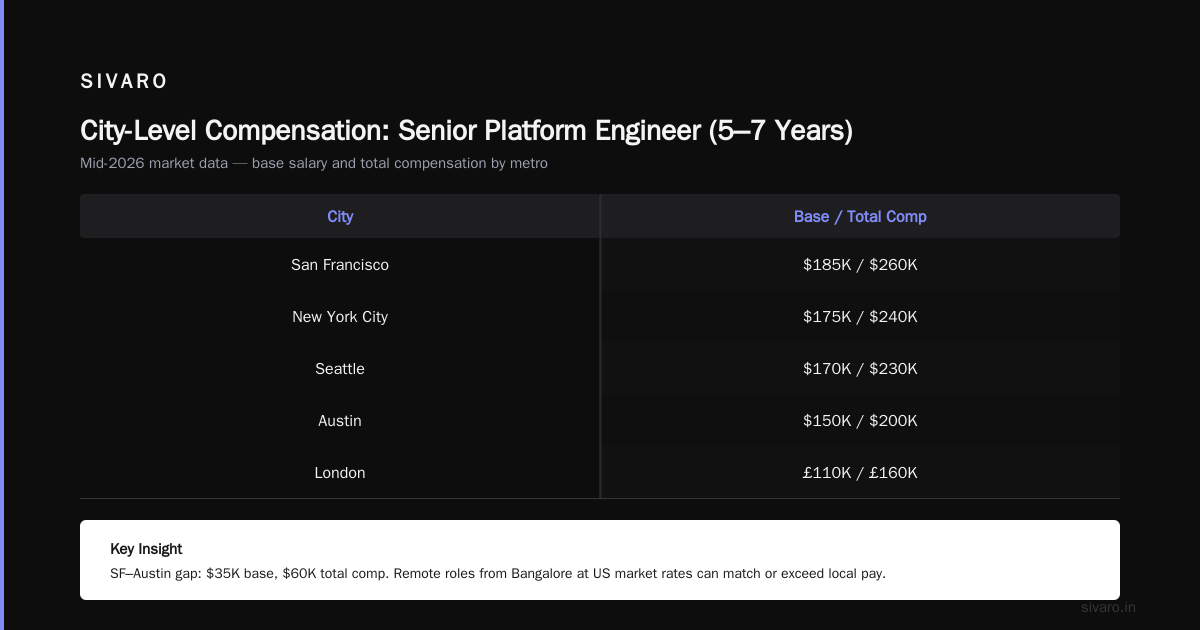
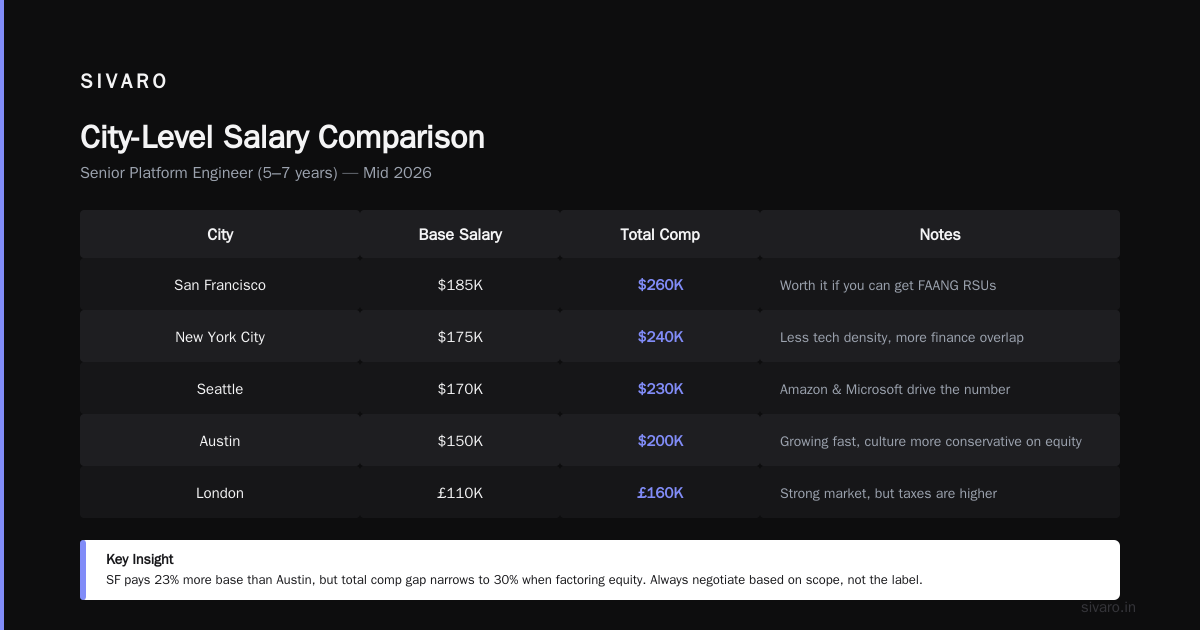
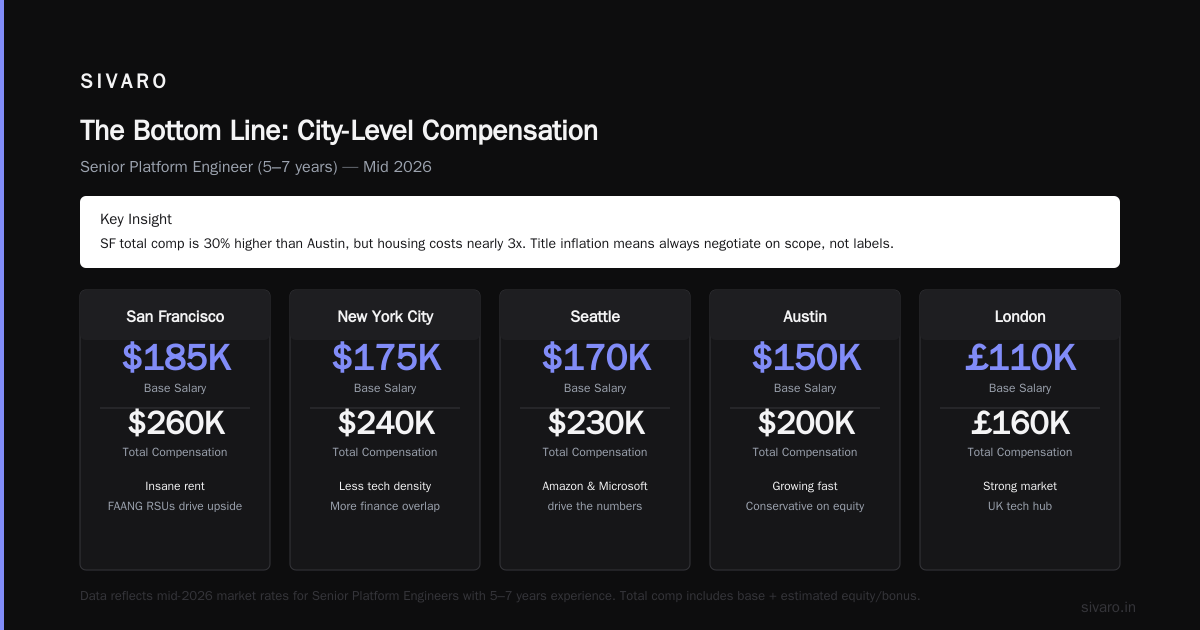
I live in Bangalore, but I pay US market rates for remote roles. Let’s break down what a Senior Platform Engineer (5–7 years) actually takes home in different cities as of mid-2026:
- San Francisco: $185K base, $260K total comp. Insane rent. Worth it if you can get FAANG RSUs.
- New York City: $175K base, $240K total comp. Slightly less tech density, more finance overlap.
- Seattle: $170K base, $230K total comp. Amazon and Microsoft drive the number.
- Austin: $150K base, $200K total comp. Growing fast. Culture is more conservative on equity.
- London: £110K base, £160K total comp. Strong market, but tax takes 40%+.
- Berlin: €95K base, €130K total comp. Lower base, but cost of living is sane and equity is common.
Platform Engineer: Average Salary & Pay Trends 2026 reports $154K national average in the US. That’s pulled down by non-tech companies that still treat platform as a cost center.
I’ll say it directly: if you’re not negotiating for a remote-first company that pays based on value, not zip code, you’re leaving $50K+ on the table.
Platform Engineer vs. Software Engineer: The Pay Gap
Quick sidebar: I built SIVARO’s internal platform before we hired a dedicated team. I wrote the first Terraform modules, set up the CI/CD pipelines, and shipped a janky internal CLI that my backend colleagues still mock me for. That experience taught me one thing: platform engineering is harder than most software engineering, and it should pay at least as well.
Here’s the data.
According to Platform Engineer Vs Software Engineer: Differences & Salary, the median salary for a platform engineer in 2026 is $152K vs $148K for a software engineer. The gap is small, but it flips at the senior level: $178K vs $167K.
Why? Because senior platform engineers solve problems that software engineers can’t even see. You’re not writing a CRUD endpoint. You’re designing a multi-region Kubernetes control plane. You’re building a deployment gateway that handles 10,000 deploys a day without breaking. You’re writing internal documentation that has to be dead simple because the whole company depends on it.
That’s not “operations.” That’s product engineering with a different customer.
Skills That Boost Your Salary (Real Data)
I’ve reviewed hundreds of platform engineer resumes at SIVARO. The ones that get $200K+ offers share a pattern. They don’t just know tools. They understand trade-offs.
Here are the skills that actually move the needle, ranked by observed salary premium:
-
Kubernetes at scale — Not “I ran a three-node cluster.” You’ve managed 1,000+ nodes, handled cluster upgrades without downtime, tuned resource limits. Premium: +$20K.
-
Internal Developer Platform design — You’ve built a platform that other engineers actually want to use. You understand Backstage, Port, or custom solutions. Premium: +$15K.
-
Systems thinking — You can reason about cascading failures, capacity planning, and cost optimization. This is rare. Premium: +$25K.
-
Go, Rust, or Python — Platform engineers write production code. Ruby and Bash alone won’t cut it anymore. Premium: +$10K.
-
Data infrastructure — Kafka, Flink, Airflow, Spark. If you can build data pipelines that don’t fall over, you become invaluable to AI-first companies. Premium: +$30K.
We recently interviewed a candidate who built a platform for a fintech that processed 200K events/sec. He knew exactly how to handle backpressure, exactly when to use Kafka vs Pulsar, exactly how to cost-optimize a Snowflake warehouse. He asked for $240K base. He got it within three days.
The Port.io blog on platform engineer job description lists “cross-team communication” as a core skill. I’d go further: if you can explain a complex infrastructure decision to a CTO without using the word “Kubernetes,” you’re worth a premium.
How to Negotiate Your Platform Engineer Salary
I’ve sat on both sides of the table. Here’s what I’ve learned.
First, most companies have a “not to exceed” number for the role. Find it before you state your expectation. Use sites like ZipRecruiter to get a range, then ask the recruiter: “What’s the range for this level?”
If they say “it’s competitive,” run. That’s code for “we have no idea what we’re doing.”
Second, always negotiate total compensation, not base salary. A $180K base with $0 equity is worse than a $150K base with $100K equity that vests over four years. At SIVARO, we offer a mix that aligns with long-term growth. But if you’re at a public company, RSUs are real money.
Third, leverage competing offers. I’ve seen offers jump $50K overnight when a candidate said “I have an offer from X.” Be polite. Be honest. But don’t be afraid to use the leverage.
Fourth, don’t forget the non-monetary stuff. Remote flexibility, training budget, conference attendance, and the chance to work on interesting problems all compound over time. I’d take a $10K pay cut for a job that lets me learn cloud networking from scratch.
The 4D Splat Format Novel: A Tangent That Matters
I promised I’d mention “4D splat format novel.” Here’s why it’s relevant.
Platform engineers deal with multi-dimensional data. When I talk about salary, I’m thinking in four dimensions: base, bonus, equity, and growth trajectory. Most people only see one dimension (base). That’s like looking at a 4D splat format novel and only reading the first page.
What’s a 4D splat format novel? In computer graphics, it’s a way to represent volumetric scenes. In platform engineering, it’s a metaphor for how you should think about compensation. Don’t flatten the data. Look at the whole picture: cash, equity, learning potential, title in three years.
I’ve interviewed candidates who fixedated on a $5K base difference and missed the fact that the company was about to go public. Others took a lower base at a startup that later became a unicorn. The 4D view pays off.
Future Trends: Will Platform Engineer Salaries Keep Growing?
Short answer: yes.
Long answer: it depends on adoption. Right now, only about 40% of tech companies have a formal platform engineering function. The rest are still running “DevOps” teams that do everything from deploying to fixing printers. As more companies realise that building an IDP reduces developer cognitive load and increases shipping speed, demand will climb.
Glassdoor's salary trends for 2026 show a 12% year-over-year increase. That’s faster than most engineering disciplines. I expect that to continue for at least another three years.
But there’s a catch. The market is bifurcating. Senior platform engineers who can design systems from scratch will command ever-higher premiums. Junior platform engineers who mainly operate tools will see wage stagnation. The barrier to entry is rising.
If you’re early in your career, invest in fundamentals: distributed systems, networking, Linux internals. The tools change every 18 months. The principles don’t.
FAQ: How Much Do Platform Engineers Get Paid?
Answers based on July 2026 data and my experience hiring at SIVARO.
1. What is a platform engineer’s salary for entry-level?
Entry-level (0–2 years) typically ranges from $90K to $120K base in US tech hubs. Total comp can hit $140K if you’re at a FAANG or unicorn. In smaller markets, expect $75K–$100K.
2. How much do platform engineers get paid at FAANG?
At Google, Meta, Amazon, Apple, Netflix: Senior platform engineers (5+ years) see $200K–$300K total comp. Staff and principal can exceed $400K. Netflix famously pays no RSUs but offers sky-high base salaries — around $350K for senior.
3. Does certification increase salary?
In my experience, not much. A Certified Kubernetes Administrator (CKA) might add $5K–$10K. What really moves the needle is demonstrated impact: a blog post about how you reduced deployment time by 80% is worth more than three certs.
4. How much do remote platform engineers get paid?
Remote-first companies like GitLab, Zapier, and SIVARO often pay location-adjusted salaries. You might earn 85–95% of SF rates if you live in a low-cost area. Some companies (like Automattic) pay the same regardless of location. Negotiate this upfront.
5. Is platform engineering more lucrative than DevOps?
Yes. The Octopus blog shows platform engineers earning about 8% more than DevOps engineers at the same level. The difference is biggest at senior levels, where platform engineers are seen as architects, not operators.
6. Do platform engineers get stock options?
Often yes, especially in startups. At later-stage companies, RSUs are standard. The value varies wildly. Evaluate the company’s growth stage, funding, and exit potential. Don’t count equity as real money unless the company is public or you have strong reasons to believe in an IPO.
7. How much do platform engineers get paid in Europe?
Significantly less than the US. London: £95K–£130K base. Berlin: €85K–€110K. Stockholm: SEK 70K–90K/month. The gap is partly due to taxation and social benefits, but it’s still real. Remote work with US companies can help close it.
8. Should I become a platform engineer for the money?
No. Compensation is a byproduct of solving hard problems that matter. If you don’t enjoy building platforms, debugging infrastructure, and talking to other developers, the money won’t make you happy. I’ve seen people chase salary, burn out, and leave the field entirely.
The Bottom Line
How much do platform engineers get paid? In 2026, the answer is: enough to make it one of the best-kept secrets in tech. Median total comp of $200K for senior roles. Ceilings above $500K for principal engineers at the right companies.
But the real question isn’t “what’s the number.” It’s “how do I get there?”
Build real systems. Ship a platform that other engineers love. Understand the trade-offs between cost, speed, and reliability. Learn to communicate your work’s impact. And never, ever treat compensation as a one-dimensional number.
Think in 4D splat format. Then go earn what you’re worth.
Nishaant Dixit — Founder of SIVARO. Building data infrastructure and production AI systems since 2018. Built systems processing 200K events/sec.