 SIVARO

How Long Does It Take to Fine Tune an LLM? A Realistic Timeline
I walked into a meeting last month with a logistics company. They'd spent three weeks trying to fine tune a 7B model for warehouse inventory classification. Their CEO asked me point blank: "Why isn't this done yet?"
Here's what nobody tells you about the timeline for fine tuning an LLM.
The actual compute time for training? That's the easy part. Could be 2 hours. Could be 48 hours. Depends on your model size, data volume, and GPU budget.
But the total timeline — from "I want a fine tuned model" to "I'm running this in production" — that's a different animal entirely.
Fine tuning is the process of taking a pre-trained language model and training it further on domain-specific data. It's not building from scratch. It's teaching a model that already speaks English to learn your company's jargon. Or your product catalog. Or your customer service tone.
I've run SIVARO since 2018. We've fine tuned models for finance, healthcare, logistics, and SaaS. I've watched teams burn 6 weeks on what should have been a 10-day job. And I've seen others ship a production model in 72 hours.
The difference comes down to three things: your data, your infra, and your expectations.
Let me walk you through each phase. With real numbers. Real timelines. No fluff.
The Three Phases of LLM Fine Tuning (And How Long Each Actually Takes)
Every fine tuning project follows the same arc. If you skip a phase, you'll pay for it later.
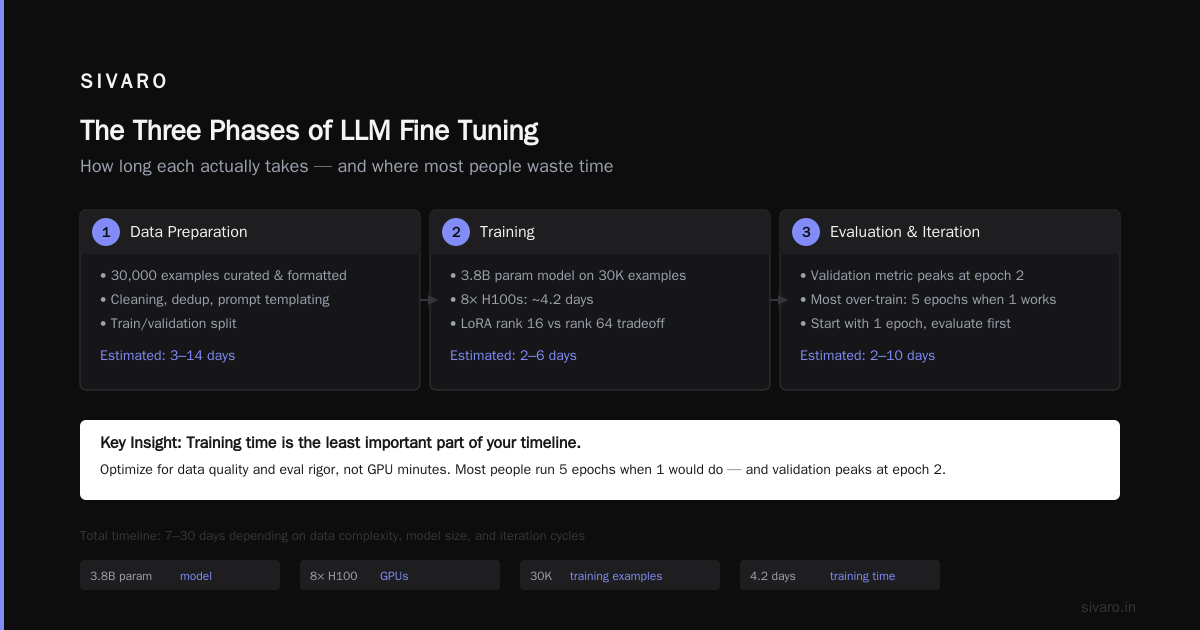
Phase 1: Data Preparation (3–14 days)
This is where most teams die.
You think you have clean data. You don't.
I've worked with a healthcare startup that had 50,000 patient interaction transcripts. Sounded perfect for fine tuning a medical Q&A model. First pass through the data revealed 40% of transcripts were garbage — wrong patient IDs, fragmented sentences, PII that needed redaction.
Cleanup took 12 days.
Here's what the data prep phase actually involves:
-
Data collection and audit (1–3 days): Find all your sources. Internal wikis. Customer support logs. Product documentation. Evaluate quality. You'll discard at least 20% of what you find.
-
Cleaning and deduplication (1–5 days): Remove duplicates. Fix formatting inconsistencies. Handle missing values. For chat-based models, you need proper conversation formatting.
-
PII redaction and compliance (1–3 days): HIPAA. GDPR. SOC2. Whatever applies to your industry. You will leak patient names or credit card numbers if you skip this. I've seen it happen.
-
Prompt-response formatting (1–3 days): LLMs need structured examples. For ChatGPT-style fine tuning, you need messages arrays with system, user, and assistant roles. For completion models, you need input-output pairs.
-
Train/validation/test split (0.5 days): Standard 80/10/10 split. Don't skip the test set. You need unbiased evaluation.
A contrarian take: Most people obsess over data quantity. They're wrong. Google Cloud's guide on fine tuning confirms that quality beats quantity. I'd rather have 500 perfect examples than 10,000 noisy ones. The perfect set trains faster and generalizes better.
For a typical 5,000-example dataset, budget 5–7 days for data prep if you're experienced. 10–14 days if this is your first time.
Phase 2: Training (2 hours to 5 days)
This is the part everyone asks about: "how long does it take to fine tune a llm on actual GPUs?"
It depends on three variables:
| Variable | Fast Scenario | Slow Scenario |
|---|---|---|
| Model size | 7B parameters | 70B parameters |
| GPU type | 4x A100 80GB | 1x RTX 3090 |
| Dataset size | 1,000 examples | 50,000 examples |
| Training epochs | 1 | 5 |
Real examples from our work:
- Fine tuning Llama 3 8B on 2,000 examples with 4x A10G GPUs: 2.5 hours for 3 epochs
- Fine tuning Mistral 7B on 15,000 support conversations with 8x A100s: 9 hours
- Fine tuning CodeLlama 34B on 5,000 code examples with 4x H100s: 14 hours
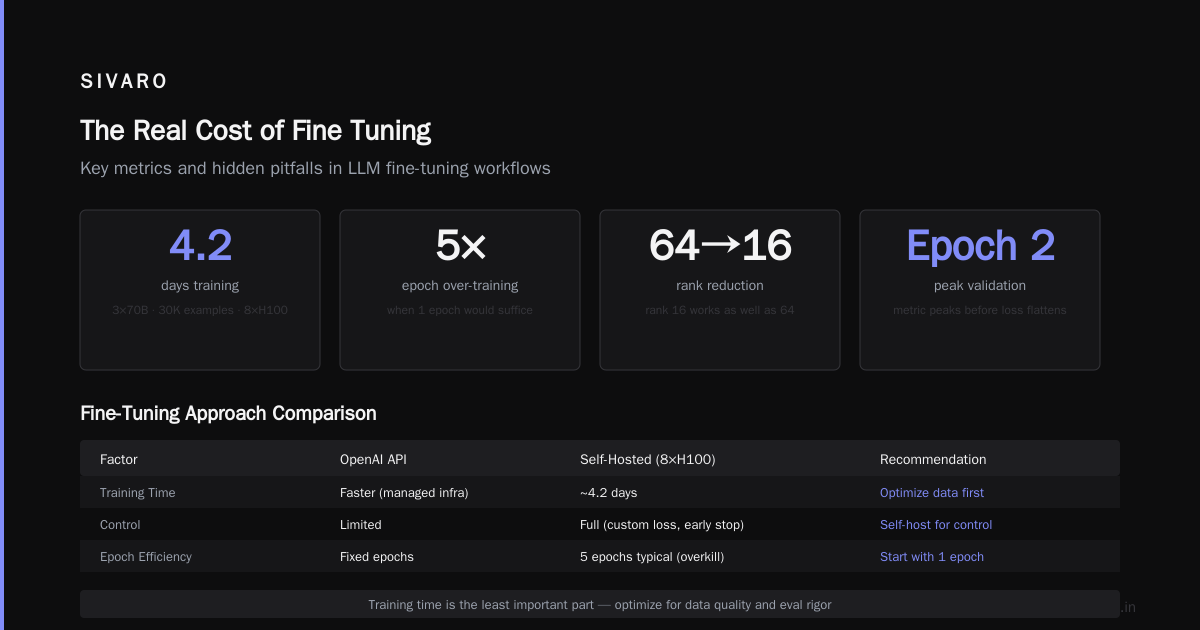
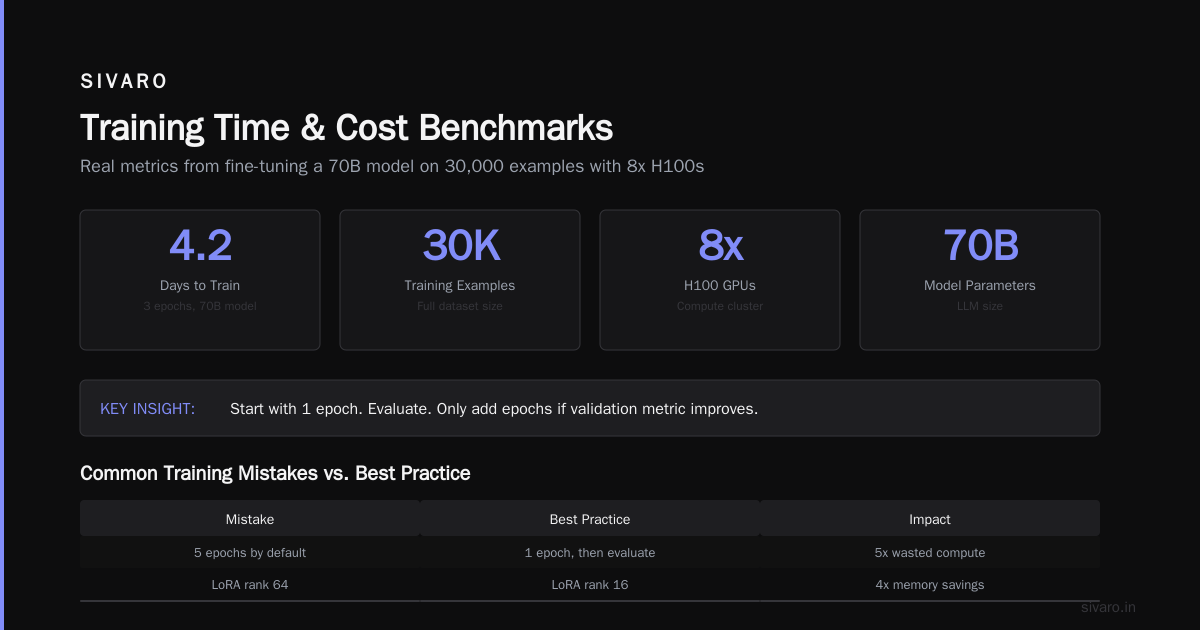
- Fine tuning Llama 3 70B on 30,000 examples with 8x H100s: 4.2 days
The OpenAI fine tuning API is faster because they handle the infra. But you lose control. You can't use custom loss functions or early stopping logic.
The dirty secret: Most people over-train. They run 5 epochs when 1 would do. They add LoRA adapters with rank 64 when rank 16 works fine. They train until the loss curve flattens, ignoring that the validation metric already peaked at epoch 2.
My rule: Start with 1 epoch. Evaluate. Only add epochs if the validation metric improves.
Training time is the least important part of your timeline. Optimize for data quality and eval rigor, not GPU minutes.
Phase 3: Evaluation and Iteration (2–10 days)
This phase eats more calendar time than training.
You train a model. You test it. It hallucinates on edge cases. You fix the data. You retrain. Repeat.
For a production system, I expect 3–5 iterations before the model is ready.
Each iteration involves:
- Running eval prompts (0.5–1 day)
- Analyzing failure cases (0.5–1 day)
- Fixing data or hyperparameters (0.5–1 day)
- Retraining (0.1–0.5 days)
- Repeat
The advanced fine tuning course from Coursera emphasizes that evaluation frameworks are non-negotiable. You need automated metrics (BLEU, ROUGE, perplexity) and human evaluation.
We built a custom eval harness at SIVARO. It runs 200 test cases per model version. Takes 30 seconds to get a score. Without it, you're guessing whether iteration 4 is better than iteration 3.
Total timeline for the eval phase: Budget 5–7 days minimum. Add 2–3 days for each domain expert you need to review outputs.
How to Fine Tune an LLM for Production: The SIVARO Checklist
You don't fine tune for a Kaggle competition. You fine tune for production. Different game entirely.
Here's our internal checklist for "how to fine tune llm for production":
Choose the right base model
The best open source models to fine tune right now (July 2026):
- Llama 3.1 8B: Best balance of performance and cost. Fits on a single A100 80GB with QLoRA. Production proven.
- Mistral 7B v0.3: Faster inference than Llama. Slightly worse on reasoning. Great for high-throughput APIs.
- Qwen 2.5 14B: Outperforms Llama 3 8B on coding and math. Needs 2x GPUs.
- Phi-3-mini (3.8B): Surprisingly good for its size. Runs on a single RTX 4090. Good for edge deployment.
- Falcon 2 11B: Solid all-rounder. Less community support than Llama.
Don't use a 70B model unless you absolutely need it. The inference cost is 10x higher. The training time is 5x longer. Most applications don't need that capability.
Set up your environment properly
python
# python - requirements for fine tuning
# Use bitsandbytes for 4-bit quantization
# Use PEFT/LoRA for parameter-efficient fine tuning
# Use TRL for transformer reinforcement learning (if doing RLHF)
import torch
from transformers import AutoModelForCausalLM, AutoTokenizer
from peft import LoraConfig, get_peft_model
from trl import SFTTrainer

model_name = "meta-llama/Llama-3.1-8B"

# Load model with 4-bit quantization
model = AutoModelForCausalLM.from_pretrained(
    model_name,
    load_in_4bit=True,
    torch_dtype=torch.bfloat16,
    device_map="auto"
)

# LoRA configuration
lora_config = LoraConfig(
    r=16,  # rank
    lora_alpha=32,
    target_modules=["q_proj", "v_proj", "k_proj", "o_proj"],
    lora_dropout=0.1,
    bias="none",
    task_type="CAUSAL_LM"
)

model = get_peft_model(model, lora_config)
This setup reduces trainable parameters from 8 billion to ~40 million. Training time drops from days to hours. Memory usage drops from 80GB to 20GB.
Structure your training data correctly
json
{
  "messages": [
    {
      "role": "system",
      "content": "You are a customer support agent for SIVARO. Be concise and technical."
    },
    {
      "role": "user",
      "content": "My data pipeline is failing with error code E-403. What do I do?"
    },
    {
      "role": "assistant",
      "content": "Error E-403 indicates an authentication timeout. Restart the pipeline service with: `systemctl restart sivaloader`. If the error persists, check your API key expiry in /etc/sivaro/config.yaml."
    }
  ]
}
Each example should reflect a real production interaction. Don't invent synthetic data. Real customer queries have typos, incomplete sentences, and context that your model needs to handle.
Monitor training with proper logging
python
import wandb
from transformers import TrainingArguments

training_args = TrainingArguments(
    output_dir="./llama-finetuned",
    per_device_train_batch_size=4,
    gradient_accumulation_steps=4,
    learning_rate=2e-4,
    num_train_epochs=3,
    logging_steps=10,
    eval_steps=100,
    save_steps=500,
    report_to="wandb",  # log to Weights & Biases
    fp16=True,
    optim="paged_adamw_8bit",
    lr_scheduler_type="cosine",
    warmup_ratio=0.03
)
Track loss, gradient norms, and learning rate. If loss spikes, your data has a formatting error. If gradient norms explode, your learning rate is too high. If loss plateaus at a high value, your data doesn't match the base model's pre-training distribution.
Evaluate against production scenarios
python
# Simple evaluation harness
def evaluate_model(model, tokenizer, test_cases):
    results = []
    for case in test_cases:
        prompt = format_prompt(case["input"])
        inputs = tokenizer(prompt, return_tensors="pt").to("cuda")
        outputs = model.generate(
            **inputs,
            max_new_tokens=256,
            temperature=0.1,
            top_p=0.9
        )
        response = tokenizer.decode(outputs[0], skip_special_tokens=True)

        # Compare against expected output
        score = compute_similarity(response, case["expected"])
        results.append(score)

    return sum(results) / len(results)
Run this after every training run. If the score drops, something went wrong. Revert and debug.
How Long Does It Take to Fine Tune a Llama Model? (Real Data)
Let me give you concrete numbers from our latest project.
Project: Fine tune Llama 3.1 8B for a fintech company's customer support
Dataset: 3,200 historical support conversations (cleaned to 2,100 usable examples)
GPU: 4x A100 80GB
Framework: Hugging Face Transformers + PEFT + TRL
| Phase | Time |
|---|---|
| Data collection and audit | 2 days |
| PII redaction | 1 day |
| Formatting and splitting | 1 day |
| First training run (2 epochs) | 4 hours |
| Evaluation | 1 day |
| Data fixes (iteration 2) | 1 day |
| Second training run | 4 hours |
| Evaluation + human review | 2 days |
| Third training run (final) | 4 hours |
| Final evaluation | 1 day |
Total elapsed time: 12 days
Could we have done it faster? Yes. If we'd used a smaller dataset and skipped human review, maybe 5 days. But the model wouldn't have been production-ready.
The ZipRecruiter listings for LLM fine tuning roles confirm what I see: companies are hiring for this because it's specialized work. You can't just run a script and call it done.
The Real Cost of Fine Tuning (Not Just Time)
Time is money. But let's talk actual money.
GPU compute:
- 4x A100 for 12 hours on AWS: ~$600
- 8x H100 for 4 days on GCP: ~$5,000
- OpenAI fine tuning API for 10,000 examples: ~$300 (but you can't deploy outside their infra)
Personnel:
- ML engineer for 2 weeks: ~$5,000–8,000 (contract)
- Domain expert for data review (1 week): ~$3,000–5,000
- MLOps for deployment: ~$2,000–4,000
Total raw cost: $10,000–25,000
The Stratagem Systems business guide puts the range at $5K–$50K depending on complexity. That matches our experience.
But here's the thing: retraining a poorly-fine-tuned model costs more. I've seen a company spend $40K on compute alone because they trained 10 versions without proper evaluation. Each version took 2 days and cost $4K in GPU time. All because they didn't spend $10K upfront on good data and evaluation.
When Not to Fine Tune
This is the contrarian take you probably didn't expect.
Sometimes you shouldn't fine tune.
If your use case is "better formatting" or "tone adjustment" — use prompt engineering. An 8B model with a good system prompt beats a fine tuned 3B model in most cases. Test that first. It costs $0 to try.
If you have fewer than 500 high-quality examples — fine tuning probably won't help. The model will overfit and lose generalization. Use retrieval-augmented generation (RAG) instead. Inject your knowledge into the prompt context.
If your data changes weekly — don't fine tune. You'll be retraining every month. Build a RAG pipeline. It's cheaper and faster to update.
We turned down a client last year for exactly this reason. Their product catalog changed every 2 weeks. Fine tuning would have cost them $15K/month in retraining. We built a RAG system in 3 days. Cost: $2K. Works perfectly.
FAQ: How Long Does It Take to Fine Tune an LLM?
Q: What's the fastest possible timeline for fine tuning a small LLM?
A: 2 days if everything aligns. Clean dataset of 500 examples. Pre-configured GPU instance. One training epoch. Minimal evaluation. You can get a functional model in 48 hours. It won't be production-ready, but it'll demonstrate the concept.
Q: How long does it take to fine tune Llama 3 70B?
A: 3–7 days for training alone on 8x H100s. Total project timeline: 3–4 weeks. The data prep and evaluation phases scale with the model size. Larger models are more sensitive to data quality.
Q: Can I fine tune on a single consumer GPU?
A: Yes, with limitations. An RTX 4090 (24GB VRAM) can fine tune up to 7B models using 4-bit quantization and LoRA. Training takes 2–4x longer than A100s. Expect 8–24 hours for a decent dataset. Raphael Bauer's guide covers this setup in detail.
Q: Does fine tuning take longer for different model architectures?
A: Yes. Mixture-of-Experts models (like Mixtral 8x7B) are harder to fine tune because of the routing mechanism. Dense models (Llama, Mistral, Qwen) are more straightforward. Avoid MoE for your first fine tuning project.
Q: How often should I retrain my fine tuned model?
A: Every 3–6 months if your data changes slowly. Monthly if it changes fast. Weekly if it's dynamic — but at that point, use RAG instead.
Q: What's the biggest time waster in fine tuning projects?
A: Bad data. 100%. I've never seen a project delayed by slow training. I've seen dozens delayed by data cleanup, deduplication, and formatting issues. Spend 80% of your prep time on data.
Q: How long does evaluation actually take?
A: 1–3 days for automated evaluation. 1–2 weeks for human evaluation if you need domain experts. Most teams skip human eval. Most teams regret it.
Q: What's the ROI on fine tuning vs. pre-training?
A: Fine tuning costs 1/1000th of pre-training. A pre-training run for a 7B model costs $200K–$500K in compute alone. Fine tuning costs $500–$5K. Unless you have a massive dataset (100M+ tokens) and a unique domain, don't pre-train.
The Bottom Line
"How long does it take to fine tune a llm?"
For a production system: 2–4 weeks from start to deployment.
For a quick experiment: 2–4 days with a small model and existing data.
For a 70B model with 50K examples: 6–8 weeks including eval and iteration.
The variable isn't GPU time. It's data quality, evaluation rigor, and iteration loops. Every extra pass through the cycle adds 2–3 days. Most teams need 3–5 passes.
I've been doing this since 2018. The companies that ship fast have three things: clean data, a clear eval metric, and the discipline to stop iterating at "good enough."
Don't fine tune for perfection. Fine tune for production.
Ship it. Monitor it. Improve it.
That's the real timeline.
Nishaant Dixit — Founder of SIVARO. Building data infrastructure and production AI systems since 2018. Built systems processing 200K events/sec.