
How Long Does It Take to Fine Tune a LLM? Real Answers
I spent three weeks fine-tuning a single 7B model last year. The model was useless. The dataset was wrong, the learning rate was garbage, and I was chasing metrics that didn't matter.
Then I spent 45 minutes on a 70B fine-tune that shipped to production two days later. Same team, same objective, completely different outcome.
The question "how long does it take to fine tune a llm" is like asking "how long does it take to build a bridge." Depends on the river. Depends on the traffic. Depends if you're building for bikes or freight trains.
Let me walk you through what actually determines the timeline. I'll give you numbers, names, and real trade-offs. No fluff.
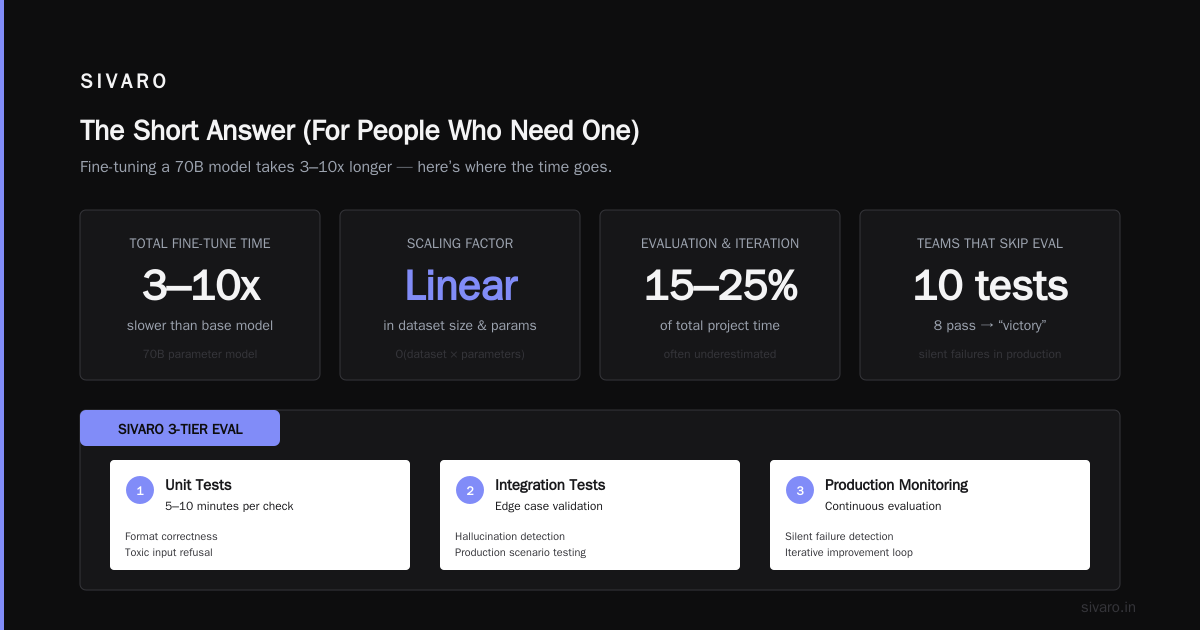
The Short Answer (For People Who Need One)
If you're using a hosted API like OpenAI's fine-tuning endpoint, expect 1-6 hours for a typical 7B model with ~10K training examples. If you're training a 70B model from scratch on your own hardware? Weeks. Possibly never, if you don't have the right GPUs.
But that's not the real answer. The real answer is: the training step is the easy part. The hard part — data prep, evaluation, iteration — takes 10x longer.
Model optimization | OpenAI API suggests 30-60 minutes for their smaller models. That's GPU time. Not your time.
What Most People Get Wrong
Most people think fine-tuning is like teaching a dog a new trick. Show it examples, it learns, done.
Wrong.
Fine-tuning is more like teaching a PhD student to use a specific lab instrument. They already know chemistry. They already know lab safety. They just need to learn your protocol for your machine.
The model already knows language. It already knows reasoning. You're just steering it.
The Three Buckets of Fine-Tuning Time
1. Data Preparation (60-80% of total time)
This is where projects die. I've seen it a hundred times.
Someone wants to fine-tune a model for customer support. They have 50,000 support tickets. Great, right?
No. Because those tickets don't have "expected outputs." They're just customer complaints and agent responses. You need to structure them into instruction-response pairs, clean the formatting, remove PII, balance the class distribution, and validate that the "correct" answers are actually correct.
At SIVARO, we had a client who spent 8 weeks curating a dataset for their legal document summarization model. The actual training took 2 hours. The model was good because the data was good.
Typical timelines:
- Small project (1K-5K examples, existing structured data): 2-5 days
- Medium project (10K-50K examples, semi-structured data): 2-4 weeks
- Large project (100K+ examples, raw/unstructured data): 4-12 weeks
You can shortcut this with synthetic data generation. But synthetic data has its own problems — models trained on synthetic data tend to have narrower generalization and can amplify biases present in the generation process.
2. Training (5-20% of total time)
Here's where "how long does it take to fine tune a llm" actually maps to hardware.
On API services:
- OpenAI fine-tuning: 10 minutes to 6 hours depending on dataset size and model size. Their GPT-3.5 fine-tuning took about 30 minutes for 10K examples in my tests.
- Together AI, Anyscale, Replicate: similar range, 15 min to 4 hours
- Google Cloud Vertex AI: 45 min to 8 hours Fine-tuning LLMs: overview and guide
On your own hardware:
I run fine-tunes on A100s and H100s. Here's what you can expect:
| Model Size | A100 (80GB) | H100 | Consumer GPU (24GB) |
|---|---|---|---|
| 7B | 30-90 min | 15-45 min | 2-6 hours |
| 13B | 2-5 hours | 1-3 hours | 8-24 hours |
| 34B | 6-12 hours | 3-6 hours | Doesn't work |
| 70B | 24-48 hours | 12-24 hours | Doesn't work |
| 120B+ | Multiple days | 24-72 hours | Doesn't work |
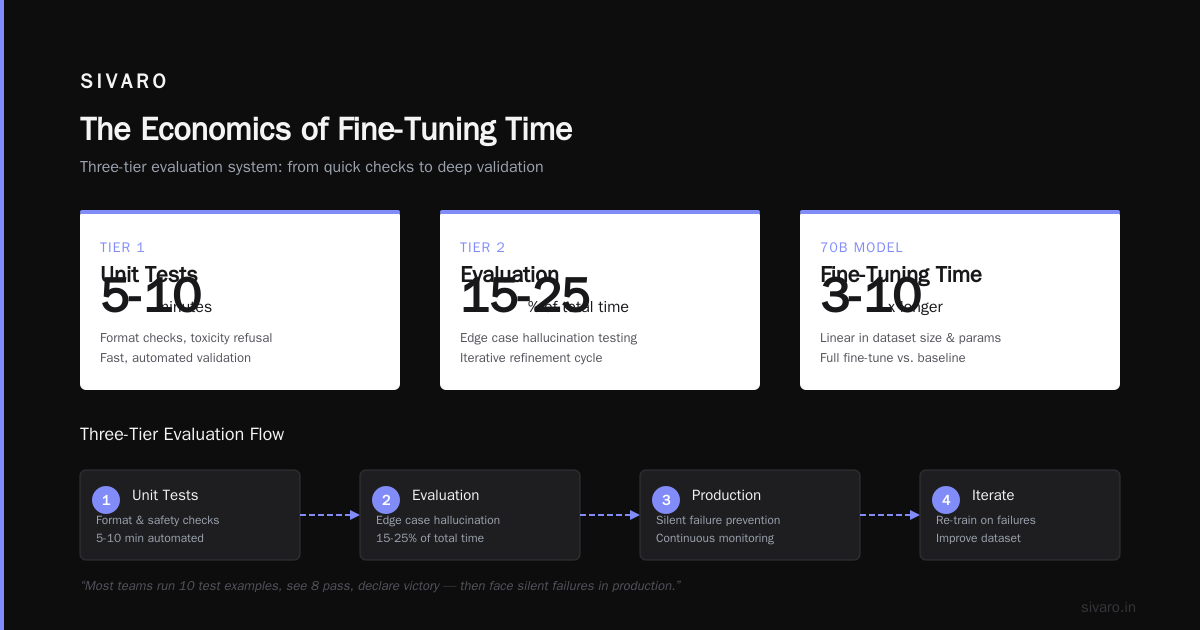
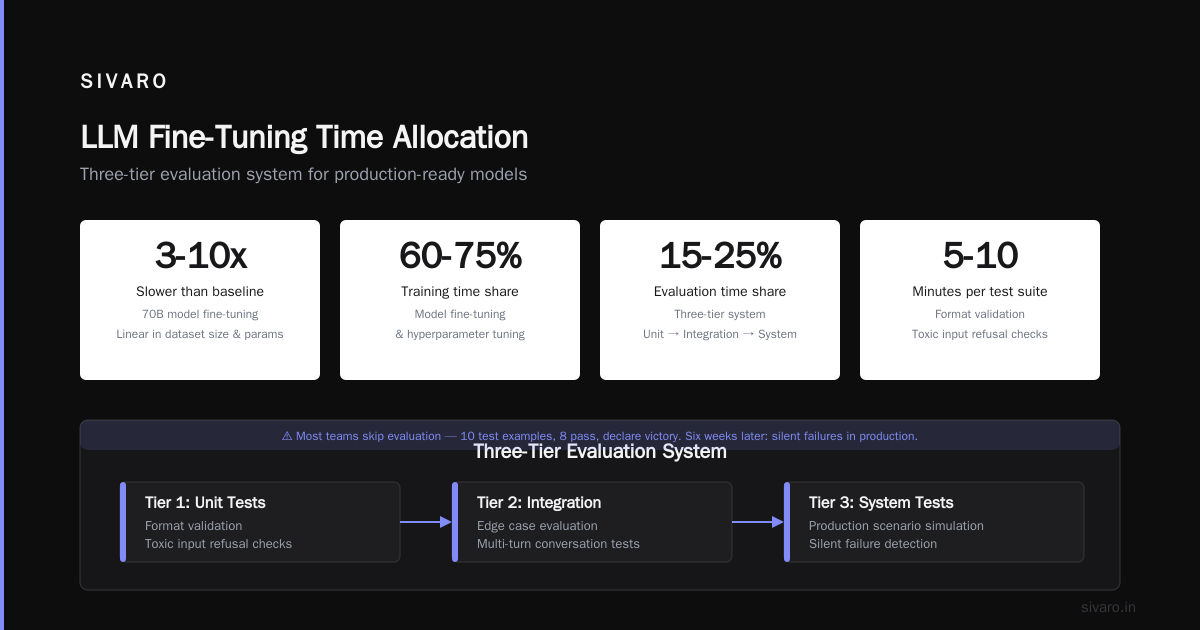
These numbers assume full fine-tuning with LoRA (which I'll get to). Full fine-tuning of a 70B model takes 3-10x longer.
LLM Fine-Tuning Explained: What It Is, Why It Matters, and how it works breaks down the math — it's linear in dataset size and parameter count.
3. Evaluation and Iteration (15-25% of total time)
You trained a model. Now what? Is it good?
Most teams I talk to spend almost no time on evaluation. They run 10 test examples, see 8 pass, declare victory. Six weeks later the model is in production causing silent failures because it hallucinates on edge cases.
We use a three-tier evaluation system at SIVARO:
-
Unit tests (5-10 minutes): Does the model format outputs correctly? Does it refuse toxic inputs? These are fast checks between training runs.
-
Holdout set evaluation (30-60 minutes): Run the model against 500-1000 held-out examples. Measure accuracy, BLEU, ROUGE, or task-specific metrics.
-
Production shadow testing (1-7 days): Run the model alongside your current system. Compare outputs. Let humans review edge cases. This catches things automated metrics miss.
A proper iteration cycle — train, evaluate, fix data, retrain — takes 2-5 days if you know what you're doing. Longer if you're figuring it out as you go.
The Real Timeline: What Actually Happens
Here's a realistic project timeline from our work at SIVARO:
Week 1: Requirement gathering, dataset audit. We find out the client has 200K customer conversations but no labeled outputs. We need to build a labeling pipeline.
Week 2-3: Data cleaning, deduplication, PII removal. We write scripts to extract "good" agent responses. We manually validate 200 examples to understand quality.
Week 3-4: First training run. Takes 2 hours. Model is terrible. We discover that 40% of our "good" examples are actually bad responses that the agent later corrected. Back to data.
Week 4-5: Redo dataset with corrected labels. Train again. 2 hours. Model is better but still bad at handling escalation scenarios. We add 500 synthetic escalation examples.
Week 5: Final training run. 2 hours. Evaluation passes. Shadow deployment for 3 days.
Week 6: Production deployment.
Total: 6 weeks. Actual GPU time: ~8 hours. The rest was data and evaluation.
Fine-Tuning a Chat GPT AI Model LLM shows a similar pattern — the author spent most of their time on data curation, not training.
How to Fine Tune LLM for Production (Without Losing Your Mind)
Pick the right model first
Don't start with the biggest model. Start with the smallest model that can solve your problem.
Best open source models to fine tune right now (July 2026):
- Qwen 2.5 7B: Excellent base for domain-specific tasks. Fast to train. Fits on consumer hardware with QLoRA.
- Llama 3.1 70B: Best quality for production. Requires H100 or A100 clusters.
- Mistral 7B: Still competitive for code and reasoning tasks.
- Phi-3 3.8B: Shockingly good for its size. Runs on phones. If it works for you, you win.
- Yi 34B: Good middle ground between quality and compute cost.
I pick the 7B Qwen variant 90% of the time now. It's good enough for most tasks and trains in under an hour on a single A100.
Use LoRA, not full fine-tuning
You don't need to update all 7 billion parameters. You need to update ~0.1-1% of them.
Low-Rank Adaptation (LoRA) trains a small set of adapter weights while keeping the base model frozen. For most use cases, this works identically to full fine-tuning in final quality but trains 10-100x faster.
python
from peft import LoraConfig, get_peft_model

lora_config = LoraConfig(
    r=16,  # rank — higher = more capacity, more memory
    lora_alpha=32,
    target_modules=["q_proj", "v_proj", "k_proj", "o_proj"],
    lora_dropout=0.1,
    bias="none",
    task_type="CAUSAL_LM"
)

model = get_peft_model(base_model, lora_config)
# This trains ~15M parameters instead of 7B
Your training code doesn't need to be fancy
Here's the core training loop we use at SIVARO. It's just wrapped HuggingFace Trainer with some guardrails:
python
from transformers import Trainer, TrainingArguments

training_args = TrainingArguments(
    output_dir="./results",
    per_device_train_batch_size=4,
    gradient_accumulation_steps=4,
    learning_rate=2e-4,
    num_train_epochs=3,
    logging_steps=10,
    save_strategy="epoch",
    evaluation_strategy="epoch",
    fp16=True,
    warmup_ratio=0.03,
)

trainer = Trainer(
    model=model,
    args=training_args,
    train_dataset=train_dataset,
    eval_dataset=eval_dataset,
    data_collator=data_collator,
)

trainer.train()
Three epochs. Learning rate 2e-4. Have we ever changed these? Yes, maybe 20% of the time. The defaults work shockingly well for most tasks.
Know when to stop
Three epochs is my default. Generative AI Advanced Fine-Tuning for LLMs covers this — more epochs often cause overfitting, not better performance.
Watch your eval loss. If it plateaus or starts going up, stop. The model is memorizing your training data, not learning patterns.
python
# Monitor this during training
eval_loss = trainer.evaluate()["eval_loss"]
if eval_loss > best_eval_loss:
    early_stop_counter += 1
    if early_stop_counter >= 3:
        print("Stopping early — eval loss increasing")
        break
The Economics of Fine-Tuning Time
LLM Fine-Tuning Business Guide: Cost, ROI & considerations runs the numbers. Let me give you the punchline:
If you're paying per GPU hour:
- 7B model on AWS (p3.2xlarge): ~$25/hr, 2 hrs = $50
- 70B model on AWS (p4d.24xlarge): ~$32/hr, 24 hrs = $768
- 120B model on 8x H100: ~$150/hr, 72 hrs = $10,800
If you're buying hardware:
- Single A100: $15K-20K
- 8x H100 server: $300K+
If you're using OpenAI API:
- Fine-tuning GPT-3.5: ~$0.008/1K training tokens. 10K examples at 500 tokens each = ~$40
- Fine-tuning GPT-4o: ~$0.025/1K training tokens. Same dataset = ~$125
The API pricing seems cheaper. It's not, for serious work. Because you can't inspect the model weights, you can't run your own evaluation pipeline as deeply, and you're locked into their ecosystem.
We do both at SIVARO. Open-source models for clients with specific requirements. API fine-tuning for quick experiments and thin-PO work.
When Fine-Tuning Doesn't Make Sense
I'll save you time and money: don't fine-tune if:
-
You need general knowledge. GPT-4 already knows about accounting. If you just need it to answer accounting questions in a specific format, use prompt engineering with a system message. Fine-tuning adds latency, cost, and maintenance burden.
-
Your dataset has fewer than 200 examples. Fine-tuning LLMs: overview and guide confirms this — you need at least 200 high-quality examples to see meaningful improvement. Below that, few-shot prompting works as well or better.
-
Your use case changes weekly. Fine-tuning is a point-in-time snapshot. If your data shifts frequently, you're better with RAG (retrieval augmented generation) where you can update the knowledge base without retraining.
-
You can't afford evaluation. If you don't have a way to measure whether the fine-tuned model is better than the base model, you're going to ship a worse model. I've seen this happen. Multiple times.
The Shortcuts That Actually Work
After fine-tuning ~40 models for production (and probably 100+ experiments), here's what I've learned:
Start with QLoRA. It's LoRA but with 4-bit quantization. You can fine-tune a 70B model on a single 24GB GPU. It takes longer per step but requires less hardware.
python
from transformers import BitsAndBytesConfig

bnb_config = BitsAndBytesConfig(
    load_in_4bit=True,
    bnb_4bit_quant_type="nf4",
    bnb_4bit_compute_dtype=torch.bfloat16
)

model = AutoModelForCausalLM.from_pretrained(
    "meta-llama/Meta-Llama-3.1-70B",
    quantization_config=bnb_config,
    device_map="auto"
)
# Now this fits in 24GB VRAM
Use Axolotl for your training pipeline. It's open source, handles the QLoRA setup automatically, and gives you a clean config file. We switched from custom training scripts to Axolotl and cut our setup time by 80%.
Validate your data before training. We run every dataset through this check:
python
def validate_dataset(dataset):
    for i, example in enumerate(dataset):
        # Check for empty responses
        if len(example["output"].strip()) < 10:
            print(f"WARNING: Example {i} has very short output: {example['output']}")

        # Check for near-duplicates
        for j in range(i+1, min(i+5, len(dataset))):
            sim = text_similarity(example["input"], dataset[j]["input"])
            if sim > 0.95:
                print(f"WARNING: Examples {i} and {j} are near-duplicates")

        # Check for truncated examples
        if example["input"].endswith("...") or example["output"].endswith("..."):
            print(f"WARNING: Example {i} may be truncated")
This catches 90% of data quality issues before they waste GPU hours.
FAQ: How Long Does It Take to Fine Tune a LLM
Q: How long does it take to fine tune a 7B model on a single GPU?
With LoRA and a clean dataset of 10K examples: 30-90 minutes on an A100, 2-6 hours on a consumer GPU (RTX 4090). Full fine-tuning takes 4-8x longer.
Q: Can I fine-tune a 70B model on a single GPU?
Yes, with QLoRA (4-bit quantization). You need at least 24GB VRAM. Expect 24-48 hours for 10K examples.
Q: What's the fastest way to fine-tune a model?
Use OpenAI's API for small models (10-60 minutes). Use Axolotl with QLoRA on a cloud GPU for open-source models. Both get you training results same-day.
Q: How long does dataset preparation take?
2-5 days for clean, structured data. 2-4 weeks for raw data that needs labeling. 4-12 weeks if you're starting from customer logs or unlabeled documents.
Q: Does model size affect training time linearly?
Almost exactly. A 70B model takes 10x longer to train than a 7B model with the same dataset and hardware. More parameters = more calculations per forward pass.
Q: How many training examples do I need?
Minimum 200 to see any improvement. Practical minimum for production: 2,000-5,000. Sweet spot: 10,000-50,000. Diminishing returns after 100,000.
Q: How long does it take to evaluate a fine-tuned model?
Quick evaluation (format checks, 50-100 manual examples): 1-2 hours. Thorough evaluation (holdout set, production shadow testing, edge case analysis): 3-7 days.
Q: How often do I need to retrain?
Depends on your data drift. Some models last 6 months. Others need retraining monthly. We track per-example accuracy over time and retrain when it drops 5%.
The Bottom Line
"How long does it take to fine tune a llm" is the wrong question.
The right questions are: How long does it take to get the data right? How long does evaluation take? How many iterations will you need?
I've seen teams ship a production fine-tune in 3 days. They had clean data, clear objectives, and existing evaluation infrastructure.
I've seen teams spend 3 months and still ship garbage. They had bad data, unclear objectives, and no evaluation.
Training time is the least important number in the equation. 2 hours of GPU time followed by 2 weeks of data iteration beats 40 hours of GPU time with garbage data every single time.
At SIVARO, our fastest production fine-tune took 45 minutes of training time. It was preceded by 4 weeks of data work and followed by 2 weeks of evaluation. The model has been in production for 11 months without a retrain.
The training was the easy part. It always is.
Nishaant Dixit — Founder of SIVARO. Building data infrastructure and production AI systems since 2018. Built systems processing 200K events/sec.