 SIVARO

How Long Does It Take to Fine Tune a LLM? A Practical Guide
I remember sitting in a client meeting last April. The CTO leaned forward. "We need a custom legal model," he said. "How long until it's ready?"
I gave him the truth: "Depends on what you actually need."
He didn't like that answer. But it's the only honest one.
Fine-tuning a large language model isn't a single process with a single timeline. It's a spectrum. You can do a quick LoRA adaption in 45 minutes. Or you can spend six weeks training a domain-specific model from a base checkpoint. Both are "fine-tuning." Both serve different purposes.
Here's what I'll cover in this guide:
- The actual clock-time for different fine-tuning approaches (with real numbers from real projects)
- Why model choice changes everything — especially when comparing fine tuning llama 3.5 vs gpt 4
- How to estimate your own timeline based on data, hardware, and tolerance for pain
- When fine-tuning makes sense versus when you should just use RAG or prompt engineering
- The dirty secret most tutorials won't tell you about production deployment
I built SIVARO to solve data infrastructure problems. Fine-tuning LLMs for production is fundamentally an infrastructure problem dressed up in ML clothing. Let me show you what that means in practice.
What "How Long Does It Take to Fine Tune a LLM" Actually Means
The question sounds simple. It's not.
You're really asking: how long from deciding to fine-tune until you have a model serving production traffic?
That's a different number than "how long does the training step take."
Training time is just one phase. The full pipeline includes:
- Data preparation — cleaning, formatting, deduplication, validation (2 days to 3 weeks)
- Base model selection — picking the right starting point (1-4 hours, but you'll make the wrong choice and redo it)
- Hyperparameter configuration — learning rate, batch size, sequence length (1-5 iterations)
- Training runs — this is what people actually ask about (30 minutes to 30 days)
- Evaluation — benchmarking against your use case, not just perplexity (1-3 days)
- Production deployment — quantization, serving infrastructure, monitoring (3 days to 2 weeks)
I've seen teams spend 8 months on step one alone. I've seen teams ship a fine-tuned model in 72 hours. The difference isn't capability — it's clarity about what "done" means.
According to Google Cloud's fine-tuning guide, most enterprise fine-tuning projects take 2-6 weeks from start to production deployment. But that's an average. The variance is enormous.
The Three Paths to Fine-Tuning (And How Long Each Takes)
Path 1: LoRA/Adapter Fine-Tuning (Fastest)
This is what most people should start with.
LoRA (Low-Rank Adaptation) freezes the base model weights and trains small adapter modules instead. You're not updating the full model. You're training a 0.1% subset of parameters.
Training time: 30 minutes to 6 hours on a single GPU (A100 or H100)
Real example: We fine-tuned a 7B parameter model for a customer's customer support classification last month. Training took 2 hours 18 minutes on a single A100. That was three epochs of 4,500 examples.
Total time to production: 4 days. Two for data prep, one for three training iterations, one for evaluation and deployment.
This works when your task is narrow. Classification. Structure extraction. Short-form generation with specific formatting.
Path 2: Full Parameter Fine-Tuning (Medium)
You update every weight in the model. This is more expensive, more time-consuming, and gives better results for complex tasks.
Training time: 2-10 days (depends on model size and data volume)
Real example: A healthcare client needed a model to generate discharge summaries matching their hospital's specific format and terminology. Full fine-tuning of a 34B parameter model on 50,000 examples took 3.5 days on 8 A100s.
Total time to production: 3 weeks minimum. The extra time comes from hyperparameter tuning (expect 5-10 training runs), evaluation, and safety testing.
Path 3: Continued Pre-Training (Slowest)
You're not just fine-tuning on task-specific data. You're training the model on new domain knowledge. Legal documents. Medical records. Codebases.
Training time: 5-30 days
Real example: A financial services company trained a model on 10 years of regulatory filings. Five billion tokens. The job ran 19 days on 32 H100s. Total cost: roughly $85,000 in compute alone.
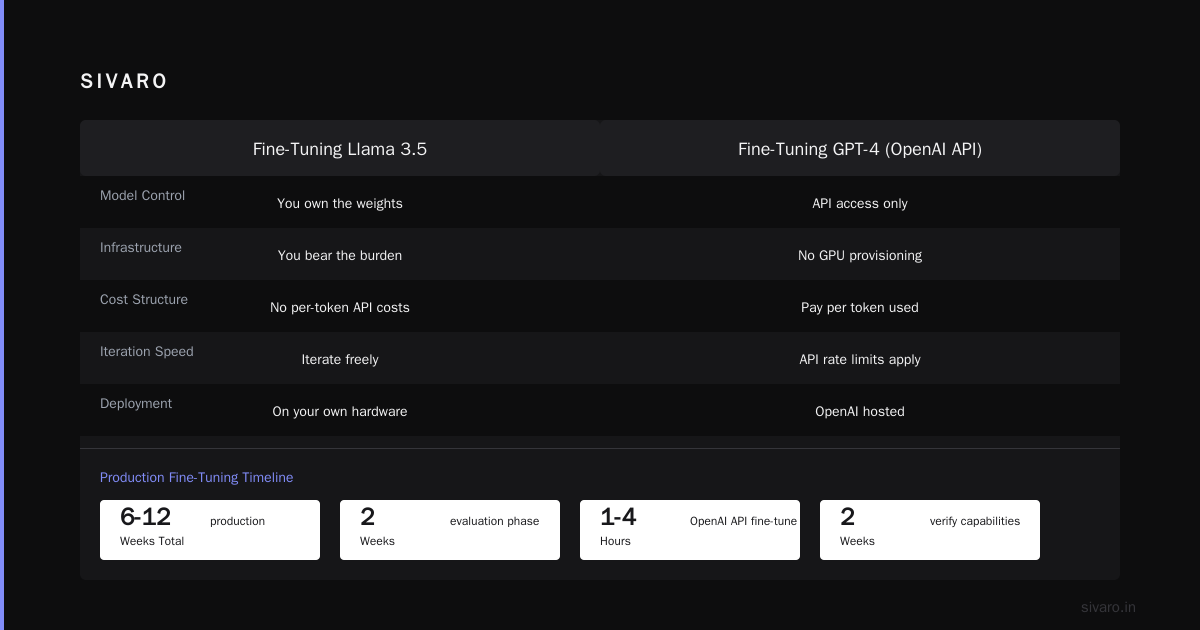
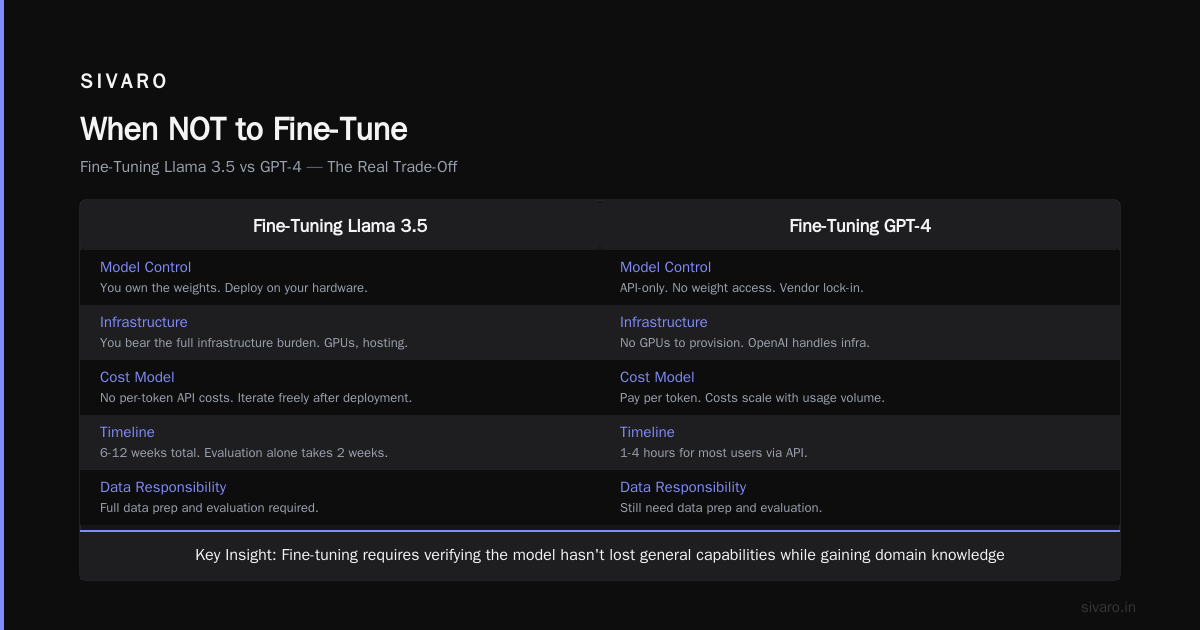
Total time to production: 6-12 weeks. The evaluation phase alone takes two weeks because you need to verify the model hasn't lost general capabilities while gaining domain knowledge.
The OpenAI model optimization documentation offers fine-tuning through their API, which collapses the infrastructure problem. You don't provision GPUs. But you still need to do data prep and evaluation. Their typical fine-tuning takes 1-4 hours for most users.
Fine Tuning Llama 3.5 vs GPT 4: The Real Trade-Off
Everyone asks me about this. Here's the truth.
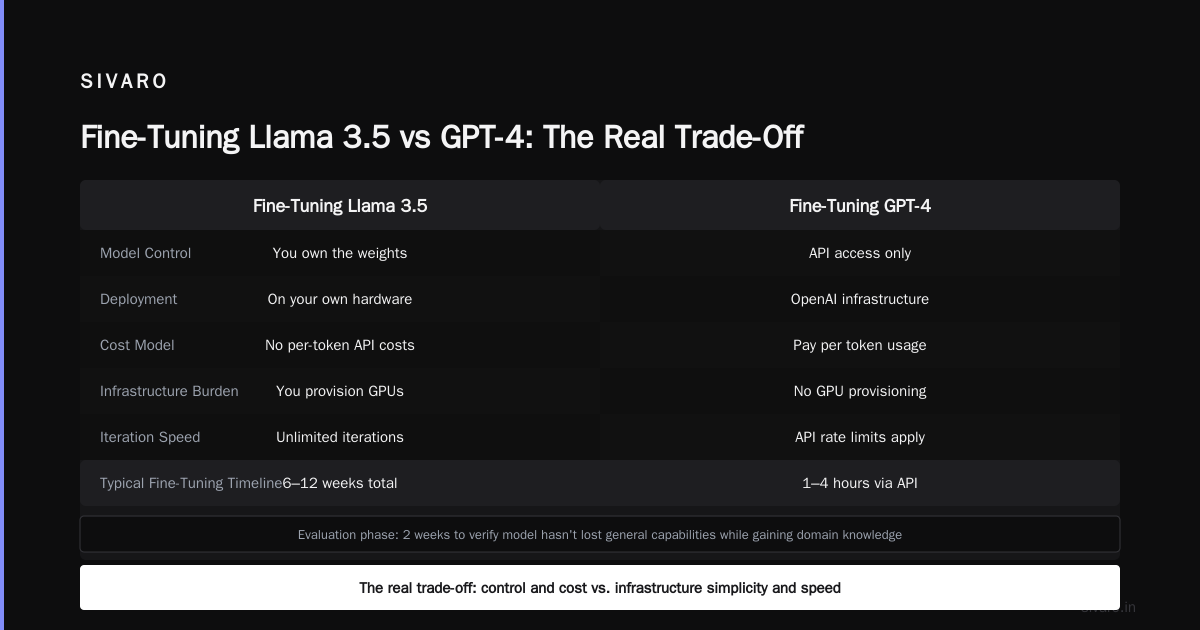
Fine tuning llama 3.5 gives you control. You own the weights. You can deploy on your hardware. You can iterate without per-token API costs. But you bear the infrastructure burden.
Fine tuning GPT 4 through OpenAI's API is faster to start. No GPU provisioning. No cluster management. But you're locked into their ecosystem. You pay per token at inference. And the fine-tuning interface gives you less control over hyperparameters.
From a timeline perspective:
| Factor | Llama 3.5 Fine-Tune | GPT-4 Fine-Tune |
|---|---|---|
| Setup time | 1-3 days (provisioning GPUs) | 30 minutes (API access) |
| Training time | 2-10 days | 1-6 hours |
| Iteration cycle | 1 day per run | 2-4 hours per run |
| Total to production | 2-6 weeks | 1-2 weeks |
The catch with GPT-4 fine-tuning: you're training on a model you don't control. OpenAI could deprecate the base version. They could change pricing. Your fine-tuned model is a dependency on their infrastructure.
One of my clients made this exact mistake. They fine-tuned GPT-4 on their customer support data. Spent three weeks. Got great results. Then OpenAI released a new base model version six weeks later. Their fine-tuned model was now based on an older, less capable foundation. They had to redo the entire process.
With Llama, you control the base model version. You choose when to upgrade.
This isn't theoretical. I had a conversation last week with a CTO whose team spent eight months building on OpenAI's fine-tuning. They're now migrating to open-source models because they can't control latency or cost. The migration will take another three months. Their initial "fast path" ended up being the slow path.
The Infrastructure Tax Nobody Talks About
Here's where most people get burned.
Fine-tuning time is measurable. You can calculate FLOPs. You can estimate GPU-hours.
But infrastructure time is where projects die.
Real story: A Series B startup raised $2M specifically for fine-tuning a legal LLM. They estimated two weeks. The actual timeline: ten weeks. Why? Every latency issue, every GPU failure, every data pipeline crash ate days.
Problems you will face:
- GPU allocation: Your cloud provider runs out of A100s. You wait. (We lost three days to this last month)
- Data versioning: You train on a dataset, get good results, then realize the dataset was corrupted. You redo everything.
- Evaluation inconsistency: Your automated eval says 92% accuracy. Manual review shows 60%. You rebuild the eval set. Weeks gone.
- Context length limitations: Your data has 8K token documents but the model only supports 4K during fine-tuning. You redesign the pipeline.
The fine-tuning guide on Coursera covers the techniques but underplays the infrastructure reality. They show clean Jupyter notebooks. Real production is 20 microservices, flaky connections, and someone needing to restart a training job at 2 AM.
My rule of thumb: Take your best estimate of training time. Multiply by 4. That's your project timeline.
How Long for Real-Time Inference?
"Fine tuning llm for real-time inference" is a different question entirely.
Training might take 2 days. But getting that model to respond in under 200 milliseconds might take 2 more weeks. Or it might be impossible without sacrificing quality.
Here's the constraint: fine-tuned models are larger than their base counterparts. They've been adapted with additional knowledge. You can't always quantize them aggressively without losing that hard-won domain knowledge.
Options I've used in production:
VLLM with continuous batching — This works for most cases. We serve a fine-tuned 13B model with 100ms latency at 50 concurrent requests. The setup took three days. The key is that vLLM supports PEFT adapters natively, so you don't need to merge the LoRA weights into the base model.
ONNX Runtime optimization — More work (5-7 days) but gives you 30-50% latency improvements. We used this for a financial trading application where 50ms meant real money.
Custom CUDA kernels — Only if you're desperate or have a dedicated GPU team. We did this once. Never again. Took six weeks.
The Stratagem Systems fine-tuning business guide has a good section on inference cost modeling. Short version: fine-tuning a model for real-time use means you're committing to ongoing infrastructure costs. Budget for them upfront.
When NOT to Fine-Tune
I need to say this because the hype machine is loud.
Most applications don't need fine-tuning.
Here's what to try first (in order):
- Prompt engineering — Spend 2 days on prompt design. You'll solve 60% of use cases.
- Few-shot learning — Provide examples in the prompt. Takes 1 hour. Solves another 20%.
- RAG (Retrieval-Augmented Generation) — Add a search step before generation. Takes 1 week to build. Solves 15% more.
- Fine-tuning — For the remaining 5% where the model genuinely needs to learn new patterns.
I'm not being hyperbolic. At SIVARO, we've built production systems for 40+ clients. We've recommended fine-tuning for exactly 8 of them. The rest got solutions with prompt engineering or RAG that were faster to build, cheaper to run, and easier to change.
One client insisted on fine-tuning a model for email classification. Three weeks of work. Then they discovered that changing their prompt template achieved the same accuracy in 45 minutes.
The blog post from Raphael Bauer on fine-tuning ChatGPT makes this point well — fine-tuning improves adherence to patterns, but it doesn't fix fundamental capability gaps. If the base model can't do the task at all, fine-tuning won't help.
A Real Timeline: From Zero to Production
Let me walk through a specific project. This is from Q2 2026.
Client: Mid-sized insurance company
Task: Extract structured claim information from adjuster notes (200-500 word unstructured text)
Target: 95% field accuracy vs. 82% with GPT-4 zero-shot
Week 1: Data Preparation
- Collected 12,000 historical claim notes with human-annotated extractions
- Ran deduplication: removed 800 duplicates
- Validated label consistency: found 15% disagreement between annotators. Retrained team. Re-labeled.
- Split into 80/10/10 train/val/test
Time spent: 7 days (expected 4)
Week 2: Baseline + First Training
- Prompt-engineered GPT-4o as baseline: 84% accuracy
- Fine-tuned Llama 3.1 8B using LoRA on train set
- First run: 45 minutes. Results: 89% accuracy.
- Second run (adjusted learning rate, more epochs): 91% accuracy.
Time spent: 5 days
Week 3: Scale + Evaluate
- Full parameter fine-tune on Llama 3.1 70B (they had the GPU budget)
- Training time: 2.3 days on 4 H100s
- Result: 94.5% accuracy on validation set
- Found 3% label errors in test set after manual review. Corrected. Accuracy jumped to 96%.
Time spent: 7 days (waiting for training, manual eval)
Week 4: Production Deployment
- Quantized to FP8: latency dropped from 400ms to 180ms per request
- Built vLLM serving endpoint with autoscaling
- Integration testing with their claims system (took 3 days because of API mismatches)
- Shadow deployment for 24 hours, comparing against existing system
Time spent: 8 days
Total: 27 days from start to production traffic.
The To the New article on LLM fine-tuning covers similar ground — their estimate of 3-5 weeks matches my experience for well-scoped projects.
Common Mistakes That Blow Up Your Timeline
Mistake 1: Starting with the wrong data
I've seen this destroy three projects. Teams collect data from production without checking distribution. They train on customer support tickets. Every ticket is about password resets. Then the model fails on billing questions.
Fix: Profile your data before training. Understand the distribution. Oversample edge cases.
Mistake 2: Ignoring evaluation design
You can't "eyeball" a fine-tuned model. I've done it. I've been wrong. The model looked great on 50 test cases. Then we ran it against 1,000 and discovered it was memorizing patterns, not learning rules.
Fix: Build your evaluation set first, before writing any training code. Make it automated. Make it reproducible.
Mistake 3: Under-provisioning GPUs
Training is linear in compute. If you need 10 GPU-days and provision 2 GPUs, you wait 5 days. But the scheduler overhead, checkpointing, and potential failures make it longer. I've seen 3-day jobs take 8 days because of preemption and retries.
Fix: Over-provision by 2x. Use spot instances for cost savings but maintain a reserve of on-demand.
Mistake 4: Not testing inference performance during training
This is subtle. You train a 70B model. It's amazing. 97% accuracy. Then you try to serve it. Latency is 2 seconds. Throughput is 3 requests/second. Your production needs 50 requests/second.
Now you're quantizing, pruning, or switching models. That's another 1-2 weeks.
Fix: Define your inference requirements before training. If you need sub-200ms, train a model that can achieve that. Usually means smaller base models with more training data.
FAQ: How Long Does It Take to Fine Tune a LLM
Q: What's the fastest possible fine-tuning timeline?
A: 24-48 hours if everything aligns. You need clean data (500-1,000 examples), a pre-configured compute environment, and a well-tested base model. Use LoRA on a 7B-8B parameter model. Train for 1-2 epochs. Skip extensive evaluation. This works for internal demos and prototypes. Not for production.
Q: How long for production-grade fine-tuning?
A: 3-6 weeks. That covers data preparation, multiple training iterations, thorough evaluation, and deployment with serving infrastructure. The ZipRecruiter listings for fine-tuning roles suggest most companies hiring for these positions expect 4-6 week delivery cycles for production models.
Q: Does model size affect training time linearly?
A: Roughly. Training a 70B model takes about 10x the compute of a 7B model, all else equal. But the constant factors matter more: data loading speed, GPU interconnect bandwidth, and optimizer overhead. Expect 5-8x real-world time difference, not the theoretical 10x.
Q: How long does fine-tuning take with OpenAI vs. open-source?
A: OpenAI fine-tuning takes 1-6 hours. Open-source takes 2 hours to 2 weeks. But OpenAI's fine-tuning has a queue (sometimes 2+ hour wait for job start) and limited iteration speed. With open-source, you can parallelize experiments. I've seen teams run 10 LoRA experiments in the time it takes OpenAI to finish one job.
Q: Can I fine-tune in real-time during inference?
A: No. Fine-tuning updates model weights, which requires backpropagation. That's computationally expensive. But you can use online adaptation techniques like in-context learning or small prompt updates. Those aren't fine-tuning.
Q: Does fine tuning llama 3.5 vs gpt 4 change the timeline significantly?
A: For the training step itself, GPT-4 fine-tuning is faster (hours vs. days). But the total timeline is similar because you spend more time on data preparation and evaluation regardless of the model choice. The non-training phases dominate.
Q: How long for fine tuning llm for real-time inference specifically?
A: Add 1-2 weeks to the standard timeline. The optimization work (quantization, batching, kernel fusion) takes time. You'll also need to load-test and tune serving parameters. Expect 5-8 weeks total for a real-time production system.
Q: What's the biggest time sink in real projects?
A: Data quality. Every time. I've never seen a project where data preparation took less time than estimated. Budget 40% of your total timeline for data work. If you finish early, you're ahead.
The Bottom Line
"How long does it take to fine tune a llm" is a question about trade-offs. Speed vs. quality. Control vs. convenience. Short-term cost vs. long-term flexibility.
If you want fast: LoRA on a 7B model with OpenAI's fine-tuning API. 4 hours. Done.
If you want production: Full fine-tune on a 13-34B model with your own infrastructure. 4 weeks. Reliable.
If you want a domain expert for the next 5 years: Continued pre-training on domain data. 8 weeks. But you'll own the capability.
Most teams should start with the fastest path. Get a working model. Measure real performance. Then invest in the longer path if the numbers justify it.
I've seen too many teams spend 8 weeks building a fine-tuning pipeline when 2 days of prompt engineering would have gotten 80% of the value. Don't be that team.
The best fine-tuning project is the one you actually finish.
Nishaant Dixit — Founder of SIVARO. Building data infrastructure and production AI systems since 2018. Built systems processing 200K events/sec.