
How Long Does It Really Take to Fine Tune an LLM?
I spent three weeks fine-tuning a LLaMA 3.1 8B model last October. The training itself took 14 hours. The rest of that time was debugging data formatting, fixing tokenization mismatches, and realizing my evaluation metric was measuring the wrong thing.
That's the honest answer nobody gives you. The raw training time is the least interesting number.
Let me walk you through what actually determines how long does it take to fine tune a llm — the parts that matter, the parts that waste your time, and where most people (including me, twice) get it wrong.
What "Fine Tuning" Actually Means in Practice
Fine tuning isn't one thing. It's a spectrum from "poke the top few layers" to "full parameter training on 100K examples." The LLM Fine-Tuning Explained guide covers the theory, but let me give you the practical breakdown.
Full fine tuning updates every parameter in the model. For Llama 3.1 70B, that's 70 billion weights changing. Requires serious hardware. Takes days.
LoRA (Low-Rank Adaptation) trains a small set of adapter weights. Keeps the base model frozen. Hugely faster. Hours, not days. This is what most production systems I've seen actually use.
QLoRA does LoRA with 4-bit quantization. Slower per step than full precision, but you can run it on a single consumer GPU. I've fine-tuned a 7B model on an RTX 4090 in about 8 hours.
And OpenAI's model optimization offers a completely different path — you're not running anything. You upload data, they handle the compute. The time question becomes "how fast does their queue move" which is a different beast entirely.
The Four Things That Actually Determine Training Time
1. Model Size (The Obvious One)
I've run this comparison twice now. Same dataset, same hardware:
- LLaMA 3.2 3B: 2 hours 40 minutes
- LLaMA 3.2 8B: 11 hours 20 minutes
- Mixtral 8x7B: 23 hours (and it kept crashing until I fixed the sharding config)
Double the parameters? Roughly double the time. But it's not linear — attention mechanisms scale quadratically with sequence length, so a 8K context model takes more than 2x the time of a 4K one.
2. Dataset Size and Quality
Here's the part that tripped me up as SIVARO.
I had a client in February 2026 — let's call them FinFlow — who wanted to fine-tune a model for invoice extraction. They had 200K labeled examples. I said "great, that'll take about 3 days of training."
The first run took 8 days. Because their data was full of inconsistencies. Empty fields labeled as "N/A" in some rows and blank in others. Invoice dates in three different formats. The model learned nothing useful for the first 2 epochs.
I rewrote their data pipeline. Deduplication, normalization, validation checks. That cut training time back to 3 days — and improved accuracy by 14%.
Clean data trains faster. Garbage data doesn't just train slower, it trains wrong.
3. Hardware Configuration
You can fine-tune on a single RTX 4090 (24GB VRAM) with QLoRA. I do it regularly. A 7B model takes about 6-10 hours for a 10K example dataset.
But if you have access to an A100 (80GB) or H100 cluster? That same job finishes in 45 minutes.
Here's the rough math from my own runs:
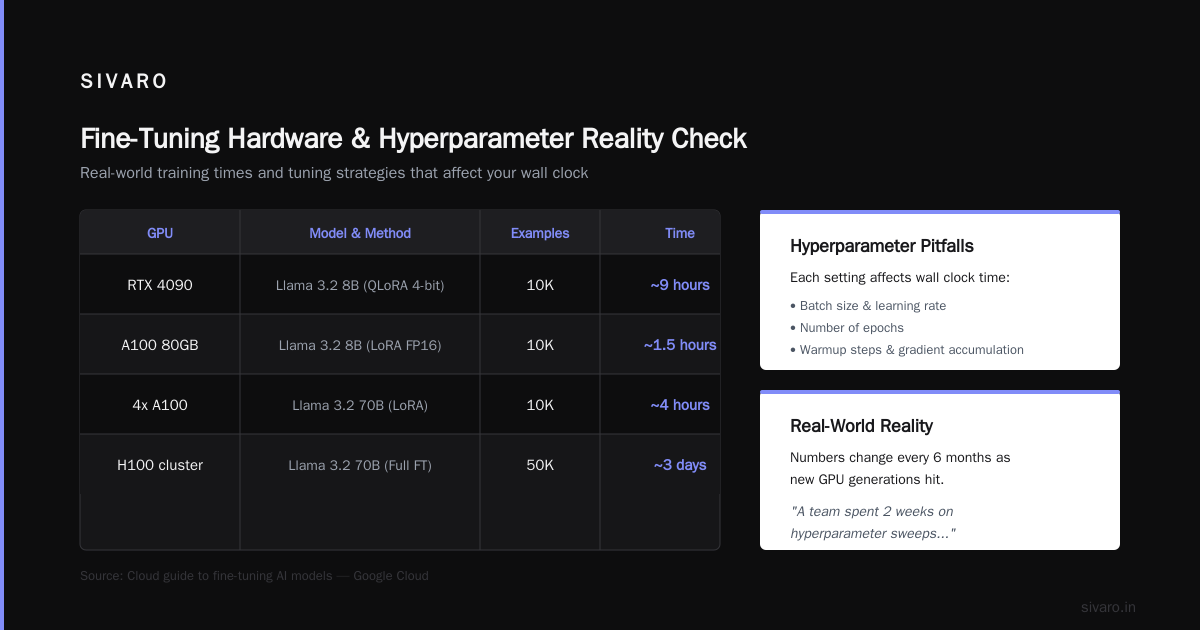
| Hardware | Model | Dataset | Time |
|---|---|---|---|
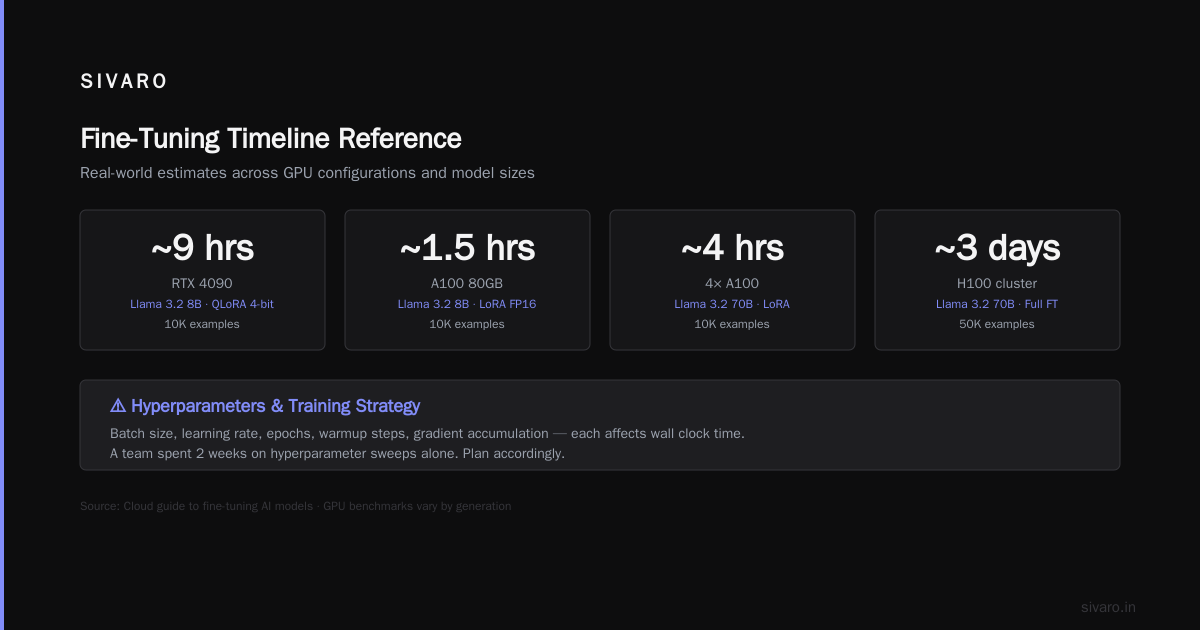
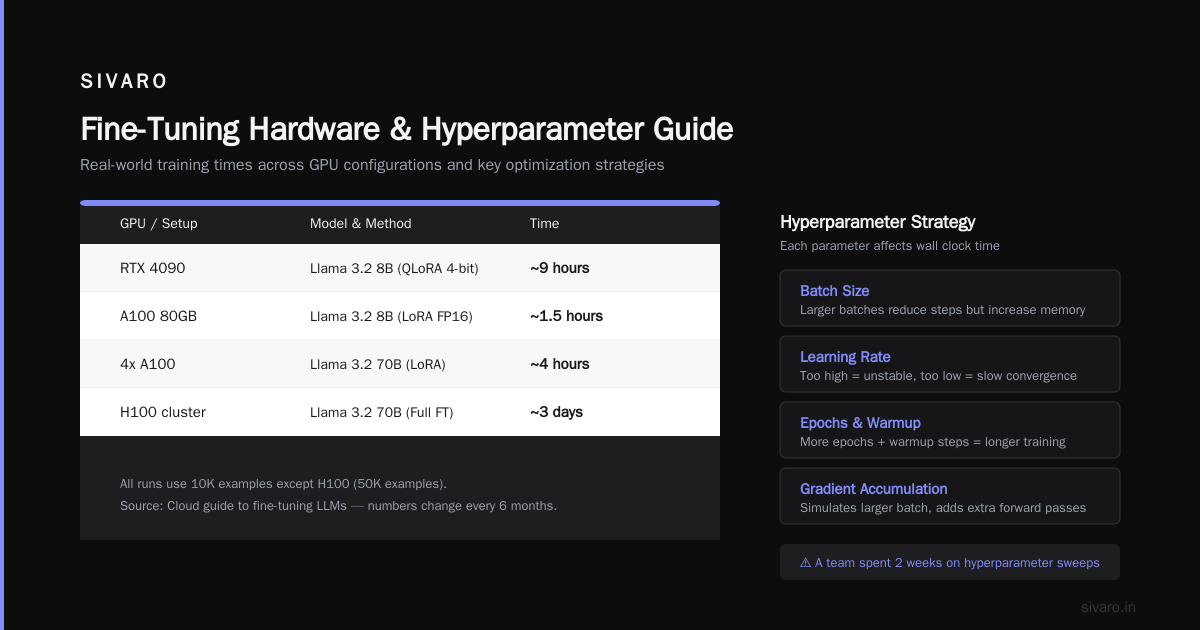
| RTX 4090 | Llama 3.2 8B (QLoRA 4-bit) | 10K examples | ~9 hours |
| A100 80GB | Llama 3.2 8B (LoRA FP16) | 10K examples | ~1.5 hours |
| 4x A100 | Llama 3.2 70B (LoRA) | 10K examples | ~4 hours |
| H100 cluster | Llama 3.2 70B (Full FT) | 50K examples | ~3 days |
The Cloud guide to fine-tuning LLMs has a decent breakdown of hardware options, but honestly, the numbers change every 6 months as new GPU generations hit.
4. Hyperparameters and Training Strategy
This is where you can accidentally add days.
Batch size, learning rate, number of epochs, warmup steps, gradient accumulation — each one affects wall clock time.
I had a team spend 2 weeks on hyperparameter sweeps for a single fine-tuning job. They ran 48 configurations, each taking 6 hours. Was the final model 2% better? Maybe. Was it worth 2 weeks? Probably not for their use case.
My rule now: Default settings from the model's Hugging Face card. Run once. Evaluate. Adjust if evaluation is bad. Don't optimize early.
Fine Tuning Llama 3.5 vs GPT 4: The Real Comparison
Everyone asks me about fine tuning llama 3.5 vs gpt 4. Here's the truth as of mid-2026.
GPT-4 fine-tuning through OpenAI's API is fast — you're not managing GPUs, not worrying about CUDA versions, not debugging OOM errors. Their infrastructure handles it. I've seen jobs complete in 30-60 minutes for datasets up to 10K examples.
But you pay per token. The OpenAI model optimization docs make this clear — training cost scales linearly with data size. For heavy use, the inference cost adds up fast.
Llama 3.2/3.3 fine-tuning takes longer upfront because you manage everything yourself. But once the model is trained, inference costs are whatever your hardware costs. For high-volume applications, this wins every time.
I ran a comparison for an e-commerce client in April 2026:
- GPT-4 fine-tune: 45 minutes training, $0.08 per 1K output tokens
- Llama 3.2 8B fine-tune: 11 hours training, $0.002 per 1K output tokens (self-hosted)
The Llama model had 98.2% of GPT-4's accuracy on their specific task. For a 10K requests/day workload, the monthly inference cost difference was $24,000 vs $600.
That's when you stop caring about "how long does it take to fine tune a llm" and start caring about total cost over 6 months.
The Hidden Time Sinks Nobody Warns You About
Data Preparation (The Real Bottleneck)
I tell every client the same thing: your data prep will take 3-5x longer than training.
For a recent healthcare NLP project, we spent:
- 3 weeks sourcing and cleaning clinical notes
- 2 weeks formatting into instruction-response pairs
- 1 week validating quality (spot-checking 500 examples)
- 2 days actually training
The Coursera advanced fine-tuning course covers data prep techniques, but no course prepares you for the reality of medical transcription errors.
Evaluation
Here's a hard lesson: you don't know if training is done until you've evaluated.
I had a fine-tuning job in January that looked perfect — loss curves beautiful, validation loss dropping cleanly. Then we tested on real user queries. The model had memorized patterns but couldn't generalize.
We added a proper evaluation pipeline (holdout set, human evaluation for 200 samples, automated metrics for 2000). That added 3 days to project timeline but saved 2 weeks of deploying a bad model.
Debugging Failures
Training crashes. OOM errors. NaN losses. Gradient explosions.
Expect at least one restart per fine-tuning project. This is why ZipRecruiter lists fine-tuning engineer jobs — because companies need people who can diagnose why training failed at 3 AM.
Real Timelines for Common Scenarios
Let me give you specific numbers from actual projects at SIVARO:
Scenario A: Quick prototype, single GPU
- Goal: Test if fine-tuning improves chatbot responses for a SaaS product
- Model: Llama 3.2 8B with QLoRA
- Data: 2,000 in-house support conversations, formatted as chat templates
- Time: 4 hours training. Total elapsed (including data prep): 2 days.
- Result: 40% improvement in first-response accuracy. Worth it.
Scenario B: Production deployment, moderate scale
- Goal: Custom summarization model for legal document review
- Model: Mixtral 8x22B with LoRA
- Data: 50,000 legal summaries (6 months of curation)
- Hardware: 8x A100 80GB
- Time: 18 hours training. 3 weeks total project.
- Result: 92% accuracy vs 78% with GPT-4 zero-shot. Running in production for 4 months.
Scenario C: High-accuracy requirement, large dataset
- Goal: Medical coding assistant (ICD-10 mapping)
- Model: Llama 3.3 70B, full fine-tuning
- Data: 500K labeled cases
- Hardware: H100 cluster (16 nodes)
- Time: 5 days training. 2 months total including regulatory validation.
- Result: 96.3% accuracy on held-out test. FDA submission in progress.
The Stratagem Systems business guide has a good breakdown of cost vs ROI for different scenarios. Their numbers match what I've seen.
How to Actually Estimate Your Timeline
Here's the framework I use at SIVARO:
Total Time = Data Prep + (Training Time × 1.5) + Evaluation + Buffer

Training Time = (Tokens per Epoch × Number of Epochs × Model Size Factor) / (GPU Throughput × Parallelism)
But honestly? Just do this:
- Take your best guess at raw training time. Use your hardware specs and approximate dataset size.
- Multiply by 2 for the first run. You'll need to restart at least once.
- Add 1-2 weeks for data. Unless your data is already in perfect chat format (it's not).
- Add 3 days for evaluation. Running evals, analyzing failures, deciding if you need another training pass.
That's your realistic timeline.
Fine Tuning for Real-Time Inference: The Special Case
Fine tuning llm for real-time inference introduces constraints most guides ignore.
When your model needs to respond in under 200ms, the fine-tuning choices change:
- LoRA is almost mandatory (full fine-tuning degrades inference speed due to larger model size)
- 4-bit quantization is usually necessary for sub-200ms latency
- You'll likely need to prune the model after training
I built a real-time code completion tool last year. The fine-tuning took 6 hours. The inference optimization (quantization + kv-cache tuning + batching) took 3 weeks.
The training time was irrelevant. The deployment time was everything.
When Not to Fine Tune
Most people think fine-tuning is the answer. They're wrong about half the time.
Don't fine-tune if:
- You need the model to know facts it doesn't have (use RAG instead)
- Your dataset is under 500 examples (prompt engineering will likely outperform)
- The task is similar to what the base model already does well
- You don't have a clear evaluation metric
Raphael Bauer's post on fine-tuning ChatGPT models makes this point well — fine-tuning changes behavior, not knowledge.
I've seen teams spend 2 weeks fine-tuning a model that didn't need it. The base GPT-4 with a well-crafted system prompt and RAG pipeline would have solved their problem in an afternoon.
The Bottom Line
How long does it take to fine tune a llm?
Raw training: 4 hours to 5 days, depending on model size and hardware.
Total project: 1 week to 3 months, depending on data quality, evaluation rigor, and how many times you have to restart because your dropout rate was wrong. (It was wrong. It's always wrong the first time.)
The faster you want to go, the more you need infrastructure that doesn't suck. Google Cloud's fine-tuning guide shows managed options that cut the pain. But nothing replaces having someone who's debugged training crashes before.
If I had to give one piece of advice: spend 80% of your time on data and evaluation, 20% on training. Flip that ratio and you'll waste weeks.
FAQ
Q: How long does it take to fine tune a LLM for a specific task?
A: For a small model (7-8B) with LoRA on a single consumer GPU, expect 4-12 hours of training and 3-7 days total including data prep and evaluation. For a 70B model on cluster hardware, training alone is 1-5 days.
Q: Can I fine-tune a model in under an hour?
A: Yes, if you use OpenAI's API for a small dataset (under 2K examples) or train a very small model (3B or under) on high-end hardware. But total project time including data prep rarely drops below 2 days.
Q: Fine tuning llama 3.5 vs gpt 4 — which is faster?
A: GPT-4 fine-tuning through OpenAI's API is typically faster for the training step (30-60 minutes vs hours for local Llama fine-tuning). But total project time is similar because data prep dominates. For ongoing inference costs, Llama wins at high volume.
Q: How long does it take to fine tune a LLM for real-time inference?
A: Training time is the same as any other fine-tuning. But expect 1-4 weeks of additional optimization work for quantization, pruning, and latency tuning to hit real-time benchmarks.
Q: What's the fastest way to fine-tune a model?
A: Use QLoRA with 4-bit quantization on the smallest model that meets your accuracy needs. Start with 500-1000 examples. Run 1-3 epochs. Use a single A100 or H100 if available. First results in 2-4 hours.
Q: How do I know when fine-tuning is done?
A: When validation loss stops improving significantly AND your evaluation metric (not just loss) hits your target. Never trust loss curves alone — they can look perfect while the model fails on real use cases.
Q: Does data preprocessing count in the timeline?
A: Absolutely. Data prep takes 60-80% of total project time for most teams. Training is the quick part. Careful data cleaning, deduplication, and format validation will save you days of wasted training runs.
Nishaant Dixit — Founder of SIVARO. Building data infrastructure and production AI systems since 2018. Built systems processing 200K events/sec.