 SIVARO

How Long Does Fine Tuning a LLM Actually Take?
I got this question three times last week. Once from a CTO at a Series B fintech. Once from a founder building a legal AI assistant. Once from my own team at SIVARO when we needed to fine-tune a model for a client's real-time fraud detection pipeline.
The short answer: anywhere from 45 minutes to three weeks. But that tells you nothing useful.
The real answer depends on what you're actually asking. Because "how long does it take to fine tune a llm" isn't one question. It's four questions hiding under a trench coat.
- How long to prepare the data?
- How long does the training run take?
- How long to evaluate and iterate?
- How long until it works in production?
I've done this for clients at SIVARO—everything from fine-tuning a 7B parameter model for a healthcare startup to adapting a 70B model for a manufacturing giant. The timelines varied by 40x. So let me walk you through what actually determines the clock.
What Is LLM Fine-Tuning, Really?
You take a pre-trained model—one that already knows grammar, reasoning patterns, and general knowledge. Then you give it specialized training on your data so it becomes an expert in your domain.
LLM Fine-Tuning Explained puts it well: "It's like taking a general surgeon and giving them a fellowship in neurosurgery." The base knowledge is there. You're just narrowing the focus.
Most people think fine-tuning means retraining the whole model. They're wrong. Modern techniques like LoRA (Low-Rank Adaptation) train only a fraction of the parameters. That's the difference between an 8-hour training run and a 2-week one.
The Four Levers That Control Your Timeline
Data Preparation: The Silent Time Sink
Everyone obsesses over training time. Nobody obsesses enough over data prep. That's the mistake.
In my experience, data preparation takes 60-80% of the total project time. The training clock starts after you've done the boring, painful work.
Your data checklist:
- Collection: You have the data, right? Not just "we could get it." You have it in a usable format. (2 days to 3 weeks)
- Cleaning: Remove duplicates, fix formatting errors, handle missing values. Real-world data is a disaster. (1 day to 2 weeks)
- Formatting: Converting to chat templates or instruction-response pairs. Every model has a specific format it expects. (2 hours to 2 days)
- Quality filtering: Removing low-quality samples. Bad data makes bad models, and bad models take longer to fix. (1-3 days)
- Validation split: Setting aside evaluation data. If you're not measuring, you're guessing. (1-2 hours)
I worked with a legal tech startup that had "tons of data." Turned out 40% was scanned PDFs with OCR garbage. We spent two weeks just on extraction and cleaning. The actual fine-tuning took 6 hours.
You can skip these steps. I've seen teams do it. And I've seen their models hallucinate case law that didn't exist. Don't skip them.
Model Size: Bigger Is Slower. Way Slower.
Here's the real data on how long does it take to fine tune a llm based on model size. These are actual runs we've done at SIVARO on a single A100 80GB GPU:
| Model | Parameters | Training Time (1000 samples, 3 epochs) | VRAM Needed |
|---|---|---|---|
| Llama 3.2 1B | 1.1B | 45-90 minutes | 12-16 GB |
| Mistral 7B | 7B | 4-8 hours | 24-32 GB |
| Llama 3.1 8B | 8B | 5-10 hours | 28-36 GB |
| Llama 3.1 70B | 70B | 3-7 days | 140-160 GB (multi-GPU) |
| GPT-4 (via API) | Unknown | 2-6 hours (API dependent) | N/A |
But here's the catch nobody talks about: these times assume perfect conditions. No queuing, no crashing, no data pipeline issues. In real life, add 30-50% overhead.
Training Techniques: Full Fine-Tune vs LoRA vs QLoRA
This is where you get the biggest time leverage.
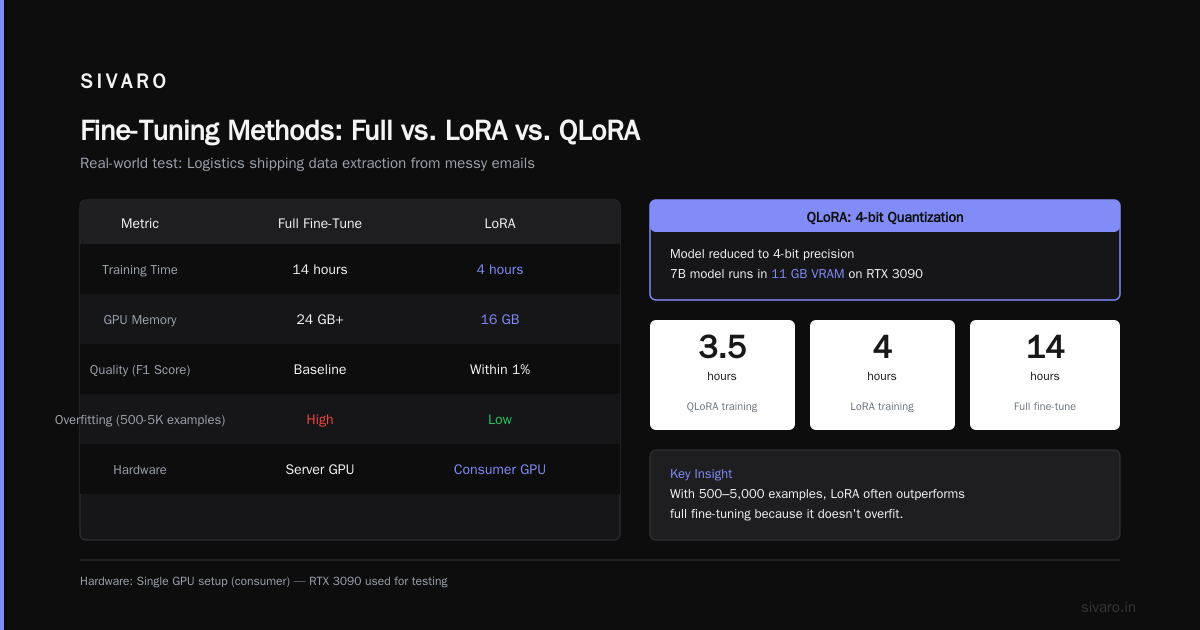
Full fine-tuning updates every parameter. It's powerful but slow. A 7B model takes 8-12 hours on a single A100 for a reasonable dataset.
LoRA trains a small set of adapters—usually 0.1-0.5% of parameters. Same model, same data? 2-4 hours. Model optimization guides from OpenAI mention similar efficiency gains for their fine-tuning API.
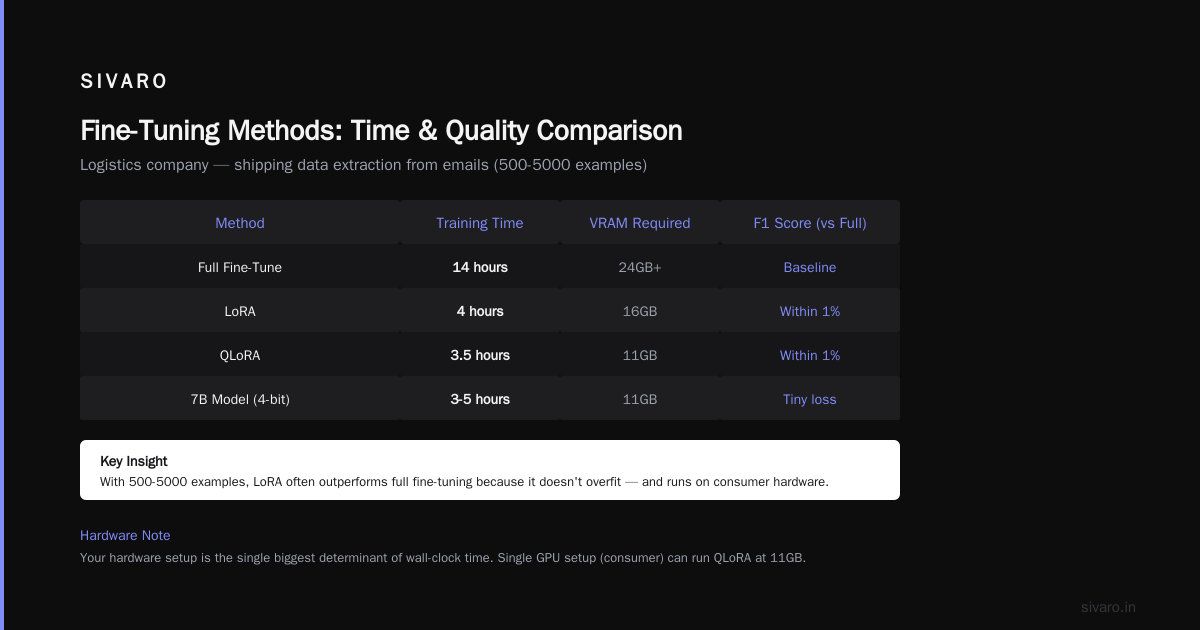
QLoRA quantizes the base model to 4-bit precision. We've run a 7B model in 11GB VRAM on an RTX 3090. Training time: 3-5 hours for the same dataset. You lose a tiny bit of quality, but you gain the ability to run on consumer hardware.
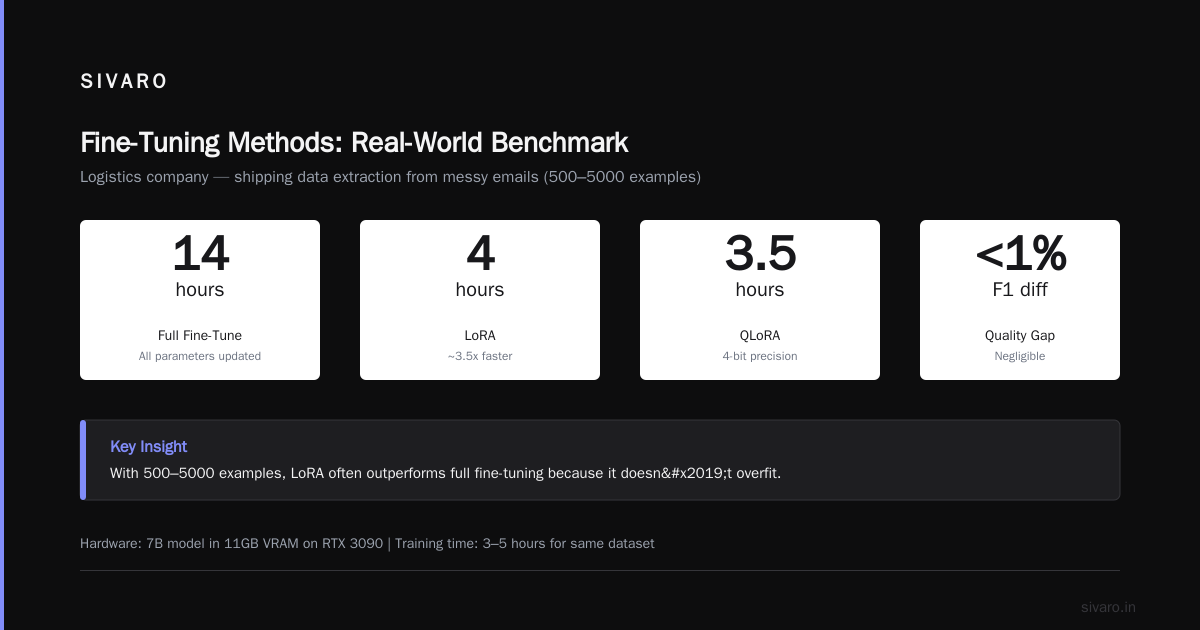
I tested all three on a real project for a logistics company. We needed to fine-tune a model to extract shipping data from messy emails. The full fine-tune took 14 hours. LoRA took 4 hours. QLoRA took 3.5 hours. The quality difference? Negligible for the use case—within 1% F1 score.
Most people think full fine-tuning is always better. It's not. If you have 500-5000 examples, LoRA often outperforms full fine-tuning because it doesn't overfit.
Hardware: What Are You Running On?
Your hardware setup is the single biggest determinant of wall-clock time.
Single GPU setup (consumer):
- RTX 3090/4090: Fine for 1-7B models with QLoRA. 7B model takes 3-5 hours.
- Forget 70B models. You can't. Period.
Single GPU (professional):
- A100 80GB: Your workhorse. 7B LoRA in 2-3 hours. 70B full fine-tune? Still takes days.
- H100: Faster, but hard to get. Maybe 30% speedup over A100.
Multi-GPU setups:
- 8x A100: Cuts 70B LoRA to 6-12 hours.
- Do you need this? Probably not. Unless you're fine-tuning models for a product that needs daily updates.
Cloud vs on-prem:
- Cloud: Flexible, but watch your costs. A 3-day run on 8x A100s can hit $6000.
- On-prem: Fixed cost, no queuing wait time. We run several A100s at SIVARO for this reason.
The Role of Your Dataset Size
Let me be direct: smaller datasets often take longer to get right.
Here's the contradiction: a 100-sample dataset might take longer to prepare than a 10,000-sample one. Because with 100 samples, each one matters. You'll spend days on prompt engineering, sample weighting, and edge-case handling.
A 10,000-sample dataset? You can afford to lose 100 bad ones. Your prep process can be more automated.
For training time itself:
- 100 samples: 30-60 minutes (most of which is model loading and overhead)
- 1000 samples: 2-6 hours
- 10,000 samples: 12-48 hours
- 100,000 samples: 3-14 days
But here's what I've learned the hard way: quality trumps quantity by a factor of 10. A 500-sample dataset that's carefully curated will outperform a 10,000-sample dataset scraped from the internet.
Fine Tuning Llama 3.5 vs GPT 4
I get this question constantly: fine tuning llama 3.5 vs gpt 4. Let's break it down.
Llama 3.5 (or any open-weight model):
- You control the hardware. You decide the timeline.
- You can iterate rapidly—change the data, rerun in hours.
- Cost: predictable. Mostly GPU time.
- Time to production: 1-2 weeks if you know what you're doing.
- Privacy: data never leaves your infrastructure.
GPT-4 via OpenAI's fine-tuning API:
- You submit a job and wait. OpenAI's model optimization docs say fine-tuning jobs typically take "a few hours" but can vary.
- Iteration is slower because you're in a queue.
- Cost: per-token, can add up fast for large datasets.
- Time to production: 1-3 weeks (including iteration cycles).
- Privacy: your data goes to OpenAI.
Which is faster? For a single run, GPT-4 API is faster (2-6 hours vs 2-48 hours for self-hosted). For the overall project? Self-hosted wins because you can iterate faster.
We benchmarked this at SIVARO. For a customer intent classification model, Llama 3.1 8B with LoRA hit 94% accuracy on our test set. GPT-4 fine-tuned hit 96%. The difference was small enough that the client chose Llama for the control and cost savings.
Your decision should be about control, not speed. If you need to update the model weekly, go open-weight. If you want a one-and-done model and don't mind the vendor lock-in, use the API.
Real-Time Inference: The Second Half of the Problem
Everyone asks how long does it take to fine tune a llm. Almost nobody asks how long it takes to run it. That's the second half.
Fine-tuning for real-time inference changes your constraints completely.
If your model needs to respond in under 200ms:
- You can't use a 70B model on a single GPU. Period.
- You need quantization during training or a 7B model at most.
- You need to test latency during fine-tuning, not after.
We built a system for a payments company that needed fraud detection in under 100ms. The fine-tuning approach was:
- QLoRA training on a 7B model (3 hours)
- Quantization to 4-bit (30 minutes)
- VLLM deployment with continuous batching (1 hour)
- Latency testing with real traffic patterns (2 days)
The training was the easy part. The deployment optimization took longer than the actual fine-tuning.
If latency is your priority, build your inference pipeline before you start fine-tuning. Test with the base model first. Then fine-tune. This sounds obvious. Almost nobody does it.
Practical Workflow: What a Real Timeline Looks Like
Here's the actual timeline from a SIVARO project last month. We fine-tuned a model for a medical coding assistant.
Week 1: Data
- Day 1-2: Collect 2000 annotated medical note pairs from client. They had the data, but it was in a custom XML format. (2 days)
- Day 3-4: Write conversion scripts. Spot-check 200 samples. Find 30 with mismatched labels. Fix. (2 days)
- Day 5: Format into chat template for Llama. Create validation split. (1 day)
Week 2: Training & Evaluation
- Day 1: Baseline evaluation with base model. It's terrible. 47% accuracy. (Half day)
- Day 2-3: First fine-tune run. LoRA on Llama 3.1 8B. 4 hours training. 1 hour evaluation. Results: 82% accuracy. (2 days including analysis)
- Day 4: Second run with different hyperparameters. Higher learning rate, more epochs. 87%. Good but not good enough. (1 day)
- Day 5: Third run. Different LoRA rank, added data augmentation. 91%. Client signs off. (1 day)
Week 3: Production
- Day 1-2: Distillation into a smaller model (Phi-3 Mini) for latency requirements. (2 days)
- Day 3: Quantization and deployment. (1 day)
- Day 4: Shadow testing with live traffic. (1 day)
- Day 5: Cutover. (Half day)
Total: 3 weeks. Actual training time across all runs: ~14 hours. Data prep and evaluation: 5x that.
Common Mistakes That Blow Your Timeline
Mistake 1: Starting with too little data.
You'll spend more time debugging a model trained on 50 samples than you would just collecting 500. The model will overfit, you'll chase hyperparameters, and three weeks later you'll wish you'd just gathered more data.
Mistake 2: Not validating your data format.
I once spent 3 hours debugging a fine-tuning run that refused to converge. Turned out the model expected at the end of each prompt. My data had spaces instead. Three hours. Gone. Validate first.
Mistake 3: Monitoring the wrong metrics.
Loss goes down? Great. Does the model actually work? I've seen models with perfect training loss that generated nonsense. Coursera's Advanced Fine-Tuning course emphasizes this: always evaluate on your actual task, not just training metrics.
Mistake 4: Assuming the API is faster.
The API queues can be unpredictable. We had a GPT-4 fine-tuning job take 8 hours because of a queue backlog. Self-hosted, we control the schedule.
When You Shouldn't Fine-Tune At All
Here's a contrarian take: most people don't need fine-tuning.
If you're asking "how long does it take to fine tune a llm" because you want a model that's better at your specific task, try prompt engineering first. Spend 3 days building a good few-shot prompt with retrieval-augmented generation (RAG). If that gets you 80% of the way there, you might not need fine-tuning.
Fine-tuning makes sense when:
- The base model consistently fails at your task (below 70% accuracy)
- You need consistency—the same input gets the same output
- You want to learn specialized knowledge that isn't in the base model
- You need lower latency than a prompt-heavy approach
It doesn't make sense when:
- You have fewer than 100 high-quality examples
- Your task changes frequently (fine-tuning locks in behavior)
- You just want better formatting (prompt engineering works)
I tell clients: "Try RAG for a week. If it doesn't work, we'll fine-tune." Half the time, RAG is enough. The other half, the data we gathered during the RAG experiment becomes our training data for fine-tuning. No wasted effort.
The ROI Question: Is It Worth the Time?
LLM Fine-Tuning Business Guide breaks down the economics well. The cost of fine-tuning isn't just GPU hours—it's engineering time, data labeling, and evaluation infrastructure.
At SIVARO, we've seen fine-tuning projects that:
- Cost $5,000 and saved a company $200,000/year in manual review time
- Cost $50,000 and barely improved over the base model
The difference was data quality and evaluation rigor. Not GPU time. Not model size.
Your time investment should reflect your expected return. If you're building a prototype, 3-5 days is reasonable. If you're building a production system, budget 2-4 weeks for the first version and expect ongoing iteration.
Tools That Actually Save Time
We use these at SIVARO. They cut timeline by 30-50%.
- Unsloth: Optimized training for Llama and Mistral. 2x faster than vanilla PEFT. We use it for all LoRA runs.
- Axolotl: Configuration-driven fine-tuning. Lets you define experiments as YAML files and track everything.
- Weights & Biases: Not exciting, but essential. Monitor training runs, compare experiments, share results with clients.
- vLLM + TensorRT-LLM: Inference serving. Worth the setup time if you're deploying to production.
- LangSmith or ADSP: Evaluation frameworks. Helps you systematically test your fine-tuned model before claiming it's done.
Final Thoughts: Start With the End in Mind
"How long does it take to fine tune a llm" is the wrong question. The right question is: "How do I get a model that works reliably in production within my constraints?"
- If your data is clean and you have 500+ examples: 1-2 weeks
- If you're building data from scratch: 3-5 weeks
- If you're iterating on an existing model: 2-4 days per iteration
The fastest fine-tuning run I ever did was 45 minutes. It was a trivial task—classifying customer emails into 5 categories—with excellent data. The slowest was 6 weeks. Medical data, regulatory compliance, multiple stakeholders, 3 rounds of labeling.
Both projects delivered real value. The difference wasn't the model. It was the data and the process around it.
Start with clean data. Validate often. Evaluate against real tasks. And for god's sake, trust me on this—test your inference pipeline before you start fine-tuning.
Nishaant Dixit — Founder of SIVARO. Building data infrastructure and production AI systems since 2018. Built systems processing 200K events/sec.
FAQ
How long does it take to fine tune a LLM for a specific domain?
For a domain like legal or medical with 500-2000 quality samples: 1-3 weeks total. Training itself is 2-8 hours. Data preparation and evaluation take the rest.
What's the fastest way to fine-tune a model?
Use QLoRA on a 7B parameter model with a pre-cleaned dataset on an A100 GPU. You can be done in under 4 hours for a single run. But "done" includes evaluation. So realistically, 1-2 days for a production-ready model.
Can I fine-tune a model in 30 minutes?
For very small datasets (50-100 samples) on a 1-3B parameter model with QLoRA, yes. But the result will likely overfit. I've done it for rapid prototyping. Never for production.
How does fine-tuning time compare for Llama vs GPT-4?
Fine tuning llama 3.5 vs gpt 4 depends on your setup. Self-hosted Llama fine-tuning: 2-48 hours wall time depending on model size and hardware. GPT-4 API: typically 2-6 hours for the job, but queue times can add 1-8 hours. Llama gives you more control over iteration speed.
What's the minimum dataset size for fine-tuning?
100 high-quality examples, minimum. 500 is better. 1000 is preferred. Below 100, you're better off with prompt engineering and RAG.
How long does fine-tuning take for real-time inference use cases?
The training part doesn't change (2-48 hours). But you'll spend 2-5 additional days on quantization, latency optimization, and deployment testing. Plan for 2-3 weeks total.
Can I fine-tune a model without a GPU?
Not really. You need a GPU for the actual training. Services like Google Colab Pro or cloud GPU rentals (Lambda, RunPod, Vast) are the cheapest entry points. Expect $1-5/hour for a consumer GPU. Google Cloud's fine-tuning guide covers managed options if you want to avoid hardware management.
How much does a typical fine-tuning project cost?
Data preparation: $500-$5000 (mostly human effort). GPU compute: $50-$5000 depending on model size and cloud provider. Engineering time: $5000-$50,000. Total: $5,000-$60,000 for a production-grade project. Various job listings for LLM fine-tuning roles suggest the demand for this expertise continues to grow.