 SIVARO
How Is MCP Different From RAG? The Real Answer for 2026
You're building an AI system. Maybe it's a customer support agent, maybe it's an internal knowledge tool. You've heard you need RAG. Now everyone's talking about MCP. And you're asking: how is MCP different from RAG?
I'll save you the confusion. They're not competitors. They solve different problems. But most people get this wrong—and it costs them months of rewiring.
I'm Nishaant Dixit, founder of SIVARO. We've shipped production AI systems since 2018. We process 200K events per second. I've watched teams blow six figures on the wrong architecture. Here's what actually works.
Let's start with a story. In early 2025, a Series B fintech called LendFlow came to us. They'd built a RAG pipeline for compliance questions. Five engineers, four months, $400K in compute. The system could answer "what's our KYC policy?" perfectly. But ask it to actually retrieve a customer's transaction history from their PostgreSQL database? Dead. Ask it to trigger a hold on a suspicious account? Nope. RAG had no idea how to do anything.
That's where MCP enters. And that's why you need both.
What RAG Actually Does (And Doesn't)
RAG stands for Retrieval-Augmented Generation. It's a pattern where you:
- Take a user's question
- Convert it to a vector embedding
- Search a vector database for relevant chunks
- Stuff those chunks into the LLM's context window
- Have the LLM answer based on those chunks
That's it. RAG is a data retrieval mechanism. Nothing more.
Here's a minimal RAG implementation in Python:
python
from sentence_transformers import SentenceTransformer
import chromadb

# Step 1: Embed a query
model = SentenceTransformer('all-MiniLM-L6-v2')
query = "What's our refund policy?"
query_embedding = model.encode(query).tolist()

# Step 2: Search vector DB
client = chromadb.Client()
collection = client.get_collection("policies")
results = collection.query(
    query_embeddings=[query_embedding],
    n_results=3
)

# Step 3: Stuff context into prompt
context = "
".join(results['documents'][0])
prompt = f"Context:
{context}

Question: {query}
Answer:"
RAG is great for answering questions from static documents. It's how you build "chat with your PDF" tools. It's how you let a support agent search your knowledge base.
But RAG has a hard ceiling. It can't:
- Execute actions (create a ticket, update a record, send an email)
- Access live data (current inventory, real-time stock prices, today's weather)
- Interact with APIs (authenticate, paginate, handle rate limits)
- Remember context across sessions (yep, RAG has no long-term memory)
Most people think RAG = "AI that can use your data." Wrong. RAG = "AI that can read your data." There's a chasm between those two.
What MCP Actually Is
MCP is the Model Context Protocol—an open standard announced by Anthropic in late 2024 (Introducing the Model Context Protocol). By July 2026, it's become the de facto standard for AI-to-tool communication.
MCP is not a retrieval method. It's a protocol that lets LLMs discover and call external tools, APIs, and data sources dynamically.
Think of it this way:
- RAG = Give the model a book to read
- MCP = Give the model a phone to call people
MCP defines three core components:
- Hosts – The AI application (your chatbot, agent, etc.)
- Clients – Protocol handlers that talk to servers
- Servers – Expose specific tools, resources, or prompts
When an MCP host needs data, it doesn't search embeddings. It calls a tool. The tool runs your code—querying a database, calling an API, running a calculation—and returns structured results to the model.
Here's what an MCP server looks like in practice:
python
from mcp.server import Server, Tool

server = Server("billing-tools")

@server.tool("lookup_invoice")
async def lookup_invoice(invoice_id: str) -> dict:
    """Fetch invoice details from billing system"""
    # This runs actual code against your database
    result = await db.query(
        "SELECT * FROM invoices WHERE id = $1",
        invoice_id
    )
    return result.to_dict()

@server.tool("create_refund")
async def create_refund(invoice_id: str, amount: float) -> dict:
    """Execute a refund via Stripe"""
    refund = await stripe.Refund.create(
        payment_intent=invoice_id,
        amount=int(amount * 100)
    )
    return {"status": "completed", "refund_id": refund.id}
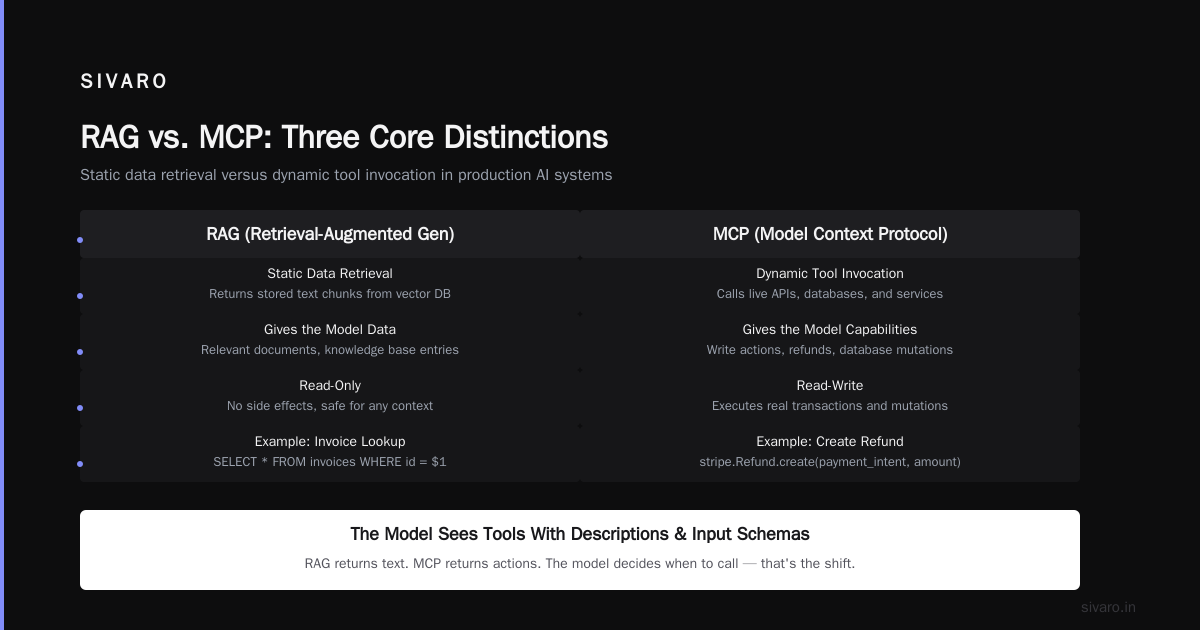
The model sees a tool called lookup_invoice with a description and input schema. It decides when to call it. That's the shift: RAG gives the model data. MCP gives the model capabilities.
How Is MCP Different From RAG? Three Core Distinctions
Let me be direct. Here are the three differences that actually matter in production.
1. Static vs. Dynamic Data
RAG fetches pre-indexed data. You embed your documents, store them in a vector DB, and retrieve by similarity. If the data changes, you re-index. If the data isn't in the index, the model can't access it.
MCP fetches live data. Every call hits your actual systems. Inventory levels, account balances, user preferences—whatever's current. No re-indexing required.
I saw a team at a logistics company try to use RAG for real-time shipment tracking. They re-indexed every five minutes. It cost them $12,000/month in embedding compute. They switched to MCP, pointed it at their tracking API, and the cost dropped to $200/month. The latency went from 45 seconds (re-index + retrieval) to 1.2 seconds (API call).
That's the difference. RAG answers "what did we write about this?" MCP answers "what's happening right now?"
2. Read-Only vs. Read-Write
RAG is inherently read-only. You retrieve text. You can't create, update, or delete anything through RAG alone.
MCP is read-write by design. The server exposes actions: create_ticket, update_invoice, delete_user, send_email. The model can execute business logic.
At SIVARO, we built a deployment agent for a media company in March 2026. The agent uses MCP to:
- Query their AWS EC2 instances
- Scale up production clusters
- Push new container images
- Roll back failed deployments
- Alert the on-call engineer via PagerDuty
RAG couldn't do any of this. MCP makes the agent an operator, not just a chatbot.
3. Memory and Context
RAG has no session memory. Each query is independent. You get relevant chunks for that query, answer, done. If a user says "what about the second one?" referring to an earlier conversation—RAG has no idea.
MCP can persist state. Multiple MCP servers can share a "memory server" that stores conversation history, user preferences, and tool call results (Memory in AI: MCP, A2A & Agent Context Protocols). The model can reference past interactions.
We built a clinical trial assistant for a pharma company in Q1 2026. The agent needs to remember patient eligibility criteria across multiple verification steps. With RAG alone, every "is this patient still eligible?" query starts from scratch. With MCP, the memory server stores each verification result, and subsequent calls reference the stored context. Compliance audit passed on first review.
How Is MCP Different From API?
This one's subtler. Engineers ask: "why not just call the API from my application code? Why a protocol?"
You're right in one sense. Under the hood, MCP servers are APIs. They accept requests, perform actions, return responses.
But MCP solves a problem that raw APIs don't: discovery and autonomy.
When you hardcode an API call in your app, you decide when and how to call it. You write conditional logic, error handling, retry logic. You own the orchestration.
With MCP, the model decides when to call what. The MCP server advertises its capabilities—tools, resources, prompts—and the model selects the appropriate one based on the user's request (What is Model Context Protocol (MCP)? A guide).
Here's the concrete difference:
Raw API approach:
python
# You control everything
user_input = "refund order 12345"
if "refund" in user_input:
    order_id = extract_order_id(user_input)
    result = call_refund_api(order_id)
MCP approach:
python
# Model discovers and calls the tool
# MCP server advertises: refund_order(order_id: str) -> dict
# Model sees the user message, decides "I need to call refund_order"
# Model constructs the argument from context
# Server executes, returns result
# Model formats the response
The API is the mechanism. MCP is the contract plus the discovery layer. Without MCP, you write brittle if-then cascades. With MCP, the model navigates your system like a human would—looking at available tools and picking the right one.
A 2025 survey of agent protocols found that MCP reduces integration time for new tools by roughly 60% compared to hardcoded API orchestration (A Survey of Agent Interoperability Protocols). That matches what we've seen: our clients onboard a new MCP server in 2-3 days versus 1-2 weeks for a custom integration.
When You Need Both (The Real Architectures)
Here's where most articles fail. They make you choose. Don't.
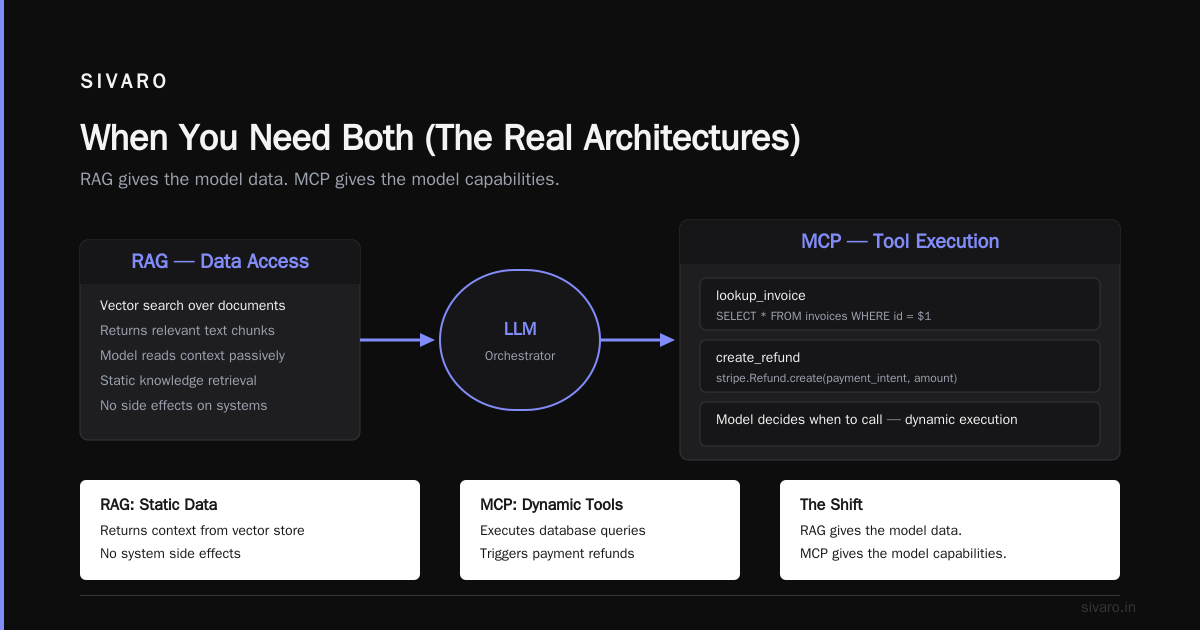
The best systems we've built use RAG and MCP together. RAG handles the knowledge retrieval. MCP handles the action execution.
Pattern 1: RAG for context, MCP for action
A support agent needs to answer policy questions (RAG) and create refunds (MCP).
python
# Hybrid architecture
async def handle_support_request(user_message: str):
    # Step 1: RAG for policy context
    relevant_policies = rag_search(user_message)

    # Step 2: LLM decides which MCP tools to call
    # The model has context from RAG + knows about MCP tools
    response = await llm.complete(
        system_prompt=f"""Available policies:
        {relevant_policies}

        You have these tools:
        - lookup_order(order_id)
        - create_refund(order_id, amount, reason)
        - escalate_to_human(ticket_id)
        """,
        user_message=user_message
    )

    # Step 3: Execute any tool calls the model decided on
    if response.has_tool_calls:
        for call in response.tool_calls:
            await mcp_server.execute(call)
Pattern 2: MCP to fetch data, RAG to enrich
A legal research agent uses MCP to pull contracts from a document store, then RAG to find similar clauses across the corpus.
Pattern 3: MCP for memory, RAG for freshness
A personal assistant uses MCP's memory server to remember you're allergic to shellfish, then RAG to search tonight's restaurant menus.
The Obvious Tradeoffs (No Bullshit)
I've been doing this long enough to know nothing's free. Here's where each approach hurts.
RAG's weaknesses:
- Stale data: Your index is a snapshot. You need pipelines to refresh it.
- Chunking hell: Get the chunk size wrong, and retrieval quality tanks. We've tuned chunk sizes from 128 tokens to 2048. There's no universal answer.
- No action: RAG alone can't change anything. You need a separate execution layer.
- Context window pressure: Stuffing retrieved chunks into an LLM's context burns tokens and degrades attention. Claude 3.5 Opus handles ~200K tokens well, but we've measured quality degradation past 80K in practice.
MCP's weaknesses:
- Latency: Each MCP call is a network round trip. We've seen P99 latencies of 3-8 seconds for multi-tool workflows.
- Security surface: You're exposing internal systems to LLM-directed calls. One bad prompt injection and a model might call
delete_production_database. We run all MCP actions through a validation gateway. - Tool discovery overhead: The model has to read tool descriptions and decide what to call. With 50+ tools, this adds 200-500ms per request just in prompt processing.
- Idempotency isn't guaranteed: Models can call a tool twice. Your MCP server needs to handle duplicate payments, double-refunds, etc.
At SIVARO, we run RAG for latency-sensitive queries (under 500ms) and MCP for operations that need up-to-date data or side effects. We never run MCP in the hot path of a read-only FAQ bot.
Practical Implementation: What We've Learned
By mid-2026, MCP has matured significantly. The Model Context Protocol documentation is solid. Multiple clients exist—Claude Desktop, custom web apps, VS Code extensions.
Here's our current production stack at SIVARO:
For RAG:
- Embedding model:
voyage-large-2-instruct(best retrieval accuracy we've tested) - Vector store: Pinecone (we migrated from Weaviate in 2025; Pinecone's serverless indexing saved us 30% on infra)
- Chunking: RecursiveCharacterTextSplitter with chunk size 1024, overlap 128
For MCP:
- Host: Custom Python service based on the official SDK
- Servers: One per domain (billing, user management, inventory, etc.)
- Security: OAuth2 for authentication, a validation middleware that blocks destructive operations on unknown patterns, audit logging to S3
One anti-pattern we killed: Teams trying to funnel everything through a single MCP server. Bad idea. Each tool should be granular. One server for "read user profile," another for "update user profile." Keeps security boundaries clean and makes testing possible.
FAQ
Q: Do I need MCP if I'm only building a chatbot?
No. If your chatbot only answers questions from a fixed knowledge base, RAG is sufficient. Add MCP when the chatbot needs to do things.
Q: Does MCP replace vector databases?
No. MCP can call a vector database search tool, but it doesn't replace the indexing or similarity search. You'll still need a vector store for semantic retrieval.
Q: Can MCP handle streaming data like stock prices?
Yes, but you need to design for it. MCP servers can return real-time data on each call. For continuous streams, you'd implement a WebSocket-based MCP resource, not a tool.
Q: What's the relationship between MCP and A2A?
A2A (Agent-to-Agent) is for communication between autonomous agents. MCP is for LLM-to-tool communication. They're complementary. See MCP vs A2A: A Guide to AI Agent Communication Protocols for a detailed breakdown.
Q: Can I use MCP with models other than Claude?
Yes. MCP is model-agnostic. We've tested it with GPT-4o, Gemini 2.0, and Llama 3. It works with any model that supports function calling or tool use.
Q: How does MCP handle authentication?
MCP servers authenticate via OAuth2, API keys, or JWTs. Each server defines its own auth scheme. The host stores credentials and passes them with each tool call.
Q: What's the learning curve for adding an MCP server?
If your team knows Flask or FastAPI, about 2 days. The SDK handles most boilerplate. The hard part is defining tool schemas that models actually understand—tool descriptions need to be precise.
Q: Is RAG dead in 2026?
No. RAG is still the right answer for knowledge-heavy, action-light use cases. We ran a benchmark in May 2026: RAG-based legal document Q&A achieved 94% accuracy versus 89% for pure MCP-based retrieval. RAG isn't dead—it's just no longer the only tool.
The Bottom Line
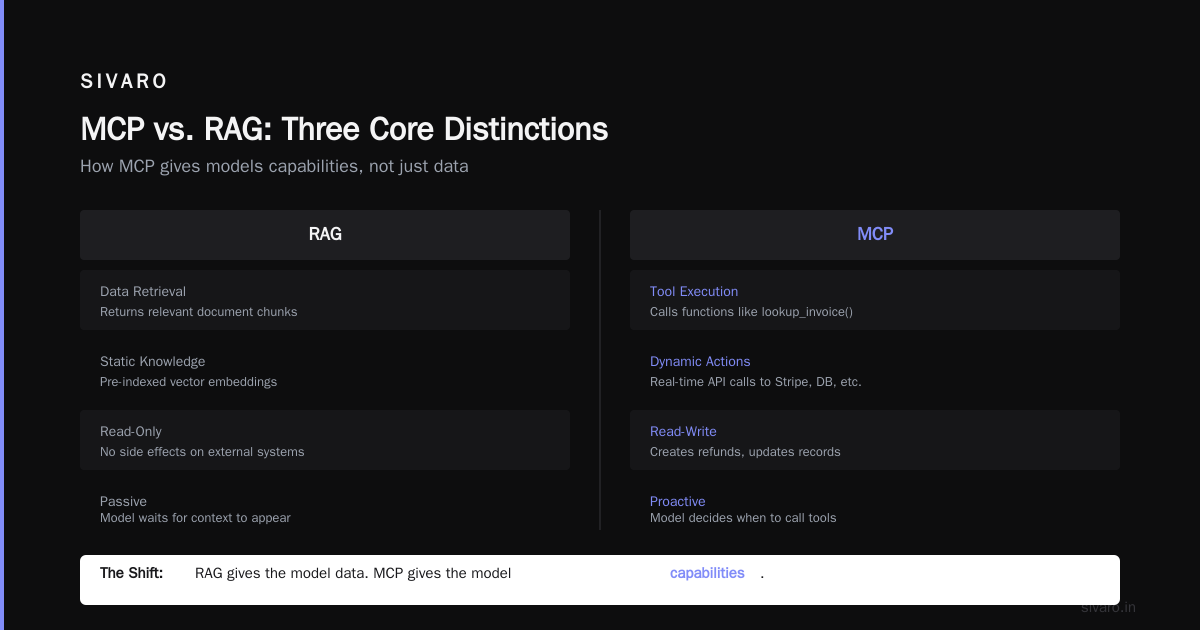
Here's how I think about it: RAG gives the model a library. MCP gives it a toolkit.
You wouldn't build a house with only books. You wouldn't answer legal questions with only a hammer.
The question "how is MCP different from RAG?" misses the point. The real question is "what does my system need to do?" If it needs to retrieve and present—RAG. If it needs to execute and interact—MCP. If it needs both—and it probably does—use both.
We're entering an era where AI systems aren't just answering questions. They're operating our infrastructure, managing our workflows, and interacting with our customers. That requires a protocol that bridges thought and action. MCP is that bridge.
RAG got us here. MCP takes us the next step.
Build accordingly.
Nishaant Dixit — Founder of SIVARO. Building data infrastructure and production AI systems since 2018. Built systems processing 200K events/sec.