 SIVARO
How Is MCP Different From API? A Practitioner's Guide
July 19, 2026
I spent three weeks last year trying to make an LLM reliably query my company's customer database. We had REST endpoints. We had GraphQL. We had a perfectly good API gateway. And the model still couldn't figure out which endpoint to call, with what parameters, and what to do when the response came back malformed.
That's when I stopped thinking about APIs as the answer to AI integration.
Here's the short version: An API tells you how to call a function. MCP tells an AI what functions exist, why it might want them, and how the results connect to everything else the model needs to know. They're not competitors. They're different layers of abstraction for different consumers.
By the end of this guide, you'll know exactly when to use which, and why "how is MCP different from API?" is the wrong question — but the one you need to answer before you build another AI integration.
What Actually Is MCP?
Let's start with the definition from the source. The Model Context Protocol is an open standard Anthropic released in late 2024. It's a protocol for giving LLMs structured access to tools, data sources, and context in a way that models can discover and use autonomously.
Think of it as a standardized contract between AI models and the systems they interact with. Not just endpoints — but the full lifecycle of discovery, invocation, and context management.
MCP defines three core primitives:
- Resources — data that the model can read (files, database records, API responses)
- Tools — actions the model can execute (send email, create ticket, run query)
- Prompts — pre-written templates the model can use to structure its output
Each one comes with metadata that describes what it does, not just how to call it.
Compare that to a typical REST API. Your /api/users/:id endpoint returns a JSON payload. But it doesn't tell the caller what "user" means in your domain model, which fields are required for updates, or what happens if you POST without an authorization header. That's fine for a human developer reading docs. It's terrible for an LLM trying to act autonomously.
The Core Difference: Discovery vs. Contract
Let me say this plainly.
An API is a contract. You sign it, you implement it, you version it. The consumer knows exactly what to expect because they read your OpenAPI spec or your Postman collection.
MCP is a discovery mechanism. The model asks "what can you do?" and your MCP server responds with a manifest of tools, resources, and prompts, each described in semantic terms the model can parse.
Here's the practical difference. When you build an API, you're designing for another developer. When you build an MCP server, you're designing for an LLM. Those two consumers have radically different needs.
A developer reads documentation once and memorizes the patterns. An LLM reads schema every single time it connects. A developer can handle ambiguous error messages. An LLM will hallucinate a workaround that deletes your production database. A developer knows which fields are optional. An LLM needs to be told explicitly, with examples, what valid values look like.
I learned this the hard way when our first MCP server returned a tool that said "parameter: email (string)". The model tried to call it with "user@company.com" when the underlying API expected "email":"user@company.com" as a JSON body field. The tool description was technically correct. But it wasn't specific enough for an LLM.
Anthropic's announcement from November 2024 made this distinction clear: MCP isn't a new transport protocol. It's a protocol for context. The model doesn't just call endpoints — it receives context about what those endpoints do, why they exist, and how to interpret the results.
How Is MCP Different From RAG?
This is the question I get most often from engineering teams. "How is MCP different from RAG?" And the answer reveals a fundamental misunderstanding of both.
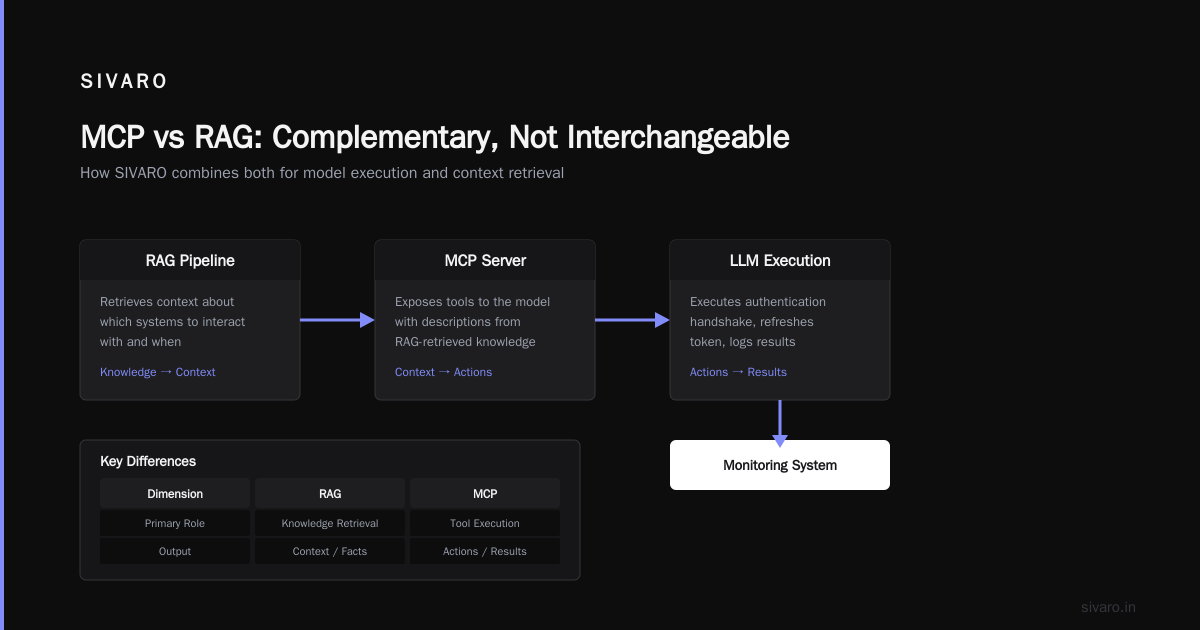
RAG (Retrieval-Augmented Generation) is a pattern for injecting relevant documents into an LLM's context window at inference time. You index your knowledge base, embed the chunks, and retrieve the most relevant ones when a user asks a question. It's about retrieving information.
MCP is about interacting with systems. RAG gives the model facts. MCP gives the model tools.
Here's concrete: If you have a Confluence page about your API authentication flow, you'd use RAG to let the model answer questions about it. If you want the model to actually execute an authentication handshake, refresh a token, and log the result to your monitoring system, you need MCP.
They complement each other. We run both at SIVARO. Our RAG pipeline feeds our MCP tools with context about which systems to interact with and when. The MCP server then exposes those tools to the model with descriptions generated from the RAG-retrieved knowledge.
But they're not interchangeable. If your architecture treats them as the same thing, you'll end up with a model that knows facts but can't act, or a model that can act but doesn't know what it's doing.
How MCP Changes the Integration Game
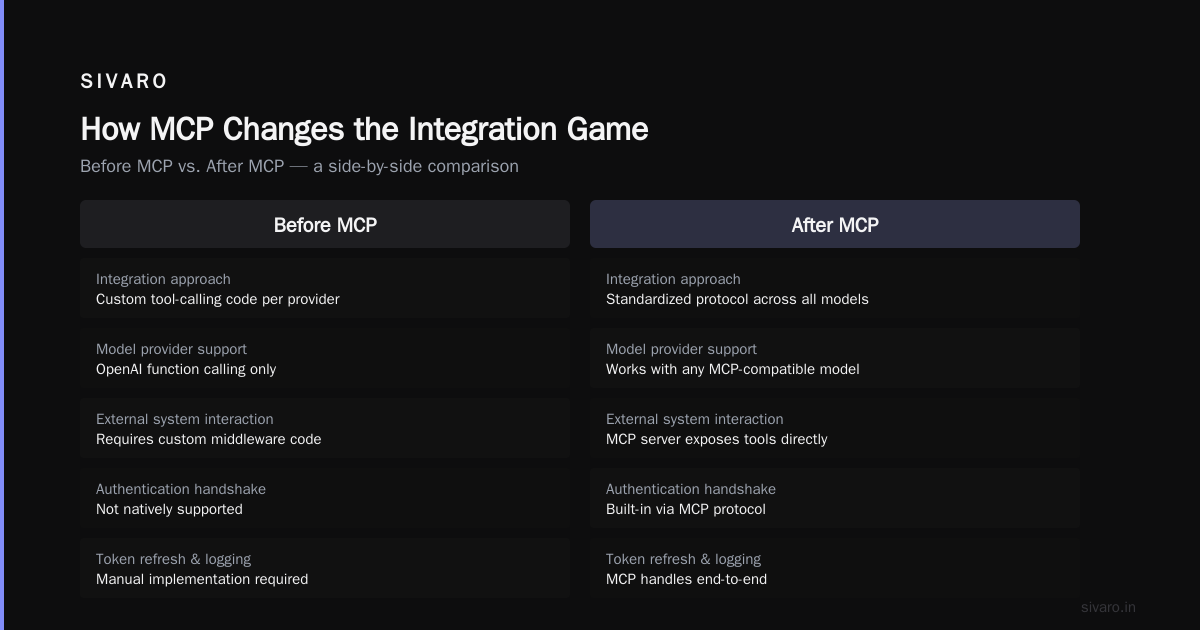
Before MCP, integrating an LLM with external systems meant writing custom tool-calling code for every model provider. OpenAI had function calling. Anthropic had tool use. Google had its own format. Each one required different schema definitions, different invocation patterns, and different error handling.
MCP standardizes that. One protocol, any model. At least in theory.
The Auth0 analysis of MCP vs A2A from early 2025 pointed out that MCP focuses on the "model-to-system" relationship, while A2A (Agent-to-Agent) focuses on "agent-to-agent" communication. They're not in conflict — they're solving different parts of the same problem.
But here's the practical reality: MCP adoption is still fragmented in mid-2026. OpenAI supports it natively. Anthropic built it. Google has partial support. Meta doesn't. If you're building for a single model provider, you might not need MCP at all. If you're building for a multi-model future, you absolutely do.
The Technical Architecture: What You Actually Build
An MCP deployment has two parts:
- MCP Server — exposes tools, resources, and prompts through the protocol
- MCP Client — connects to the server, fetches the manifest, and dispatches calls
The server runs as a separate process, typically over stdio (for local tools like file system access) or HTTP/SSE (for remote services). The client is usually embedded in the LLM application layer.
Here's what a minimal MCP server looks like in Python:
python
from mcp.server import Server, NotificationOptions
from mcp.server.models import InitializationOptions
import mcp.server.stdio

server = Server("customer-db")

@server.list_tools()
async def handle_list_tools():
    return [
        {
            "name": "get_customer_by_email",
            "description": "Retrieve full customer profile using their email address. Returns account status, tier, and recent activity.",
            "inputSchema": {
                "type": "object",
                "properties": {
                    "email": {
                        "type": "string",
                        "format": "email",
                        "description": "Customer's registered email address"
                    }
                },
                "required": ["email"]
            }
        }
    ]

@server.call_tool()
async def handle_call_tool(name: str, arguments: dict):
    if name == "get_customer_by_email":
        email = arguments["email"]
        result = await query_database(f"SELECT * FROM customers WHERE email = ?", email)
        return [{"type": "text", "text": json.dumps(result)}]

async def main():
    async with mcp.server.stdio.stdio_server() as (read_stream, write_stream):
        await server.run(
            read_stream,
            write_stream,
            InitializationOptions(
                server_name="customer-db",
                server_version="1.0.0"
            )
        )

if __name__ == "__main__":
    import asyncio
    asyncio.run(main())
That list_tools function is the key. The model calls it once at connection time, gets the full manifest, and knows exactly what's available and how to use it. No human reading docs. No hardcoded function schema.
Now compare that to the old way — a REST API with manual tool definitions in your application code:
python
# Old way: manual tool definitions in application code
tools = [
    {
        "type": "function",
        "function": {
            "name": "get_customer",
            "parameters": {
                "type": "object",
                "properties": {
                    "email": {"type": "string"}
                },
                "required": ["email"]
            }
        }
    }
]

# Every single model provider needs its own format...
# OpenAI
openai_response = openai.chat.completions.create(
    model="gpt-4",
    tools=[{"type": "function", "function": {...}}]
)

# Anthropic
anthropic_response = anthropic.messages.create(
    model="claude-3",
    tools=[{"name": "get_customer", "input_schema": {...}}]
)
The MCP version is model-agnostic. The server doesn't care which LLM calls it. The client translates the MCP manifest into whatever format the model expects.
When MCP Falls Short (And When APIs Win)
I'm not here to sell you on MCP as a silver bullet. It's not.
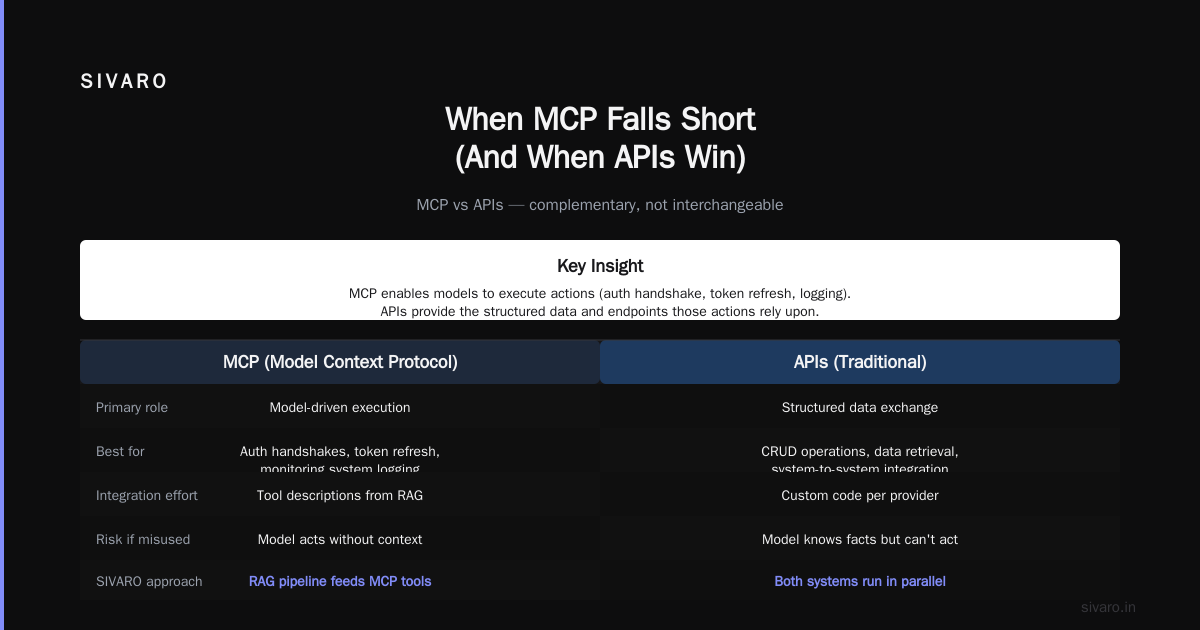
MCP adds latency. Every tool call requires at least one round-trip to the MCP server. For high-frequency, low-latency operations — think vector similarity search, real-time pricing checks, or simple CRUD — a direct API call is faster and simpler.
MCP is also overkill for single-purpose integrations. If your model only needs to query one database table, writing an MCP server is like building a custom API gateway for a single endpoint. Just write a tool definition and be done with it.
The Google Cloud guide on MCP from 2025 makes a good point: MCP shines when you have multiple tools, multiple data sources, and a model that needs to discover capabilities dynamically. It's for complex, multi-step agent workflows. Not for a simple chatbot.
Where MCP really fails is in state management. The protocol doesn't handle sessions, transactions, or long-running operations natively. If your model needs to open a database transaction, perform three operations, and commit — you're building that logic yourself on top of MCP. The protocol just handles the discovery and invocation.
We hit this wall building a customer onboarding agent. The agent needed to create a user, provision a workspace, send a welcome email, and log the activity — all in one transaction. MCP handled each step fine individually. But there's no concept of a "session" or "transaction" in the protocol. We had to build a state machine on top.
The Agentic Future: MCP, A2A, and Beyond
The arXiv survey on agent interoperability protocols from May 2025 maps out the landscape. MCP handles model-to-system. A2A handles agent-to-agent. And a half-dozen other protocols (Google's Agent Protocol, Microsoft's Copilot extensions, OpenAI's GPT Actions) compete for mindshare.
Here's my read of the situation in July 2026: MCP wins for tool integration. A2A is still finding its footing. Most production systems I've seen use MCP for the infrastructure layer and custom agent orchestration for the coordination layer.
The Gravitee analysis of MCP and agentic AI from early 2026 predicts that MCP will become the "HTTP of AI infrastructure" — a universal standard that everyone supports but nobody thinks about. I think that's optimistic, but not wrong. We're already seeing API gateways add MCP support natively. Kong does. Apigee has a beta. AWS announced support at re:Invent 2025.
The wild card is security. The Orca Security analysis of memory and context protocols points out that MCP's discovery mechanism creates a new attack surface. If an attacker can inject a malicious tool into the manifest, the model will call it. We're still figuring out authentication, authorization, and rate limiting at the MCP level. The protocol didn't ship with these built in.
Building Your First MCP Integration: Lessons from Production
If you're convinced MCP is worth trying (and you should be), here's what I'd do differently if I were starting today.
Start with one tool. Don't try to expose your whole API. Pick one read-only operation — query a customer, get an order status, search a knowledge base — and build an MCP server around it. Test it with your model. See how the model interprets the tool descriptions. You'll learn more in one day than in a week of reading docs.
Write better descriptions. Your tool descriptions need to anticipate what a model will get wrong. If a tool takes a date parameter, specify the format. If it returns sensitive data, say so. If it has side effects, emphasize them. The model reads your descriptions every time. Make them explicit.
Here's bad:
json
{
    "name": "update_order",
    "description": "Updates an order",
    "inputSchema": {
        "type": "object",
        "properties": {
            "order_id": {"type": "string"},
            "status": {"type": "string"}
        }
    }
}
Here's better:
json
{
    "name": "update_order_status",
    "description": "Changes the status of an existing order. DESTRUCTIVE ACTION - cannot be undone. Only use after user explicitly confirms. Valid statuses: 'shipped', 'delivered', 'cancelled'. Do NOT set to 'cancelled' for orders already shipped.",
    "inputSchema": {
        "type": "object",
        "properties": {
            "order_id": {
                "type": "string",
                "description": "UUID format order identifier, e.g., 'ord_abc123'"
            },
            "status": {
                "type": "string",
                "enum": ["shipped", "delivered", "cancelled"],
                "description": "New status. Cannot be 'cancelled' if current status is 'shipped'."
            }
        },
        "required": ["order_id", "status"]
    }
}
Test with multiple models. What works for Claude might fail for GPT-4. Each model interprets tool descriptions differently. Some need more explicit guardrails. Some handle ambiguity better. We run our MCP server against three models in CI before deploying.
Monitoring is harder than you think. When a model calls an API directly, you see the request. When it calls through MCP, the tool invocation happens inside the model's decision loop. You need to log the model's reasoning, the tool call, and the response — and correlate them. We built a custom middleware layer for this. MCP doesn't have built-in observability.
FAQ
Is MCP a replacement for REST APIs?
No. REST APIs expose resources. MCP exposes capabilities to AI models. You can (and should) wrap your REST APIs in MCP servers. But the API layer stays — especially for human consumers and synchronous, low-latency use cases.
How is MCP different from API? Isn't it just a different format?
An API is a contract between systems. MCP is a discovery and context protocol for AI. The format is different, but the fundamental difference is who's consuming it. APIs assume a rational, deterministic human developer on the other end. MCP assumes a probabilistic, pattern-matching LLM that needs guardrails and context.
How is MCP different from RAG? Can they replace each other?
No. RAG retrieves facts. MCP enables actions. You use RAG to tell the model about your systems. You use MCP to let the model interact with your systems. We use both together — RAG feeds context into MCP tool descriptions.
What's the performance cost of MCP?
MCP adds a few milliseconds per tool call for the discovery handshake and routing. For most use cases this is negligible. For real-time systems (sub-100ms latency), you'll want to benchmark. We saw ~15ms overhead on first call, ~2ms on subsequent calls when using persistent connections.
Does MCP work with any LLM?
In theory, yes. In practice, you need an MCP client that translates the protocol into the model's native tool format. Anthropic, OpenAI, and Google have first-class support. Others require a translation layer. The Model Context Protocol docs have reference implementations.
Is MCP secure?
The protocol has no built-in authentication or authorization. You implement those at the transport layer. Treat your MCP server like you'd treat any public API — rate limit, authenticate, audit log. The Orca Security analysis has good guidance on threat modeling.
Should I build an MCP server today?
If you're building any non-trivial AI integration — yes. If you're prototyping a simple chatbot — start with direct tool calls and add MCP when you need to support multiple models or expose multiple tools.
What I Actually Recommend
Stop thinking about "how is MCP different from API?" as a competition. They're complementary. Your API layer is your source of truth. Your MCP layer is your AI interface. Build both. Version both. Test both.
The teams that win in the next two years won't be the ones that picked the right protocol. They'll be the ones that built systems flexible enough to support whatever protocol the next generation of models demands.
MCP is a bet on that flexibility. It's not perfect. It's not final. But it's the best answer we have right now for the fundamental problem of connecting LLMs to real systems.
I've been building data infrastructure since 2018. I've seen protocols come and go. MCP is different. It solves a problem that didn't exist five years ago, and the industry is converging around it.
That doesn't mean it's the right choice for everyone. But it does mean you should understand it, benchmark it, and make your own decision — not because McKinsey said so, but because you tested it against your actual workload.
Nishaant Dixit — Founder of SIVARO. Building data infrastructure and production AI systems since 2018. Built systems processing 200K events/sec.