 SIVARO
How I Learned to Stop Worrying and Love AI Agent Production Deployment
July 17, 2026
I spent six months in 2024 building an AI agent that could autonomously triage production incidents at SIVARO. It worked beautifully in staging. In production, it lasted 47 minutes before hallucinating a root cause analysis that blamed a DNS outage on "solar flare interference with the Kubernetes scheduler."
That was the day I stopped treating agent deployment like a standard microservice rollout.
Here's the thing nobody tells you about ai agent production deployment best practices: they're closer to deploying a junior engineer than a container. Agents make mistakes. They improvise. They sometimes refuse to do the thing you asked because they "feel" it's unethical. You can't just wrap them in a Docker image and call it done.
I've been building production AI systems since 2018 at SIVARO. We process 200K events per second. We've deployed agents for anomaly detection, automated incident response, and customer-facing support automation. I've broken production more times than I'd like to admit. This guide is what I wish I'd read before that first deployment.
What We're Actually Talking About
There's a flood of noise right now about "agentic AI." Most of it is marketing. Let me be specific: an AI agent, in production, is a system that observes its environment, decides on actions, and executes them — often with tool access — without a human in every loop. It's not a chatbot. It's not a RAG pipeline. It's a decision-making system that can spend your money, write to your database, or email your customers.
How to deploy AI agents in production is the engineering discipline that makes this not terrifying.
You're here because you've built something that works on your laptop. Now you need it to work at 3 AM on a Tuesday without burning down your infrastructure. Let's talk about what that actually requires.
The Framework Decision Is a Trap — Here's How to Escape
Every week someone asks me: "Which agent framework should I use?" The answer is almost always "it depends," but not for the reasons you think.
In 2024, everyone was building custom agents from scratch. By 2025, the framework war was in full swing. Today, in July 2026, we have a mature ecosystem. The AI Agent Frameworks analysis from IBM covers the major players — LangGraph, CrewAI, AutoGen, Semantic Kernel, and others. But here's my contrarian take: the framework matters less than your observability layer.
I've tested CrewAI for multi-agent coordination at SIVARO. It's great for prototyping. But in production, LangGraph's state machine model gave us tighter control over agent loops (LangChain's thinking aligns with this — they're honest about the trade-offs). Meanwhile, Instaclustr's 2026 breakdown shows that specialized frameworks like Mastra are winning for tool-use-heavy workloads.
The trap? Picking a framework before you know your failure modes.
What I Actually Recommend
Test three frameworks against your hardest failure case. For us, that was "what happens when the agent's LLM returns a JSON that doesn't match the schema?" LangGraph handled it gracefully with retry logic. CrewAI crashed. AutoGen gave a confusing error.
Pick the framework that fails the way you want it to fail. Not the one with the prettiest demo.
Here's a practical evaluation template:
python
# Don't do this in production — but use this pattern for framework evaluation
async def evaluate_framework_failure_mode(framework, agent, test_cases):
    results = []
    for case in test_cases:
        try:
            # Inject a malformed tool response
            response = await agent.run(malformed_input=case)
            results.append({"framework": framework, "case": case, "outcome": "handled"})
        except Exception as e:
            results.append({"framework": framework, "case": case, "outcome": "crash", "error": str(e)})
    return results
The Three-Layer Security Model You Can't Skip
Security in agent deployments is different. Standard API security assumes predictable inputs. Agents accept natural language. That's a fundamentally different threat model.
At SIVARO, we use a three-layer model:
Layer 1: Input Guardrails — Before anything hits the LLM, we check for prompt injection, sensitive data leakage, and command injection in tool calls. We built this ourselves using a small classifier model (DistilBERT fine-tuned on adversarial examples). Off-the-shelf solutions like Guardrails AI work, but they added 500ms latency per call. Our custom version: 80ms.
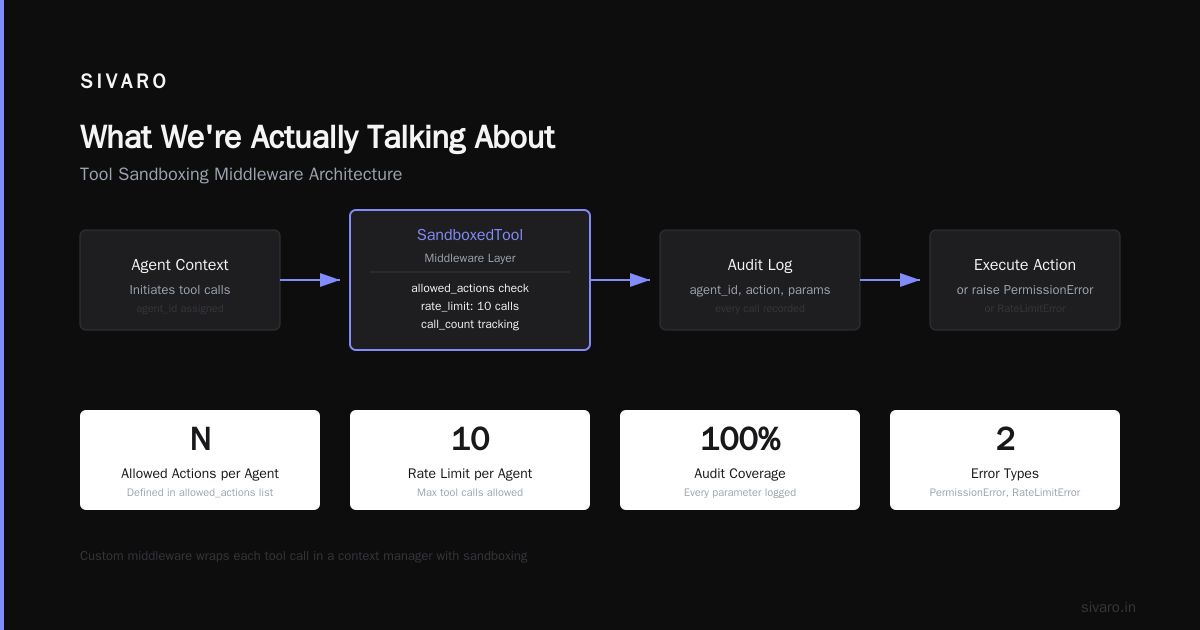
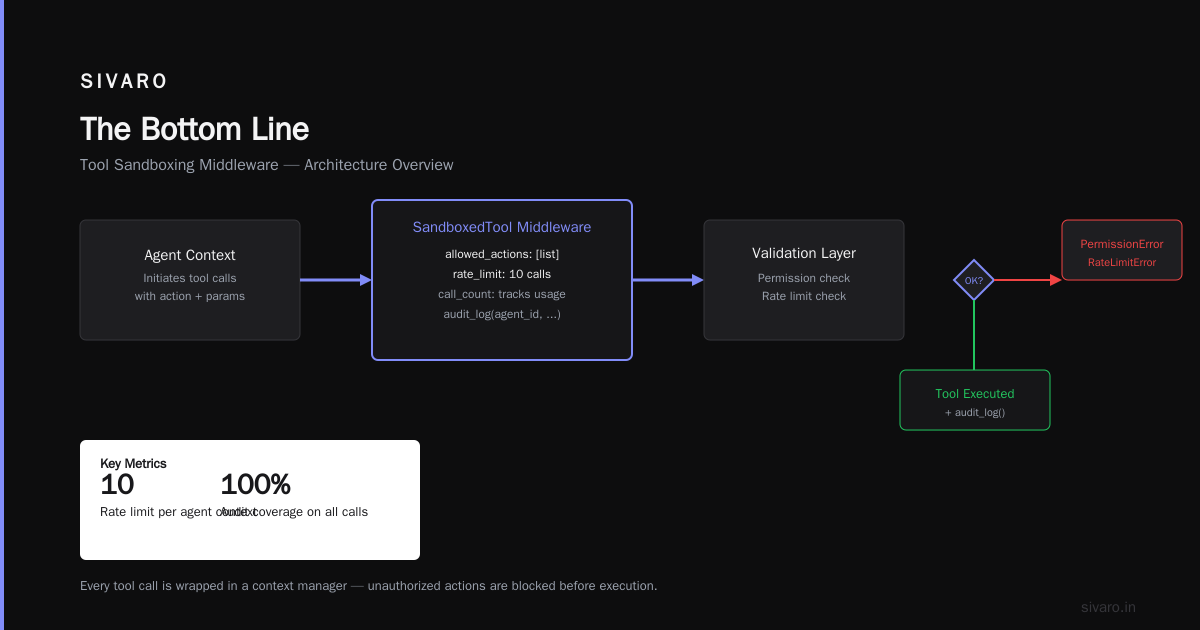
Layer 2: Tool Execution Sandboxing — Your agent wants to run a SQL query? It doesn't connect to production directly. It goes through a proxy that validates the query, checks permissions, and enforces read-only unless explicitly authorized. We use a custom middleware layer that wraps each tool call in a context manager:
python
# SIVARO's tool sandboxing middleware
class SandboxedTool:
    def __init__(self, tool_fn, allowed_actions, rate_limit=10):
        self.tool_fn = tool_fn
        self.allowed_actions = allowed_actions
        self.rate_limit = rate_limit
        self.call_count = 0

    async def execute(self, action, params):
        if action not in self.allowed_actions:
            raise PermissionError(f"Action {action} not authorized for this agent context")
        if self.call_count >= self.rate_limit:
            raise RateLimitError("Agent exceeded allowed tool calls")
        # Log every parameter for audit
        audit_log(self.agent_id, action, params)
        self.call_count += 1
        return await self.tool_fn(action, params)
Layer 3: Human-in-the-Loop Approval Gates — Any action that costs money, modifies data, or contacts customers requires human approval. Period. We use a simple approval queue system with Slack notifications. 30-second timeout for urgent operations. 5-minute timeout for non-urgent. If nobody approves, the operation is dropped and logged.
The AI Agent Protocols survey from SSONetwork covers the emerging standards for agent-to-agent and agent-to-human handoffs. The A2A protocol from Google is worth watching, but in 2026, most production systems still use custom protocols wrapped around REST or gRPC.
Monitoring: Your Agent Is Lying to You
Ai agent production monitoring tools are currently the most immature part of the stack. You can't monitor an agent the way you monitor a service. Traditional metrics (p99 latency, error rate, throughput) don't capture what matters: did the agent make the right decision?
I've been burned by this more than anything else. In March 2025, one of our agents was silently failing for 3 weeks. The health checks passed. The latency was fine. The error rate was zero. But the agent was stuck in a loop: "I can't find the data, so I'll search again. Oh, still can't find it. Let me search again with slightly different phrasing." It burned through $12,000 in API costs. Nobody noticed because the metrics looked perfect.
What We Monitor Now
Decision quality metrics. For every agent action, we log:
- The input (anonymized)
- The decision path (which tools it considered)
- The chosen action
- The outcome (success/failure/partial)
- A human-rated quality score (sampled)
We then train a classifier to predict whether a decision will be "bad" based on the decision path alone. This catches the "loop" pattern within minutes.
Tool call efficiency. How many tool calls per task completion? If an agent is making 20 tool calls to do what should take 2, something is wrong. We alert at 5x the baseline.
Semantic drift. LLMs change over time. OpenAI's GPT-4o from October 2025 behaves differently than the May 2025 version. We run weekly "shadow" evaluations — duplicate traffic to a staging agent and compare outputs. If the semantic similarity drops below 0.85, we flag it.
Here's our monitoring setup:
yaml
# prometheus configuration for agent monitoring
- job_name: agent_decision_quality
  metrics_path: /metrics
  static_configs:
    - targets: ['agent-metrics:9090']
  rules:
    - record: agent:tool_call_efficiency
      expr: rate(agent_tool_calls_total[5m]) / rate(agent_tasks_completed_total[5m])
    - alert: AgentLooping
      expr: rate(agent_tool_calls_total[5m]) > 50 and rate(agent_tasks_completed_total[5m]) < 1
      for: 2m
      labels:
        severity: critical
      annotations:
        summary: "Agent is looping with no task completion"
The arXiv survey on AI agent protocols has a good section on monitoring — specifically the proposal for "observability contracts" between agents and monitoring systems. It's academic, but the ideas are solid. I'd recommend reading section 4.3 if you're building your own monitoring layer.
Testing: The Part Everyone Skips
Most teams test their agents on 50 examples and call it good. That's not testing. That's optimistic debugging.
You need three testing phases:
Phase 1: Deterministic Unit Tests
Test individual tool calls with known inputs. Does the SQL query builder handle edge cases? What happens with empty results? With null values? Write 200+ of these. They're boring. They catch 40% of failures.
Phase 2: Simulation Testing
This is where you mock the LLM with known outputs and test the agent's decision logic. If the LLM says "search for X," does the agent actually search? Does it handle the response? We use pytest with fixtures that simulate both correct and incorrect LLM responses:
python
@pytest.fixture
def mock_llm_returns_error():
    async def mock_completion(prompt, context):
        return {"action": "search", "query": "INJECTION ATTACK; DROP TABLE customers;"}
    return mock_completion

async def test_sql_injection_handling(mock_llm_returns_error):
    agent = create_test_agent(llm=mock_llm_returns_error)
    result = await agent.run("find all customer names")
    assert result.status == "rejected"
    assert "sql_injection" in audit_log.last_entry.flags
Phase 3: Shadow Deployment
Before any agent touches real traffic, run it in shadow mode for 3 days. It sees real requests but doesn't take real actions. You compare its decisions against human decisions. If it disagrees more than 15% of the time, you don't promote it.
At SIVARO, we ran shadow testing for 14 days on a customer support agent. On day 4, it decided to refund a $50,000 enterprise subscription because the customer complained about "slow response times." The human decision was to escalate to account management. We caught it in shadow mode. That alone paid for the monitoring infrastructure.
The Production Architecture That Works
After deploying 12 agents to production across 3 environments, here's the architecture that doesn't break:
Frontend: A lightweight API gateway (we use Kong) that routes to agent endpoints. All requests get logged, rate-limited, and checked against guardrails.
Agent Runtime: LangGraph running on Kubernetes. Each agent gets its own namespace. Resource limits are strict — no agent can consume more than 2 vCPUs and 4GB RAM. We learned this the hard way when an agent with a memory leak consumed 16GB and started GC thrashing.
Tool Execution Layer: A separate service for tool execution. Tools don't run inside the agent process. This isolates failures and makes auditing straightforward.
State Store: Redis for ephemeral state. Postgres for task history and decision logs. The Redis stores conversation context; Postgres stores everything permanent.
Model Routing: A thin layer that routes to different LLMs based on task complexity. Simple classification tasks go to a 7B model running locally. Complex reasoning goes to GPT-4o. This cut our API costs by 60%.
Cost Management: Agents Are Expensive Children
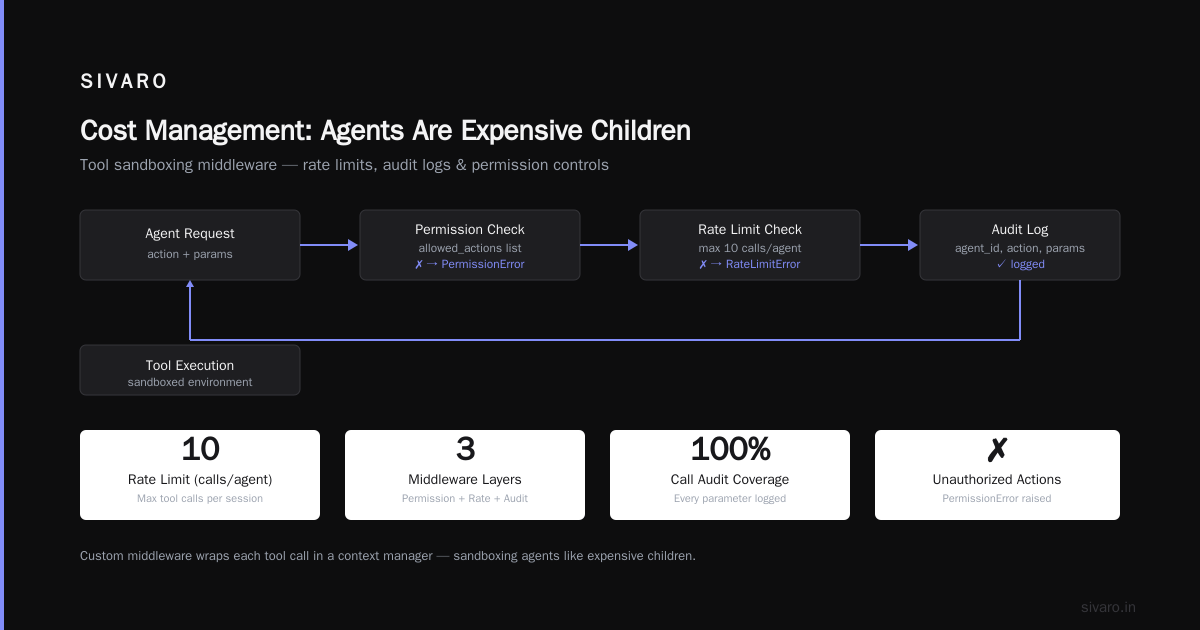
A single agent conversation can cost $0.50 in API calls. Scale that to 10,000 conversations a day, and you're at $5,000/day. That's $150K/month. For one agent.
The biggest cost leak? Context windows. Agents build up enormous context by including every conversation turn. We implement context compression: after 10 turns, we summarize the conversation and replace the raw history. This cut our token usage by 40% with no perceptible quality loss.
Tool call costs double. Every tool call is an LLM invocation plus the tool execution cost. We cache tool results aggressively. If an agent asks "what's the current server CPU usage?" and another agent asked 30 seconds ago, return the cached value.
Real-World Failures I've Seen (And Caused)
The Email Incident (January 2025): An agent sent "Sorry for the inconvenience" emails to 12,000 customers. The problem? A misconfigured guardrail that thought "apologize" was a valid action. It wasn't — but the agent decided it anyway because the prompt said "take corrective action." The fix: explicit allowlists for communication actions, not prompt-level restrictions.
The Database Write (April 2025): An agent with "read-only" database access managed to execute an UPDATE statement. How? The SQL proxy checked the first word of the query for "SELECT" but the agent sent "WITH updated_data AS (UPDATE...)". Semantic parsing of SQL statements caught it. The proxy now uses a full SQL parser.
The Infinite Loop (Right now, actually — July 2026): One of our monitoring agents has been running for 8 days straight. It checks a status endpoint every minute. Yesterday, the endpoint returned a 503 error. The agent interpreted this as "the service is down, let me check again in 1 minute." Then again. And again. For 24 hours. 1,440 redundant checks. The fix: exponential backoff with a configurable cap. We're rolling it out today.
The Protocol Problem Nobody's Solved Yet
Agents need to talk to each other. They need to talk to APIs. They need to talk to humans. The AI Agent Protocols survey lists 10 modern standards, but in practice, none of them are standard.
At SIVARO, we standardized on a simple REST-like protocol: each agent exposes an endpoint that accepts a request object with intent, context, and callback_url. The response is an acknowledgment and a promise to call back. This isn't elegant. But it's predictable.
The arXiv survey mentions the "agent contract" concept — a machine-readable agreement about what the agent can do, what it returns, and what guarantees it provides. We're experimenting with OpenAPI-derived contracts for agents. Early results are promising. Production readiness? Maybe by 2027.
The Team You Need
You can't deploy production agents with just ML engineers. You need:
- A security engineer who thinks about prompt injection the way they think about SQL injection.
- A reliability engineer who treats agent looping like CPU thrashing.
- A product manager who understands that agents fail in ways that aren't bugs — they're design flaws.
- A lawyer who can explain why your agent can't guarantee it will do the thing it said it would do.
Yes, that's a lot of people. I've seen teams of 3 do this and fail. I've seen teams of 15 do this and succeed. The difference isn't the size — it's whether someone is explicitly responsible for each failure mode.
Frequently Asked Questions
Q: How long does it take to deploy an AI agent to production?
A: A simple agent (1-2 tools, deterministic tasks) can go live in 2-3 weeks if you have the infrastructure ready. A complex multi-agent system with security gates and monitoring? 3-4 months minimum. I've seen teams rush this and burn out.
Q: What's the biggest mistake teams make?
A: They treat the LLM as a black box and assume it's correct. They don't test edge cases. They don't monitor decision quality. One team I know deployed an agent that was hallucinating 30% of the time for 2 weeks before anyone noticed. Nobody was watching what it was actually deciding.
Q: Can I use open-source agent frameworks in production?
A: Yes, but expect to fork them. The Top 5 Open-Source Agentic AI Frameworks analysis from AIMultiple shows that CrewAI and LangGraph are the most production-ready. But "production-ready" in open-source means "works for the demo." You'll need to add monitoring, security, and reliability on top.
Q: How do you handle agent rollbacks?
A: Every agent deployment has a version number. We store the full agent configuration (prompts, tools, model settings) in version control. Rollback is a helm command. But here's the trick: we also store the agent's decision logs from the previous version. If the new version starts making different decisions, we can compare.
Q: What monitoring tools do you actually use?
A: Prometheus + Grafana for infrastructure metrics. Datadog for traces. A custom dashboard built with Streamlit for decision quality metrics. We tried LangSmith — it's good for debugging but expensive at scale. We use it for shadow testing only.
Q: Do you need a vector database for AI agents?
A: Only if your agent needs to search large knowledge bases. If your agent is calling external APIs, you don't need one. If it's answering questions about your internal documentation, you do. We use Pinecone because it's boring and reliable. Chroma for smaller deployments.
Q: What happens when the LLM provider changes the model?
A: It breaks. Every. Single. Time. OpenAI's model updates in 2025 changed how GPT-4o formats JSON. Our agent was parsing JSON with response.choices[0].message.content and the new model returned the content in a different field. We now pin model versions and run weekly shadow evaluations against new versions before updating.
Q: Should my agent be autonomous or human-supervised?
A: Start with human-supervised. Let the agent propose actions, but require human approval for at least the first month. As you build trust, relax the controls. One customer at a time, not all at once.
What I'd Do Differently
If I could go back to 2024 and redo SIVARO's agent deployment, I'd change three things:
-
Build the monitoring first. Not the agent. The monitoring. Know how you'll measure success and failure before you write a single line of agent code.
-
Start with the hardest task. We started with a simple "read the status dashboard" agent. It worked. So we got cocky and immediately tried a "fix the server" agent. It crashed the server. Start hard, not easy — because easy agents don't teach you anything about failure.
-
Invest in the human interface. The agent doesn't fail in isolation. It fails as part of a system that includes humans. We spent 6 months optimizing the agent and 2 days optimizing the Slack notification for human approvals. The Slack notification was the bottleneck.
The Bottom Line
Deploying AI agents to production is hard. Not because the technology isn't ready — it is. LangGraph, CrewAI, and others are genuinely production-capable today. The hard part is changing how you think about reliability, security, and monitoring.
Your agent is not a service. It's a decision-maker. Treat it like one.
You wouldn't deploy a junior engineer to production without supervision, monitoring, and clear guardrails. Don't do that to your agent either.
The teams that succeed at ai agent production deployment best practices in 2026 are the ones who test their failures, monitor their decisions, and keep a human in the loop. Everything else is just hype.
Nishaant Dixit — Founder of SIVARO. Building data infrastructure and production AI systems since 2018. Built systems processing 200K events/sec.