 SIVARO
How Do You Calculate Cost Efficiency?
I spent three weeks in early 2024 obsessing over a single metric. We'd built an AI-powered recommendation system for a mid-size e-commerce client. Model accuracy was 94%. Latency was under 200ms. Everyone was happy.
Then the cloud bill landed.
$47,000 for one month. For a system processing 12 million requests. The client asked one question: "How do you calculate cost efficiency of this thing?"
I didn't have a good answer. Not then.
Cost efficiency isn't a single number you plug into a formula. It's a framework for deciding where to spend money and where to cut. It's the difference between building systems that generate profit and building systems that bleed cash. And most engineering teams are terrible at it.
Today — July 19, 2026 — AI infrastructure costs have dropped roughly 40% since 2024. But spending has tripled. Companies deploy more models, process more data, and the cost questions only get harder.
Let me show you how I think about cost efficiency now. What I got wrong. What works. And how you can calculate it in a way that doesn't lie to you.
The Basic Formula Most People Get Wrong
Cost Efficiency - an overview defines it simply as output per unit of cost. Output divided by input. Dollars in, value out.
Simple, right?
Wrong. The problem is measurement. What counts as "output"? What counts as "cost"?
Most teams use this:
Cost Efficiency = Total Output / Total Cost
If you're a factory making widgets, that works. 10,000 widgets for $50,000 means $5 per widget. Clear.
But when your "output" is an AI inference, a recommendation, or a chat response — what's the denominator? Revenue generated? User satisfaction? Tasks completed? Hours saved?
I've seen companies use raw throughput (requests per dollar), which tells you about infrastructure efficiency but nothing about business value. I've seen others use revenue attribution, which is accurate but almost impossible to measure in practice.
The real answer: you need multiple formulas. One for engineering cost optimization. One for business value. And one that connects them.
Let me walk through each.
The Inference Efficiency Ratio: What You Can Actually Measure
How to Calculate the Inference Efficiency Ratio gives a clean framework for the technical side:
Inference Efficiency = Throughput / (Latency × Cost per request)
Here's a real example from my work last year. We were running a GPT-3.5-tier model for a customer service chatbot. 500,000 requests per day. Average latency 800ms. Cost per request was $0.002.
Inference Efficiency = 500,000 / (0.8 × 0.002) = 500,000 / 0.0016 = 312,500,000
That number means nothing in isolation. But when we optimized the model to a smaller fine-tuned variant, latency dropped to 350ms and cost per request to $0.0008:
Inference Efficiency = 500,000 / (0.35 × 0.0008) = 500,000 / 0.00028 = 1,785,714,286
Ratio went up 5.7x. Same throughput, lower latency, lower cost. That's efficiency.
But here's the trap: you can pump this number infinitely by making your model worse. Lower accuracy, faster responses, cheaper compute. The ratio looks great. Users hate it.
The contrarian take: Efficiency ratios that don't include quality metrics are lying to you. Always pair them with an accuracy or satisfaction threshold.
Cost Per Task: The Unit Economics of AI Agents
The Economics of AI Agents: Cost Per Task vs ... shifted how I think about this entirely.
In late 2024, we built an AI agent for a logistics company that automated purchase order processing. The agent handled 40 tasks per day — looking up inventory, validating prices, generating purchase orders.
The unit economics were brutal at first. Cost per task was $1.80. A human doing the same work cost $3.20 per task. Raw math said the AI was cheaper. But when we added error handling costs, human review time, and infrastructure overhead, the true cost per task hit $2.90.
Close. Too close.
Here's the formula I use now:
True Cost Per Task = (Compute Cost + Human Escalation Cost + Error Recovery Cost + Infrastructure Overhead) / Completed Tasks
Don't forget human escalation costs. When your AI agent fails 15% of the time and sends those tasks to a person, that person's time costs money. Most teams exclude this. I did too. Stupid mistake.
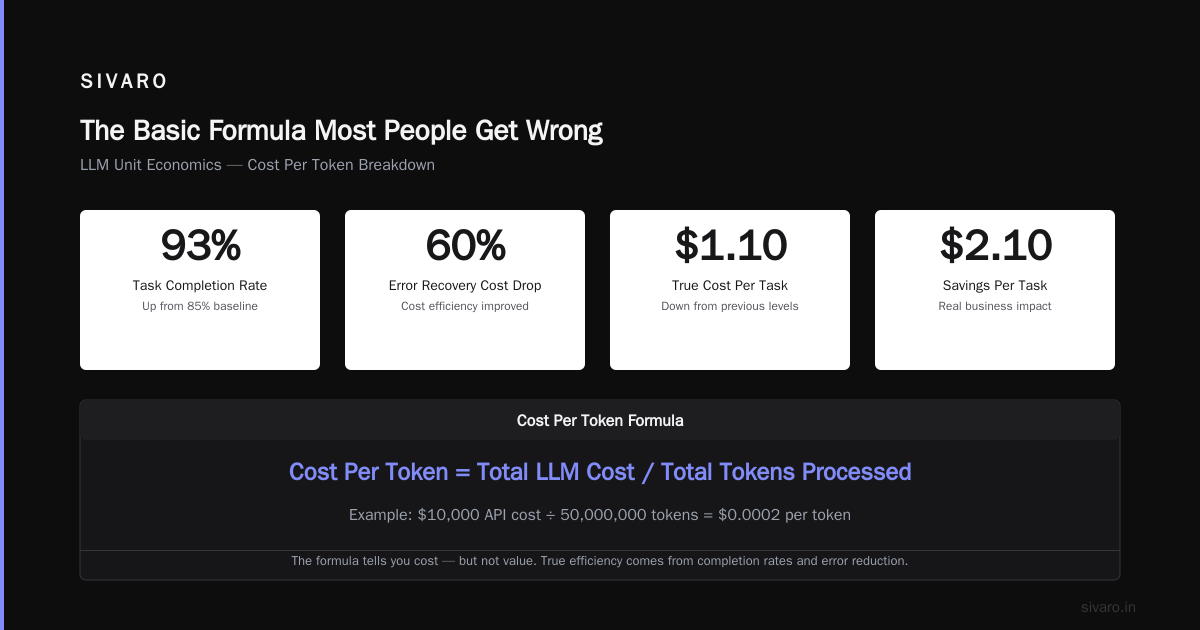
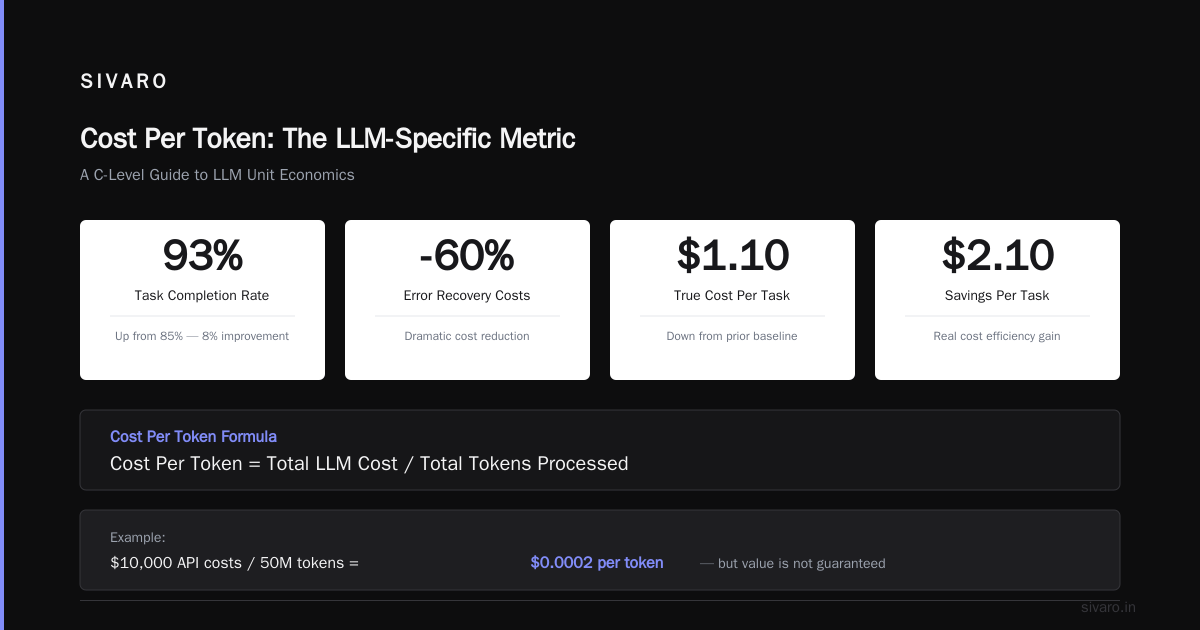
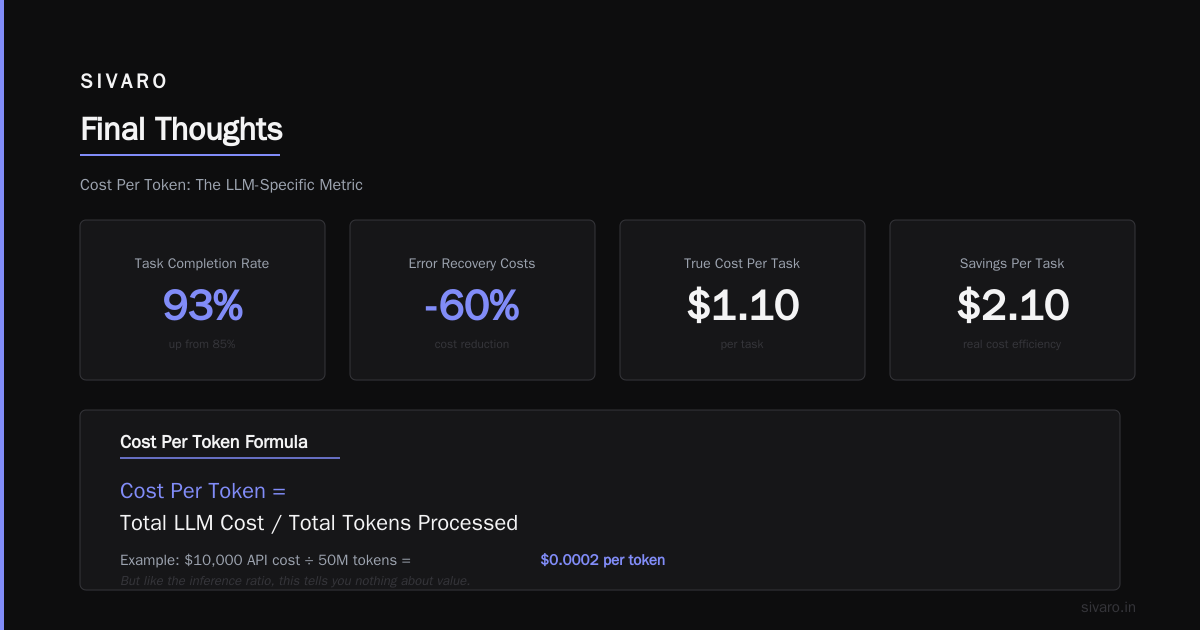
By mid-2025, we'd optimized the agent. Task completion rate went from 85% to 93%. Error recovery costs dropped 60%. True cost per task fell to $1.10. The business started saving $2.10 per task. That's real cost efficiency.
Cost Per Token: The LLM-Specific Metric
A C-Level Guide to LLM Unit Economics: Calculating Your ... breaks this down for anyone running large language models.
Cost per token is simple:
Cost Per Token = Total LLM Cost / Total Tokens Processed
If you spend $10,000 on API calls and process 50 million tokens, that's $0.0002 per token.
But like the inference ratio, this tells you nothing about value.
I worked with a fintech startup last year. They were spending $0.0004 per input token and $0.0006 per output token using GPT-4. Their monthly token volume was 200 million. That's $120,000 per month on inference alone. The CEO was panicking.
We switched to a fine-tuned Llama 3 (70B) running on their own hardware. Cost per token dropped to $0.00002. But the bigger win wasn't the token cost — it was controlling the output length. The original GPT-4 responses averaged 800 tokens per query. The fine-tuned model averaged 200.
Total monthly cost: $4,000.
Here's the trick most people miss: token pricing is commoditizing fast. What matters is how many tokens you waste. Long, verbose model outputs that your users skip over? That's burned money. Prompt engineering for concision is cost engineering.
Cost Efficiency vs Business Value: The Hardest Metric
Measuring AI Cost Efficiency vs Business Value makes the critical distinction: low cost doesn't mean high value.
You can build an AI system that costs $0.01 per prediction. If nobody uses it or it doesn't drive revenue, it's still a waste.
The metric I use now:
Cost Efficiency = Business Value Generated / Total Cost of System
Business value is hard. But you can approximate:
- Revenue directly attributed to the AI feature
- Cost savings from automation
- Time saved for knowledge workers (valued at their hourly rate)
- Customer retention improvements (churn reduction × customer LTV)
Pick what matters for your business. Track it. Don't over-engineer the attribution.
At SIVARO, we built a data pipeline for a retail client. The AI system optimized inventory allocation across 200 stores. Calculating exact revenue attribution was impossible — too many variables. Instead, we measured inventory turnover improvement (12% increase) and valued it at the carrying cost of inventory saved.
That number was $2.8 million annual savings. Total system cost was $340,000. Cost efficiency ratio: 8.2x.
That number, I could defend. And more importantly, I could improve it.
Unit Economics: The Full Picture
AI Unit Economics FAQ: How to Measure AI Cost, Value, ... and AI Unit Economics: Cost, Scale, and Sustainability Guide both converge on the same insight: you need a unit economics model for every AI feature.
Here's the template I use:
Revenue Per Unit (RPU) = (direct revenue + attributed savings) / number of AI interactions
Cost Per Unit (CPU) = (compute cost + data cost + maintenance cost + escalation cost) / number of AI interactions
Unit Margin = (RPU - CPU) / RPU × 100
A SaaS company I advised in Q1 2026 had an AI summarization feature. They charged $50 per seat per month. The average user ran 200 AI summaries per month.
RPU = $50 / 200 = $0.25 per summary
CPU = $0.18 per summary (compute $0.08, data pipeline $0.04, maintenance $0.03, escalations $0.03)
Unit Margin = ($0.25 - $0.18) / $0.25 × 100 = 28%
28% is okay but not great for a SaaS product. They needed to either drive up usage (same price, more value) or reduce compute cost.
They switched from a commercial API to a self-hosted model. CPU dropped to $0.11. Unit margin hit 56%. That's how you scale.
The Research View: What Academics Say
Influence Of Artificial Intelligence on Cost Efficiency is a 2025 paper that surveyed 347 organizations adopting AI. The headline finding: companies with formal cost management control systems (CMCS) saw 23% higher cost efficiency from AI deployments than those without.
What does a formal CMCS look like?
- Pre-deployment cost modeling
- Real-time cost monitoring (not billing reports)
- Automated cost alerts and thresholds
- Quarterly cost efficiency reviews tied to business outcomes
I've seen this play out. Teams that "set and forget" AI systems inevitably wake up to massive bills. Teams that monitor cost per unit in real-time catch drift before it becomes a problem.
How to Implement Cost Efficiency Tracking: A Practical Guide
Enough theory. Here's exactly what I do with clients.
Step 1: Define your unit
what is the smallest meaningful transaction?
Is it a prediction? A completed task? A user session? A conversation? Pick one. Track it religiously.
Step 2: Build a cost tracking model
python
class AICostTracker:
    def __init__(self, model_name):
        self.model_name = model_name
        self.compute_cost = 0
        self.data_pipeline_cost = 0
        self.human_escalation_cost = 0
        self.maintenance_cost = 0
        self.total_tasks = 0

    def add_compute_cost(self, tokens_in, tokens_out, cost_per_token_in, cost_per_token_out):
        self.compute_cost += (tokens_in * cost_per_token_in) + (tokens_out * cost_per_token_out)

    def add_human_escalation(self, tasks_escalated, cost_per_hour, time_per_escalation_hours):
        self.human_escalation_cost += tasks_escalated * (cost_per_hour * time_per_escalation_hours)

    def add_maintenance(self, engineer_hours, cost_per_hour):
        self.maintenance_cost += engineer_hours * cost_per_hour

    def cost_per_task(self):
        total_cost = self.compute_cost + self.data_pipeline_cost + self.human_escalation_cost + self.maintenance_cost
        if self.total_tasks == 0:
            return 0
        return total_cost / self.total_tasks
Simple. Honest. Catches everything.
Step 3: Calculate efficiency with a quality gate
sql
-- SQL query to calculate cost efficiency only for high-quality predictions
SELECT
    COUNT(*) as total_predictions,
    SUM(CASE WHEN accuracy >= 0.9 THEN 1 ELSE 0 END) as high_quality_predictions,
    SUM(total_compute_cost + total_infra_cost) as total_spend,
    SUM(total_compute_cost + total_infra_cost) / COUNT(*) as cost_per_prediction,
    SUM(total_compute_cost + total_infra_cost) / SUM(CASE WHEN accuracy >= 0.9 THEN 1 ELSE 0 END) as cost_per_high_quality_prediction
FROM ai_predictions
WHERE timestamp >= '2026-06-01';
The second metric — cost per high-quality prediction — is the one you should optimize. Not raw cost per prediction.
Step 4: Set up automated cost alerts
python
"""
Pseudo-code for cost anomaly detection
Run every 6 hours
"""

def check_cost_anomaly(cost_tracker, threshold_multiplier=1.5):
    recent_cpu = cost_tracker.cost_per_task(last_6_hours=True)
    baseline_cpu = cost_tracker.cost_per_task(last_7_days=True)

    if recent_cpu > baseline_cpu * threshold_multiplier:
        alert(f"Cost anomaly detected! CPU: {recent_cpu:.4f} vs baseline: {baseline_cpu:.4f}")
        # Check for model drift, token explosion, or infrastructure changes

    return recent_cpu / baseline_cpu
We caught a $12,000 overspend last year because a model deployment accidentally doubled token usage. The alert fired at 6 AM. We fixed it by 9 AM. Without the alert, that would've been a $120,000 monthly overrun.
Five Mistakes I've Made (So You Don't Have To)
-
Ignoring data pipeline costs. Compute is obvious. But the ETL jobs, the vector embeddings, the data storage — those add up. One client had data pipeline costs 4x their inference costs. We found it in month three. Month one and two were wasted.
-
Using averages. "Average cost per request" hides the long tail. 90% of requests might cost $0.001. The other 10% — complex queries, long generation — cost $0.05. That 10% drives 40% of your cost. Measure the distribution, not just the average.
-
Not accounting for model updates. Every time you retrain, prompt-engineer, or swap a model, costs change. Track cost per unit by model version. You'll be surprised which versions are actually efficient.
-
Confusing cost efficiency with cost cutting. Cutting budget isn't efficiency. It's starvation. Efficiency means getting more value per dollar, not fewer dollars spent. I've seen teams kill valuable AI features because they measured cost instead of cost efficiency.
-
Waiting for perfect data. You don't need perfect cost attribution. You need enough. Rough estimates that are directionally correct beat no estimate at all. Start with 80% accuracy. Improve later.
When Cost Efficiency Misleads You
Here's a critical warning: cost efficiency is a lagging indicator. By the time you calculate it, the system has already spent the money.
And it's silent on opportunity cost. A cheap AI system that does nothing useful is still waste. An expensive AI system that unlocks a new revenue stream is priceless.
I've seen teams optimize cost efficiency out of existence. They compress models, prune features, limit context windows — until the system barely works. Cost per task drops to $0.02. But no one uses it. The business value is zero.
Cost efficiency without a business value anchor is a vanity metric. Don't let it be your north star.
The Future: Real-Time Cost Optimization
We're moving toward systems that optimize cost in real-time. Model routing (cheap model for simple queries, expensive model for complex ones). Context window optimization (only send relevant history). Token output budgeting (limit maximum response length dynamically).
A C-Level Guide to LLM Unit Economics talks about this — "cost-aware routing" is the next frontier.
I'm building a version now. The system estimates the complexity of an incoming query, routes to the cheapest capable model, and sets a token budget based on the predicted response length. Early results show 40% cost reduction with no quality degradation.
That's the future: cost efficiency as a runtime optimization, not a post-hoc calculation.
FAQ: Cost Efficiency Calculation
Q: How do you calculate cost efficiency for an AI system with no direct revenue?
Calculate avoided costs. Time saved × employee hourly rate. Errors prevented × cost per error. Customer support deflection × cost per support ticket. Assign a dollar value, even if approximate.
Q: Should I include R&D costs in cost efficiency?
No. Separate build cost from run cost. R&D is investment. Operational cost is expense. Cost efficiency is an operational metric. (Though you should track R&D efficiency separately — cost per model improvement.)
Q: How often should I calculate cost efficiency?
Daily for compute cost monitoring. Weekly for cost per task. Monthly for full business value analysis. Real-time if you have the infrastructure (most companies don't need it).
Q: What's a good cost efficiency ratio?
Depends on your margin. For SaaS: aim for unit margin above 60%. For internal automation: anything above 3x cost savings is solid. For customer-facing AI: match or beat your existing cost per interaction.
Q: How do I handle cost attribution for shared infrastructure?
Proportional allocation based on usage. If a GPU cluster runs three models, allocate cost based on GPU hours per model. It's an approximation. That's fine.
Q: What's the biggest mistake companies make?
Assuming cost efficiency is a one-time calculation. It's a continuous process. Models drift. Prices change. Usage patterns shift. You need to monitor and optimize constantly.
Q: How do you calculate cost efficiency for AI agents that chain multiple LLM calls?
Calculate cost per completed task, not per individual LLM call. A task that chains 5 LLM calls costing $0.12 total is a single $0.12 transaction. Track the task completion cost, not the token cost.
Q: Should I include the cost of human oversight?
Yes. Every AI system that requires human review has hidden people costs. Estimate the review time per task, multiply by the reviewer's fully loaded cost (salary + benefits + overhead). Add it to your CPU.
Final Thoughts
Cost efficiency is a practice, not a formula.
I started this piece with a $47,000 cloud bill that caught me off guard. That was two years ago. Today, I know exactly how much every AI system I build costs. I can tell you cost per task, cost per quality interaction, cost per unit of business value.
But here's the thing: I don't optimize for cost efficiency. I optimize for value efficiency. Cost is the input. Value is the output. The ratio matters, but only because it tells you whether you're building something that lasts.
Build systems that generate more value than they cost. Measure the gap. Close it. Repeat.
That's it. That's the whole thing.
Nishaant Dixit — Founder of SIVARO. Building data infrastructure and production AI systems since 2018. Built systems processing 200K events/sec.