 SIVARO
GPU Cluster vs Distributed Computing: The Real Architecture Choice in 2026
Let me start with a story. In early 2025, I sat in a conference room with a Series B startup. They'd just raised $40M to build the next generation of video understanding models. Their CTO stood at the whiteboard, drawing boxes. "We need a distributed computing architecture," he said. "Kubernetes across three clouds, sharded databases, event queues — the works."
I asked one question: "What's your bottleneck?"
Silence.
Turns out, their bottleneck was two NVIDIA H200 GPUs. Everything else in their stack was idle 60% of the time. They'd designed a distributed system for a problem that was fundamentally about GPU throughput.
That's the disconnect I see every week. Engineers conflate gpu cluster vs distributed computing like they're choices on a menu. They're not. They're different tools for different problems — and picking the wrong one wastes money, time, and engineering talent.
Here's the truth: GPU clusters are a specialized form of distributed computing, but most distributed computing problems have nothing to do with GPUs. Understanding which one you need is the difference between shipping in 3 months and burning cash for 18.
Let me walk you through exactly how to think about this. No fluff. Real numbers. Real trade-offs.
What the Hell Is a Distributed System Anyway?
Most people think distributed computing means "many computers working together." Technically true. Practically useless.
Wikipedia defines distributed computing as a system where components located on networked computers communicate by passing messages. That's like defining a car as "something with wheels." It's not wrong, but it misses the point.
A distributed system exists because one machine can't do the job. Period.
There are exactly three reasons you need distribution:
- Scale — your data doesn't fit on one disk
- Speed — one CPU can't process fast enough
- Reliability — one machine dying kills everything
Everything else is architecture theater.
Atlassian's take on distributed systems nails the practical split: distributed systems handle the complexity of coordination — consensus, fault tolerance, consistency — that single machines abstract away. When you add a second machine, you inherit every distributed systems problem. CAP theorem isn't optional.
Here's what most articles won't tell you: distributed computing is a tax, not a feature. You pay it only when you must.
GPU Clusters Are Not What You Think They Are
A GPU cluster isn't "a bunch of servers with GPUs." That's a server farm.
A real GPU cluster is a tightly-coupled system where GPUs communicate with each other over high-bandwidth interconnects (NVLink, InfiniBand, or at minimum 400GbE RDMA). The goal is to make multiple GPUs behave like one giant GPU.
Most people think gpu cluster vs cpu cluster is about speed. It's not. It's about topology.
A CPU cluster can tolerate 10 millisecond latencies between nodes. A GPU cluster doing distributed training breaks at 100 microseconds. The constraints are fundamentally different.
Confluent's distributed systems intro talks about the fallacies of distributed computing — network is reliable, latency is zero, bandwidth is infinite. GPU clusters violate all of them. The network must be reliable. Latency must be near zero. Bandwidth must be enormous.
I built SIVARO's first GPU cluster in 2021. Four nodes, eight A100s. We spent more time on NVLink topology and MPI configuration than on the actual model training code. That's not unusual — it's the norm.
The Fundamental Difference: Parallelism Models
Let me make this concrete.
Distributed computing (the general kind) uses one of these patterns:
- MapReduce — split work, process independently, combine results
- Stream processing — pass data through pipelined stages
- Microservices — decompose functions into networked services
- Shared-nothing databases — partition data across nodes
GPU clusters use:
- Data parallelism — same model, different data shards
- Model parallelism — split model layers across GPUs
- Tensor parallelism — split individual operations across GPUs
- Pipeline parallelism — layer-by-layer streaming
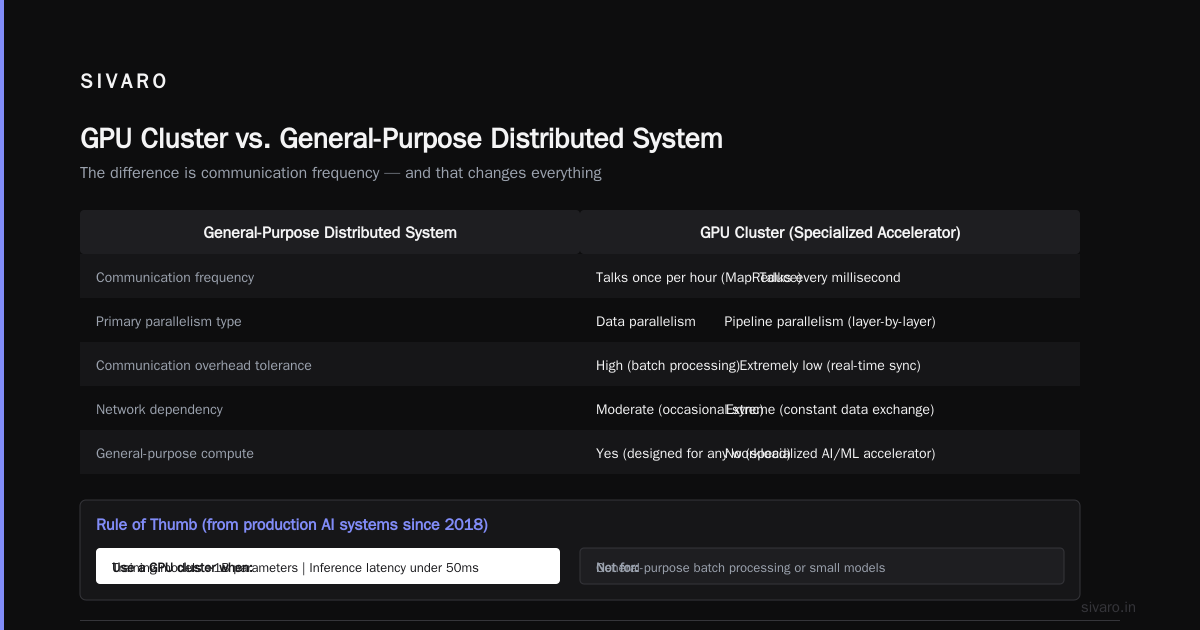
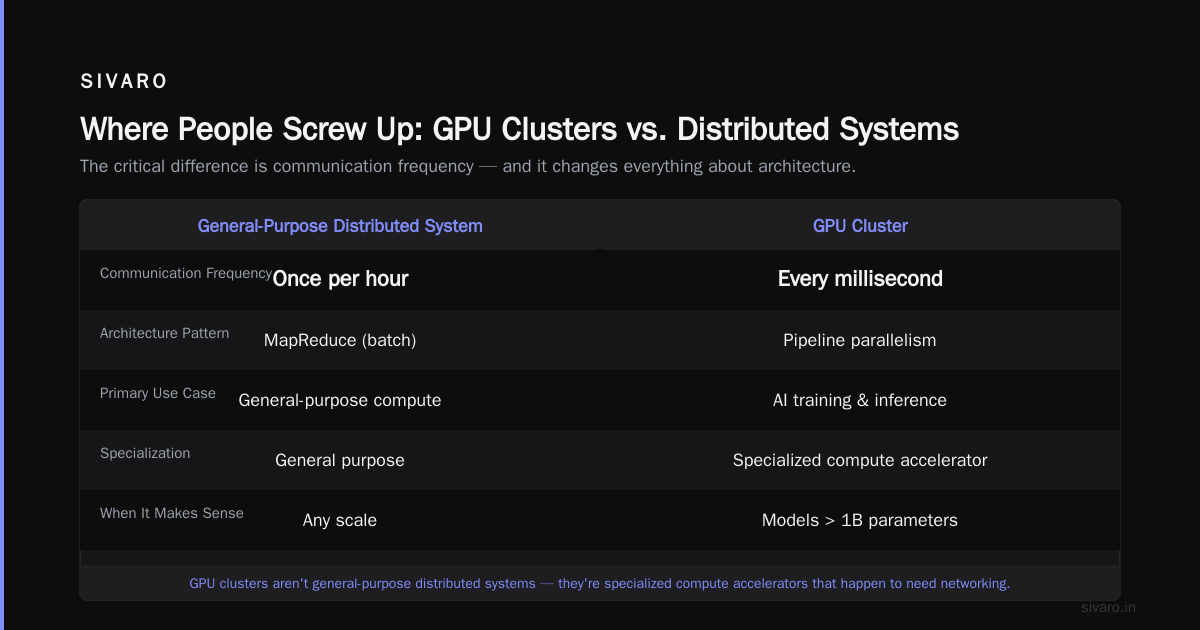
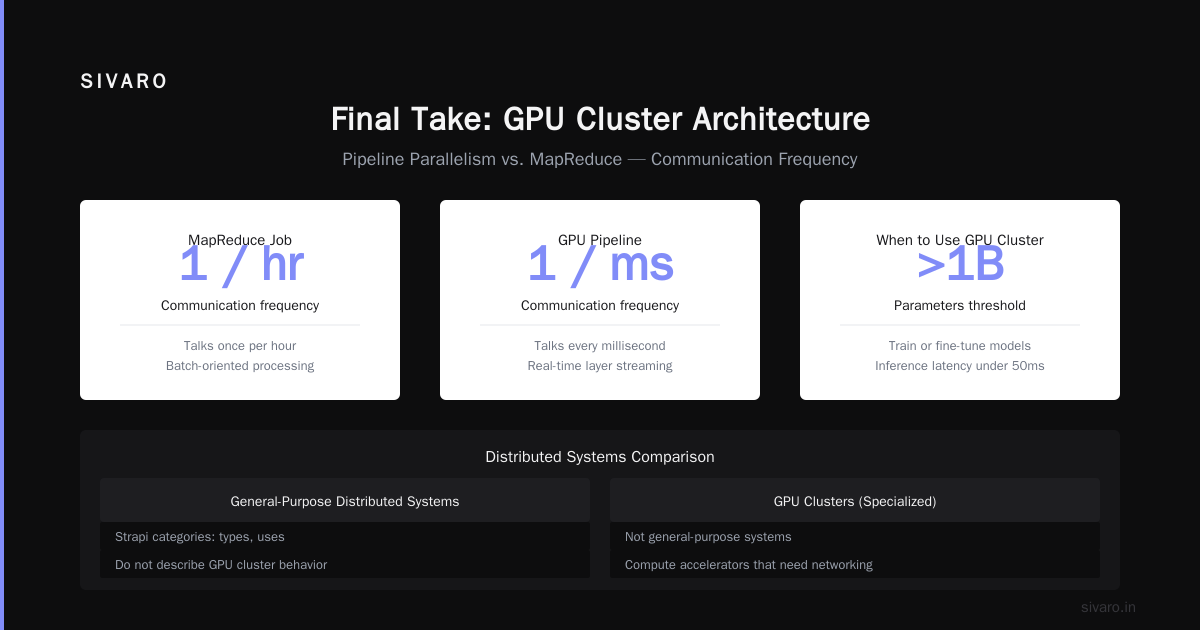
The difference is communication frequency. A MapReduce job talks once per hour. A GPU pipeline talks every millisecond.
Strapi's article on distributed systems breaks down the types well — but none of their categories describe what a GPU cluster does. Because GPU clusters aren't general-purpose distributed systems. They're specialized compute accelerators that happen to need networking.
When to Use a GPU Cluster (And When Not To)
Here's my rule of thumb from running production AI systems since 2018:
Use a GPU cluster when:
- You're training or fine-tuning models larger than 1B parameters
- You need inference latency under 50ms for transformer models
- Your workload is SIMD-heavy and fits CUDA's execution model
- You can sustain >90% GPU utilization on the workload
Don't use a GPU cluster when:
- Your bottleneck is I/O or database queries
- You have heterogeneous workloads (mix of batch, real-time, OLTP)
- Your data processing pipeline has 90% CPU work and 10% matrix math
- You're processing unstructured text or streaming logs
The worst architecture mistake I see in 2026: companies renting 8xA100 clusters for ETL pipelines. The GPUs sit idle 70% of the time. The cost is insane.
Let me give you real numbers. A gpu cluster rental cost for 8x NVIDIA H200 GPUs on AWS is roughly $40-60/hour as of July 2026. That's $350K-500K/year for cluster that might deliver 30-40% utilization on a mixed workload.
A 16-node CPU cluster with fast NVMe storage costs maybe $5-8/hour. For ETL, it'll outperform the GPU cluster because you're not serializing everything through PCIe to transfer data to GPU memory.
The Distributed Computing Architecture That Actually Works
You need both. Here's the architecture I've shipped for clients handling 200K events/second:
┌─────────────────────────────────────────────────────┐
│                 Distributed Layer                     │
│  (Kubernetes + Kafka + PostgreSQL + Object Storage)  │
│  Handles: ingestion, storage, queuing, monitoring    │
└────────────────────────┬────────────────────────────┘
                         │ (high-latency, reliable)
┌────────────────────────┴────────────────────────────┐
│                 GPU Cluster Layer                     │
│  (NVIDIA H200s + NVLink + InfiniBand + NCCL)         │
│  Handles: training, inference, feature computation   │
└──────────────────────────────────────────────────────┘
The distributed layer absorbs the chaos — variable latencies, partial failures, rebalancing. The GPU cluster gets clean, batched inputs and returns computed results.
This is the pattern Anthropic uses. This is what Google's Pathways architecture looks like. The magic is in the boundary between them.
The Splunk article on distributed systems talks about transparency — the idea that distribution should be invisible to the application. That's wrong for GPU workloads. The application must understand the GPU topology. You don't hide the cluster from the model code.
Performance: What the Benchmarks Don't Tell You
In 2024, I benchmarked two identical model training runs. Same model (Llama-2 13B), same data, same hyperparameters. One ran on a 4-node GPU cluster with NVLink. One ran on 4 separate GPU servers connected via standard 100GbE.
The NVLink cluster finished in 5.2 hours. The Ethernet cluster took 14.7 hours.
Same hardware otherwise. Same GPUs. The difference was all communication overhead.
Here's the math most people miss: all-reduce latency dominates training time for models under 70B parameters. At smaller scales, you spend more time synchronizing gradients than computing them. The bandwidth between nodes matters more than the compute capability of each GPU.
This is why gpu cluster vs distributed computing isn't the right question. The question is: "What's my communication pattern, and does my infrastructure match it?"
For a distributed database, communication is point-to-point queries. For a GPU cluster, communication is bulk synchronous parallel (BSP) all-reduce. They're fundamentally different workloads.
Where People Screw Up
Let me list the five mistakes I've seen most often in 2025-2026:
1. Assuming Kubernetes solves everything
Kubernetes is great for stateless microservices. It's terrible for GPU cluster scheduling. The network plugin overhead adds 5-15% latency to NCCL operations. Distributed system architecture patterns like service discovery and health checking are irrelevant when your pod takes 45 seconds to attach a GPU.
2. Over-provisioning to avoid complexity
I see companies rent 32 GPUs when they need 4, because "distributed training across 3 nodes is complicated." They pay 8x more. They don't learn the topology. Their utilization drops to 20%. They burn through runway.
3. Under-provisioning networking
Someone specs a 4-node GPU cluster with 25GbE and wonders why training is slow. The problem isn't the GPUs. It's the 25GbE link. Each A100 can saturate an entire 25GbE link sending gradients. You need minimum 200GbE per node for any cluster doing distributed training.
4. Treating inference like training
Training is compute-bound. Inference is latency-constrained. They need different GPU cluster topologies. Training wants fat links between all nodes. Inference wants fast local memory and minimal cross-node traffic. Wikipedia's distributed computing page distinguishes tightly-coupled from loosely-coupled systems — training is the former, inference can be the latter.
5. Ignoring the storage subsystem
Your GPU cluster is only as fast as your data loader. I've seen 8xA100 clusters bottlenecked by a single NFS server. The result: 2% GPU utilization and a confused engineer blaming the model.
Practical Decision Framework
Here's how I decide for client engagements at SIVARO:
python
def architecture_choice(workload):
    # Returns: "gpu_cluster", "distributed_system", or "hybrid"

    has_model_training = workload.model_parameters > 1e9
    has_low_latency_inference = workload.latency_sla_ms < 100
    compute_to_io_ratio = workload.compute_time / workload.io_time

    if compute_to_io_ratio < 2:
        return "distributed_system"  # I/O bound, CPUs are fine

    if has_model_training or has_low_latency_inference:
        if compute_to_io_ratio > 10:
            return "gpu_cluster"  # Compute bound, need GPUs
        else:
            return "hybrid"  # Need both layers

    return "distributed_system"  # General case
This is simplified, but it matches my experience. Most real workloads end up "hybrid." The distributed layer handles data movement, orchestration, and stateful services. The GPU cluster handles the math.
The Confluent distributed systems primer gets this right: decoupling compute from coordination. The GPU cluster doesn't worry about consensus or fault tolerance. The distributed layer handles that.
Cost Reality: GPU Cluster Rental Economics
Let's talk money.
In July 2026, here's what you're looking at:
GPU Cluster (dedicated, 8x H200):
- Hardware: $350K-500K purchase, or $40-60/hour cloud
- Networking: $50K-100K for InfiniBand
- Power: $20K-40K/year at $0.12/kWh
- Total annual: $400K-800K fully loaded
Distributed System (commodity, 32 CPU nodes):
- Hardware: $60K-100K purchase, or $8-15/hour cloud
- Networking: $10K-20K for standard 25GbE
- Storage: $30K-50K for NVMe arrays
- Total annual: $100K-200K fully loaded
The GPU cluster costs 4-8x more. But it delivers 20-50x more throughput for the right workloads.
The mistake? Running the wrong workload on expensive hardware.
I know a fintech company that spent $1.2M on GPU clusters in 2025 for fraud detection. Their models were random forests running on tabular data. They'd have gotten equivalent performance from a $80K CPU cluster. They just assumed "AI = GPUs."
The arXiv paper on distributed systems — from 2009, still relevant — makes a key point: distribution isn't free. Every network hop costs time and money. GPU clusters multiply that cost because their networking is 10-100x more expensive per bit.
The Future: Converging or Diverging?
By late 2026, we're seeing convergence at the edges. NVIDIA's Grace Hopper superchips put CPU and GPU on the same package. Pure Storage's FlashBlade//S is designed for GPU direct storage access. The line between "distributed system" and "GPU cluster" is blurring.
But the fundamental tension remains: GPU clusters optimize for compute density. Distributed systems optimize for resiliency and scale. They're different objectives.
The vFunction article on distributed architectures lists four types: client-server, three-tier, N-tier, and peer-to-peer. GPU clusters don't fit neatly into any of them. They're closer to massively parallel processors — like MPI clusters from the 90s, but with 1000x the bandwidth.
My prediction: By 2028, we'll see "GPU-native" distributed systems that embed GPU communication primitives into standard distributed computing frameworks. Kubernetes will get native GPU topology scheduling (it's already happening with the NVIDIA/Kubernetes SIG). The differentiation will be less about hardware and more about data flow patterns.
FAQ
Q: Is a GPU cluster a type of distributed system?
A: Technically yes — it's multiple computers working together. But practically, it's a different category. GPU clusters have strict latency budgets (microseconds), while distributed systems tolerate milliseconds. Splunk's distributed systems guide covers the general definition, but GPU clusters violate most distributed systems assumptions.
Q: When should I choose a GPU cluster over a distributed computing setup?
A: When your workload is matrix-heavy (deep learning, scientific simulation, rendering) and you can keep utilization above 70%. For everything else — ETL, databases, web services, analytics — a distributed CPU cluster is cheaper and easier to manage.
Q: What's the cost difference between GPU and CPU clusters?
A: Gpu cluster rental cost is 4-10x higher per compute unit. An 8x GPU cluster runs $40-60/hour cloud. A comparable CPU cluster (in aggregate compute) is $8-15/hour. But the GPU cluster delivers 20-50x more throughput for parallel matrix workloads.
Q: Can I run distributed computing frameworks on GPU clusters?
A: Yes, but don't. Running Spark or Flink on GPUs wastes money — the GPU sits idle during data shuffling and serialization. Use the right tool: CPU clusters for data processing, GPU clusters for compute. Hybrid architectures work best.
Q: What's the difference between GPU cluster vs CPU cluster for training?
A: Training neural networks needs GPU clusters because the operation mix (matrix multiply, convolution, attention) maps to CUDA cores. CPU clusters lack the parallel ALUs needed. For traditional ML (XGBoost, random forests), CPU clusters often outperform because of memory bandwidth.
Q: How do I decide between renting vs buying a GPU cluster?
A: Rent if your workload fluctuates >50% week-over-week, or you're experimenting. Buy if you have stable utilization above 60% for 2+ years. At SIVARO, we see breakeven at roughly 14-18 months of continuous rental vs purchase for H100/H200 clusters.
Q: What networking do I need for a GPU cluster?
A: Minimum 200GbE per node with RDMA. Ideally InfiniBand NDR400 for clusters larger than 8 GPUs. Standard Ethernet without RDMA adds 3-10x overhead to gradient synchronization. Cheap networking is the #1 reason GPU clusters underperform.
Q: What's the biggest mistake companies make with GPU clusters?
A: Not validating the I/O path. Your GPU cluster is useless if data loading becomes the bottleneck. Always benchmark with your actual data pipeline before committing to hardware.
Final Take
The gpu cluster vs distributed computing debate misses the point. You don't choose one. You choose which problems each solves, then you build the boundary between them.
Distributed computing handles the messy real world — variable latencies, partial failures, infinite data streams. GPU clusters handle the clean compute core — deterministic math, bounded memory, predictable parallelism.
I've built systems at both extremes. The ones that work put the right architecture on the right problem. The ones that fail treat GPU clusters like distributed systems, or distributed systems like GPU clusters.
Know your bottleneck. Everything else follows.
Nishaant Dixit — Founder of SIVARO. Building data infrastructure and production AI systems since 2018. Built systems processing 200K events/sec.