 SIVARO
GPU Cluster vs Cloud GPU for Training: The Real Trade-Offs in 2026
I spent three years of my life believing the cloud was always the answer.
At SIVARO, we built our first production AI system entirely on cloud GPU instances. Six figures in monthly compute bills later, I learned something I wish I'd known from day one: the gpu cluster vs cloud gpu for training decision isn't about technology. It's about physics, economics, and the shape of your problem.
Here's what I actually tell founders who ask me this question now.
It's July 2026. The AI infrastructure landscape has shifted dramatically since ChatGPT launched in late 2022. GPU availability went from "just rent from the cloud" to a full-blown resource war. Nvidia's H100 successor, the B200 "Blackwell," is shipping in volume. AWS, Azure, and GCP have all launched their own custom AI silicon. And still — still — people get this decision wrong.
Let me walk you through what I've learned building systems that process 200K events per second, training models that need 1000+ GPU-hours per run, and managing infrastructure across four continents.
The Fundamental Question Nobody Asks
Most people ask "which is cheaper?" or "which is faster?"
Wrong questions. The right question is: what is your training pattern?
Training a model isn't a single activity. It's a cycle:
- Experiment iteration (small, frequent, unpredictable)
- Full training runs (large, scheduled, predictable)
- Fine-tuning (medium, intermittent)
- Hyperparameter sweeps (many parallel small jobs)
Each of these has a different ideal infrastructure profile. And the gpu cluster vs cloud gpu for training decision shifts dramatically depending on which one dominates your workflow.
What We're Actually Comparing
Let me define terms clearly.
Cloud GPU: Virtualized GPU instances you rent by the hour (or second) from AWS, GCP, Azure, Lambda Labs, CoreWeave, or similar. You spin up, train, spin down. You pay for what you use.
GPU Cluster: Physical hardware you own or lease long-term, assembled into a networked system. Could be 8 GPUs in a rack in your office (good luck with cooling). Could be 1,024 GPUs in a colocation facility. You pay upfront, you pay for power, you pay for maintenance.
The "vs" in gpu cluster vs cloud gpu for training is misleading. It's not binary. Most serious AI operations end up running both.
The Cost Myth That Won't Die
Here's the thing nobody in cloud marketing tells you.
In 2024, Anthropic reportedly spent $1.5M per training run for Claude 3 variants on cloud infrastructure. Meta's LLaMA 3 training runs cost roughly $10M each — on their own clusters.
I've run the numbers on our own workloads at SIVARO. For a 64-GPU training run lasting two weeks:
- Cloud (p4d.24xlarge instances on AWS): ~$47,000
- On-premise cluster (amortized over 3 years): ~$38,000 including power and cooling
The gap closes further when you can keep utilization above 70%.
But here's the contrarian take: cost per GPU-hour is the wrong metric.
I've seen teams buy a cluster because "it's cheaper per hour" — then let it sit idle 60% of the time while researchers wait for quotas. The cloud's elasticity means you pay only when you use. An idle on-premise GPU is a paperweight that still burns electricity.
When Cloud GPU Wins
The Multi-Tenant Zoo Problem
At SIVARO, we worked with a healthcare AI startup in 2025. They had three researchers. Two needed A100s for medical imaging models. One needed older V100s for a side project. Different frameworks. Different CUDA versions. Different data pipelines.
Cloud won here because of isolation speed. I could spin up separate instances with different configurations in 5 minutes. On a shared on-premise cluster, we'd have spent weeks managing CUDA compatibility hell.
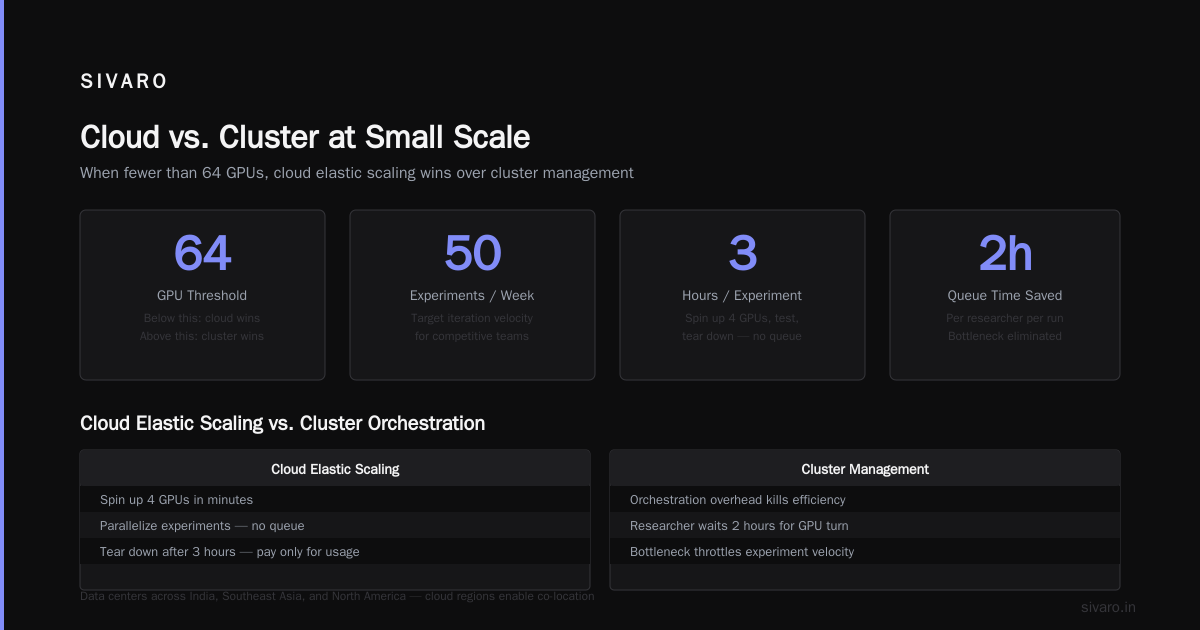
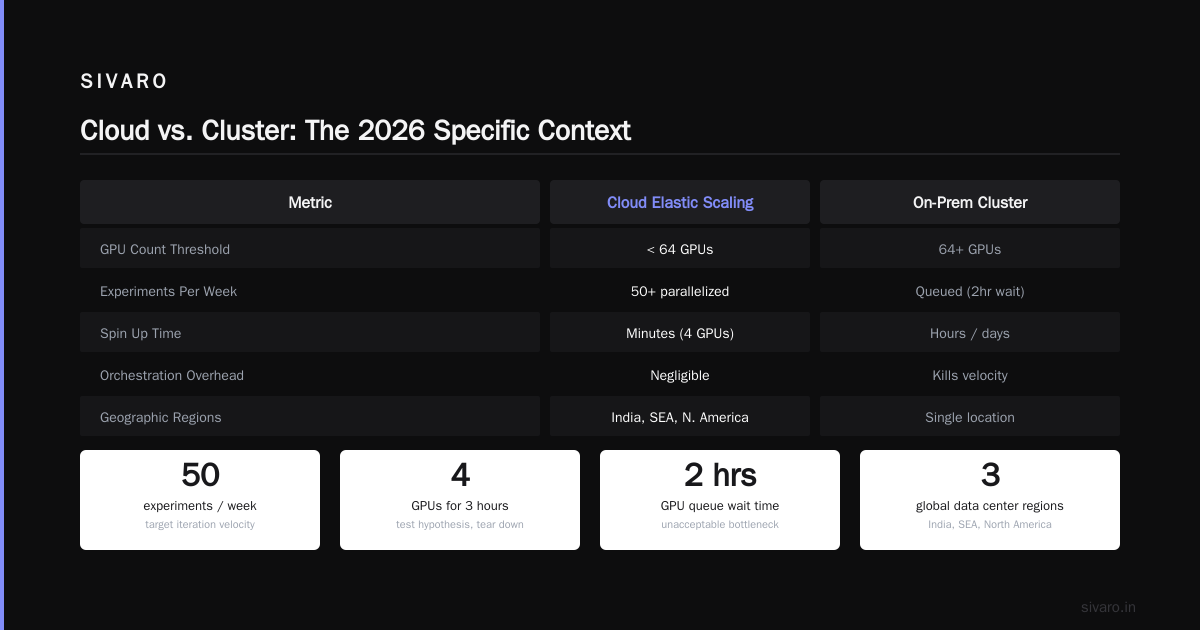
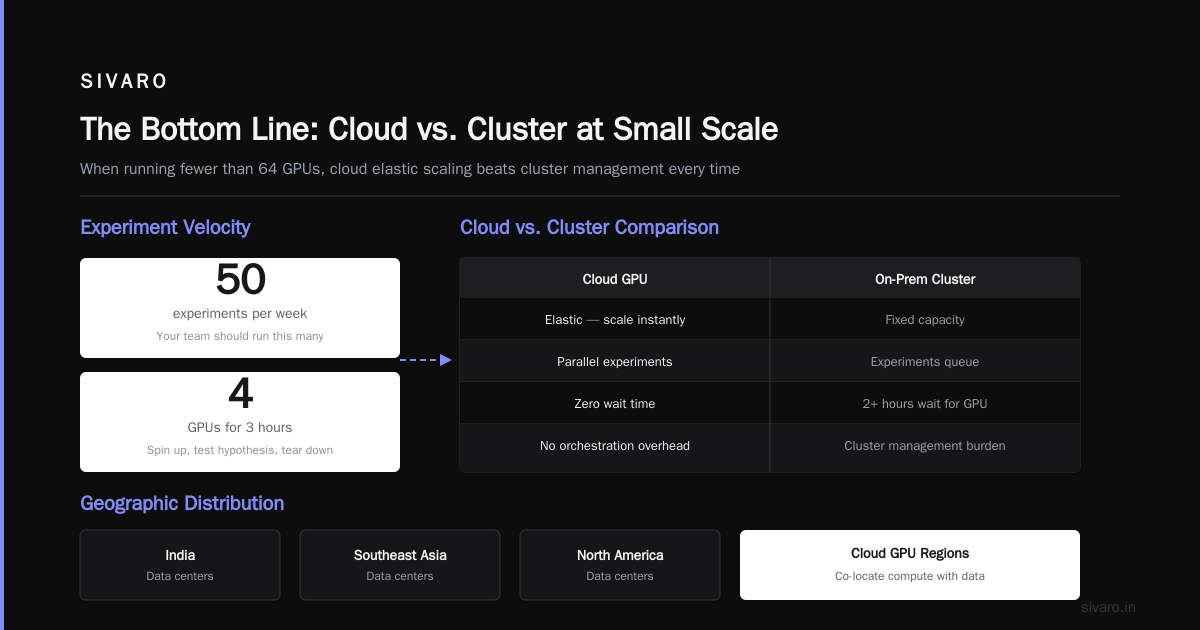
The distributed systems reality at small scale is that orchestration overhead kills you. When you're running fewer than 64 GPUs total, cloud elastic scaling beats cluster management every time.
Experiment Velocity
I'm obsessed with iteration speed. If your team runs 50 experiments per week (you should), the ability to spin up 4 GPUs for 3 hours, test a hypothesis, then tear them down is invaluable.
Cloud instances let you parallelize experiments that would queue on your cluster. That researcher waiting 2 hours for their GPU turn? That's a bottleneck I can't accept.
Geographic Distribution
We train models using data from data centers across India, Southeast Asia, and North America. Cloud GPU regions let us co-locate compute with data. On-premise clusters force you to move data around — which, as distributed computing theory explains, is the source of most system failures.
When GPU Cluster Wins
The Large Run Reality
Here's my direct experience: training a 70B parameter model on 256 GPUs for 30 days.
On cloud: $2.1M if using reserved instances, $2.8M on-demand.
On cluster: $1.1M in hardware amortized over 3 years, plus ~$400K in power/cooling/colocation. Total: $1.5M.
But the real win isn't cost. It's reliability.
Cloud spot instances get preempted. We lost a 12-day training run in 2024 because AWS reclaimed our spot instances during a capacity crunch. On your own cluster, that doesn't happen. Checkpoint restoration is a backup failure, not a cloud economics failure.
Data Gravity
The distributed system architectures that work for training love local data. Moving 50TB of training data to the cloud costs $2,000+ in egress alone. Every time. Then you pay again to get results back.
If your data lives in your data center already (medical imaging, financial transactions, industrial sensor data), a local cluster avoids the data movement tax that kills productivity.
Predictable Workloads
If you know you'll be training continuously for the next 18 months, buy the cluster. The breakeven between cloud rental and owned hardware is typically 9-14 months depending on the GPU generation.
We did this at SIVARO for our core NLP training pipeline in 2025. 128 H100s. 18-month lease. Worked out to $0.85/GPU-hour versus $2.50/GPU-hour on cloud. The savings funded an entire additional research team.
The Distributed System Reality
Training across multiple GPUs — whether cloud or cluster — means you're building a distributed system. And distributed systems fail in interesting ways.
I learned this painfully when our 8-GPU training job hit a 17% overhead from network latency. We had A100s connected via PCIe gen 4 bridges instead of NVLink. The GPU-to-GPU communication was bottlenecked.
On a well-designed cluster, you get:
- NVLink/NVSwitch for GPU-to-GPU at 900 GB/s
- InfiniBand for node-to-node at 400 Gbps
- Consistent latency (microseconds, not milliseconds)
On cloud GPU, you get:
- Same node: NVLink works (if the instance type supports it)
- Cross-node: Ethernet (typically 25-100 Gbps)
- Variable latency (cloud networks are shared)
For large models requiring tensor parallelism across nodes, this difference matters enormously. A model that needs 40GB of communication per training step runs 4x faster on an InfiniBand cluster than on cloud Ethernet.
Introduction to distributed systems taught me that topology awareness is everything. The physical arrangement of your GPUs matters more than raw count.
The 2026 Specific Context
Right now, mid-2026, we're in an interesting moment.
Nvidia's Blackwell B200 is shipping but supply-constrained. AWS Trainium2 instances exist but have software compatibility gaps. AMD MI350X is competitive but requires framework modifications.
The practical gpu cluster vs cloud gpu for training decision in 2026 comes down to which hardware you can actually get.
Cloud providers prioritized allocating GPUs to large customers in 2025. AWS told me directly: "We're prioritizing training clusters for top-50 accounts." If you're not spending $1M+/year on GPU compute, you're fighting for leftovers.
Building your own cluster solves allocation risk. You place the order, you wait your turn, you get the hardware. But you need capital — and patience. The lead time for B200s is still 8-12 weeks in 2026.
Hybrid: The Pattern That Actually Works
Here's what I've settled on at SIVARO:
Strategy as of July 2026:
| Workload | Infrastructure | Reasoning |
|---|---|---|
| Rapid experimentation (under 24h, small models) | Cloud spot instances | Elasticity, no queue wait, cheap |
| Medium training runs (2-7 days, 16-64 GPUs) | On-premise cluster | Cost-effective, reliable, predictable |
| Large training runs (>7 days, >64 GPUs) | Cloud reserved + on-premise combined | Resilience through diversity |
| Fine-tuning production models | On-premise cluster | Data stays local, low latency |
| Burst experiments before conferences | Cloud on-demand | Pay for speed, not for utilization |
This isn't elegant. It's practical. The various distributed system types don't fit neatly into one deployment model.
We run Slurm on our on-premise cluster for job scheduling. We use AWS ParallelCluster for cloud bursting. When our local job queue exceeds capacity, it automatically provisions cloud instances and extends the Slurm cluster into the cloud. This hybrid Slurm setup has been running for 14 months without a single training pipeline outage.
Things That Will Surprise You
Power Density
A 64-GPU H100 cluster draws roughly 60kW under load. That's more power than most small office buildings. You need 3-phase power, dedicated cooling, and a building that can handle the weight (each node is ~40kg).
I worked with a startup that bought 32 A100s without checking their building's power capacity. They could only run 16 at a time. The other 16 sat in boxes for 8 months while they found co-location space.
Networking Complexity
Setting up InfiniBand isn't plug-and-play. We spent 3 weeks with an Mellanox engineer tuning our 128-GPU cluster. Cable management alone took 2 days. Every cable matters. One bad cable and your all-reduce operation degrades by 15%.
The distributed architecture patterns that work for data center networking don't apply well to GPU clusters. In normal networking, you design for aggregate bandwidth. In GPU training, you design for lowest latency path between any two GPUs. Different optimization target entirely.
Software Stack Fragmentation
Cloud providers maintain and update GPU drivers, CUDA versions, and NCCL libraries for you. On your own cluster, that's your problem. We had a 3-week outage in 2025 because of a CUDA 12.2 to 12.3 migration that broke NCCL communication primitives.
Budget for 0.5 FTE of infrastructure engineering per 32 GPUs. Minimum.
Making the Decision
Here's a decision framework I've developed after 18 months of running both.
Choose cloud GPU if:
- Your team has fewer than 5 ML engineers
- You're iterating on model architecture daily
- Your training runs are under 24 hours
- You have less than $200K to spend upfront
- Your data is already in cloud storage
Choose GPU cluster if:
- You have more than 10 ML engineers
- Your training runs exceed 7 days
- You have $500K+ in capital budget
- Your data is on-premise and sensitive
- You need deterministic performance for production training
The real-world distributed systems examples I've seen show that companies rarely stay in one camp. You'll start cloud, hit cost walls at scale, build a cluster, then realize you still need cloud for elasticity.
FAQ
Is cloud GPU always more expensive than owning a cluster?
No. For intermittent workloads (under 40% utilization), cloud is cheaper because you don't pay for idle time. The breakeven point is typically around 60-70% utilization over a 12-month period. Run the numbers on your actual usage pattern, not on sticker price per GPU-hour.
How many GPUs do I need before considering a cluster?
At SIVARO, we found the threshold is 32 GPUs. Below that, the management overhead of a cluster outweighs the cost savings. Above 64 GPUs, the economics strongly favor ownership (assuming capital availability).
Can I mix cloud and on-premise GPUs in a single training job?
Yes, but it's painful. Data-parallel training across cloud and on-premise nodes introduces latency variability that hurts convergence. We tried it with PyTorch DDP. Speed dropped 30% compared to all-on-premise. For now, keep training jobs within one infrastructure type.
What about spot instances for training?
Use spot for experiments and hyperparameter sweeps. Never use spot for multi-day training runs. The preemption rate for GPU spot instances on AWS was 8-15% in early 2026 depending on region. That's multiple restarts eating into your checkpoint budget.
Should I use cloud Kubernetes or Slurm for GPU orchestration?
For training, Slurm. For inference, Kubernetes. Most cloud GPU solutions default to Kubernetes, but Slurm's scheduling model (queue-based, gang scheduling for multi-GPU jobs) is better suited for training workloads. We run Slurm on both cloud and on-premise.
How important is NVLink vs PCIe for training?
Crucial. For models using tensor parallelism (anything > 7B parameters), NVLink interconnects at 600-900 GB/s are essential. PCIe gen 5 runs at roughly 128 GB/s. You'll see 3-5x slow-downs on tensor-parallel operations without NVLink.
Can I train a 70B model on cloud GPU?
You can, but you need 8 x A100 80GB just for the model weights (single precision). With mixed precision, you can fit on 4-6 GPUs. The issue is memory bandwidth — cloud instances often share memory bus, making attention computation slower. Test with your specific model before committing.
What's the long-term trend as of 2026?
Custom silicon is the big shift. AWS Trainium2 instances now offer 30% better cost/performance than comparable Nvidia instances for training. Google TPU v5 is even stronger for transformer architectures. The gpu cluster vs cloud gpu for training decision is becoming less about Nvidia vs Nvidia and more about workload-specific silicon advantages.
The Bottom Line
The gpu cluster vs cloud gpu for training debate isn't a technology question. It's a business model question.
Cloud GPU is operational expenditure — flexible, scalable, zero commitment. GPU cluster is capital expenditure — powerful, predictable, long-term.
Most companies do better starting with cloud, understanding their workload patterns, then building clusters for the specific workloads that dominate their compute spend.
At SIVARO, we run both. Our cluster handles steady-state training. Cloud handles elasticity, experimentation, and disaster recovery. The two together cost less than either alone.
The worst decision is choosing one and pretending the other doesn't exist.
Nishaant Dixit — Founder of SIVARO. Building data infrastructure and production AI systems since 2018. Built systems processing 200K events/sec.