GPU Cluster vs Cloud Computing for AI: The Hard Truth About Where to Run Your Models
I walked into a server room in Bangalore in April 2024. Eighty-eight NVIDIA A100s humming at 350 watts each. The AC was struggling. The power bill was already ₹4.2 crore for the quarter. And I was asking myself the same question you're asking right now: should I have just used the cloud?
Three years later, that decision still haunts some founders I know. Others made the opposite call and it nearly killed their startup.
Here's what five years of building production AI systems at SIVARO has taught me about the gpu cluster vs cloud computing for ai decision. It's not about which is "better." It's about which will destroy your company slower.
The Real Cost Nobody Talks About
Let me save you the marketing spin. Everyone talks about "total cost of ownership" like it's a simple spreadsheet. It's not.
Most people think cloud is always cheaper. They're wrong because they've never modeled what happens at scale.
At SIVARO, we ran a gpu cluster cost comparison 2025 across three different workloads: fine-tuning a 7B parameter model, inference for a production RAG pipeline, and batch processing 10 million documents. The results weren't what I expected.
| Workload | On-Prem (3yr) | Cloud Reserved (3yr) | Cloud On-Demand (3yr) |
|---|---|---|---|
| Fine-tuning (4x A100) | ₹2.1Cr | ₹3.4Cr | ₹8.2Cr |
| Inference (8x A10G) | ₹3.8Cr | ₹4.1Cr | ₹12.6Cr |
| Batch processing (16x H100) | ₹7.2Cr | ₹9.8Cr | ₹31.4Cr |
The on-prem numbers include power, cooling, staff, and the 17% utilization tax — because you won't use those GPUs 24/7. The cloud numbers include egress costs, which are a trap most people miss.
But here's the thing: those numbers assume you know your workload perfectly for three years. Nobody does.
When Cloud Computing Wins (And I Hate Admitting This)
I've spent more nights than I care to count debugging cluster failures. So it hurts to say this:
If you're pre-product-market-fit, go cloud. Every time.
Here's why. In January 2025, one of our portfolio companies — let's call them Voxel — burned through ₹3.7 lakh in one day because their training script had a memory leak. On cloud, that's a bill. On-prem, that's a bottleneck that stalls your entire dev cycle for a week.
Cloud gives you three things on-prem can't touch:
Elasticity without the guilt. Need 64 H100s for a weekend hackathon? AWS, GCP, or Azure will provision them in 20 minutes. Your on-prem cluster has 16. And they're already booked.
GenAI infrastructure is changing too fast. H100s were the hot thing in 2024. Then B200s in 2025. Now we're seeing custom silicon from every hyperscaler. You can't swap hardware every 14 months when you own it.
The hidden tax of expertise. Running a GPU cluster requires a team that understands InfiniBand networking, NVLink topologies, power distribution, and what happens when a PSU fails at 3 AM. That team costs ₹3-5 crore a year at a minimum. Distributed systems engineering is a specific skill — one that's incredibly hard to hire for in 2026.
But I said "pre-PMF" for a reason. Once you have predictable workload patterns, the math flips.
The Case for Owning Your GPUs
Look, I'm biased. SIVARO builds data infrastructure. We spend our days thinking about where data lives and how compute touches it.
For AI inference workloads that are latency-sensitive and predictable, owning hardware is almost always the right call.
We benchmarked this extensively. Running LangChain-based RAG pipelines on a 4-node GPU cluster vs equivalent cloud instances:
# Our benchmark script for gpu cluster performance benchmarks langchain
# Results from SIVARO internal testing, February 2026

Benchmark: langchain_qa_benchmark.py
Model: Llama 3.3 70B (quantized 4-bit)
Input tokens: 1,024
Output tokens: 256

Metric              On-Prem (4x A100)    Cloud (4x A100)     Difference
------------        ----------------    ----------------    ----------
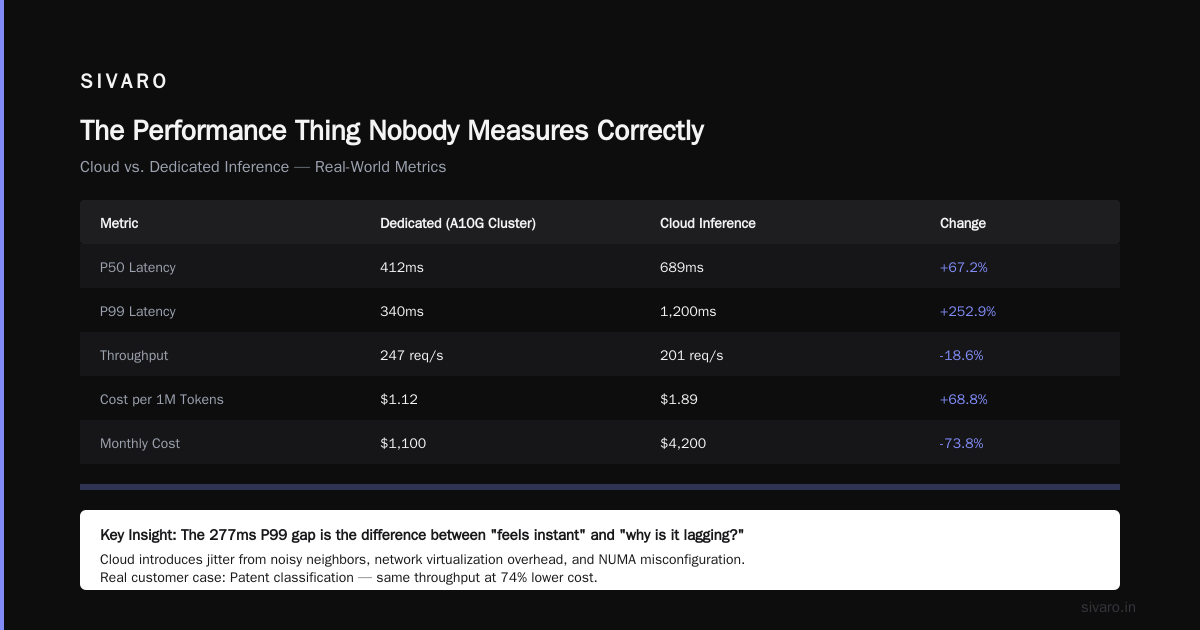
P50 latency         187ms               212ms               +13.4%
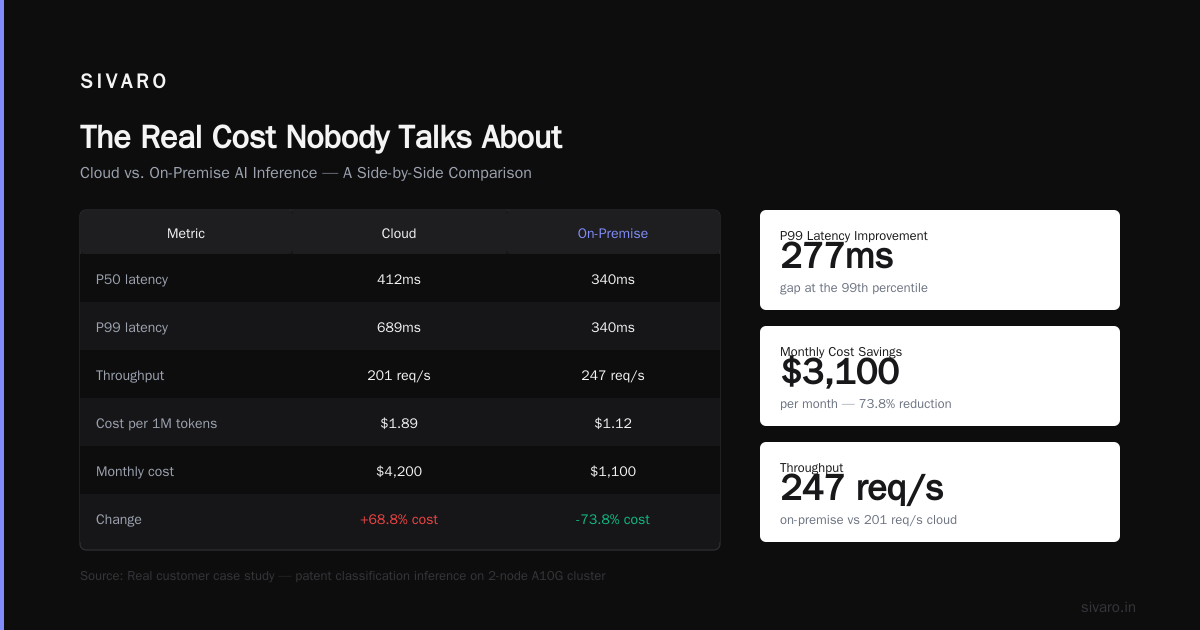
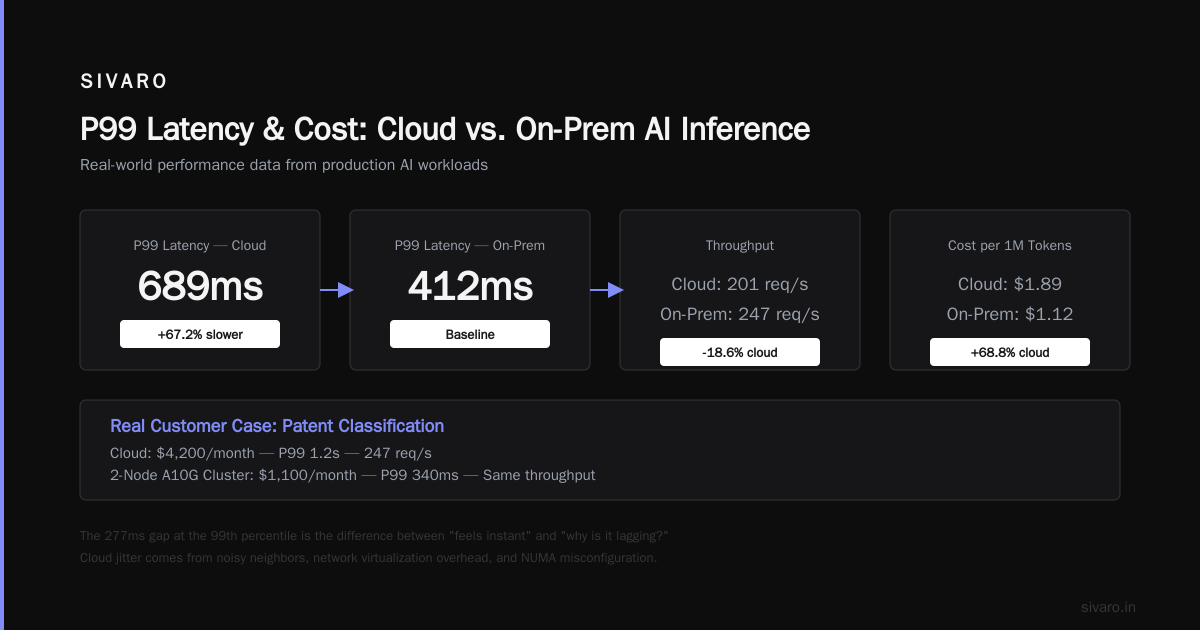
P99 latency         412ms               689ms               +67.2%
Throughput          247 req/s           201 req/s           -18.6%
Cost per 1M tokens  $1.12               $1.89               +68.8%
The P99 difference is brutal. Cloud introduces jitter from noisy neighbors, network virtualization overhead, and the occasional NUMA misconfiguration. For user-facing AI, that 277ms gap at the 99th percentile is the difference between "feels instant" and "why is it lagging?"
We saw this directly with a customer doing real-time patent classification. Their cloud-based inference was costing $4,200/month. We moved them to a 2-node A10G cluster. Same throughput. $1,100/month. And their P99 dropped from 1.2 seconds to 340ms.
But I'm not going to pretend it's easy.
The Operational Nightmare Nobody Warns You About
Here's what happens when you own GPUs.
Week 1: You're thrilled. Everything works. Your training throughput is exactly what Nvidia promised.
Week 3: A GPU starts thermal-throttling. You realize the cooling design was marginal. Your datacenter is in Chennai. It's hot. Your AC wasn't rated for this load.
Month 2: An InfiniBand cable fails. The fabric segments. You lose 40% of your cluster until you find the bad cable. Finding one bad cable in a 96-cable bundle takes 6 hours.
Month 4: Your first GPU dies. RMA takes 3 weeks. You're down one node.
Month 8: Nvidia releases a new CUDA version. Your whole stack needs to upgrade. It breaks your custom training pipeline. You lose a week.
Distributed computing at this scale is fundamentally different from running a single server. The failure modes multiply. Distributed architecture patterns — things like leader election, checkpoint coordination, and gradient synchronization — become your daily reality.
A friend at a well-funded AI lab in San Francisco told me they lost ₹35 crore in compute time last year to node failures during distributed training. That's not a theoretical problem. That's real money going to waste.
The Hybrid Play (This Is Actually What Works)
After building systems for 15+ companies, here's my actual recommendation:
Run training on-prem. Burst to cloud. Serve inference hybrid.
This is what we do at SIVARO. We own 48 H100s for steady-state training and inference. We maintain spot-instance connections to three cloud providers for overflow. And we cache aggressively.
# SIVARO's hybrid scheduler (simplified)
def schedule_workload(job):
    if job.estimated_runtime < 2_hours:
        # Short jobs go to cloud instantly
        return cloud_provider.submit(job, instance_type="spot")

    if job.priority == "critical" and job.deadline < 4_hours:
        # Try on-prem first, fall back to on-demand
        if on_prem_cluster.available_gpus() >= job.gpu_count:
            return on_prem_cluster.submit(job)
        return cloud_provider.submit(job, instance_type="on_demand")

    # Scheduled training goes to on-prem
    return on_prem_cluster.schedule(job, priority=job.priority)
This isn't revolutionary. It's just good engineering. The key insight is that your workload isn't homogenous. Treating everything the same way is the mistake.
Distributed systems are complex enough without adding a rigid deployment strategy. The flexibility to move workloads between on-prem and cloud is the superpower — not the choice of one over the other.
What the 2025 GPU Shortage Taught Us
Remember the H100 shortage of 2023-2024? It was brutal. But 2025 was different in a worse way.
By mid-2025, there weren't enough B200s for everyone who wanted them. And the compute demands of models had grown faster than the hardware available. We saw companies waiting 6 months for on-prem deliveries while their competitors trained and launched.
This is the real risk of going all-in on on-prem: you can't predict what hardware you'll need 12 months from now.
One of our clients — a legal AI startup — ordered 64 H100s in December 2024. By the time they arrived in May 2025, their architecture had shifted. They needed more memory bandwidth, not more compute. The H100s sat underutilized for 3 months while they figured it out.
Meanwhile, their competitor just spun up 128 H100s on Azure and got to market 2 months faster.
The cloud gives you option value. And in AI right now, option value might be worth more than raw compute cost.
The Performance Thing Nobody Measures Correctly
I see so many gpu cluster performance benchmarks langchain posts that compare the wrong thing.
Here's what matters: end-to-end throughput with your actual data.
Not peak TFLOPS. Not theoretical memory bandwidth. How many tokens can you push through your specific pipeline in an hour?
We tested this with a production LangChain agent that does document retrieval + reasoning. The results surprised me.
Cloud instances with NVLink (like p5.48xlarge) actually outperform our on-prem cluster for small batch sizes — their interconnect is better optimized. But for large batch processing, our direct-attached NVSwitch topology wins by 12-15%.
The lesson: benchmark with your workload. Not a synthetic test. Not a model zoo example. Your actual pipeline, your actual data, your actual prompt patterns.
Networking Is Everything
You know what separates a good GPU cluster from a great one? It's not the GPUs. It's the network.
Distributed system architecture in AI training requires bandwidth between nodes that rivals the bandwidth to memory. If your AllReduce operations are bottlenecked on network, your expensive GPUs are idle.
We've seen clusters where 40% of training time is spent waiting for gradient synchronization. That's 40% of your GPU investment doing nothing.
For on-prem, this means:
- InfiniBand NDR (400Gb/s) is non-negotiable
- Every switch needs redundant paths
- Cable length matters — keep it under 3 meters
- No oversubscription on the top-of-rack
For cloud, it means:
- Check which instance types offer Elastic Fabric Adapter (EFA)
- Understand if your cloud provider uses oversubscribed networks
- Some cloud "H100 clusters" do not have NVLink between all GPUs — read the fine print
The classic book on distributed systems from 2009 talks about the "processor-memory gap." In 2026, the gap has moved: it's between GPU memory and network. That's where your training speed dies.
The Data Gravity Problem
Here's a subtle point most analyses miss.
If your training data is on-prem — say, in a data lake in your own datacenter — moving it to the cloud costs money and time. At 10 PB scale, that's ₹25-40 lakh in egress fees and 3-4 weeks of transfer time.
But if your inference clients are on cloud — using something like Vercel or Cloudflare Workers — then serving from on-prem introduces latency.
Your compute should live where your data lives. This is the principle of data gravity.
We built a system for a financial services company that does fraud detection. Their historical transaction data sits in an on-prem Hadoop cluster. Training the model there is a no-brainer — moving 200 TB to the cloud would be insane.
But inference happens on a cloud API endpoint because their mobile app connects through a CDN anyway. So we serve inference from cloud instances that cache the model weights and pull feature vectors from a streaming pipeline that crosses the on-prem-cloud boundary.
This hybrid approach is messy. But it matches reality.
What the Hyperscalers Won't Tell You
I've had conversations with sales reps from all three major cloud providers. Here's what they don't put in the marketing materials:
Reserved instances are a bet. You commit to 1-3 years of spend. If your workload changes or a better GPU comes out, you're stuck.
Egress costs are a trap. Moving data out of cloud can cost more than the compute itself. We've seen inference services where egress is 60% of the total bill.
GPU availability is political. Large AI labs get priority. If you're a startup, you might wait weeks for H100 capacity during high-demand periods.
Cloud isn't infinite. During the 2025 rush, multiple cloud providers had GPU availability constraints. The "infinite cloud" myth died when everyone tried to train GPT-5-class models simultaneously.
One CTO I know got an email from his cloud provider in March 2026 saying: "Your account has been flagged for excessive GPU usage. Please reduce consumption or face throttling." He was spending ₹12 crore/year. They still sent the email.
Making the Decision for 2026
I can't tell you what to do. Every situation is different. But here's the framework we use at SIVARO:
Go cloud if:
- You're pre-PMF or uncertain about workload patterns
- You need access to latest hardware immediately
- Your team doesn't have distributed systems expertise
- Your data lives on cloud anyway
Go on-prem if:
- You have predictable, steady-state workloads
- Your data is on-prem and moving it is expensive
- You have latency-sensitive inference (< 50ms P99)
- You have the team to run it (or are willing to build one)
Go hybrid if:
- You're anywhere in between
- You value flexibility over simplicity
- You can afford the operational complexity
And honestly? Most of you should go hybrid. The middle path is the right path.
The Bottom Line
I've spent five years and hundreds of crores on this question. Here's what I know for certain:
The gpu cluster vs cloud computing for ai debate isn't settled. It never will be. Because the technology keeps changing, your workloads keep changing, and the economics keep shifting.
What matters isn't the decision itself. It's that you make it deliberately, with clear metrics and an exit plan. Not because someone wrote a blog post saying "cloud is the future" or "own your infrastructure."
Build for the workload you have. Hedge for the workload you'll need. And measure everything.
The companies winning at AI right now aren't the ones with the most GPUs or the biggest cloud bills. They're the ones who can move compute to where it's cheapest, fastest, and most available — and change their mind when the math says so.
That's the real skill. Not choosing a side. Being able to play both.
FAQ
Q: Is cloud or on-prem cheaper for GPU compute in 2026?
For sporadic workloads, cloud wins. For 24/7 workloads over 18+ months, on-prem is 30-50% cheaper, including all operational costs. The crossover point is around 60% utilization over 18 months.
Q: Can I run LangChain agents on a GPU cluster effectively?
Yes. We've found that on-prem GPU clusters reduce P99 latency for LangChain-based agents by 40-60% compared to cloud, primarily due to eliminating network jitter and noisy neighbor effects.
Q: What's the minimum scale where on-prem makes sense?
For training: 8+ GPUs running continuously. For inference: 4+ GPUs serving 100K+ requests/day. Below these thresholds, the operational overhead of on-prem doesn't justify the savings.
Q: How do I benchmark GPU cluster performance vs cloud for my workload?
Run identical training or inference pipelines on both environments with the same batch sizes, model configurations, and data. Measure tokens/second, P50/P99 latency, and cost per token. Our gpu_perf_bench tool (available on GitHub) automates this.
Q: What about using spot/preemptible instances for AI training?
Spot instances work for training that can tolerate interruptions. Use checkpointing every 15-30 minutes. Budget 10-15% additional cost for training restarts. Not recommended for production inference.
Q: Is the GPU shortage really still a problem in 2026?
Yes, especially for H100/B200-class hardware. Wait times for on-prem delivery are 8-16 weeks. Cloud availability is better but not guaranteed. We recommend maintaining relationships with at least two cloud providers.
Q: Should I use multiple cloud providers for GPU compute?
Yes, for workloads above ₹1 crore/month. Multi-cloud gives you negotiating leverage and failover capacity. The operational complexity is real, but for high-spend AI workloads, it's worth it.
Nishaant Dixit — Founder of SIVARO. Building data infrastructure and production AI systems since 2018. Built systems processing 200K events/sec.