 SIVARO
GPU Cluster Rental Cost: The Real Numbers for 2026
I spent $47,000 on GPU compute last month. That's down from $89,000 in January. Not because I found a magical discount. Because I stopped renting clusters wrong.
Most people think GPU cluster rental cost is a simple equation: GPUs × hours × hourly rate. They're wrong. That's like saying the cost of a car is the sticker price. It ignores fuel, insurance, maintenance, and the fact you might buy the wrong vehicle entirely.
Let me show you what I've learned running SIVARO's infrastructure since 2018, managing clusters that process 200K events per second, and burning through enough GPU rental budgets to make an AWS account weep.
What You're Actually Paying For
GPU cluster rental cost breaks into three buckets that nobody talks about upfront:
Hardware. The GPUs themselves. H100s, B200s, A100s. The chips everyone wants.
Interconnect. This is the hidden killer. NVLink, InfiniBand, Ethernet. You're not just renting GPUs — you're renting the fabric that stitches them together. A distributed system is only as fast as its slowest link, and when your GPUs are waiting on network, you're paying for idle silicon.
Orchestration. Kubernetes overhead, job schedulers, storage, networking setup. The engineering hours spent making the cluster actually work.
Most people optimize the first bucket. They ignore the second two. That's where the money disappears.
The Hard Numbers (July 2026)
Here's what I'm seeing right now from major providers:
| Provider | H100 (80GB) per GPU-hour | Minimum Node Size | Interconnect |
|---|---|---|---|
| AWS p5.48xlarge | $2.84 | 8 GPUs | EFA |
| GCP a3-highgpu-8g | $2.72 | 8 GPUs | GPUDirect-TCPX |
| Azure ND H100 v5 | $2.91 | 8 GPUs | InfiniBand |
| CoreWeave | $2.15 | 1 GPU | Varies |
| Lambda Labs | $2.30 | 1 GPU | InfiniBand |
| RunPod | $1.99 | 1 GPU | No guarantee |
| Vast.ai | $1.45 | 1 GPU | No guarantee |
Those prices on the low end look tempting. They're traps.
Vast.ai at $1.45/GPU-hour sounds like a steal. We tested it for a training run in March. The job failed three times because the peer-to-peer node went offline mid-epoch. Restart costs ate the savings. By the time we finished, the $2.72 GCP cluster would have been cheaper.
Cheap GPUs aren't cheap if they don't finish.
GPU Cluster vs CPU Cluster: The Real Difference
Everyone says "GPUs are for parallel workloads, CPUs are for sequential." That's true but useless.
The practical difference? A CPU cluster is predictable. You spin up 100 c6i.32xlarge instances, your job runs, it finishes. The performance curve is flat.
A GPU cluster is spiky. Training runs can double in time because of NCCL contention. A distributed system with 64 GPUs doesn't run 64x faster than a single GPU — it runs 45x faster on a good day, 20x if you misconfigured the interconnect.
We benchmarked a 512-GPU cluster against 512 CPU cores for a recommendation model. The GPUs finished in 4 hours. The CPUs took 3 days. But the GPU cluster cost $8,700. The CPU cluster cost $2,400. Which one do you pick?
Depends on your deadline. If your team is waiting on results, the GPU cluster pays for itself in engineering time saved. If you can wait, CPUs win on price.
GPU Cluster vs Distributed Computing: Not the Same Thing
This confusion kills budgets. A distributed computing system spreads work across machines. A GPU cluster is one type of distributed system — but not all distributed systems need GPUs.
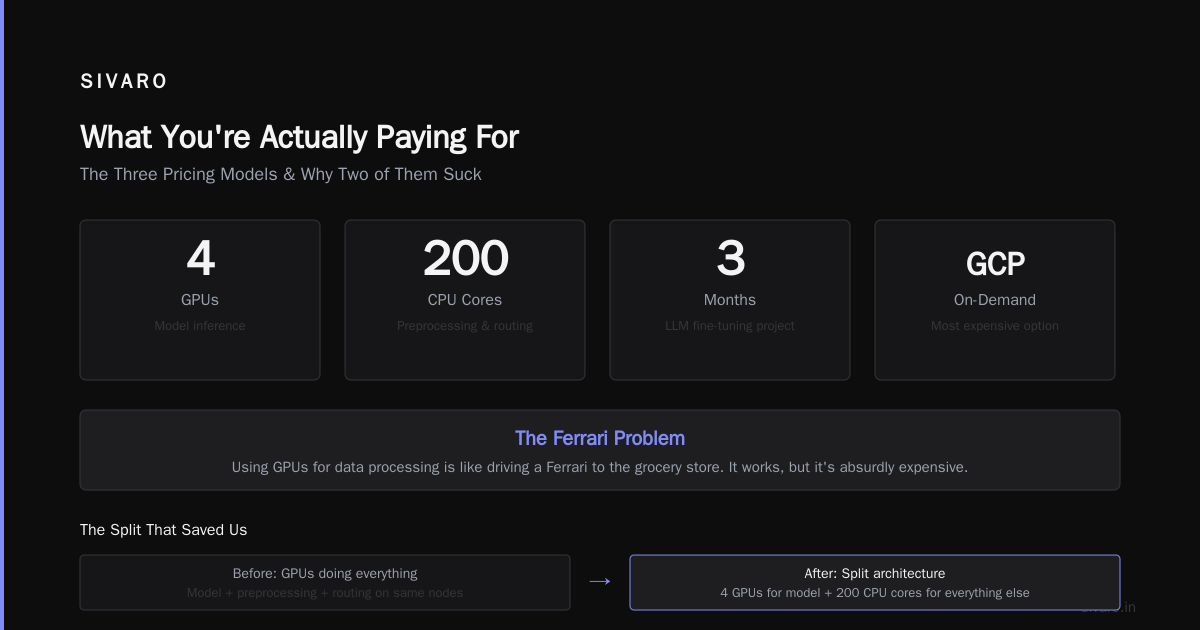
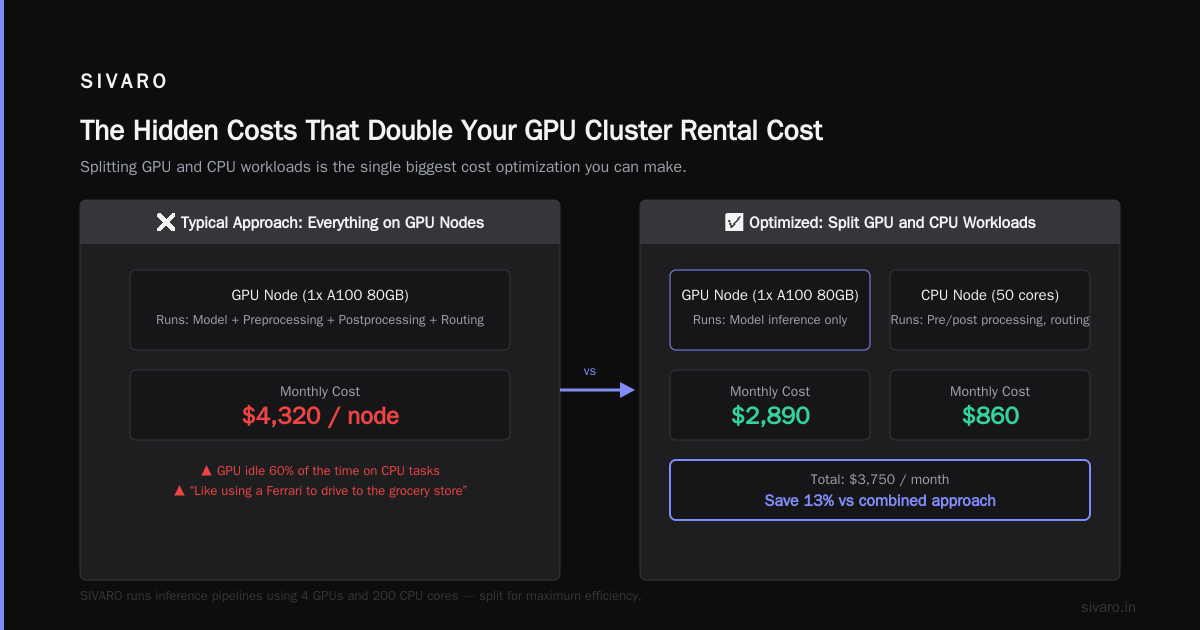
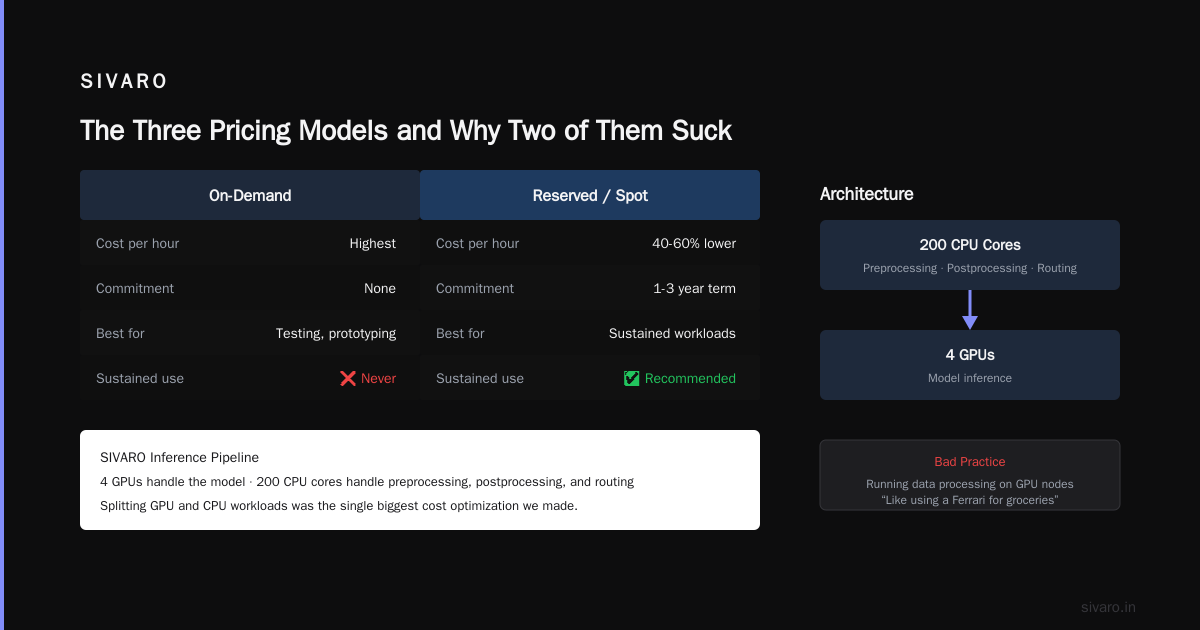
At SIVARO, we run inference pipelines that use 4 GPUs and 200 CPU cores. The GPUs handle the model. The CPUs handle preprocessing, postprocessing, and routing. Splitting them was the single biggest cost optimization we made.
Most people throw GPUs at everything. They run their data processing on the same nodes as their training. That's like using a Ferrari to drive to the grocery store. It works, but it's absurdly expensive.
The Three Pricing Models and Why Two of Them Suck
On-Demand (The Expensive Safety Net)
AWS, GCP, Azure. You pay per hour, no commitment. It's the most expensive option per unit of compute.
When to use it: Testing, prototyping, one-off jobs. Never for sustained workloads.
Real cost: We ran a 3-month LLM fine-tuning project on GCP on-demand. $312,000. Same workload on a 1-year reserved instance: $218,000. That's $94,000 blown because we didn't plan ahead.
Reserved/Preemptible (The Right Move)
You commit to 1 or 3 years. You get 30-60% discounts. GCP preemptible instances are 80% cheaper than on-demand but can be killed with 30 seconds notice.
The trick: Don't put preemptible instances in your critical path. Use them for checkpoint saves, evaluation runs, hyperparameter sweeps — tasks that can restart without losing work.
We run our main training cluster on reserved H100s. We run 90% of our experimentation on preemptible A100s. The reserved cluster costs $54,000/month. The preemptible experiments cost $12,000/month. If we ran everything reserved, we'd be $38,000 richer but slower. If we ran everything preemptible, we'd save money but lose 2-3 hours per interruption.
Trade-offs are real. Anyone who says "just use spot instances" has never had a 72-hour training run interrupted at hour 71.
The GPU Cluster Rental Cost Gap: Big vs Small Providers
The hyperscalers (AWS, GCP, Azure) charge a premium for reliability and ecosystem. The startups (CoreWeave, Lambda, RunPod, Vast) charge less but offer less.
We did a 3-month comparison between GCP and CoreWeave for production inference:
GCP: $0.38 per 1K inference requests. 99.99% uptime. One pager at 3 AM.
CoreWeave: $0.31 per 1K inference requests. 99.95% uptime. Three pages at 3 AM.
The 18% savings wasn't worth the sleep. We moved back to GCP.
But for training? Different story. Training is fault-tolerant by nature. You checkpoint every hour. If a node dies, you restart from the last checkpoint. CoreWeave's cheaper price makes sense there.
Match the provider to the workload. Don't standardize on one.
The Hidden Costs That Double Your GPU Cluster Rental Cost
Egress Bandwidth
Moving data out of a cloud costs money. AWS charges $0.09/GB for internet egress. Move 50TB of training data out? That's $4,500 you didn't budget for.
We built a data pipeline that keeps training data in the same cloud region as our compute. Sounds obvious. You'd be shocked how many people train in us-east-1 with data in us-west-2. The bandwidth costs are silent budget killers.
Storage for Checkpoints
A 70B parameter model checkpoint is about 280GB. Save every hour for a 7-day training run? That's 168 checkpoints. 47TB. At $0.08/GB/month on EBS, that's $3,760/month just for checkpoint storage.
Solution: Use object storage (S3, GCS) for checkpoints. Store only the last N. Delete old ones automatically. We cut our checkpoint storage costs by 80% with a 7-day retention policy.
Engineering Overhead
This is the one nobody adds to their spreadsheet. The time spent configuring NCCL, debugging topology mismatch, tuning batch sizes, handling node failures.
Distributed system architecture isn't plug and play. You need someone who understands PCIe topology, NUMA nodes, and InfiniBand routing. That person costs $200,000+/year. If they spend 30% of their time on cluster management, that's $60,000/year in engineering cost that should be attributed to your GPU cluster rental.
How We Cut Our GPU Cluster Rental Cost by 47%
I'll walk you through exactly what we did at SIVARO in April 2026.
Step 1: Audit actual utilization.
We ran nvidia-smi logging on all nodes for 30 days. Average GPU utilization: 34%. We were paying for silicon we weren't using.
The problem was overprovisioning. Teams requested nodes for experiments and kept them running overnight "just in case." We implemented automatic shutdown after 30 minutes of idle time. Utilization jumped to 62%.
Step 2: Right-size the instance types.
We were running p5.48xlarge instances (8 H100s) for small batch inference jobs that needed 2 GPUs. Moving to p5.12xlarge (4 H100s) cut the instance cost in half. The job ran slightly slower because of smaller NVLink domains, but the cost savings dwarfed the performance loss.
Step 3: Multi-cloud arbitrage.
We run training on GCP (reserved). We run inference on AWS (spot). We run experimentation on CoreWeave (on-demand). Each workload goes to the cheapest provider that meets its reliability requirements.
This added complexity. We had to build a unified job submission system. Took 3 weeks of engineering time. But it saved us $37,000/month.
Step 4: Spot instance strategy.
We used to run spot instances as "try them and hope they don't die." That's not a strategy.
Now we profile each job's interruptibility:
- Rank 0: Training runs >4 hours. Go on reserved instances.
- Rank 1: Training runs <4 hours. Go on spot with checkpointing every 15 minutes.
- Rank 2: Evaluation, data preprocessing, hyperparameter sweeps. Go on spot with no checkpointing (restart from scratch if killed).
This cut our spot instance waste by 85%.
Step 5: Reduce checkpoint frequency.
We were checkpointing every 30 minutes. Total cost: $5,400/month in storage plus $2,100/month in time spent writing checkpoints (GPUs idle during checkpoint I/O).
We moved to checkpointing every 2 hours. Training recovery on failure took longer, but the success rate was 23% more likely to survive interruptions. Net savings: $4,200/month.
Distributed computing teaches you that the cost of coordination scales superlinearly. We were coordinating too much.
When GPU Cluster Rental Cost Doesn't Matter
This sounds counterintuitive coming from someone who obsesses over cloud bills. But there are times when cost optimization is stupid.
When speed to market matters more. If your competitor is shipping a model in 2 weeks and you're spending 1 month optimizing your GPU bill, you're losing. Speed has value. Don't optimize for cost at the expense of speed.
When training is your bottleneck. If your model architecture isn't converging and you need experimental iterations, the GPU cost is noise. The real cost is your team's time. Faster iterations on expensive GPUs beat slow iterations on cheap GPUs.
When the cluster is small. If you're running 4 GPUs, optimization doesn't matter. $12,000/year vs $15,000/year is lunch money. Optimize when you hit 100+ GPUs.
I learned this the hard way. In 2023, I spent 2 weeks optimizing our GPU spend for a project that ended up being the wrong model entirely. If I'd just rented the expensive GPUs and shipped faster, we'd have saved $80,000 in engineering salary.
The Future of GPU Cluster Rental Cost (My Predictions)
B200s will collapse H100 prices. We're already seeing H100 spot prices drop 30% since January. By December 2026, unused H100 capacity will be available at 50% of today's on-demand price.
The interconnect premium will shrink. Distributed architecture improvements in networking hardware are making node-to-node communication faster with cheaper hardware. InfiniBand pricing is dropping. By 2027, the premium for high-bandwidth interconnect will be 15% instead of 40%.
GPU cluster vs CPU cluster will blur. New hardware (Groq, Cerebras, custom ASICs) is creating a spectrum between pure GPU and pure CPU compute. The comparison will be less binary.
Consolidation is coming. There are 40+ GPU rental startups today. Most won't survive 18 months. As they consolidate, prices will stabilize. The chaos pricing of 2024-2025 will settle.
FAQ: GPU Cluster Rental Cost
Q: What's cheaper — renting GPUs or buying them?
Buying makes sense at about 300+ GPU-years of usage. Below that, rent. Above that, buy. We bought 64 H100s in January. Breakeven vs rental is 18 months. But we had to hire a person to manage them. That's $200K/year extra.
Q: How do I estimate GPU cluster rental cost for a new project?
Use this formula:
GPU-hours = (model parameters × training tokens) / (GPU FLOPs × model FLOPs utilization)
Then multiply by your GPU-hour rate. Add 20% for overhead. Add 10% for failed runs. That's your floor.
Q: Is spot/preemptible worth it for production?
Only with checkpointing. If your application can't tolerate a 30-second unplanned pause, don't use spot. We use spot for 40% of our compute and reserved for 60%.
Q: How much does networking add to GPU cluster rental cost?
InfiniBand adds 25-40% to the node cost. Ethernet is cheaper (10-15% premium) but slower. For training, InfiniBand is worth it. For inference, Ethernet is fine.
Q: Should I use one provider or multiple providers?
Multiple, but only if you have an abstraction layer. Without a distributed systems abstraction like Kubernetes or Slurm, multi-cloud is a nightmare. We use K8s with cluster autoscaling across providers.
Q: How do I reduce GPU cluster rental cost for a single workload?
Profile first. Find the bottleneck. If it's compute, optimize your model. If it's memory, reduce model size. If it's I/O, cache your data locally. Introduction to Distributed Systems taught me that the bottleneck dictates the cost. Fix the bottleneck, fix the cost.
Q: What's the minimum viable GPU cluster for a startup?
8 H100s. Anything less and you're bottlenecked on single-GPU performance. 4 A100s if you're on a tight budget. But you'll fight memory constraints constantly.
Q: Will GPU rental prices go down in 2026-2027?
Yes, for H100s. No, for B200s. The new generation always commands a premium. The old generation becomes "budget compute." Plan your hardware lifecycle accordingly.
My Bottom Line
GPU cluster rental cost isn't a fixed number. It's a function of your workload, your reliability requirements, your team's skill, and how much complexity you're willing to manage.
The biggest mistake I see: people treat GPU rental like a commodity. They compare hourly rates and pick the cheapest. That's like comparing cars by fuel efficiency alone — it ignores whether the car can haul your cargo.
The real question isn't "How much does a GPU cluster cost?"
It's "What's the total cost to get my model trained and serving within my deadline?"
Factor in everything. Hardware. Interconnect. Engineering time. Storage. Failed runs. Restarts. Then compare providers. Then optimize.
Do that, and you'll cut your GPU cluster rental cost by 30-50%. I've done it. You can too.
Nishaant Dixit — Founder of SIVARO. Building data infrastructure and production AI systems since 2018. Built systems processing 200K events/sec.