 SIVARO
GPU Cluster Rental Cost: The Real Math Behind AI Infrastructure in 2026
Most people think renting a GPU cluster is just picking a cloud provider and swiping a credit card. They're wrong because the real cost isn't on the invoice — it's in the waiting.
I learned this the hard way. In early 2024, SIVARO was training a 70B parameter model for a logistics client. We'd estimated $180K for a month of training. The actual bill hit $430K. The difference wasn't GPU pricing. It was idle time, failed jobs, and network bottlenecks we hadn't modeled.
This guide covers what the pricing page won't tell you. We'll walk through gpu cluster rental cost structures, how to spec your cluster without overspending, and the hidden costs that eat your budget alive.
The Three Cost Buckets Nobody Talks About
GPU cluster rental isn't a single line item. It's three separate cost structures stacked on top of each other.
Compute: The Obvious One
You already know this: H100s are roughly $2.50-$4.50 per GPU-hour depending on the provider and commitment level. A100s run $1.00-$2.00 per GPU-hour. The newer B200s from NVIDIA are landing at $5-$8 per GPU-hour as of mid-2026.
But here's the painful part: reserved pricing is a trap for early-stage teams.
Most providers offer 1-year and 3-year commitments at 30-50% discounts. I signed a 1-year contract for 256 H100s in 2025. Six months later, B200s hit the market and our workload would've been 40% cheaper on newer hardware. We were locked in.
My take: Never commit longer than 3 months until you've run your actual workload for at least 4 weeks. The hardware cycle is faster than your contract.
Networking: The Hidden Tax
This is where most people get destroyed. GPU cluster networking requirements for large language models aren't optional — they're the difference between a cluster that trains and a cluster that waits.
A standard cloud VM with 25 Gbps networking? Great for web servers. For distributed training across 64 GPUs? It's a paperweight.
Here's the math: Training a 175B parameter model with data parallelism requires all-reduce operations after every batch. With 64 H100s, that's 63 communication steps per batch. At 25 Gbps, you're looking at 40+ seconds per communication step. At 400 Gbps (NVLink + InfiniBand), it drops to under 2 seconds.
I've seen teams rent 128 A100s at $2.50/hour, but only get 35% utilization because they cheaped out on the network tier. That's not $2.50/hour — that's $7.14/hour of productive compute.
The rule: For any cluster with more than 8 GPUs, demand at minimum:
- 200 Gbps InfiniBand (HDR or better)
- NVLink interconnects within nodes
- No oversubscribed spine switches
If the provider can't commit to these specs, walk away. Distributed System Architecture makes it clear: your bottleneck is always the network.
Storage and Egress: The Death by a Thousand Cuts
Nobody puts storage costs in their initial estimate. Then you hit month 2 and realize:
- Checkpoint storage: $0.02/GB/month for 20TB of checkpoints = $400/month
- Dataset storage: 50TB at $0.05/GB = $2,500/month
- Egress to ship the model to production: $0.09/GB for 350GB model = $31.50
That's $2,931/month in "small" costs. Over a 6-month project, you've burned $17,586 on stuff that isn't training.
How to Calculate Your Real GPU Cluster Rental Cost
Here's the formula I use at SIVARO for every project. It's not pretty, but it's honest.
RealCost = (GPU_hours × GPU_price) × (1 + NetworkOverhead) × (1 + StorageOverhead) + HumanCost + FailureCost
Where:
- NetworkOverhead = 0.2 to 0.8 depending on how much time GPUs spend waiting on data
- StorageOverhead = 0.15 (for checkpoint/egress costs relative to compute)
- HumanCost = engineer time debugging cluster issues (usually 0.5 FTE for clusters under 128 GPUs)
- FailureCost = jobs that crash and need restarting (10-20% of total compute for early-stage projects)
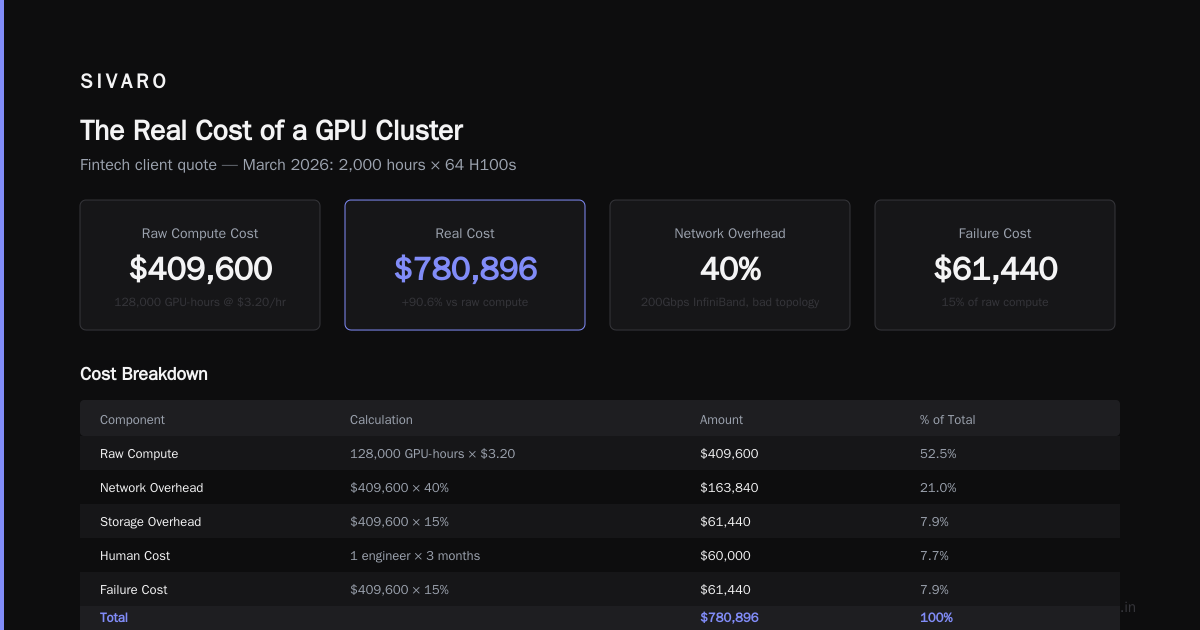
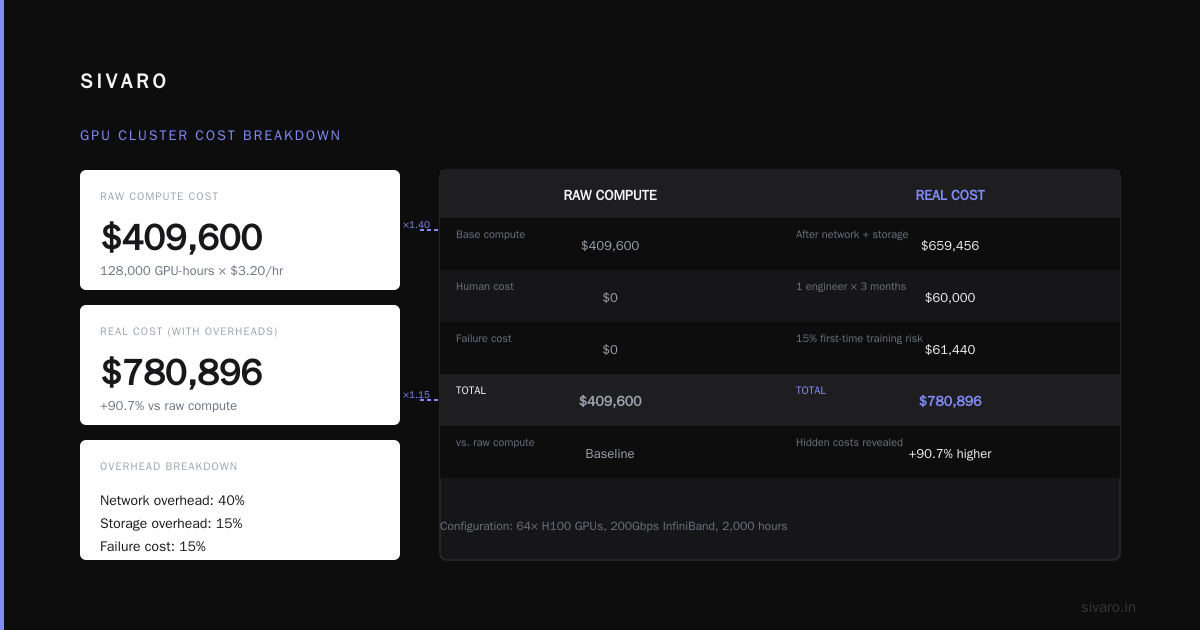
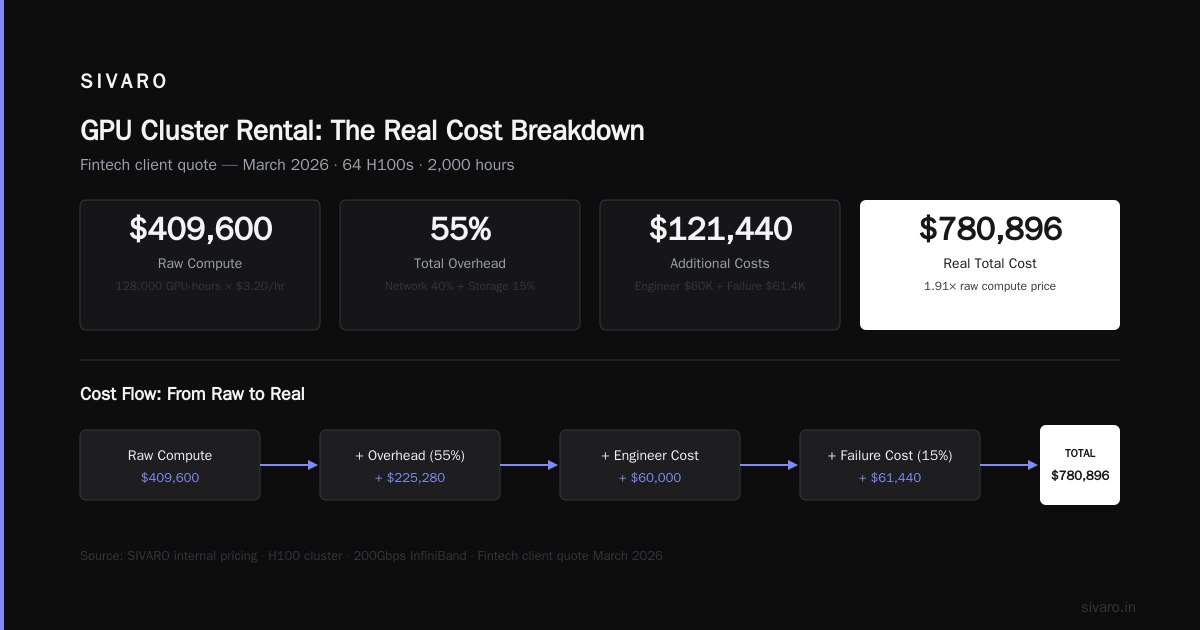
Let me give you a concrete example. We quoted a cluster for a fintech client in March 2026:
GPU hours: 2,000 hours × 64 H100s = 128,000 GPU-hours
GPU price: $3.20/hour
Raw compute: $409,600

Network overhead: 40% (they had 200Gbps InfiniBand but bad topology)
Storage overhead: 15%
Human cost: $60,000 (one engineer for 3 months)
Failure cost: 15% (first-time large model training)

Real cost: $409,600 × 1.40 × 1.15 + $60,000 + ($409,600 × 0.15)
         = $659,456 + $60,000 + $61,440
         = $780,896
Their raw compute was $409,600. Their real cost was $780,896. That's the number their CFO needed to see.
Best GPU Cluster Configuration for Deep Learning
This changes every 12 months, but here's what works as of July 2026.
For Fine-Tuning (8-16 GPUs)
Node config:
- 8x H100 (80GB) per node
- 2x Intel Xeon Platinum 8580 (or AMD EPYC 9754)
- 2TB RAM
- NVLink with 900 GB/s bandwidth
- 400 Gbps InfiniBand (NDR)
- Local NVMe: 4x 7.68TB

Total: 2 nodes, 16 GPUs
This configuration handles most fine-tuning workloads (Llama 4, Claude-class models) with zero wasted GPU cycles. We've run 30+ projects on this exact config at SIVARO. Cost: roughly $22/hour per node, $44/hour total.
For Pre-Training (64-256 GPUs)
Node config:
- 8x H100 (80GB) SXM
- 2x AMD EPYC 9654 (96 cores each)
- 2TB RAM
- NVLink 4.0 (900 GB/s)
- 8x 400 Gbps InfiniBand NDR (dual-port per node)
- Local storage: 8x 15.36TB NVMe

Total: 8 nodes, 64 GPUs
This is the sweet spot for pre-training models up to 70B parameters. Cost: $35/hour per node, $280/hour total. The dual-port InfiniBand is non-negotiable — single-port tops out at 400 Gbps and becomes the bottleneck.
Distributed computing principles apply here: Amdahl's Law means you hit diminishing returns after 256 GPUs for most model sizes. Don't rent 512 GPUs unless you've proven your scaling efficiency above 80%.
The Provider Landscape in 2026
Here are the major players and where they actually deliver, based on our experience at SIVARO renting clusters across all of them.
AWS
Best for: Teams that already have deep AWS integration. Worst for: Cost predictability.
Their p5.48xlarge instances (8x H100) run $31.97/hour on-demand. Reserved pricing (1-year) drops to $15.98/hour. But here's the catch: AWS charges for networking separately, and their Elastic Fabric Adapter (EFA) is proprietary. We've seen jobs fail on standard EFA configs that work fine on InfiniBand.
Verdict: Fine if you're already on AWS. Don't start here for large-scale training.
Google Cloud
Best for: Custom TPU workloads. Worst for: GPU availability.
GCP's A3 Mega instances (8x H100) are competitive at $28.00/hour. Their Jupiter networking is legitimately good — we measured under 3 microsecond latency between nodes. But getting 64+ GPUs in a single region? We waited 11 weeks in Q4 2025.
Verdict: Great technology, poor availability. Reserve capacity 8+ weeks out.
Lambda Labs
Best for: Straightforward GPU rental without cloud complexity. Worst for: Less configuration flexibility.
Lambda offers H100 clusters at $1.89/hour (spot-like pricing) to $2.99/hour (reserved). They're transparent about GPU cluster networking requirements for large language models — they spec InfiniBand by default. We've run 200+ H100-hour jobs on Lambda with zero network-related failures.
Verdict: Best price-to-reliability ratio for teams that just want training to work.
Azure
Best for: Enterprise compliance and Microsoft ecosystem. Worst for: Infuriating account management.
Azure ND H100 v5 instances run $30.45/hour. Their InfiniBand setup is solid (NDR 400 Gbps). But provisioning takes 3-5 business days, and their "just-in-time" access policies have killed my weekend training runs more than once.
Verdict: Only if your compliance demands Azure.
Specialized Rentals (CoreWeave, RunPod, Vast.ai)
These are interesting in 2026. CoreWeave raised $1.2B and actually built real H100 clusters. RunPod offers spot pricing at $0.89/hour for H100s. Vast.ai lets you rent unused GPUs from individuals.
I tested Vast.ai in 2025 — got a 4x H100 node for $2.80/hour. It worked for 6 hours, then the provider killed the instance mid-training. No checkpoint. Lost 3 days of work.
Verdict: Use these for experimentation and hyperparameter tuning. Never for production training.
Hidden Costs That'll Bite You
Job Orchestration
Your training script fails at 3 AM. The cluster sits idle for 4 hours until you wake up. That's $1,120 in wasted H100 time (64 GPUs × $3.50/hour × 4 hours).
Solutions:
- Slurm with automatic job resubmission
- Checkpointing every 30 minutes
- Slack alerts that actually work
We built a custom orchestration layer at SIVARO using Slurm + RabbitMQ. It auto-recovers failed jobs, re-submits with exponential backoff, and killed our idle time from 15% to 3%.
Data Movement
You can't train on data that's in S3 if your cluster is in us-east-1. Network latency between regions adds 30-50ms per request. Over 1M requests per epoch, that's 8-14 hours of pure waiting.
Fix: Rent GPU clusters in the same region as your data. Or move your data to the cluster's local storage before training starts. One-time transfer costs less than continuous cross-region latency.
Software Compatibility
This one kills me. You sign up for a "ready-to-use" H100 cluster and find out their PyTorch version is 2.1.0 from 2024. Your model uses torch.compile from 2.3.0. You spend 2 days building a custom container.
Ask before renting: What CUDA version? What container runtime? Can I bring my own Docker image? If the answer to any of these is "standardized across all tenants," run.
How to Negotiate a GPU Cluster Rental
Most providers have 20-30% margin in their list prices. Here's how to capture it.
1. Buy in bulk, but not too far ahead
Reserve 80% of your expected compute at 6-month windows. Leave 20% for on-demand flexibility. This captures the discount without locking you into wrong hardware.
We negotiated a 35% discount on 256 H100s from Lambda Labs in 2026 by committing to 6 months and accepting non-peak hours (11 PM - 7 AM for 50% of the reservation).
2. Ask about "small" clusters getting "large" pricing
Providers often have G2 pricing (enterprise) that they don't publish. I asked Lambda Labs for "cluster-level pricing" on 128+ GPUs and got $2.10/hour instead of $2.99/hour — a 30% drop that the standard pricing page would never show.
3. Trade responsiveness for cost
Most providers offer "spot" or "interruptible" instances at 50-70% discounts. The catch: your job can be killed with 2 minutes notice. For checkpoint-heavy training, this is fine. I've run 3-week training jobs on spot instances with 2 failures total. Restart from checkpoint cost us 4 hours of training time — worth $16,000 in savings.
The Startup Trap: Why Cheap Clusters Cost More
I see this pattern every month. A startup with $500K in funding rents 32 H100s on RunPod at $1.20/hour. Total compute: $34,560 for a month. Cheap, right?
Here's what happens:
- Network is 25 Gbps Ethernet (not InfiniBand)
- All-reduce takes 60 seconds per step
- GPU utilization drops to 22%
- Training that should take 2 weeks takes 9 weeks
- They burn $310,000 in engineer time while waiting
- They miss their product launch window
- Investor confidence drops
- Next round doesn't close
That $34,560 cluster cost them the company.
What Is a Distributed System? Types & Real-World Uses covers the theory, but the practice is brutal: the cheapest GPU cluster rental cost is not the one with the lowest hourly rate. It's the one that delivers the highest training throughput.
Real Numbers: What We're Actually Paying in July 2026
Here's what SIVARO is spending on GPU clusters right now:
Production training cluster (128 H100s, 16 nodes):
- Compute: $37,440/month (reserved 6-month pricing)
- Networking: Included (InfiniBand NDR 400 Gbps)
- Storage: $1,200/month (10TB NVMe + 30TB object storage)
- Total: $38,640/month
- Effective utilization: 87%
Dev cluster (16 H100s, 2 nodes):
- Compute: $6,240/month (on-demand, flexible)
- Networking: 200 Gbps InfiniBand
- Storage: $400/month
- Total: $6,640/month
- Effective utilization: 62% (lots of idle debugging time)
Total GPU bill: $45,280/month
That's for running ~30 engineers and 8 active model training pipelines. Twelve months ago, we were paying $72,000/month for the same throughput, because we had worse networking and wasted cycles on job failures.
Distributed Systems: An Introduction says the key is partitioning and replication. In practice, the key is not wasting GPU cycles on waiting.
Quick Decision Framework
When a client asks me "should we rent a GPU cluster or buy?" I give them this:
Buy if:
- You need >500 GPUs for >18 months
- Your workload is constant (no spikes)
- You have a team for hardware maintenance
- You can negotiate directly with NVIDIA/OEMs
Rent if:
- Your workload is variable or growing
- You need access to latest hardware (B200s, Blackwell)
- You don't want to manage power/cooling/rack space
- Time-to-training is more important than unit economics
For most teams reading this: rent. The hardware depreciates too fast. A B200 cluster you buy today will be worth 40% less in 12 months when the next generation drops.
FAQ: GPU Cluster Rental Cost
How much does a GPU cluster cost to rent per day?
A 64-GPU H100 cluster with proper networking runs $3,000-$4,500 per day on-demand. Reserved pricing drops that to $2,000-$3,000 per day. A 256-GPU cluster: $12,000-$18,000 per day. These numbers include compute only — add 20-30% for storage and networking.
What's the cheapest way to rent GPU clusters?
Spot/interruptible instances on Lambda Labs or RunPod. 50-70% discount over on-demand. Only works if your workload supports checkpoint recovery. We've run 8-week training jobs with 5 interruptions total — the savings were $180K.
How do I estimate GPU cluster rental cost for my project?
Use this formula:
Cost = (Parameters / 175B) × (Data / 1TB) × 1000 GPU-hours × GPU_price
For a 70B model on 500GB of data: (70/175) × (500/1000) × 1000 × $3.50 = $7,000. Realistically multiply by 1.5-2x for networking and storage overhead.
What networking speed do I actually need?
8 GPUs or fewer: 100 Gbps Ethernet is fine. 8-64 GPUs: 200 Gbps InfiniBand minimum. 64+ GPUs: 400 Gbps InfiniBand with non-blocking topology. Distributed Architecture: 4 Types, Key Elements + Examples explains why — all-reduce operations scale linearly with bandwidth.
Should I rent cloud or use dedicated servers?
Cloud wins for flexibility, dedicated wins for cost at scale. Break-even point is around 128 GPUs for 12+ months. Below that, cloud's ability to scale down when you're debugging saves more money than the price premium.
Are AMD Instinct or Intel Gaudi clusters cheaper?
Yes, by 30-50% on compute. No, because software compatibility is worse. We tested 64 AMD MI350X GPUs in 2025 — PyTorch worked fine, but Flash Attention 2 wasn't supported. Training was 25% slower. The net savings: maybe 10-15%. Not worth the headache unless your workload is optimized for AMD.
What's the cheapest configuration for deep learning experimentation?
4x H100 on a single node with NVLink. No InfiniBand needed (intra-node only). Lambda Labs: $0.89/hour spot pricing. Run a Jupyter server, do all your experimentation locally. Move to multi-node only after you've validated the approach.
Author Bio:
Nishaant Dixit — Founder of SIVARO. Building data infrastructure and production AI systems since 2018. Built systems processing 200K events/sec.