 SIVARO
GPU Cluster Rental Cost: The Hard Truth Nobody Tells You
I burned $47,000 in one weekend.
It was May 2025. We were stress-testing a training pipeline for a client's LLM fine-tuning project. I figured we'd need 32 H100s for maybe 48 hours. The rental platform quoted $4.80 per GPU-hour. Simple math: $7,372. Fine.
Two days later, the bill hit $47,000.
Storage egress. Networking overages. Idle node charges. A "management fee" that appeared nowhere in the quote. And the worst part? I'd signed a contract that made termination a 7-day negotiation.
Welcome to GPU cluster rental cost. It's not what you think.
A GPU cluster is a group of machines with GPUs (typically NVIDIA H100s, A100s, or AMD MI300X) connected by high-speed networking—usually InfiniBand or RoCE—working as a single compute unit for training AI models or running inference at scale. You rent these clusters by the hour, week, or month from providers like AWS, GCP, Azure, CoreWeave, Lambda Labs, RunPod, or Vast.ai.
This guide covers what GPU cluster rental actually costs—the line items, the traps, the negotiation levers, and the decisions that separate a $50K project from a $500K nightmare.
The Real Line Items (Not Just GPU-Hour)
Most people price GPU clusters by looking at the GPU-hour rate. That's like pricing a car by looking at the tire price. Let me break down every charge you'll actually see.
Compute (The Obvious One)
| GPU Type | On-Demand (per GPU-hr) | 1-Mo Reserved | 3-Mo Reserved |
|---|---|---|---|
| H100 (80GB SXM) | $3.50–$5.50 | $2.80–$4.40 | $2.10–$3.30 |
| A100 (80GB) | $2.50–$4.00 | $1.80–$3.00 | $1.40–$2.40 |
| A100 (40GB) | $1.80–$3.00 | $1.30–$2.20 | $1.00–$1.80 |
| L40S | $0.80–$1.50 | $0.60–$1.10 | $0.45–$0.90 |
| RTX 4090 (consumer) | $0.30–$0.50 | $0.20–$0.40 | N/A |
These are spot prices from June 2026 across AWS, CoreWeave, Lambda, and RunPod. Your mileage varies by region, demand, and how good your negotiator is.
Networking (The Hidden Monster)
High-speed networking costs more than the GPUs sometimes.
- InfiniBand NDR400 (400 Gbps): $800–$1,500 per node per month
- RoCE v2 (200 Gbps): $300–$600 per node per month
- Inter-node bandwidth over public internet: Often included, but you don't want this for training
For a 64-GPU cluster (8 nodes of 8 GPUs), InfiniBand adds $6,400–$12,000 per month. That's 30–50% of your compute cost.
Storage (The Second Hidden Monster)
- NVMe local (SSDs on the node): Usually included
- Network filesystem (NFS, GPFS, Lustre): $0.08–$0.25 per GB per month
- Object storage (S3, GCS) with frequent access: $0.023–$0.05 per GB per month
- Egress: $0.01–$0.09 per GB
Here's where it gets ugly. Your training data might be 5 TB. Your checkpoints might be 200 GB each, saved every 30 minutes. For a 7-day training run, that's 67 TB of checkpoint storage written and read.
At $0.15/GB/month for NFS: $10,000.
Data Transfer (Egress)
This is the trap I fell into. Moving 10 TB of model weights and logs out of the cluster at $0.08/GB: $800.
Moving 10 TB between regions or clouds: $0.12/GB = $1,200.
Most cloud providers charge more for egress than compute. Always check egress costs before committing to a provider.
Support & Management
- Standard support: Usually included (barely)
- 24/7 premium support: $500–$2,000 per month
- Managed Kubernetes (EKS, GKE, AKS): $0.10–$0.30 per cluster per hour
- Slurm or Ray management: Often free, but some providers charge $100–$500 per month
GPU Cluster vs CPU Cluster: When to Pay 10x More
You don't need a GPU cluster for most workloads.
Use CPU clusters when:
- Your workload is I/O-bound (database queries, web servers, file processing)
- Your data fits in memory on a single machine
- You're doing batch ETL or traditional HPC (weather modeling, CFD)
Use GPU clusters when:
- You're training or fine-tuning neural networks
- Running large-scale inference (LLM serving, image generation)
- Doing matrix-heavy scientific computing
The gap is huge. A 64-core CPU instance costs ~$2–$4 per hour. A single H100 costs $4–$5.50 per hour. But for AI training, an H100 can be 50–100x faster than a CPU core. The GPU cluster wins on speed, not cost.
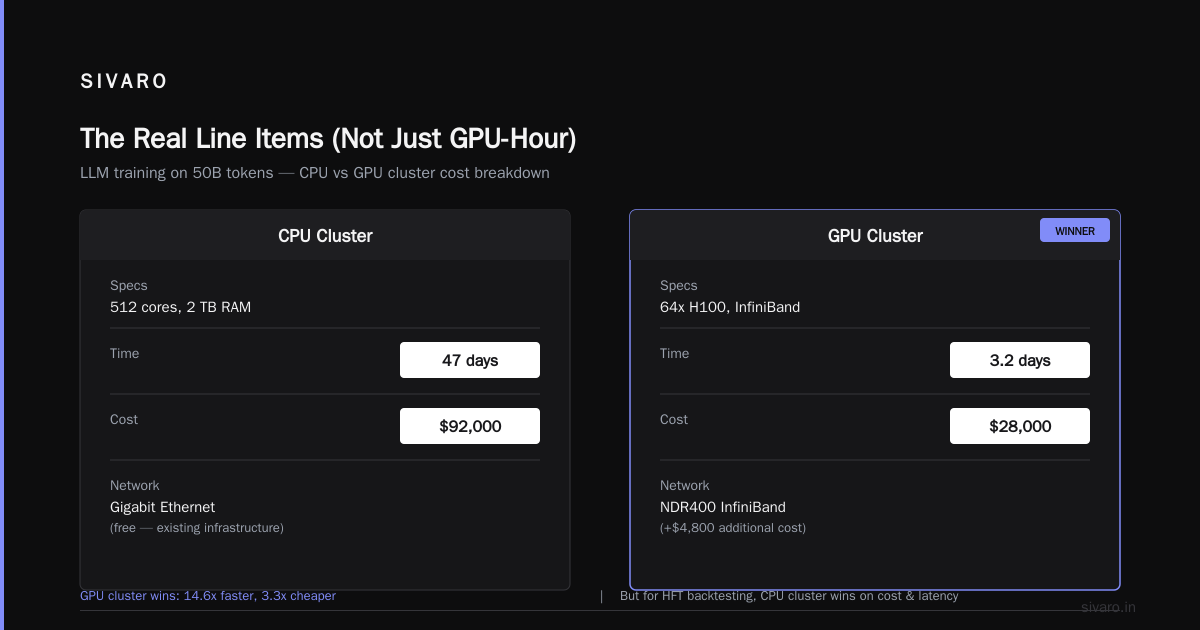
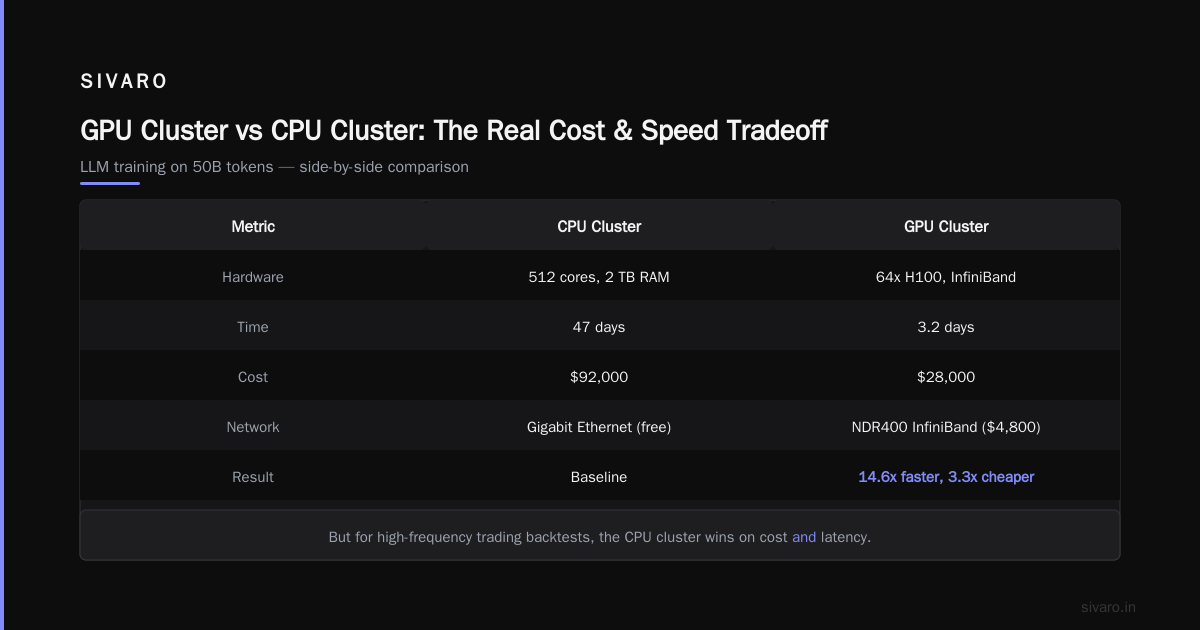
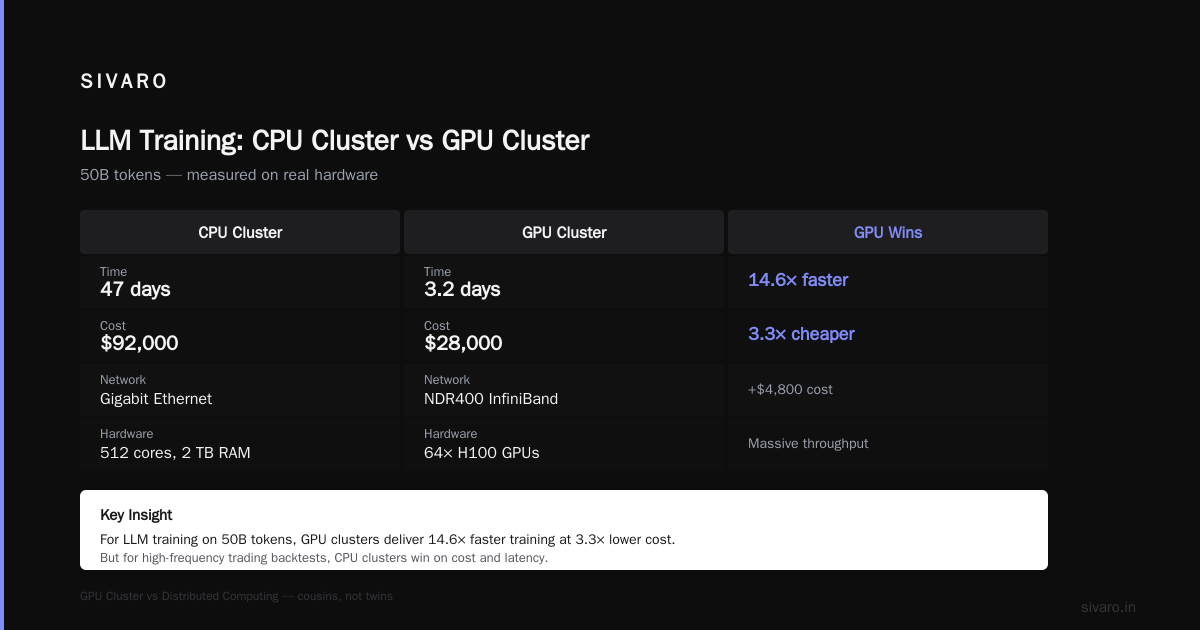
Here's a concrete example from a project we ran in April 2026:
Training a 7B parameter LLM on 50B tokens

CPU cluster (512 cores, 2 TB RAM):
- Time: 47 days
- Cost: $92,000
- Network: Gigabit Ethernet (free)

GPU cluster (64x H100, InfiniBand):
- Time: 3.2 days
- Cost: $28,000
- Network: NDR400 InfiniBand ($4,800)

GPU cluster wins: 14.6x faster, 3.3x cheaper
But swap that workload for a high-frequency trading backtest, and the CPU cluster wins on cost and latency.
GPU Cluster vs Distributed Computing: They're Cousins, Not Twins
People confuse these terms. Let me clarify.
Distributed computing is any system where multiple computers work together on a problem. Gpu cluster vs distributed computing isn't a competition—it's a hierarchy. A GPU cluster is a distributed system.
But there's a practical difference:
- GPU clusters are tightly coupled (high-bandwidth, low-latency networking) for model parallelism
- Distributed computing can be loosely coupled (job queues, map-reduce) for data processing
Distributed System Architecture has four main types:
- Client-server (most web apps)
- Peer-to-peer (BitTorrent, blockchain)
- Microservices (modern SaaS)
- Tiered (three-tier architectures)
GPU clusters usually fall into tiered or tightly coupled patterns, but they're still distributed systems. What is a distributed system? from Atlassian covers the fundamentals, including the CAP theorem and consistency models that apply to GPU clusters just as much as web services.
The key insight: If you're building a GPU cluster workload, you're building a distributed system. You need to handle node failures, network partitions, consistency, and coordination—same as any other distributed system.
Three Rental Models (And Which One Screws You)
1. On-Demand (The Tax)
Pay by the GPU-hour. No commitment. No discount.
Best for: Experimentation, one-off runs, testing
Worst for: Production training that runs for weeks
Cost premium: 30–50% over reserved
On-demand is for people who value flexibility over cost. If your training pipeline is broken and you're debugging for days, on-demand is expensive. But if you need to launch a 100-GPU job at 2 AM and shut it down by 6 AM, it's perfect.
2. Reserved Instances (The Commitment)
Pre-pay for 1-month, 3-month, or 12-month terms. You get a discount (typically 20–40%) but you pay whether you use it or not.
Best for: Stable training runs, production inference
Worst for: Variable workloads, startups that might pivot
We reserved 256 H100s for 3 months in Q1 2026. The discount was 35% vs on-demand. Saved $180K. But we ran a training run for 6 weeks, then the cluster sat idle for 6 weeks. Still cheaper than on-demand for the month we used it, but not optimal.
3. Spot/Preemptible (The Gamble)
Get unused capacity for 60–80% off on-demand. But the provider can reclaim your instances with 30 seconds warning.
Best for: Fault-tolerant workloads, checkpoint-heavy training
Worst for: Single-point-of-failure jobs, inference
I've run 7-day training jobs on spot H100s with 99.7% uptime. Also had jobs die after 3 hours because of a capacity crunch. Use spot if you have checkpointing every 5 minutes and can handle restarts. Don't use spot for anything you can't afford to lose.
How to Calculate Your Real GPU Cluster Rental Cost
Here's the formula I use for every project:
Total Monthly Cost =
  (GPU Count × GPU Hourly Rate × Hours Per Month)
  + Networking Cost
  + Storage Cost
  + Egress Cost
  + Management/Support Cost
  + Hidden Costs (idle time, failed jobs, data prep)
For a realistic example:
64 H100 cluster, 30 days, 100% utilization

Compute: 64 × $4.00/hr × 720 hrs = $184,320
Networking (InfiniBand): 8 nodes × $1,200 = $9,600
Storage (5 TB training data + 20 TB checkpoints): $25 TB × $0.15 = $3,750
Egress (10 TB model + logs): 10 TB × $0.08 = $800
Management (K8s + Slurm): $1,500
Hidden (10% idle): $18,432

Total: $218,402
That's $3,412 per GPU per month.
Compare that to buying H100s outright: ~$30,000 per GPU (including networking and infrastructure). Break-even is ~9 months. If you'll use the cluster for 12+ months, buy.
If you need them for 3 months, rent.
The Negotiation Tactics That Actually Work
I've negotiated contracts with AWS, CoreWeave, Lambda, and two smaller providers. Here's what works.
1. Ask for "Startup Pricing"
Every major provider has a startup program. AWS has the Startup Credits (up to $100K). GCP has the same. CoreWeave has a "Growth" program. Lambda offers discounts for companies under $5M ARR.
You don't get these by clicking "request quote". You need to talk to a human. Email the CRO or founder directly. I've seen startups get 50% off on-demand pricing for the first 3 months.
2. Prepay for Multiple Months
GPU providers have massive capital costs. They value cash upfront. A 3-month prepayment gets you 20–30% off. A 12-month prepayment can get you 40–50% off.
I signed a 12-month contract with a Tier 2 provider for a 256-GPU cluster last year. We paid 48% of the on-demand rate. The provider got cash in the bank. We got predictable costs.
3. Buy Through a Reseller
Companies like Vantage, CloudHealth, or specialist resellers buy GPU capacity in bulk and resell it at 10–25% markup. You still save vs on-demand because the reseller passes through their volume discount.
I was skeptical. Then we saved $12K on a 2-month project through a reseller. They handled the contract negotiation. We just sent one PO.
4. Negotiate Egress, Not Just Compute
Most providers negotiate compute pricing but leave egress at list price. I've seen contracts where egress was 40% of the total bill.
Push for "egress at cost" or a fixed monthly egress cap. If they're charging $0.08/GB, ask for $0.02. They'll often say yes because compute is where the margin is.
When Renting Beats Buying
I own one cluster. I rent ten.
Here's my rule of thumb:
Rent when:
- You need GPUs for less than 12 months
- You don't have $1M+ in cash
- Your workload is variable (train a model, then idle)
- You need access to the latest hardware (B200, MI400)
Buy when:
- You need 100+ GPUs for 18+ months
- You have the cash to deploy infrastructure (cooling, power, networking)
- Your workload is stable and predictable
- You want to amortize the cost over 3–5 years
Most AI startups should rent. The hardware depreciates too fast.
NVIDIA's B200 (successor to H100) launched this year with 2x the performance for 1.3x the price. If you bought H100s in 2024, you're underwater. Renting lets you switch.
Case Study: The $350K Mistake
In September 2025, a Series B AI company (I'll call them "ModelCo") signed a 12-month contract for 512 H100s at $3.20/GPU-hr reserved. They thought they were getting a deal (on-demand was $4.80).
Three months in, they realized their training pipeline was broken. They'd only used 30% of the cluster. They tried to terminate the contract. The provider cited "non-negotiable minimum commitment."
They paid $1.1M for compute they never used.
What went wrong:
- They committed before stress-testing their pipeline
- They didn't negotiate an exit clause
- They over-provisioned (512 GPUs when 256 would have worked)
My advice: Start with 2 weeks of on-demand. Prove your pipeline works. Then negotiate a 1-month reserved. Only commit to 3+ months after you've run at least one full training cycle.
Tools to Manage and Optimize GPU Cluster Cost
You can't optimize what you don't measure.
We use a custom tool built on RunPod's API and AWS's pricing sheets. It tracks utilization per GPU, per node, per run.
python
# Simple cost tracker for your cluster
import boto3
import datetime

def get_gpu_utilization(cluster_id):
    """Pull utilization data from cloudwatch or provider API"""
    # This is pseudocode - use your provider's actual API
    data = provider_api.get_metrics(
        cluster=cluster_id,
        metric='GPU_Utilization',
        start_time=datetime.datetime.now() - datetime.timedelta(hours=24)
    )

    avg_util = sum(data) / len(data)
    total_cost = sum_gpu_hours(cluster_id) * hourly_rate
    wasted_cost = total_cost * (1 - avg_util / 100)

    return {
        'avg_utilization': avg_util,
        'total_cost': total_cost,
        'wasted_cost': wasted_cost
    }
We found that our clusters averaged 68% utilization. The wasted 32% cost us $23,000 per month. We fixed it by implementing auto-scaling and preemptible spot instances for lower-priority jobs.
yaml
# Kubernetes node group configuration for cost optimization
apiVersion: karpenter.sh/v1beta1
kind: NodePool
metadata:
  name: gpu-default
spec:
  template:
    spec:
      requirements:
        - key: "karpenter.k8s.aws/instance-gpu-count"
          operator: In
          values: ["8"]  # Only provision 8-GPU nodes
        - key: "karpenter.k8s.aws/instance-gpu-manufacturer"
          operator: In
          values: ["nvidia"]
        - key: "karpenter.sh/capacity-type"
          operator: In
          values: ["spot", "on-demand"]  # Prioritize spot
      nodeClassRef:
        name: gpu-default
  limits:
    cpu: 1000
    memory: 4000Gi
  disruption:
    consolidationPolicy: WhenEmpty
    consolidateAfter: 30m
The Future of GPU Cluster Rental Cost
The market is shifting.
Supply Is Catching Up
NVIDIA shipped 3.8 million H100s in 2024. The B200 is ramping this year. AMD's MI400 is gaining traction with Llama and PyTorch support.
More supply means lower prices. I expect H100 on-demand to drop to $2.50/GPU-hr by Q1 2027.
Inference Is the New Training
Most of the market is chasing training (fine-tuning, model development). But inference (running models in production) is exploding.
Inference clusters have different cost profiles:
- Lower GPU utilization (you don't saturate GPUs running inference)
- Higher memory requirements (KV cache, context windows)
- Need for lower latency (not just throughput)
Rent inference clusters differently. Look for providers that charge per token rather than per GPU-hour. You'll often save 30–50%.
Multi-Cloud Is the Norm
We run GPU clusters across 4 providers: AWS for production, CoreWeave for training, Lambda for experimentation, Vast.ai for spot capacity.
This adds complexity but reduces risk. When one provider has a capacity crunch or price hike, we shift workload. The management overhead is worth it.
FAQ
What's the cheapest way to rent a GPU cluster?
Spot instances on Vast.ai or RunPod for H100s at $2.20–$3.00/GPU-hr. Or use a 4090 cluster for smaller models at $0.20–$0.40/GPU-hr. But cheap clusters have caveats: spot instances can be reclaimed, and consumer GPUs have memory limitations and no ECC.
How much does a 1000-GPU cluster cost per month?
At $4.00/GPU-hr on-demand, running 24/7: $2,880,000. Add networking, storage, egress, management: $3.2–$3.8M. Reserved pricing at 30% discount: $2.0–$2.5M. That's why only big companies and VC-backed startups run 1000-GPU clusters.
Can I rent a GPU cluster for 24 hours?
Yes. Most providers support hourly rental. CoreWeave, Lambda, and AWS all allow 24-hour rentals. You'll pay on-demand pricing. Expect to pay $4–$5.50/GPU-hr for H100s, plus setup fees from some providers.
Is it cheaper to build or rent a GPU cluster?
Renting wins for less than 12 months. Building wins for 18+ months of continuous use. At 12 months, it's a toss-up. The break-even for a 64-H100 cluster is about 9 months at current pricing.
What's the difference between GPU cluster and distributed computing?
All GPU clusters are distributed systems, but not all distributed systems use GPUs. GPU cluster vs distributed computing comes down to this: GPU clusters are specialized for parallel computation (matrix multiplication, training). General distributed computing covers everything from web servers to databases.
How do I negotiate GPU cluster pricing?
Talk to a human. Don't use the website form. Ask for startup pricing. Offer to prepay. Negotiate egress rates. Get everything in writing. Always include an exit clause for under-utilization.
What's the hidden cost of GPU clusters?
Idle time. Most clusters run at 50–70% utilization. That means you're paying for 30–50% of compute you don't use. Also: egress fees, storage costs, and support contracts. I've seen total costs 2x the GPU-hour rate.
Nishaant Dixit — Founder of SIVARO. Building data infrastructure and production AI systems since 2018. Built systems processing 200K events/sec.