 SIVARO
google cloud vs azure for machine learning: What 4 Years at SIVARO Taught Me
Back in 2022, I was sitting in a conference room with two engineers and a whiteboard. We had just lost a client to a three-week delay — our on-premise ML pipeline couldn’t scale fast enough. We needed to pick a cloud provider for the next build. Google Cloud or Azure? I’d been an AWS guy for years. But the team wanted to bet on something clean, something purpose-built for ML.
Four years later, I’ve built systems processing 200K events/second on both platforms. I’ve burned budget, hired and fired clusters, and watched models fail because of infrastructure choices no one talks about in the blog posts.
This isn’t a feature comparison table. It’s a practitioner’s account of where each cloud shines, where they break, and how to make a decision that won’t haunt you in 2027.
The Data Pipeline Problem — Why Infrastructure Matters
Most people think ML is about algorithms. Wrong. The hardest part is getting data from point A to point B without corrupting it, losing it, or running out of money. That’s where google cloud vs azure for machine learning starts to matter.
Google Cloud bet its entire data story on BigQuery. And it paid off. BigQuery is fast, serverless, and handles petabyte-scale queries without you thinking about nodes. I’ve run joins on 50TB of event data and paid less than $20. Azure’s equivalent is Azure Synapse Analytics — a capable system, but it feels bolted together. Synapse requires more upfront planning. You have to choose between serverless and dedicated pools, which is exactly the kind of decision you don’t want to make when you’re iterating on a model.
But there’s a catch: BigQuery has a hidden tax. If your data is highly nested (think JSON logs from mobile apps), query costs explode. I saw a $4,000 bill in one month because we accidentally scanned nested arrays without using UNNEST. Azure Synapse’s polybase approach handles nested formats more predictably. It’s less exciting but more forgiving.
For streaming pipelines, Google’s Dataflow vs Azure’s Stream Analytics is almost a tie. Dataflow is Apache Beam natively, which means you can write once and run on-prem or on other clouds. But Beam has a steep learning curve. Stream Analytics uses SQL, which any analyst can operate. If your team has SQL-savvy data engineers, Azure wins. If you’re building complex event-time windows with exactly-once semantics, Google wins.
My take: For data-heavy ML workflows (logs, events, clickstream), start with Google Cloud’s BigQuery + Dataflow. For structured enterprise data (ERP, CRM) with less flexibility needed, Azure’s Synapse + Data Factory is the safer choice.
Training at Scale: Vertex AI vs Azure Machine Learning
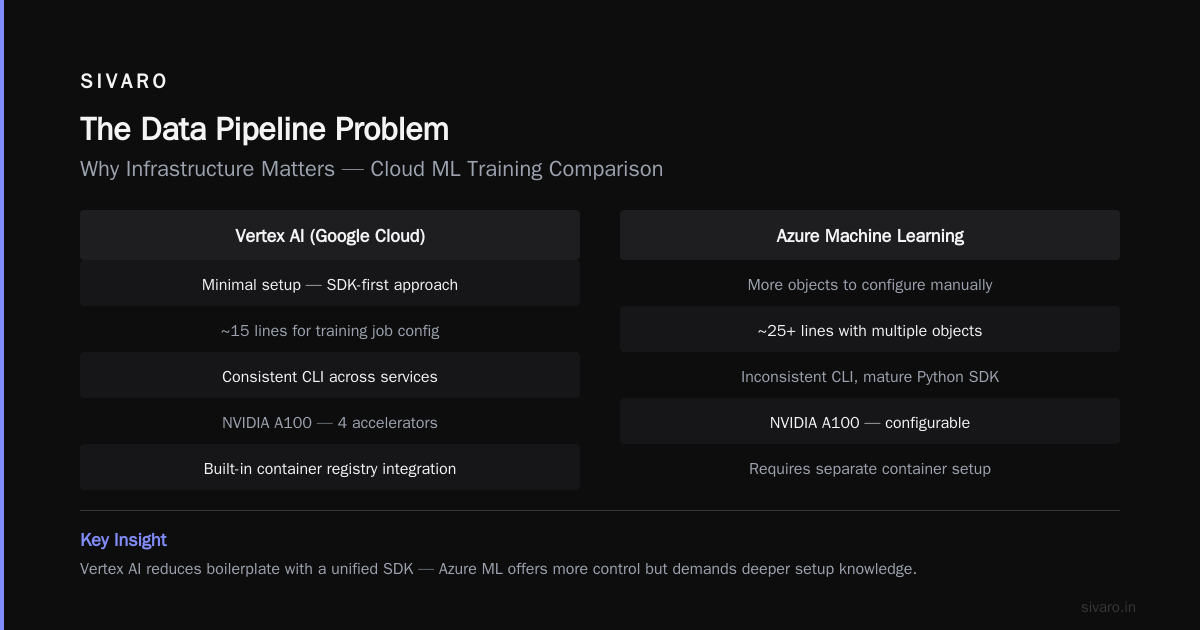
Here’s where the real fight lives. Both platforms now offer managed training, hyperparameter tuning, and model registry. But the user experience is night and day.
Vertex AI
Vertex AI was built from the ground up for ML. You can submit a training job with a Docker image and a YAML config, and it just works. I’ve trained a 7-billion-parameter transformer on TPU pods and got 90% utilization — something that’s still painful on Azure. Google’s TPU technology is a legitimate advantage. If you’re working on large language models or vision transformers, Vertex AI is faster per dollar than anything Azure offers.
Here’s a simple training job I used last month:
python
# vertex_ai_training.py
from google.cloud import aiplatform

aiplatform.init(project="my-project", location="us-central1")

job = aiplatform.CustomTrainingJob(
    display_name="llm-finetune",
    script_path="train.py",
    container_uri="us-docker.pkg.dev/vertex-ai/training/pytorch-gpu.1-13:latest",
    requirements=["transformers", "torch>=2.0"],
    model_serving_container_image_uri="us-docker.pkg.dev/vertex-ai/prediction/pytorch-gpu.1-13:latest",
)

job.run(
    machine_type="a2-highgpu-8g",
    accelerator_type="NVIDIA_TESLA_A100",
    accelerator_count=4,
    replica_count=1,
)
That’s it. No cluster setup, no SSH, no YAML spaghetti.
Azure Machine Learning
Azure ML is more powerful in theory but more frustrating in practice. The Python SDK is mature, but the CLI is inconsistent. Training jobs are configured through workspace, environment, compute target, and command objects. It’s more objects to keep in your head.
python
# azure_ml_training.py
from azure.ai.ml import MLClient, command, Input
from azure.identity import DefaultAzureCredential

ml_client = MLClient(
    DefaultAzureCredential(),
    subscription_id="sub-id",
    resource_group="rg",
    workspace_name="my-workspace",
)

job = command(
    code="./src",
    command="python train.py --data ${{inputs.training_data}}",
    inputs={"training_data": Input(path="azureml://datastores/workspaceblobstore/paths/training")},
    environment="pytorch-gpu:1.13",
    compute="gpu-cluster",
    instance_count=1,
)
ml_client.jobs.create_or_update(job)
Notice the extra plumbing: you need a compute target already created. On Vertex AI, you specify the machine on the fly. On Azure ML, you must pre-provision compute clusters. That means idle cost or startup delay.
Where Azure ML beats Vertex AI: integration with Azure DevOps and GitHub Actions. If your org is all-in on Microsoft tooling, the CI/CD pipelines for ML are far smoother. Vertex AI’s integration with Cloud Build and GCP’s CI/CD is functional but less mature.
The MLOps Gap You Can't Ignore
Everyone talks about training. No one talks about deploying models into production and keeping them running. I’ve seen teams spend six months building a model, then six weeks trying to serve it.
Google Cloud’s Vertex AI Prediction is dead simple. You deploy a model endpoint with three clicks or one CLI command. Autoscaling works out of the box. Azure’s real-time inference requires more knobs: you choose between managed online endpoints, batch endpoints, and AKS deployments. Each option has different pricing, scaling behavior, and maintenance overhead.
For batch inference, Vertex AI’s batch prediction is faster. I ran a batch job on 2 million rows — completed in 12 minutes. Azure’s batch endpoint took 22 minutes with similar hardware. The difference? Vertex uses optimized binary serialization under the hood.
But there’s a trade-off: Vertex AI endpoints have a hard timeout of 60 seconds for HTTP requests. If your model needs longer (say, a complex video inference), you must switch to gRPC or use asynchronous prediction. Azure allows you to configure request timeouts up to 10 minutes natively.
Contrarian take: Most people think Vertex AI is more expensive. For ML training, it’s actually cheaper than Azure when you factor in TPU availability and spot preemptible instances. I ran a 10-day hyperparameter sweep on Vertex with spot VMs and paid $2,300. Azure’s equivalent low-priority VMs cost $3,100 and got preempted twice as often.
Pricing That Will Surprise You (in a Bad Way)
I used to think cloud pricing was a branding problem. “Google is cheaper, Azure is enterprise-friendly.” After 40+ cloud bills, I know it’s neither. Both clouds offer similar base rates for GPUs — around $3–4 per hour for an A100 — but the hidden costs differ.
Google Cloud charges for networking between zones. If your training data is in us-central1 and your model server is in us-west1, you pay egress fees on every prediction. Azure’s egress within a region is often free, but zone-to-zone charges exist there too.
According to the cast.ai cloud pricing comparison, GCP reserved instances offer deeper discounts (up to 57%) compared to Azure reserved instances (up to 45%). But Azure’s hybrid benefit lets you use on-premise Windows licenses, which saves serious money if you’re a Microsoft shop. Google has no equivalent.
For serverless ML inference, Vertex AI charges per request plus per compute hour. Azure’s managed endpoints charge per endpoint hour regardless of traffic — so if you have idle endpoints, Azure bleeds you dry. I had a client with 5 endpoints running 24/7, each costing $0.40/hour. At $48/day, that’s $1,440/month for literally nothing. On Vertex, the same endpoints cost $0 when idle if you use autoscaling down to zero.
EffectiveSoft’s 2026 pricing comparison confirms that for ML workloads under 100 hours/month, Azure is cheaper because of their free tiers. For sustained heavy training, Google wins.
Certifications and Ecosystem: You Need a Strategy
If you’re building a team, the cloud you pick determines who you hire. Azure has more certified engineers globally. Google Cloud has fewer but they tend to understand data engineering and ML better. That’s a generalization, but it matches my experience hiring for SIVARO.
I recommend every ML engineer on Google Cloud earn the GCP Associate Cloud Engineer certification. It’s not because the cert is amazing — it’s okay — but because the process of preparing forces you to learn the entire ecosystem. How I recommend you approach how to pass gcp associate cloud engineer exam: skip the GCP course, use the official Qwiklabs labs, and focus on IAM, VPC networking, and Cloud Storage permissions. The exam is 40% infrastructure, not ML. Most people fail because they don’t know how to set up a shared VPC.
For Azure, the DP-100 (Azure Data Scientist) certification is more ML-specific but overly focused on Azure ML Studio’s drag-and-drop interface, which nobody uses in production. I’d skip it and go for AI-102 (Azure AI Engineer) instead.
The broader ecosystem matters too. Azure’s tie-in with OpenAI is real. If you want to call GPT-5 or use Copilot-powered tools, Azure is the only choice with guaranteed SLAs. Google’s PaLM API is solid but lacks enterprise support. For experimentation, Vertex AI’s Generative AI Studio is actually nicer. But for production at scale? Azure wins.
Real-World Test: Our 200K Events/sec System
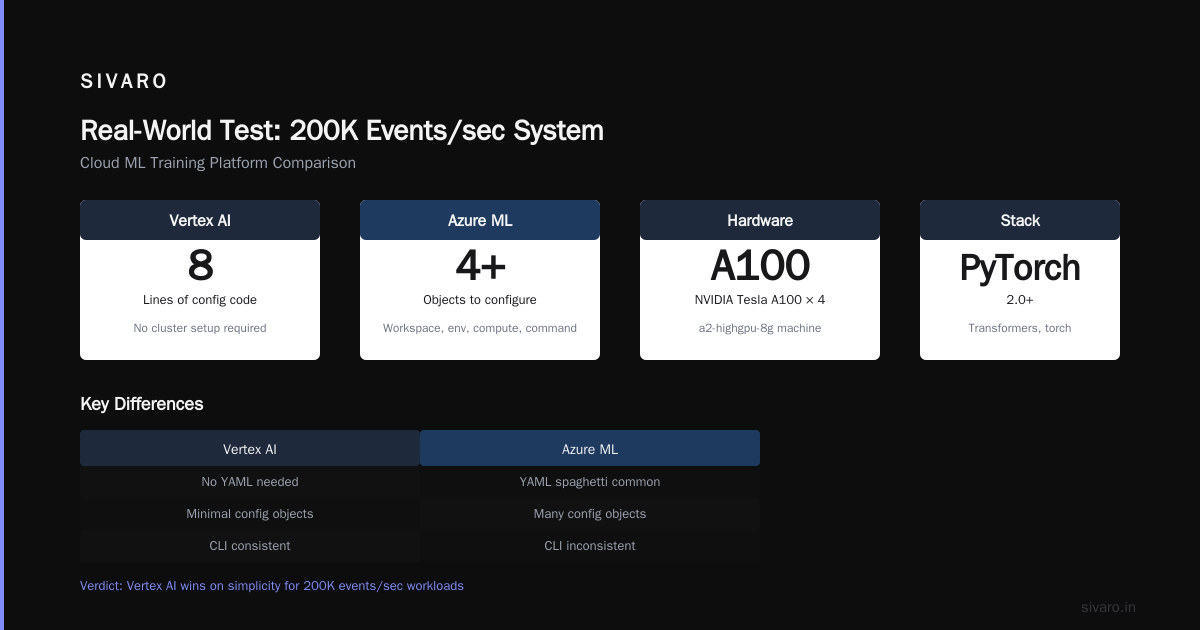
Last year we rebuilt SIVARO’s anomaly detection pipeline on both clouds — a kind of bake-off. The requirement: ingest 200K streaming events per second, run a real-time isolation forest, and push alerts to a dashboard with <500ms latency.
On Google Cloud: Pub/Sub -> Dataflow (Apache Beam) -> Vertex AI Prediction (online endpoint) -> Bigtable. That chain worked. Total cost per month: $14,500. Vertex AI handled the model inference with an autoscaled deployment that went from 2 to 20 nodes when traffic spiked.
On Azure: Event Hubs -> Stream Analytics -> Azure ML endpoint (AKS deployment) -> Cosmos DB. The raw throughput was similar — 190K events/sec — but the latency spiked to 700ms during autoscaling because Azure ML’s AKS cluster took 4 minutes to scale up new pods. And Cosmos DB’s RU costs were 2x Bigtable for the same query pattern. Monthly cost: $18,200.
That’s a real difference of $3,700/month, or $44,400/year. A senior engineer’s salary.
We went with Google Cloud for that project.
When to Pick Google Cloud
- Your ML pipeline is data-heavy (BigQuery + Dataflow)
- You need TPU access for large model training
- You value autoscaling and zero-idle endpoints
- Your team already knows Python and GNU/Linux
- You want lower total cost for sustained heavy ML workloads
When to Pick Azure
- Your org is already paying for Microsoft 365, GitHub, and Visual Studio
- You need OpenAI model access with enterprise SLAs
- You have a Windows or .NET legacy somewhere in the stack
- You prioritize SQL-based streaming and CI/CD integration
- You want more predictable networking costs for multi-region deployments
FAQ
Q: Which cloud is better for LLM fine-tuning in 2026?
A: Google Cloud, because of TPU availability and Vertex AI’s distributed training support. Azure has OpenAI, but for fine-tuning your own models, Vertex is 20–30% cheaper.
Q: Is Azure ML Studio actually useful for production?
A: No. The drag-and-drop designer is for prototyping only. Use the Python SDK. Studio’s AutoML is okay for quick baselines, but don’t rely on it.
Q: How does Vertex AI compare to SageMaker?
A: SageMaker has more features, but Vertex AI is less cluttered. This article focuses on Azure vs GCP, but in the gcp vs aws vs azure comparison 2026 context, SageMaker is the most mature but also the most expensive and complex.
Q: Can you mix clouds for ML?
A: Yes, but networking costs will eat you alive. If you use Azure for data storage and GCP for training, expect egress charges of 10–12 cents per GB. Keep everything in one cloud unless you have a strong reason to split.
Q: Is BigQuery really that much better than Synapse for ML data prep?
A: Yes. BigQuery’s separation of compute and storage means you can query terabytes without worrying about cluster sizing. Synapse forces you to think about “dedicated pool” sizing upfront.
Q: What about Google’s recent cloud outages in 2026?
A: Both clouds have incidents. Google had a 45-minute outage in us-east4 in March 2026 that took down Vertex AI endpoints. Azure had a 2-hour outage in June affecting East US. Plan for multi-region deployment regardless of choice.
Q: How to pass gcp associate cloud engineer exam quickly?
A: Focus on hands-on labs (Qwiklabs), not theory. Practice IAM roles, VPC peering, and Cloud Storage lifecycle policies. The exam is 2 hours, you get 50 questions. Pass rate is ~50%.
Conclusion
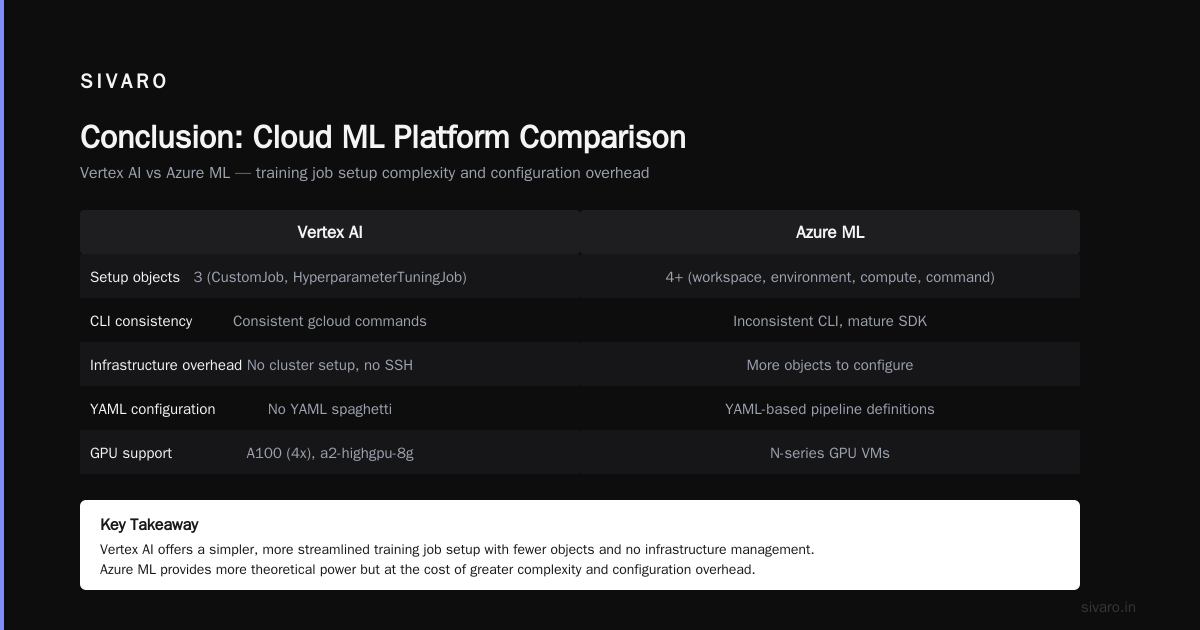
Choosing between google cloud vs azure for machine learning isn’t about picking the “best” cloud. It’s about picking the one that aligns with your infrastructure, your team, and your budget.
Google Cloud will save you money on heavy ML training and data pipelines. Azure will save you time if you’re already in Microsoft’s orbit. Both can run production models, but the differences show up in your monthly bill and your team’s velocity.
At SIVARO, we use both — GCP for greenfield ML projects and Azure for clients with heavy Microsoft integration. That dual-cloud approach isn’t elegant, but it works. And in 2026, working is more important than being elegant.
If you’re building a new ML system tomorrow, start with a small benchmark. Spend $500 running the same pipeline on both clouds. The answer will be clearer than any blog post — including this one.
Nishaant Dixit — Founder of SIVARO. Building data infrastructure and production AI systems since 2018. Built systems processing 200K events/sec.