 SIVARO
GCP vs Azure Pricing 2026: The Real Cost of Cloud Computing
You're looking at two cloud bills and your stomach drops. Both are high. One is higher. But which one is actually burning your budget alive?
I've been running SIVARO since 2018. We build data infrastructure and production AI systems. That means I stare at cloud pricing tables the way most people stare at their bank account after a vacation. And in 2026, the gap between GCP and Azure isn't just about dollars per compute hour. It's about architecture decisions, lock-in patterns, and whether your data team will hate you.
Let's cut through the marketing. This isn't a comparison blog that ends with "both are great." I'll tell you what I've seen work, what I've seen fail, and where the real money goes.
Most people think cloud pricing is about compute costs. They're wrong. It's about data movement, network egress, and the hidden tax of managed services. In 2026, that truth is louder than ever.
Why Your Cloud Bill Explodes (Spoiler: It's Not Compute)
Here's a problem I solved last month. A client was running a real-time fraud detection pipeline on Azure. Their bill was $180K/month. They assumed compute was the culprit. Nope.
I asked for the breakdown. 60% was data transfer costs between services. 25% was storage API calls. 15% was actual compute. They were paying more to shuffle data between Azure Data Lake, Azure Databricks, and Azure SQL than to run the entire ML inference pipeline.
This is the dirty secret of cloud pricing: mismatched architectures cost more than any single service. Both GCP and Azure have this problem, but they handle it differently.
According to a 2026 analysis by TECHSY, running the same application across all three clouds shows that Azure's networking costs can be 2-3x higher for inter-region traffic compared to GCP. That's not a bug — it's Azure's business model. Microsoft wants you to stay inside their ecosystem. Once you leave, they charge you.
Google, on the other hand, built GCP on their own networking backbone. That means lower egress costs and faster internal transfers. But it also means less mature enterprise tooling.
So when you ask "gcp vs azure pricing 2026", the answer depends on where your data lives and how often it moves.
Compute Pricing: The Straightforward Battle
Let's talk VMs. It's the boring part, but you need to know it.
Azure uses a per-minute billing model. GCP uses per-second billing (minimum 1 minute). For short-lived jobs — batch processing, CI/CD runners, dev environments — GCP wins. Here's why.
If you run a job for 3 minutes on Azure, you pay for 3 full minutes. On GCP, you pay for 180 seconds. The difference is meaningless for long-running workloads. But if you have thousands of short jobs per month? That adds up.
Take a data engineering team running 10,000 Spark jobs per month, each lasting 4.5 minutes. Azure charges for 5 minutes per job. GCP charges for 4.5 minutes. That's 5,000 extra minutes of billing per month — or about 83 hours of phantom compute. At $0.10/hour, it's trivial. At $0.50/hour for GPU instances? It's real money.
For committed use discounts, Azure's Reserved Instances (1-year or 3-year) can save 40-60%. GCP's Committed Use Contracts are similar. But GCP also offers sustained use discounts automatically — if you run a VM for more than 25% of a month, you get a discount without signing anything. Azure requires you to commit upfront.
I prefer GCP's model for unpredictable workloads. For predictable, always-on servers, Azure's reserved instances are fine. They're both commodities now, honestly.
Storage: Where Azure Loves Your Data (and Charges You for It)
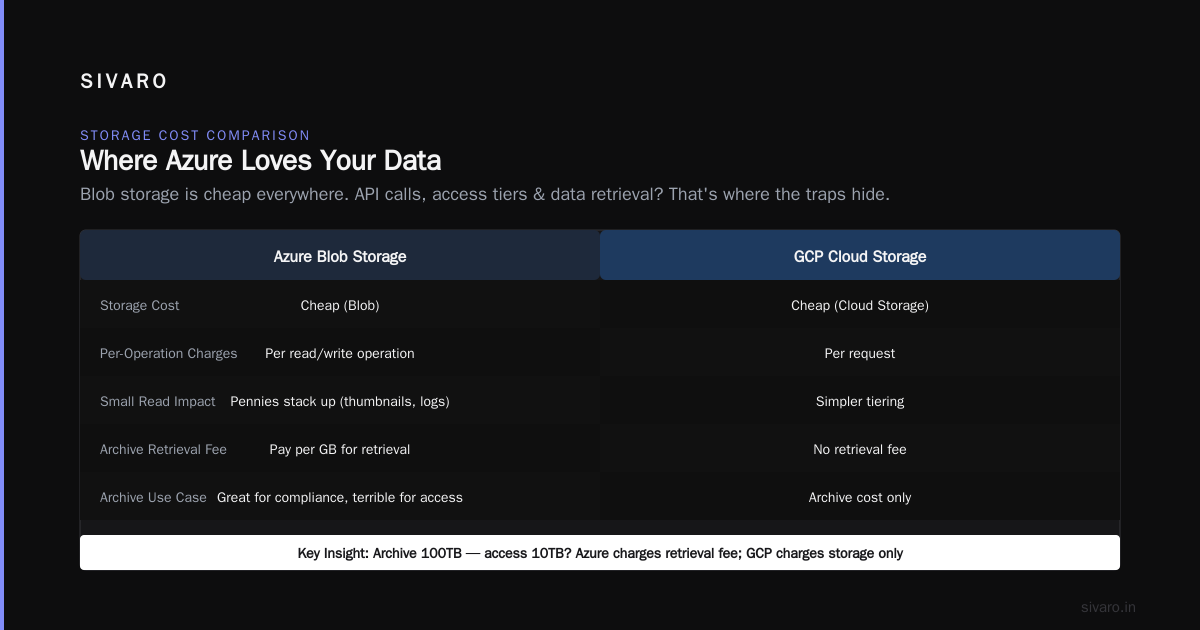
Blob storage is cheap everywhere. But API calls, access tiers, and data retrieval? That's where the traps hide.
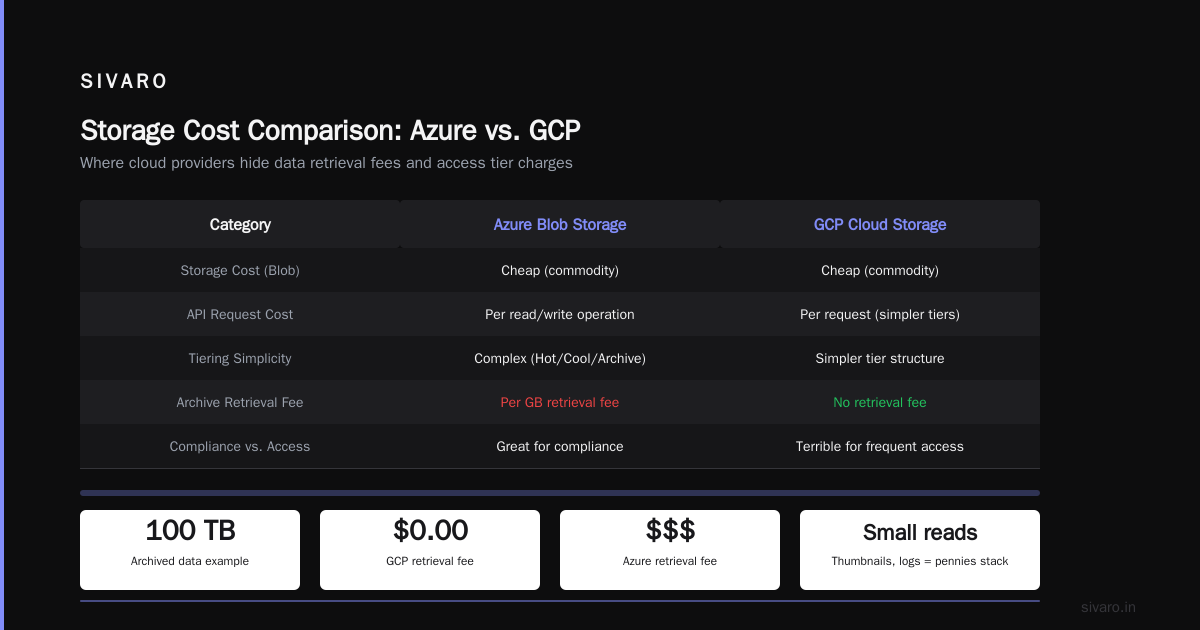
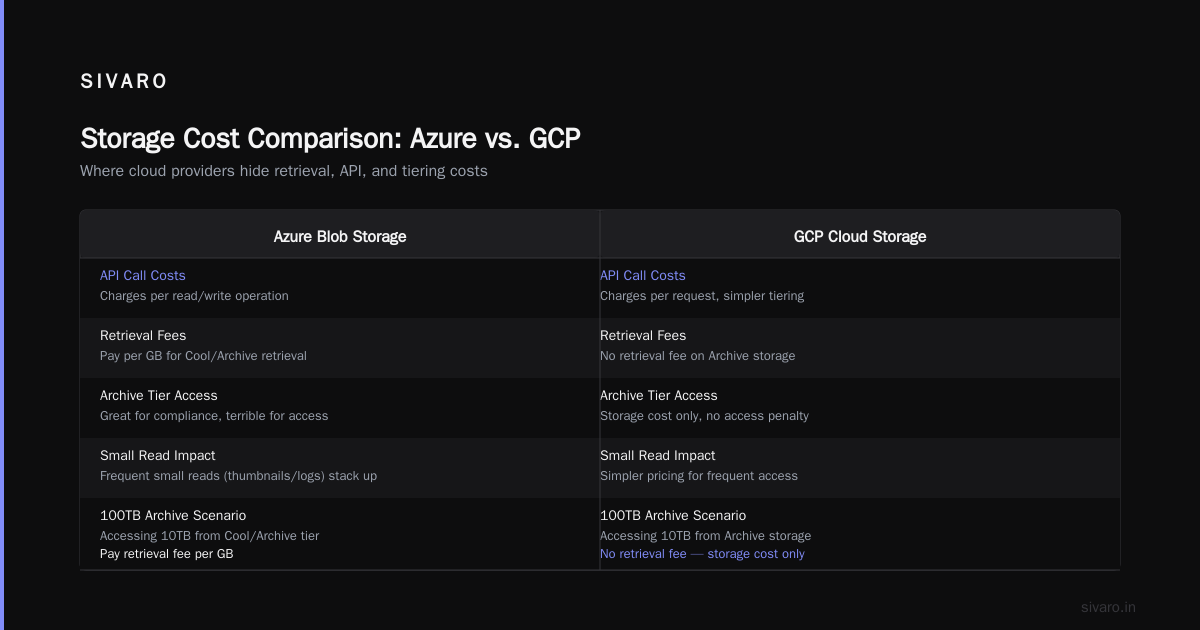
Azure Blob Storage charges per read/write operation. If your application does frequent small reads (like serving thumbnails or logs), those pennies stack up. GCP Cloud Storage charges per request too, but the tiering is simpler.
Here's the killer: Azure's archive storage is great for compliance, terrible for access. You want to restore data from Cool or Archive tier? You pay per GB for retrieval. GCP's Archive storage has no retrieval fee — just a storage cost. If you archive 100TB and need to access 10TB occasionally, GCP saves you thousands.
A real example: A fintech client I worked with stored 5 years of transaction logs on Azure Cool Blob Storage. They needed to run a one-time regulatory audit. The retrieval cost was $34,000. On GCP, that same operation would have been zero retrieval fee. They migrated to GCP the next quarter.
But Azure has better integration with Microsoft 365, Dynamics, and Active Directory. If your org lives in Microsoft's world, the convenience might justify the cost. For data engineering teams that don't, GCP wins on storage economics.
Data Engineering: GCP vs AWS for Data Engineering, But This Is About Azure
You clicked on "gcp vs azure pricing 2026". But honestly, the real competition for GCP in data engineering is AWS. Let's address that briefly.
For data engineering, GCP's BigQuery and Dataflow are mature, battle-tested, and cost-efficient. AWS has Redshift and EMR. Azure has Synapse and Azure Data Factory. The comparison between GCP vs AWS for data engineering shows that GCP tends to be cheaper for ad-hoc analytics while AWS wins for heavy ETL workloads.
But Azure? It's the middle ground. Synapse is fine but not best-in-class. Azure Data Factory is okay but lacks the simplicity of GCP's Dataflow. And pricing? Azure tends to be 15-30% more expensive for similar data pipeline throughput compared to GCP, mostly because you have to pay for compute even when pipelines are idle.
If you're doing data engineering, GCP is generally cheaper and easier. Azure makes sense if you're already in Azure for compute and want to avoid cross-cloud data transfers.
BigQuery vs Azure Synapse: The Real Price of Analytics
Let's zero in on the two elephants: BigQuery and Azure Synapse.
GCP BigQuery Pricing Per Query
This is where Google shines. BigQuery separates compute from storage. You pay for storage (data at rest) and compute (queries you run). The pricing model is simple:
- Storage: $0.02 per GB per month (standard) / $0.01 per GB (long-term)
- Compute: $5 per TB processed (on-demand) or flat-rate reservations
The catch: gcp bigquery pricing per query depends on how much data your query scans, not how long it runs. A poorly written query scanning 100TB costs $500. A well-written query scanning 1TB costs $5.
I've seen teams cut their BigQuery bills by 80% by using partitioning, clustering, and materialized views. The user doesn't have to pay for compute when queries are idle — only when they run.
Azure Synapse (formerly SQL Data Warehouse) charges per DWU (Data Warehouse Unit). You pay for reserved compute even when nothing is running. For a 24/7 analytics operation, that's fine. For bursty, exploratory work, BigQuery is dramatically cheaper.
Example: A startup running 500 exploratory queries per day, each scanning 50GB. On BigQuery: 500 * 50GB * $5/TB = $125/day. On Synapse with 100 DWU reserved: ~$4/hour * 24 = $96/day. BigQuery is more expensive here. But if queries are sporadic (10 queries one day, 50 the next), BigQuery wins because you don't pay for idle capacity.
The choice depends on your workload pattern. Continuous loads? Synapse. Bursty analytics? BigQuery.
But there's a hidden advantage to BigQuery: no server management, instant scaling, and integration with Google's data ecosystem (Analytics, Ads, etc.). For teams that value developer velocity, BigQuery is hard to beat.
Network Egress: The Silent Budget Killer
I keep coming back to this because it's the thing nobody budgets for correctly.
Azure charges egress fees at $0.087 per GB for the first 10TB, then tiered down. GCP charges $0.12 per GB for the first 1TB, then drops to $0.08 for the next 9TB. They're close, but Azure has a slight edge for high-volume egress.
But here's the uncomfortable truth: most cloud bills aren't about internet egress. They're about inter-service data transfer within the cloud. Azure charges for data moving between regions, availability zones, and even between different services in the same region. GCP charges for inter-zone traffic but has free intra-zone traffic.
If your architecture is tightly coupled in one region, GCP wins. If you have a multi-region disaster recovery setup, Azure can get expensive fast.
I had a client running a multi-region application on Azure with active-active databases in US East and West Europe. Their network costs were $40K/month just for database replication traffic. Moving to GCP saved them $12K/month — not because GCP is cheaper per GB, but because they could use Google's internal backbone more efficiently.
AI and Machine Learning: The New Pricing Frontier
In 2026, AI workloads dominate cloud spending. Both Azure and GCP have GPU and TPU offerings. But pricing is diverging.
Azure's GPU instances (ND-series) are priced at $3.40/hour for A100 GPUs. GCP's similar instances (A2) are $3.50/hour. Almost identical. But GCP preemptible (spot) instances are 60-80% cheaper than Azure spot instances because Google has more excess capacity.
For training large models, GCP's TPUs are cheaper than any GPU equivalent. A TPU v4 pod costs about $1.80/hour — less than half the cost of a comparable A100 cluster. But you're locked into TensorFlow or JAX. Azure doesn't have TPUs.
For inference, both clouds offer serverless options. Azure's Azure Machine Learning endpoint pricing is per-minute billing. GCP's Vertex AI is per-second. For low-latency inference, the difference is negligible. For batch inference jobs, GCP saves again.
The Microsoft vs Google comparison in DSStream's analysis highlights that Azure's AI services integrate deeply with Office 365 and Dynamics, while GCP's AI tools are more developer-friendly and cheaper at scale. Pick your poison.
Managed Databases: The Hidden Monthly Bombs
Database costs can dominate your cloud bill. Let's compare.
Azure SQL Database: starts at $5/month for basic, but production-use General Purpose tier costs ~$750/month for 8 vCores and 400GB storage. GCP Cloud SQL for MySQL: similar specs, ~$600/month. Not a huge difference.
But PostgreSQL? Azure Database for PostgreSQL Flexible Server is about $1,200/month for 16 vCores and 500GB. GCP Cloud SQL for PostgreSQL is $950/month. The gap widens at scale.
The real differentiator is Bigtable vs Cosmos DB. Bigtable is designed for high-throughput NoSQL workloads. Cosmos DB is Azure's answer. Cosmos DB is notoriously expensive for write-heavy workloads — you pay per RU (Request Unit). A write-heavy app on Cosmos DB can cost 2-3x what Bigtable costs for the same throughput.
I've moved two startups from Cosmos DB to Bigtable. Both saw 40% cost reduction with better latency. But Cosmos DB has global multi-master replication out of the box, which Bigtable doesn't. Trade-offs.
Which Cloud Is Actually Cheaper in 2026?
Here's my honest take after years of running production systems:
GCP is cheaper for:
- Data engineering and analytics (BigQuery dominates here)
- Short-lived or bursty workloads (per-second billing)
- High-throughput NoSQL (Bigtable)
- Machine learning training (TPUs)
- Multi-cloud or hybrid architectures (lower egress)
Azure is cheaper for:
- Long-running, predictable workloads (reserved instances are aggressive)
- Organizations already deep in Microsoft ecosystem (no cross-cloud data transfer costs)
- Enterprise compliance scenarios (better auditing and cost management tools)
- Windows workloads (obviously)
The gap between them is shrinking. In 2023, GCP had a clear pricing advantage. In 2026, Azure has closed the gap with better reserved pricing and improved storage economics. But GCP still wins on simplicity and developer experience.
If you're building a data-intensive application (which, let's be honest, most modern apps are), I'd start on GCP. The combination of BigQuery, Dataflow, and Bigtable is hard to beat for cost and velocity. If your CTO has an existing relationship with Microsoft or you need deep Office 365 integration, Azure is fine — just budget for the hidden data transfer costs.
FAQ
Why is GCP cheaper than Azure for data pipelines?
GCP separates compute from storage in BigQuery and Dataflow, so you only pay for what you use. Azure Synapse and Data Factory charge for reserved capacity even during idle periods. For ad-hoc or bursty pipelines, GCP is 20-40% cheaper.
Does Azure have any pricing advantages over GCP?
Yes. Azure's Reserved Instances for VMs offer deeper discounts (up to 72%) than GCP's committed use contracts. Azure also has better cost management tools (Cost Management + Billing) for large enterprises. And Azure Dev/Test pricing for Visual Studio subscribers can save significant amounts if you qualify.
What is the actual cost of gcp bigquery pricing per query?
BigQuery on-demand charges $5 per TB of data scanned. A query scanning 10GB costs $0.05. A query scanning 10TB costs $50. This is why query optimization matters so much. Using clustering, partitioning, and materialized views can reduce cost by 90%.
Is GCP or Azure better for AI workloads?
GCP has TPUs which are cheaper than Azure's A100 GPUs for training. But Azure has better integration with MLOps tools and OpenAI models (via Azure OpenAI Service). For inference, GCP's per-second billing is cheaper for bursty workloads. For continuous inference, they're comparable.
How do I avoid hidden costs in Azure?
Audit your network egress costs monthly. Use Azure Cost Management to identify services with high data transfer. And never use Azure Premium SSD for workloads that don't need low latency — it's 3x more expensive than Standard SSD.
Nishaant Dixit — Founder of SIVARO. Building data infrastructure and production AI systems since 2018. Built systems processing 200K events/sec.