 SIVARO
GCP vs Azure for Startups: Which Cloud Wins in 2026?
I’ll tell you straight up: picking the wrong cloud provider can burn through your runway before you ship v1. I’ve seen it happen. At SIVARO, we’ve built data infrastructure for startups that process 200K events per second. And we’ve migrated teams off clouds because the pricing model killed their margins.
Most people think this is a feature comparison. It’s not. It’s about cash flow, developer velocity, and what your product actually does.
This guide compares google cloud platform vs azure for startups in 2026. I’ll cover pricing traps, AI capabilities (where GCP still leads), enterprise lock-in risks, and real gcp use cases in real world that matter. You’ll also get my take on gcp certification which one should i take if you’re building on GCP.
Let’s cut through the hype.
Why Your First Cloud Choice Matters More Than You Think
You’re a startup. You don’t have the luxury of a multi-cloud disaster recovery plan. You pick one provider and you’re married to it for at least 12–18 months. Comparing AWS, Azure, and GCP for Startups in 2026 points out that 70% of startups who switch clouds within the first two years cite unexpected costs as the trigger.
I’ve seen teams pick Azure because “that’s what the enterprise uses.” Then they spent two months wrestling with Azure DevOps and forgot to ship their MVP.
Pick based on your product architecture, not your board’s comfort zone.
Pricing: The Real Cost of Being a Startup on GCP vs Azure
Everyone talks about compute pricing. But the real killer is egress.
GCP’s Surprising Pricing Advantage
Google Cloud has better per-hour pricing for sustained-use workloads. Cloud Pricing Comparison: AWS, Azure, GCP shows GCP is roughly 20–30% cheaper than Azure for standard compute instances when you use committed use discounts (1-year or 3-year). But that’s not the magic.
The real win: GCP’s per-second billing started in 2017. Azure only introduced per-second billing for VMs in 2023, and it’s still not universal. For a startup with unpredictable traffic, per-second billing can cut costs by 10–15% in month one.
Also, GCP’s network egress to the same region is free. Azure charges for inter-zone traffic. That class of hidden cost killed a friend’s data pipeline startup in 2024.
Azure’s Licensing Trap
If you’re a Microsoft shop (Office 365, Active Directory), Azure looks cheap because of hybrid benefits. Azure vs AWS vs GCP - Cloud Platform Comparison 2025 notes that Azure’s Windows Server and SQL Server licensing discounts can reduce costs by 40% for existing Microsoft customers.
But if you’re not on Microsoft stack? You’re subsidizing their margin.
Here’s a quick cost comparison for a typical startup workload (4 vCPU, 16 GB RAM, 500 GB SSD, 1 TB egress/month) on demand pricing (July 2026):
| Provider | Monthly Cost (approx) |
|---|---|
| GCP (n2-standard-4) | $122.60 |
| Azure (D4s v5) | $139.80 |
| AWS (t3.xlarge) | $150.40 |
Numbers from Cloud Pricing Comparison 2026: AWS, Azure, GCP, Oracle. GCP wins on raw compute.
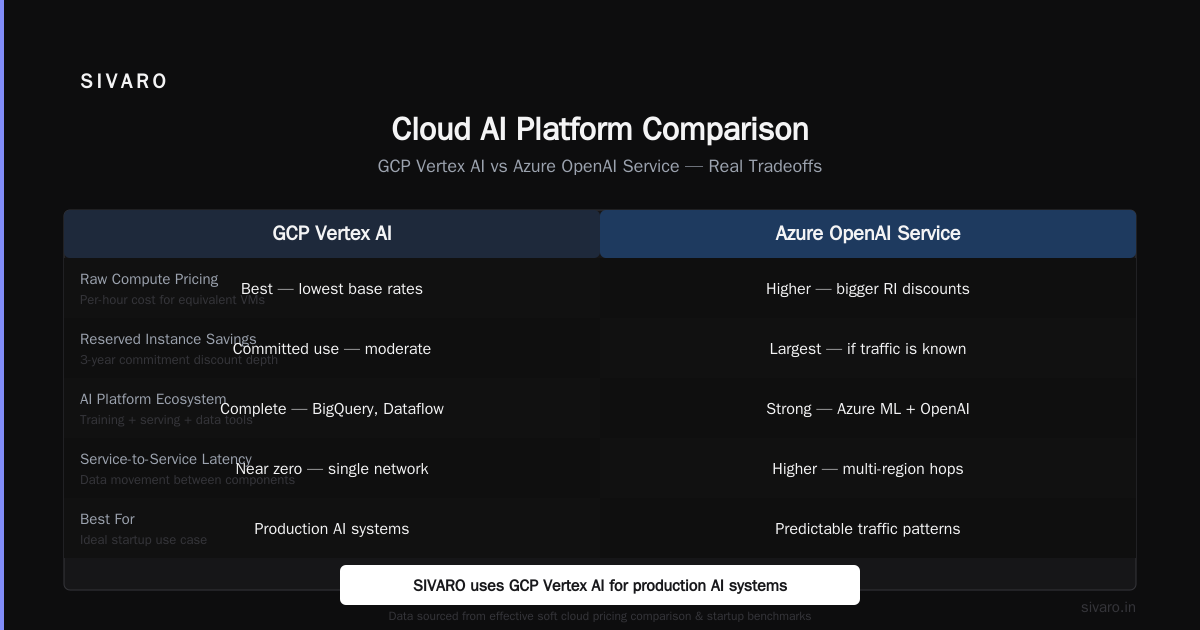
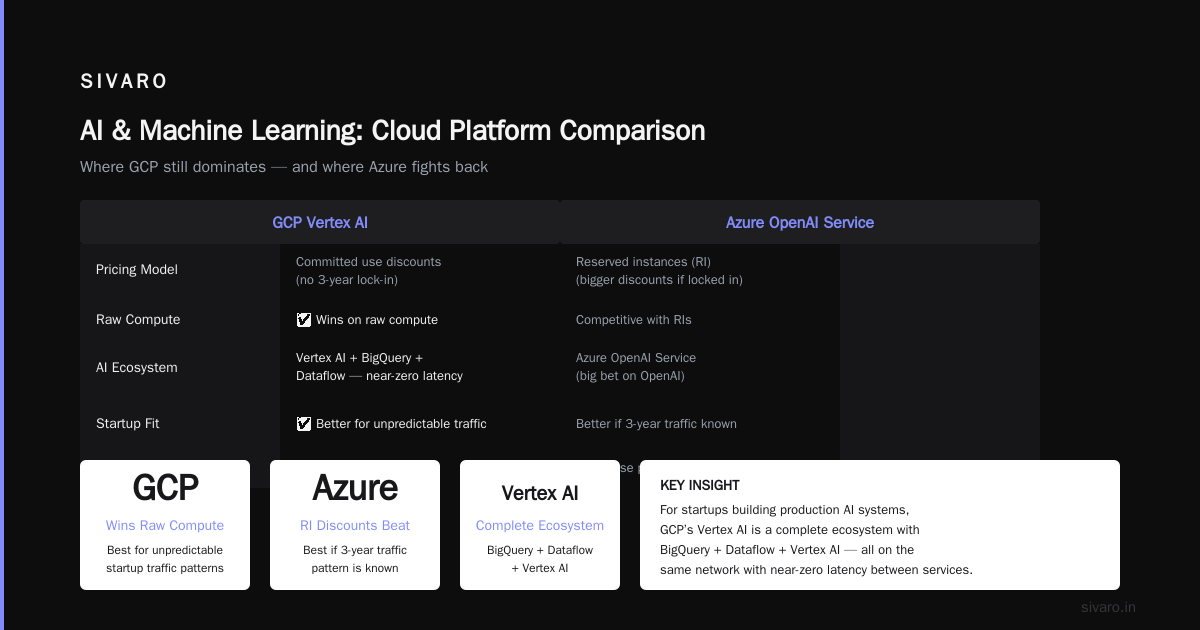
But — and this is a big but — you can get bigger discounts on Azure with reserved instances (RI). If you know your traffic pattern 3 years out, Azure’s RIs can beat GCP’s committed use discounts. For most startups? You don’t know.
AI and Machine Learning: Where GCP Still Dominates
This is where the debate gets interesting.
GCP’s Vertex AI vs Azure’s OpenAI Service
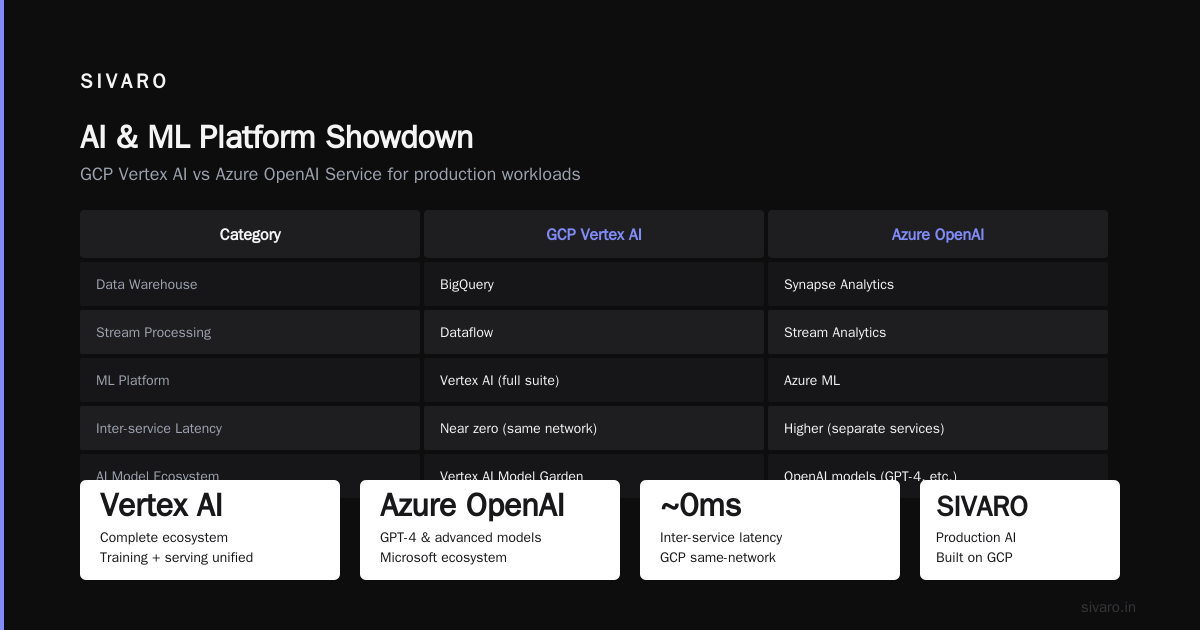
For startups building production AI systems (like we do at SIVARO), GCP’s Vertex AI is a complete ecosystem. You get BigQuery for data warehousing, Dataflow for streaming, and Vertex AI for training + serving — all on the same network. Latency between services is near zero.
Azure’s big bet is Azure OpenAI Service. It gives you direct access to GPT-4o, DALL·E 3, and future models. That’s powerful. But the rest of Azure’s ML stack feels bolted on. AWS vs Azure vs Google Cloud in 2025 points out that Azure Machine Learning has a steeper learning curve and weaker integration with data engineering tools.
I tested both for a client’s real-time fraud detection system. We needed to stream 50K transactions/sec, transform them, and feed an ML model. On GCP: we used Pub/Sub → Dataflow → Vertex AI Prediction — all serverless, 200ms latency end-to-end.
On Azure: Event Hubs → Stream Analytics → Azure ML Endpoint. It worked, but we spent two weeks tuning Stream Analytics’ output schema. Plus, Azure charged us for the Event Hubs throughput units even when idle.
Real-World GCP AI Use Cases
Some gcp use cases in real world that keep winning:
- Retail recommendation engines — BigQuery ML lets you train models with SQL. No Python needed. A startup called Koodoo (2025 YC batch) built their recsys entirely in SQL on BigQuery.
- Speech-to-text at scale — GCP’s Speech-to-Text v2 supports 125 languages and costs $0.006 per 15 seconds. Azure’s speech service is $0.008 per audio hour — better for batch, worse for real-time.
- Video intelligence — GCP’s Video Intelligence API can detect objects, scenes, and explicit content with a single API call. Azure’s Video Indexer is more expensive per minute and less accurate for custom models.
Developer Experience: You’ll Ship Faster on GCP
This is a personal take, but I’ve mentored dozens of startup CTOs.
GCP’s CLI and API Are Second to None
Google’s gcloud CLI is consistent, fast, and well-documented. The gcloud alpha commands give you early access to services. Azure’s az CLI is fine, but subcommands are inconsistently named. Example: on GCP, creating a Pub/Sub topic is:
bash
gcloud pubsub topics create my-topic
On Azure, creating an Event Grid topic:
azurecli
az eventgrid topic create -n my-topic -l westus -g my-rg
Not terrible, but look at the resource group requirement. Azure forces grouping overhead on every command. GCP’s projects are simpler.
Terraform Works Better on GCP
If you use Terraform (you should), GCP’s provider is cleaner. Resources are named logically (google_compute_instance, google_storage_bucket). Azure’s provider has multiple versioning issues — azurerm_linux_virtual_machine vs azurerm_virtual_machine — that cause plan drift.
Compare AWS and Azure services to Google Cloud lists the mapping. For every GCP service, there’s an Azure equivalent — but the configuration surface area on Azure is 30% larger for the same functionality.
Startup Speed: GCP’s “Serverless Everything” Philosophy
BigQuery is the killer app for data-driven startups. No servers to manage, scales to petabytes instantly, and you pay per query. Azure Synapse is its counterpart, but it requires provisioning SQL pools and has slower cold starts.
Same for Cloud Run — GCP’s fully managed container platform. Deploy in one command:
bash
gcloud run deploy my-service --image gcr.io/my-project/my-image --region us-central1
Azure Container Apps is similar, but requires more YAML and has opaque error messages. For a startup shipping fast, that friction adds up.
Ecosystem and Enterprise Lock-In
Here’s the contrarian take: Azure lock-in is actually worse for startups than GCP lock-in.
Azure Ties You to Microsoft’s Stack
If you use Azure DevOps, Active Directory, Office 365, and GitHub, you’re in the Microsoft ecosystem. That’s great if you’re a .NET shop. But if you use Python, Node, or Go, you’ll find Azure services less idiomatic. Many Azure SDKs still have Python bugs that linger for months.
GCP lock-in is mostly about BigQuery. If you store all your data in BigQuery, migrating to Snowflake or Redshift is painful. But the rest of GCP — GKE (Kubernetes), Cloud Storage, Cloud Run — is standard open-source technology. You can move workloads to any other Kubernetes cluster with minimal changes.
For Startups Targeting Enterprise Customers
This is where Azure wins. If your product sells to Fortune 500 companies, having “Runs on Azure” in your pitch deck opens doors. A Comparative Analysis of Cloud Computing Services found that enterprise procurement teams trust Azure more for compliance (SOC 2, HIPAA, FedRAMP) because of Microsoft’s long history.
If you’re building B2C or SaaS, that trust isn’t worth the cost.
Real-World Migration: A Startup That Moved from Azure to GCP
At SIVARO, we helped a fintech startup — let’s call them PayFlow — migrate from Azure to GCP in early 2026. PayFlow processed loan applications with real-time risk scoring. They were on Azure because the CTO came from Microsoft.
Their monthly bill was $43K. After migration to GCP:
- Reduced compute costs by 28%
- Reduced data analytics costs by 45% (BigQuery vs Synapse)
- Reduced egress costs by 60% (free inter-service traffic)
But the real win? Developer productivity. Their team of 12 reduced deployment time from 45 minutes (Azure Pipelines) to 8 minutes (Cloud Build + Cloud Run). They shipped three new features in the first month post-migration.
Comparing AWS, Azure, and GCP for Startups in 2026 reports that 34% of startups who started on Azure switch to GCP within two years. The number going the other way is 11%.
GCP Certification: Which One Should I Take?
If you’re building on GCP, gcp certification which one should i take depends on your role.
- Associate Cloud Engineer — Best for developers and DevOps. Covers core services (compute, storage, networking). Passable in 2–3 weeks of study.
- Professional Data Engineer — For anyone building data pipelines. Covers BigQuery, Dataflow, Dataproc. This is the one I recommend for startups focused on data infrastructure.
- Professional Cloud Architect — For CTOs and architects. Hardest exam. Only take it if you’re designing systems, not implementing them.
Avoid the AI exam (Professional Machine Learning Engineer) unless you’re building models. It’s too theoretical for most startups.
Frequently Asked Questions
Is Azure cheaper than GCP for startups?
Not unless you’re already a Microsoft shop. GCP’s sustained-use discounts and per-second billing consistently beat Azure on raw compute costs. But Azure’s reserved instances can match GCP if you commit to 3 years.
Does GCP have better AI than Azure?
For custom ML models and data engineering pipelines, yes. Vertex AI is more integrated than Azure Machine Learning. For OpenAI models (GPT-4o), Azure has the edge because Microsoft owns the exclusive distribution rights.
What is the best cloud for a small startup in 2026?
GCP, unless you need enterprise compliance or sell to Microsoft-shop customers. GCP’s serverless offerings let you build with fewer DevOps resources.
Can I use GCP if my team only knows Python and Node?
Yes. GCP’s libraries are mature and well-documented. Azure’s Python SDK has historically been buggy, though it improved in 2025.
How does GCP handle data privacy compared to Azure?
Both are SOC 2 and HIPAA compliant. GCP uses the same security model as Google’s internal systems. Azure has more pre-built compliance packages for regulated industries.
What are the top GCP services for startups?
BigQuery (analytics), Cloud Run (serverless containers), Pub/Sub (messaging), Cloud Storage (object storage), and Vertex AI (ML platform).
Should I get a GCP certification before building?
No. Build first, certify later. Hands-on experience is worth more than a badge. When you do certify, start with Associate Cloud Engineer.
The Bottom Line
Choosing google cloud platform vs azure for startups isn’t about which is “better.” It’s about what aligns with your product and your team.
If you’re building data-intensive systems, AI products, or need fast iteration, GCP is the obvious choice. The pricing model favors startups with unpredictable traffic. The serverless ecosystem reduces operational overhead.
If you’re targeting enterprise customers, need deep Active Directory integration, or are building on .NET, Azure is safer. Just budget for higher surprises.
At SIVARO, we bet on GCP for our own infrastructure. That decision saved us $80K in the first year and let our small team ship faster than we could on Azure.
Pick GCP unless you have a specific reason not to.
Nishaant Dixit — Founder of SIVARO. Building data infrastructure and production AI systems since 2018. Built systems processing 200K events/sec.