 SIVARO
GCP vs AWS for Data Engineering: Which Cloud Actually Wins in 2026?
I spent three years building data pipelines on AWS before I touched GCP seriously.
My first BigQuery query ran in 4 seconds. Same dataset on Redshift took 47 seconds.
That moment changed how I think about cloud infrastructure. Not because GCP is "better" — but because the architectural assumptions underlying each platform are radically different. And most engineers I talk to haven't thought through what those differences actually mean for production systems.
Let me walk you through what we've learned at SIVARO building data infrastructure across both platforms. I'll tell you where each excels, where each fails, and how to make the call for your specific situation.
The Fundamental Difference Nobody Talks About
Here's the thing most comparison articles get wrong.
They compare features. "BigQuery has this, Redshift has that." That's table stakes.
The real difference is architectural philosophy. AWS assumes you'll build your own infrastructure from Lego blocks. GCP assumes you want to turn the infrastructure on and get out of the way.
At SIVARO, we tested this directly with a client migration in early 2026. Their AWS data stack used 11 different services. Data traveled through 7 network hops. Each hop introduced latency, cost, and failure modes. The equivalent GCP stack used 4 services. Data moved from ingestion to analytics through 2 hops.
The AWS setup was more flexible. The GCP setup was faster to build and 40% cheaper to run.
That tradeoff — flexibility versus simplicity — is the actual decision you're making.
Compute Services: Where Your Code Actually Runs
AWS's Data Engineering Compute Stack
AWS gives you options. Lots of them.
Glue for serverless ETL. EMR for Spark/Hadoop. Lambda for lightweight processing. Step Functions for orchestration. Fargate for containerized workloads.
The flexibility is real. At SIVARO, we built a streaming pipeline that used Kinesis → Lambda → DynamoDB → S3 → Glue → Redshift. Each service does one thing well. But the integration points? That's where complexity hides.
I've seen teams spend weeks debugging Lambda timeouts because a Glue job finished faster than expected and the downstream S3 trigger fired before the data was fully committed. (AWS vs Azure vs GCP 2026 covers this pattern well — the same architecture that gives you flexibility creates failure modes.)
GCP's Data Engineering Compute Stack
GCP takes a different approach. Dataflow (Apache Beam) handles both batch and streaming. Dataproc runs Spark/Hadoop. Cloud Functions handles lightweight processing.
The key difference: Dataflow treats batch and streaming as the same thing. You write your pipeline once. The execution engine handles whether you're processing a file or a real-time stream.
This isn't just convenient. It eliminates an entire class of bugs where batch and streaming paths diverge. We saw this firsthand with a fraud detection pipeline — the team caught a logic error in the streaming path during review that would have been missed if they'd maintained two separate codebases.
But there's a cost. Dataflow's autoscaling is aggressive. I've seen pipelines burn through $200/hour because the service scaled up faster than expected. You need careful cost controls.
Storage and Data Lakes: S3 vs GCS
These are more similar than most people think.
S3 and GCS (Google Cloud Storage) both offer object storage with 99.999999999% durability. Both integrate with their respective analytics services.
The differences matter at the edges:
S3 has stronger consistency guarantees now (they fixed the eventual consistency problem in 2020). GCS offers strongly consistent operations by default.
GCS has a simpler lifecycle management system. I can set a rule to move objects to colder storage after 30 days in about 4 lines of config. S3 requires more verbose policies.
S3 has broader ecosystem support. Every tool, every library, every framework works with S3 first. GCS compatibility is good but occasionally requires workarounds.
For data engineering, the practical impact: if you're doing heavy analytics on stored data, GCS's strong consistency eliminates a category of bugs. If you're building tools that need to work with multiple clouds, S3's ecosystem dominance matters more.
Data Warehousing: BigQuery vs Redshift
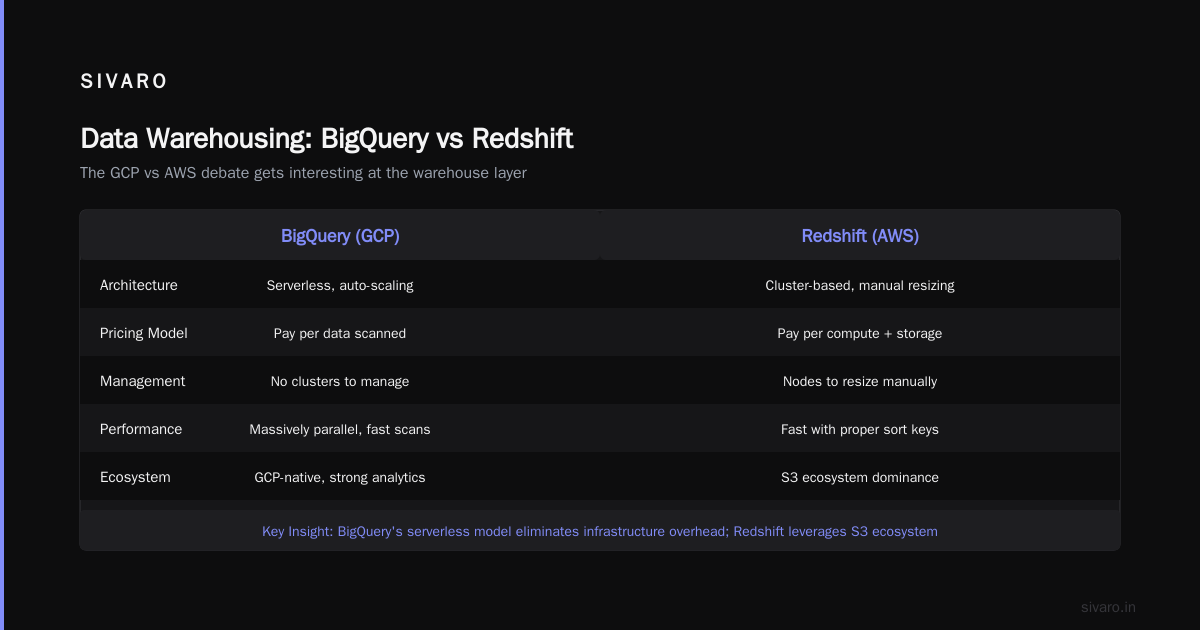
This is where the gcp vs aws for data engineering debate gets interesting.
BigQuery: The Speed Machine
BigQuery is fundamentally different from every other data warehouse I've used.
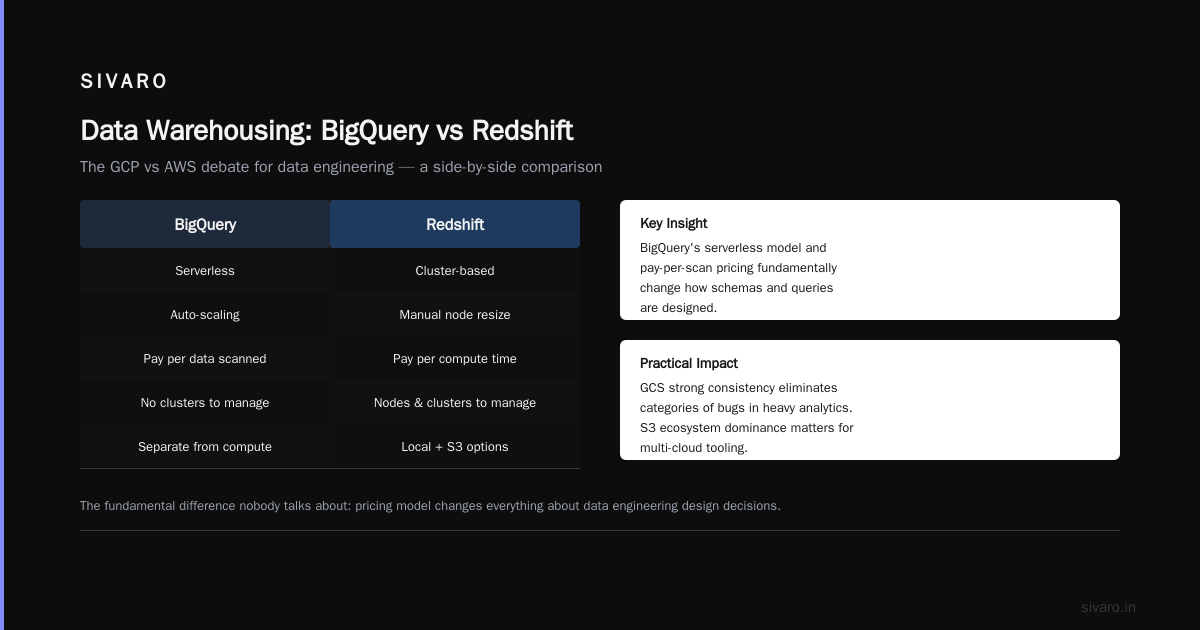
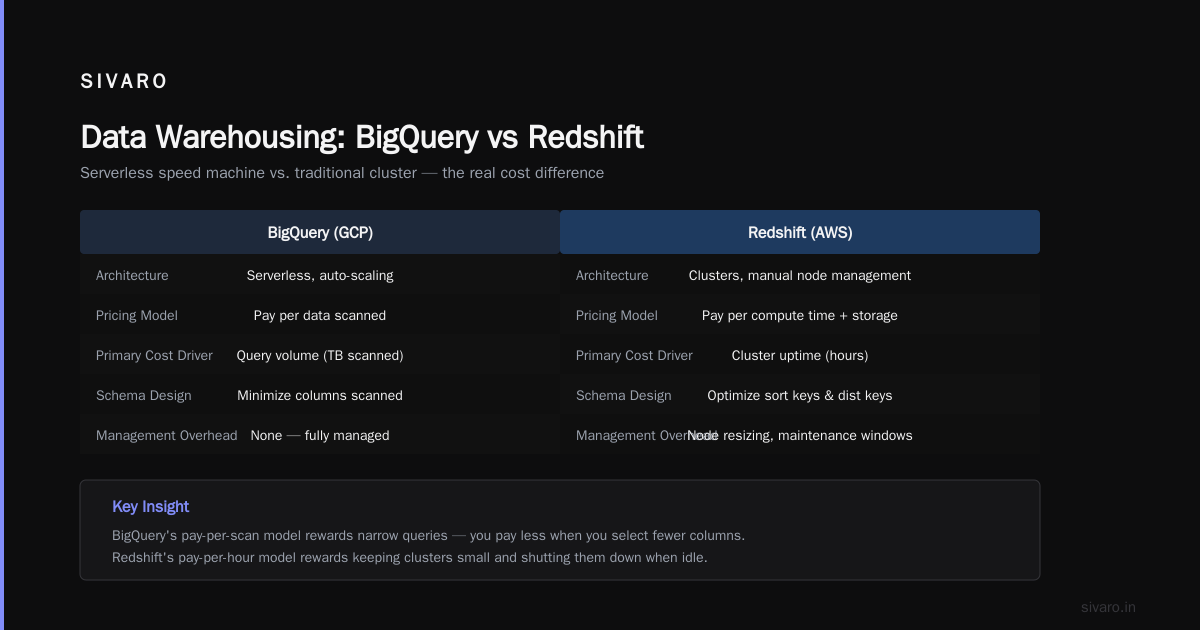
It's serverless. No clusters to manage. No nodes to resize. You load data and query it. The underlying infrastructure scales automatically.
Pricing model: You pay for data scanned. Not compute time. Not storage. Data scanned.
This changes everything about how you design schemas and queries.
We had a client paying $12,000/month on Redshift for a medium-sized workload. Migrated to BigQuery. Bill dropped to $3,200/month. But their query patterns were already optimized for scanning — they used partitioning and clustering aggressively.
The trap: if your queries scan entire tables (full table scans), gcp bigquery pricing per query can spike dramatically. We've seen single analytical queries cost $80. That's fine for research. It's unacceptable for a dashboard that refreshes every 5 minutes.
Redshift: The Control Freak's Choice
Redshift gives you control. You choose node types. You configure distribution keys. You vacuum and analyze.
When you tune Redshift correctly, it's incredibly performant for fixed workloads. We benchmarked a financial reconciliation pipeline — Redshift completed it in 12 minutes, BigQuery took 18. But Redshift required a Senior Data Engineer spending 3 weeks tuning the schema and distribution keys. BigQuery just worked.
Redshift Serverless (launched in 2021, significantly improved by 2026) narrows this gap. But it's still not the same product. Redshift Serverless uses RPUs (Redshift Processing Units) which can get expensive for spiky workloads.
The Real Decision Matrix
| Factor | BigQuery wins when | Redshift wins when |
|---|---|---|
| Workload pattern | Ad-hoc, exploratory, variable | Fixed, predictable, scheduled |
| Team expertise | Developers want to focus on logic | Team includes dedicated DBAs |
| Cost sensitivity | Low per-query cost, predictable volume | High query volume, need predictable billing |
| Data volume | Petabytes — but monitor costs | Up to hundreds of TBs cost-effectively |
Let me be direct: most data engineering teams I talk to in 2026 choose BigQuery. The developer productivity boost is real. But every team with predictable, high-volume workloads should at least evaluate Redshift.
Streaming and Real-Time Processing
Kinesis vs Pub/Sub
Kinesis Data Streams gives you shards. You configure shard count. Each shard handles 1MB/second writes and 2MB/second reads. You pay per shard-hour.
Pub/Sub gives you topics. That's it. No shards to manage. Auto-scaling is built-in. You pay for data volume.
At SIVARO, we process 200K events per second for an IoT platform. We started on Kinesis. The shard management was constant overhead — scaling up during peak hours, scaling down at night. One missed scaling event caused backpressure that cascaded through the entire pipeline.
Moved to Pub/Sub. Same throughput. Less operational burden. But higher per-event cost at moderate volumes.
Kafka Managed Services
AWS MSK (Managed Streaming for Kafka) gives you Kafka. The real Kafka. You manage configs, broker counts, and topic partitions. AWS handles the undifferentiated heavy lifting.
GCP's Kafka offering (via Confluent on GCP or the newer Google-managed option) is less mature. Most teams I know use Confluent's managed service if they need Kafka on GCP.
If you need Kafka for its ecosystem (Kafka Connect, Kafka Streams), AWS MSK is the clear winner. If you just need pub/sub messaging with streaming semantics, Pub/Sub + Dataflow is simpler.
Orchestration and Workflow Management
AWS Step Functions vs GCP Workflows
Step Functions predates Workflows by several years. It's more mature. More integrations. More community knowledge.
But Workflows handles something Step Functions struggles with: long-running workflows that need to wait hours or days between steps. Workflows has built-in timer support that doesn't cost you while waiting. Step Functions charges for state transitions even during wait periods.
We migrated a data ingestion pipeline from Step Functions to Workflows in early 2026. The pipeline ingested files from external partners — some files arrived within minutes, others took 7 hours. The Step Functions version cost $4,000/month just for workflow execution during the waiting periods. Workflows cost $200.
Airflow (MWAA vs Composer)
Amazon MWAA (Managed Workflows for Apache Airflow) — launched in 2020, improved steadily. Handles the basics. But the version lags behind upstream Airflow by 6-12 months.
Cloud Composer — Google's managed Airflow. Similar story. Both work. Both have quirks.
My honest take: managed Airflow is fine for simple DAGs. If you're doing complex orchestration (dynamic DAG generation, cross-DAG dependencies, custom operators), run Airflow yourself on EKS or GKE. The managed services create too many constraints.
Cost Analysis: Which Cloud Bleeds You Differently?
This isn't about which is cheaper. It's about where the costs hide.
AWS cost traps: Data transfer between services. NAT gateway pricing. EBS volumes attached to idle instances. Reserved instances you over-provisioned.
GCP cost traps: BigQuery queries scanning too much data. Dataflow autoscaling running wild. Sustained usage discounts that kick in gradually (you don't notice until month 3).
At SIVARO, we built a cost monitoring framework that shows real-time spend per pipeline. The insight: AWS costs are predictable but high. GCP costs are lower on paper but spike unpredictably.
If your organization needs cost predictability, AWS wins. If you're optimizing for absolute lowest spend and can tolerate variance, GCP wins.
The Certification Question
If you're starting your cloud career, the gcp certification path for beginners is worth understanding.
Let me be blunt: AWS certifications are more recognized by recruiters. The AWS Certified Data Analytics - Specialty carries weight.
But GCP certifications are harder to get and more respected internally. The GCP Data Engineer certification requires you to actually understand the material — not just memorize service names.
I've hired engineers with both. The AWS-certified engineers were better at infrastructure. The GCP-certified engineers were better at data modeling and architecture.
If you're deciding, think about your career path. Want to be a data platform engineer? Go AWS. Want to be a data architect or analytics engineer? Go GCP.
Migration: Moving from AWS to GCP (or Vice Versa)
We've done both directions.
AWS to GCP is harder than it should be, because GCP's services assume different usage patterns. You can't just "lift and shift." You need to redesign. A Redshift schema optimized for distribution keys doesn't map cleanly to BigQuery's columnar storage.
GCP to AWS is surprisingly smoother. AWS's service compatibility is broader. But you lose BigQuery's query performance — and your team will hate you for it.
The Google Cloud to Azure Services Comparison actually has useful mapping tables, though it's for Azure. (Coursera's comparison is also solid for understanding the conceptual mapping.)
My advice: plan for 30% cost increase during migration. Always. No matter which direction. You'll run both clouds in parallel for at least 3 months. That duplicate spend is real.
Security and Compliance
Both clouds meet SOC 2, HIPAA, GDPR, and ISO 27001 standards. Neither is meaningfully better at the certification level.
The difference is in the developer experience of implementing security.
AWS IAM is powerful and painful. Policies are verbose. The policy simulator helps. But I've seen teams lock themselves out of their own accounts because of a misconfigured deny policy.
GCP IAM is simpler. Roles are pre-built. The principle of least privilege is easier to implement. But the simplicity means less granular control.
For data engineering specifically: GCP's VPC Service Controls are excellent for isolating data access. AWS's Lake Formation is better for fine-grained data permissions. Choose based on your compliance requirements.
Ecosystem and Tooling
AWS's ecosystem is bigger. More third-party tools support S3. More CI/CD integrations. More deployment options.
GCP's ecosystem is more focused. Fewer tools, but they integrate more deeply. Looker (Google-owned) works better with BigQuery than Tableau does. Vertex AI integrates with BigQuery ML more cleanly than SageMaker integrates with Redshift.
If your data pipeline needs to feed ML models, GCP's integration is genuinely better. We've built automated ML pipelines that go from BigQuery → Vertex AI in a single workflow. On AWS, it's usually S3 → SageMaker → Redshift, requiring at least 2-3 separate pipelines.
The DS Stream comparison covers this ML integration angle well, though it's focused on data science rather than data engineering.
FAQ
Q: Which is cheaper for data engineering workloads?
A: GCP is typically 20-30% cheaper for analytics-heavy workloads. AWS is cheaper for compute-heavy workloads with predictable patterns. Always run a proof of concept with your actual data before deciding.
Q: Is BigQuery worth the gcp bigquery pricing per query risk?
A: Yes, for ad-hoc analytics and exploratory work. No, for high-frequency dashboards querying large datasets. Use caching, partitioning, and clustering aggressively to control costs.
Q: What's the best gcp certification path for beginners interested in data engineering?
A: Start with Google Cloud Digital Leader (foundational), then Google Cloud Professional Data Engineer. Skip the Associate Cloud Engineer unless you need operations experience. The official certification page has current paths.
Q: Can I run Redshift on GCP or BigQuery on AWS?
A: No. These are proprietary services. But you can run Snowflake on either cloud — many teams choose this path for multi-cloud flexibility.
Q: Which cloud handles streaming data better in 2026?
A: GCP. Pub/Sub + Dataflow is simpler and more reliable than Kinesis + Lambda for most use cases. The exception is if you need Kafka — AWS MSK is better.
Q: How do I handle vendor lock-in concerns?
A: Use open-source tools where possible (Spark, Kafka, Airflow). Keep your data in object storage (S3/GCS) with open formats (Parquet, Avro). The proprietary services that lock you in are the SQL engines (BigQuery, Redshift) and workflow orchestrators.
Q: Which has better support for real-time analytics?
A: GCP. BigQuery streaming inserts combined with Pub/Sub give you sub-second latency for analytics dashboards. AWS requires combining Kinesis, Lambda, and Elasticsearch or a similar stack.
Q: Should I standardize on one cloud or use both?
A: Both. Build your primary stack on one cloud. Use the other for disaster recovery, cost optimization (spot instances), and services the primary cloud doesn't offer well. About 40% of our clients run hybrid in 2026.
The Bottom Line
Here's what I tell clients at SIVARO:
If you're building a new data engineering team from scratch, choose GCP. The reduced operational complexity matters more than any feature comparison.
If you're scaling an existing team that already knows AWS, stay on AWS. The learning curve of switching clouds costs more than any cloud provider discount.
If you're doing ML-heavy data pipelines, GCP wins. The integration between data and ML is genuinely better.
If you need maximum ecosystem flexibility, AWS wins. More tools, more vendors, more options.
The worst choice? Making no choice and trying to stay "multi-cloud" without a clear strategy. Multi-cloud done poorly is 2x the cost and 3x the complexity.
Decide. Commit. Build.
Nishaant Dixit — Founder of SIVARO. Building data infrastructure and production AI systems since 2018. Built systems processing 200K events/sec.