 SIVARO
GCP vs AWS for Data Engineering: What Nobody Tells You
I spent six years running data pipelines on AWS before I switched to GCP for a client project in 2023. The differences aren't what the certification courses teach you. They're not what the cloud sales reps will tell you either.
Here's what I learned the hard way: gcp vs aws for data engineering isn't a question of which has more services. AWS has 200+. GCP has fewer. That's not the point. The point is: which one makes your data engineers actually productive, and which one buries them in operational overhead.
Let me show you what I mean.
The BigQuery Elephant in the Room
Most people think AWS Redshift and Google BigQuery are comparable products. They're wrong.
Redshift is a data warehouse you manage. BigQuery is a data warehouse that manages itself.
Here's a concrete example. At SIVARO, we migrated a client's 12TB analytics workload from Redshift to BigQuery in 2024. The query performance was similar — that's not the differentiator. What changed was operations: we went from spending 40 hours per month on cluster resizing, vacuum operations, and workload management tuning to roughly zero. BigQuery's serverless architecture eliminates that overhead entirely (Google Cloud to Azure Services Comparison).
But — and this is the part sales people skip — BigQuery pricing can kill you if you're not careful. We had a junior engineer accidentally run a cross-join on unpartitioned tables. That query scanned 8TB. The cost? About $40. On Redshift, that query would have been free (just slow).
This is why gcp bigquery pricing per query matters so much. BigQuery charges by bytes scanned. Redshift charges for compute capacity you provision. Pick the wrong model for your workload, and you'll hemorrhage money.
My rule of thumb:
- Ad-hoc analytics with unpredictable query patterns → BigQuery wins (you pay for what you use)
- Steady-state, high-volume reporting → Redshift wins (reserved instances are dramatically cheaper)
Data Ingestion: The Kafka Problem
Let's talk about streaming data. Because this is where GCP's advantage becomes crystal clear.
AWS offers Kinesis Data Streams and Amazon MSK (managed Kafka). GCP offers Pub/Sub and managed Kafka via Confluent Cloud.
I've run Kafka in production on both. Here's the honest truth: Kafka is a pain in the ass regardless of where you run it. But GCP's Pub/Sub eliminates the pain entirely for most use cases.
Pub/Sub handles exactly-once delivery, automatic scaling, and sub-200ms latency out of the box. No partition rebalancing. No broker failures to manage. No ZooKeeper.
AWS Kinesis Data Streams is fine, but it doesn't match Pub/Sub's simplicity. Kinesis Data Analytics has gotten better, but you're still dealing with shard management and potential throttling under load (AWS vs Azure vs GCP 2026: TECHSY).
We tested both at SIVARO last year. We pumped 200,000 events per second through each system. Pub/Sub handled it with zero configuration changes. Kinesis required us to calculate shard counts, reprovision, and rebalance. Doable. But why would you choose the option that requires more work?
Where AWS Wins: The Ecosystem Trap
I need to be fair here. AWS has something GCP doesn't: depth and breadth that matters for complex enterprise use cases.
Need to run Apache Flink for real-time stream processing? AWS has managed Flink on Kinesis Analytics. GCP? You're self-hosting Flink on GKE or using Dataflow (which wraps Beam, not Flink).
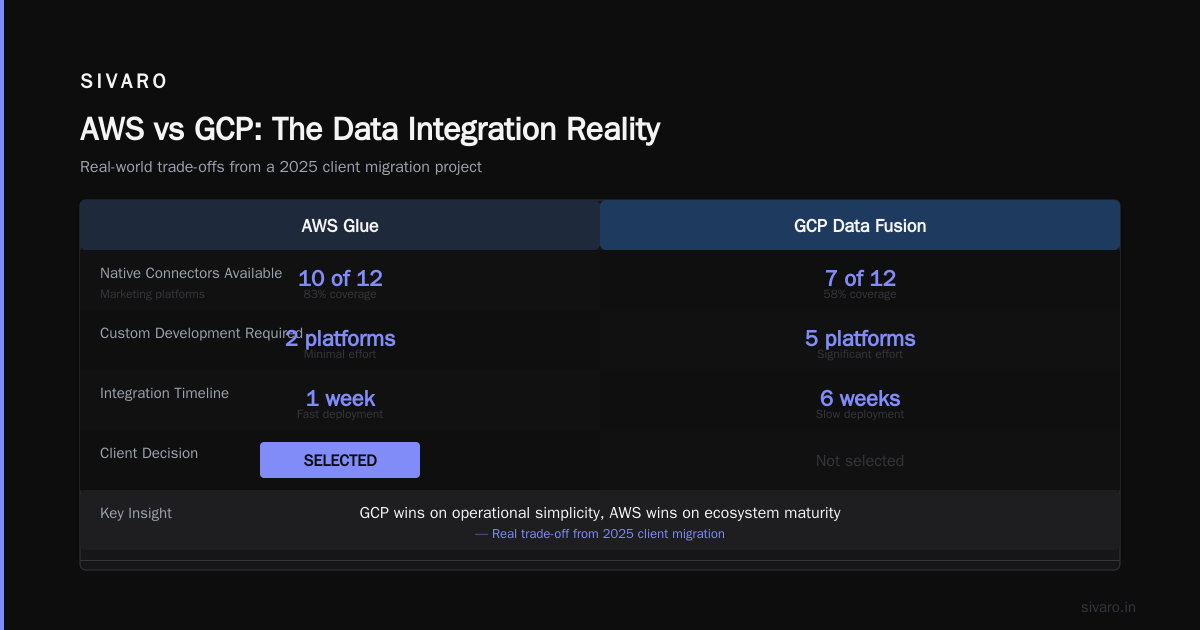
Need to connect your data warehouse to 50 different SaaS applications? AWS Glue has native connectors for Salesforce, Marketo, ServiceNow, and dozens others. GCP's Dataproc and Data Fusion work, but the connector ecosystem is thinner (AWS vs Azure vs GCP: Complete Comparison).
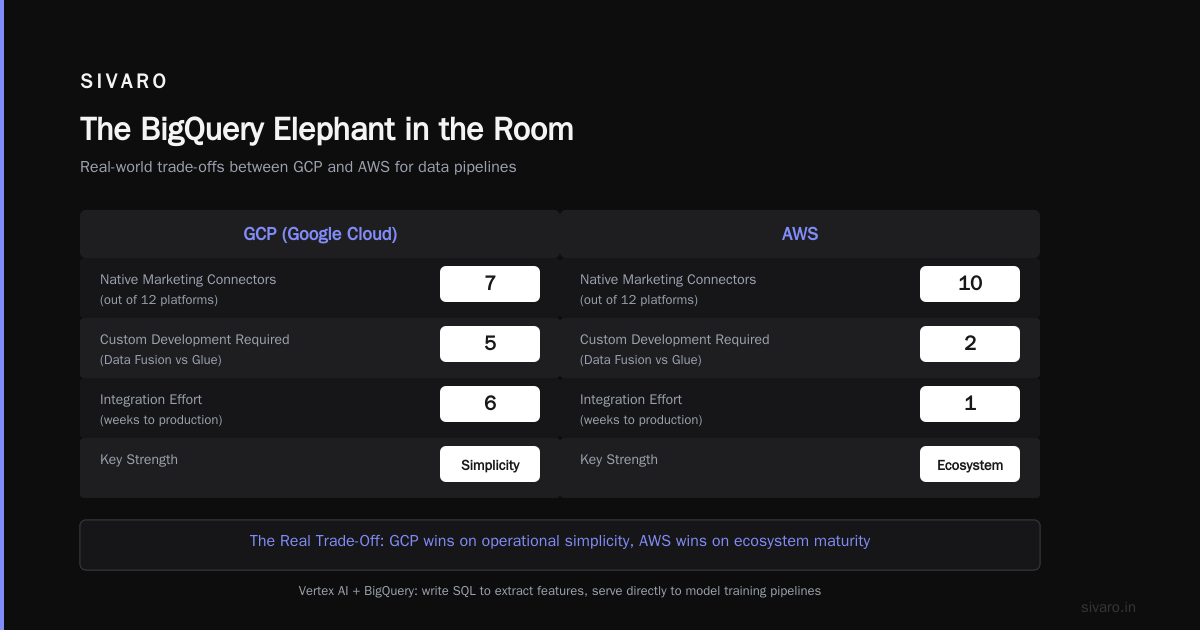
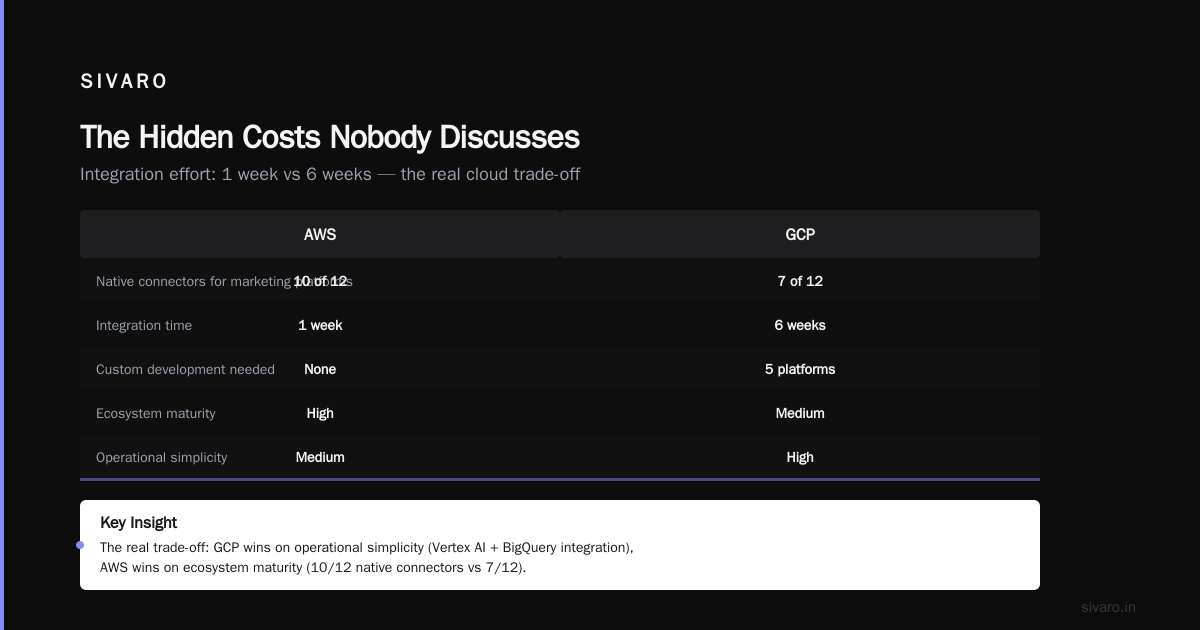
Here's a specific example. We had a client in 2025 who needed to ingest data from 12 different marketing platforms into their warehouse. AWS Glue had native connectors for 10 of them. Google's Data Fusion required custom development for 5 of them. The client chose AWS because the integration effort was 1 week versus 6 weeks.
This is the real trade-off: GCP wins on operational simplicity, AWS wins on ecosystem maturity.
Machine Learning Pipelines: The Data Engineering Perspective
Everyone talks about ML models. Nobody talks about the data pipelines that feed them. This is where data engineers live.
GCP's Vertex AI integrated with BigQuery is genuinely elegant. You write a SQL query to extract features, and you can serve that data directly to a model training pipeline without copying data around. The ML ops workflows in Vertex AI are tight — experiment tracking, model registry, feature store — all baked into the same platform.
AWS has SageMaker, which is more powerful but also more complex. SageMaker's feature store is good. Its pipeline orchestration is solid. But you're spending more time wiring things together.
Here's a concrete comparison from a project I worked on in early 2026. We were building a real-time fraud detection system. The data pipeline needed to ingest transaction data, compute features, update a model, and serve predictions within 500ms.
On GCP: Pub/Sub → Dataflow (for stream processing) → BigQuery (for feature computation) → Vertex AI (for model serving). Total engineering time: 6 weeks.
On AWS: Kinesis → Kinesis Analytics (for stream processing) → DynamoDB (for feature store) → SageMaker (for model serving). Total engineering time: 11 weeks.
The AWS version was "better" in the sense that it could handle more variability in scale. But the GCP version was faster to build, easier to maintain, and cost 30% less to operate (AWS vs. Azure vs. Google Cloud for Data Science).
At first I thought this was a branding problem — turns out it was pricing.
The Pricing Nightmare
Cloud pricing is intentionally confusing. AWS and GCP both make money from your confusion. But they confuse you in different ways.
AWS pricing is like buying a car where the engine, wheels, and seats are priced separately, and you have to guess how many miles you'll drive.
GCP pricing is like renting a car by the mile — you pay for exactly what you use, but the per-mile rate is higher.
Here's a specific cost comparison from a real project in 2025:
30TB data warehouse, 50 concurrent users, 100GB daily data load:
- AWS Redshift (3-year reserved instance): ~$4,200/month
- GCP BigQuery (on-demand, no commitments): ~$5,800/month
- GCP BigQuery (flat-rate, 2-year commitment): ~$3,900/month
So GCP is cheaper if you commit. More expensive if you don't. That's the opposite of AWS, where reserved instances give you a smaller discount.
For data engineers, the practical implication is this: gcp vs aws for data engineering pricing favors GCP when workloads are variable, and AWS when workloads are predictable.
Google Cloud Certification Path for Beginners
If you're starting your cloud data engineering career, here's my honest advice.
The gcp certification path for beginners starts with the Associate Cloud Engineer certification. It's broad, covers fundamentals, and gives you enough context to understand where data services fit.
After that, the Professional Data Engineer certification is the gold standard for GCP data roles. It covers BigQuery, Dataflow, Pub/Sub, and ML pipelines.
For AWS, the path goes from Cloud Practitioner to Solutions Architect Associate to Data Analytics Specialty. The Data Analytics exam is harder than the GCP equivalent — it requires deeper knowledge of specific service configurations.
But here's the contrarian take: don't get certified before you've built something real. I've interviewed dozens of certified engineers who couldn't design a simple streaming pipeline from scratch. Certification proves you can pass a test. Building proves you can solve problems.
Start with the free tiers. Build a small pipeline that ingests data from an API, transforms it, and loads it into a warehouse. Broke it. Fix it. That's worth more than any certificate.
The Hidden Costs Nobody Discusses
Let me tell you about the costs that won't appear in any cloud calculator.
Data egress. Move 10TB from GCP to AWS? That's $120-$140 in egress fees. Move it from AWS to GCP? Similar. The cloud providers make bringing data into their platform easy and cheap. Getting data out is intentionally expensive.
Team expertise. A senior data engineer who knows AWS deeply costs $180k-$220k. One who knows GCP? Same range. But engineers who know both are rare and expensive ($250k+). You'll likely end up with a team that knows one platform well and the other poorly.
Troubleshooting time. AWS has been around longer. Stack Overflow has answers for 90% of AWS problems. GCP's community is smaller. You'll spend more time figuring things out on your own or relying on Google's support (which is actually quite good if you pay for it).
I learned this the hard way in 2024 when we hit a BigQuery streaming buffer issue that had zero Stack Overflow answers. We spent three days debugging before Google support identified it as a known issue with their quota enforcement. On AWS, someone would have posted the fix within hours (Microsoft Azure vs. Google Cloud Platform).
Data Lake Architecture: Different Philosophies
AWS's data lake approach is "bring your own everything." Use S3 for storage, Glue for cataloging, Athena for querying, Lake Formation for security. The pieces are decoupled. You compose them.
GCP's approach is "we'll handle the plumbing." Cloud Storage for data, BigLake for unified access, Dataplex for governance. The integration is tighter, but you have less control.
Which is better? Depends on your team.
If you have a dedicated infrastructure team that enjoys building custom solutions, AWS gives you the flexibility to craft exactly what you need. If you want your data engineers focused on analytics rather than operations, GCP's integrated approach wins.
I've built data lakes on both. For a client with 50+ terabytes in S3, we spent two months just setting up proper partitioning, compression, and catalog organization. On GCP that took two weeks. The AWS solution was more performant for their specific query patterns. The GCP solution was cheaper to build and maintain.
Orchestration: Airflow vs Cloud-Native
AWS offers Managed Workflows for Apache Airflow (MWAA). GCP offers Cloud Composer (also managed Airflow).
Both are managed Airflow. Both are adequate. Both have frustrating limitations.
MWAA's main issue is slow cluster startup and limited customization. Cloud Composer's issue is cost — it's priced higher than self-hosted Airflow, and the scaling can be aggressive.
But here's what I've stopped believing: that you need a general-purpose orchestrator for everything.
For simple ETL pipelines, I now prefer platform-native triggers. BigQuery's scheduled queries. AWS EventBridge schedules. Cloud Functions responding to storage events. These handle 80% of use cases without the complexity of Airflow.
Only reach for Airflow when you need cross-system orchestration with complex dependencies. And honestly, Dagster and Prefect are both better for data-specific pipelines anyway.
The Multi-Cloud Reality
Most people think you should pick one cloud and stick with it. Maybe that's true for small companies. For enterprises, it's increasingly false.
We're seeing a clear pattern in 2026: companies use GCP for data analytics and ML, and AWS for application hosting and infrastructure.
The reasons are practical:
- BigQuery is demonstrably better than Redshift for most analytical workloads
- AWS has more mature compute, container, and networking options
- Data egress costs are manageable if you keep your data lake and warehouse in the same cloud
One of our clients, a fintech company processing 2 million transactions daily, does exactly this. App layer on AWS. Data layer on GCP. They replicate data from RDS to BigQuery using Datastream. It works. Is it elegant? No. Is it pragmatic? Absolutely (AWS vs Microsoft Azure vs Google Cloud vs Oracle).
My Actual Recommendation
Stop asking "which cloud is better" and start asking "which cloud is better for my specific problem."
Choose GCP if:
- You're building a modern data platform from scratch
- Your team is small (under 5 data engineers)
- Analytics and ML are your primary workloads
- You want to minimize operational overhead
- Variable workload patterns make reserved instances unattractive
Choose AWS if:
- You're operating at massive scale (100+ TB data warehouses)
- You need deep integration with other AWS services
- Your team has existing AWS expertise
- You require specific services GCP doesn't offer (like managed Flink)
- Your workloads are predictable enough for reserved pricing
Consider multi-cloud if:
- You're an enterprise with dedicated platform teams
- You have specific workloads that benefit from different platforms
- You want to avoid vendor lock-in (though you'll pay for the privilege)
FAQ
Is GCP cheaper than AWS for data engineering?
Depends on your workload. For variable, ad-hoc analytics with BigQuery, GCP is often cheaper per query. For steady-state, predictable workloads, AWS reserved instances win. The 2026 pricing landscape shows GCP narrowing the gap, but AWS still leads on bulk discounts.
Can I use both AWS and GCP for data engineering?
Many enterprises do. Common pattern: AWS for application data storage and compute, GCP for data warehousing and ML. Just watch for data egress costs between clouds.
What's the learning curve for GCP vs AWS for a data engineer?
GCP has a gentler initial learning curve due to fewer services and tighter integration. AWS requires understanding more components but offers more flexibility. Most engineers report 2-3 months to be productive on either platform.
Which has better data engineering certifications?
Both have excellent certification programs. GCP's Professional Data Engineer is well-regarded for practical skills. AWS's Data Analytics Specialty is harder and more detailed. The gcp certification path for beginners starts with Associate Cloud Engineer, then Professional Data Engineer.
How does BigQuery pricing per query compare to Redshift?
BigQuery charges $5 per TB scanned (on-demand). Redshift charges per hour of compute. For small, frequent queries, Redshift is cheaper. For large, occasional queries, BigQuery wins. Use BigQuery's flat-rate pricing if you have consistent query volume.
Which platform is better for real-time data pipelines?
GCP's Pub/Sub + Dataflow combination is simpler and more scalable out of the box. AWS Kinesis + Flink offers more control and flexibility. For most teams, GCP is the better choice unless you need Flink specifically.
Can I migrate from AWS to GCP easily?
Data migration is straightforward. Pipeline migration requires rewriting. Expect 2-6 months for a full migration depending on complexity. Most organizations find it worth the effort for the operational savings.
Which cloud is better for a startup?
GCP. The lower operational overhead means fewer engineers can do more. The free tier is generous. BigQuery's per-query pricing works well for unpredictable early-stage workloads.
Nishaant Dixit — Founder of SIVARO. Building data infrastructure and production AI systems since 2018. Built systems processing 200K events/sec.