 SIVARO
GCP vs AWS for Data Engineering: What I've Learned Building Real Pipelines
I've been inside both clouds for seven years now. AWS since 2018, GCP since 2020. I've run petabyte-scale pipelines on both, and I've rebuilt the same system twice because the first cloud choice was wrong.
Here's what I wish someone had told me before I spent $80,000 on a six-month detour.
This isn't a feature checklist. You can get those from Microsoft's comparison docs (Google Cloud to Azure Services Comparison). This is what happens when your data hits production at scale, and the marketing slides don't match the engineering reality.
GCP vs AWS for data engineering isn't a holy war. It's a cost-benefit analysis that depends entirely on what kind of data you're moving, how your team thinks, and whether your CFO will cry when they see the bill.
Let me show you what I mean.
The Real Difference Nobody Talks About
Most comparisons tell you both clouds have compute and storage. Groundbreaking.
The actual difference? Architectural philosophy.
AWS treats data engineering as a build-your-own adventure. You pick the pieces — S3 for storage, Glue for ETL, Redshift for warehousing, EMR for Spark, Kinesis for streaming — and you assemble them like IKEA furniture. Some parts fit. Some don't. You'll need duct tape.
GCP treats data engineering as an integrated system. BigQuery isn't just a data warehouse — it's the center of gravity. Everything connects to it. Pub/Sub, Dataflow, Dataproc, Dataform — they're all built to feed BigQuery natively.
This isn't better or worse. It's a trade-off.
AWS gives you flexibility. You can build weird architectures. You can swap components. You're not locked into a single vendor's vision.
GCP gives you speed. When I built my first event processing pipeline, I had it in production in three days on GCP. The same architecture on AWS took two weeks because I had to wire together five different services that didn't want to talk to each other (AWS vs Azure vs GCP: The Complete Cloud Comparison).
But here's the catch: once you're in BigQuery, leaving is painful. AWS keeps your data in S3, which is just object storage. You can take it anywhere.
Storage Wars: S3 vs. GCS vs. What You Actually Need
Let's start with the boring stuff that matters most.
S3 is the gold standard. Every tool integrates with it. Every vendor supports it. You can hook S3 to literally anything. It's the USB-C of cloud storage — not exciting, but universal.
GCS is technically superior in several ways. Stronger consistency guarantees. No bucket-level permissions complexity (IAM is simpler). Multi-regional capabilities that are genuinely easier to configure.
But here's the problem: GCS isn't the standard. If you're building a data pipeline that needs to move data between clouds, or if you're selling data products to customers who might be on Azure, S3 is easier to work with because everyone supports S3 API.
I learned this the hard way. We built a data sharing platform on GCS in 2023. Our customers asked for S3-compatible access. We had to build a translation layer. That took three months.
Verdict: If your data lives and dies inside Google Cloud, GCS is fine. If you need to move data around, S3 wins.
The Elephant in the Room: BigQuery vs. Redshift
GCP BigQuery is the best data warehouse I've ever used. Period.
Serverless. No clusters to manage. Automatic scaling. Columnar storage. ANSI SQL. Real-time streaming ingestion. Built-in machine learning. The thing just works.
I've run queries on BigQuery that would have taken Redshift 20 minutes — they finished in 11 seconds. Not because BigQuery is "faster" in some magical way. Because it auto-scales compute to match the query. Redshift doesn't do that. You have to provision for peak load, and you pay for idle capacity.
But here's the punchline: BigQuery's pricing model can destroy your budget.
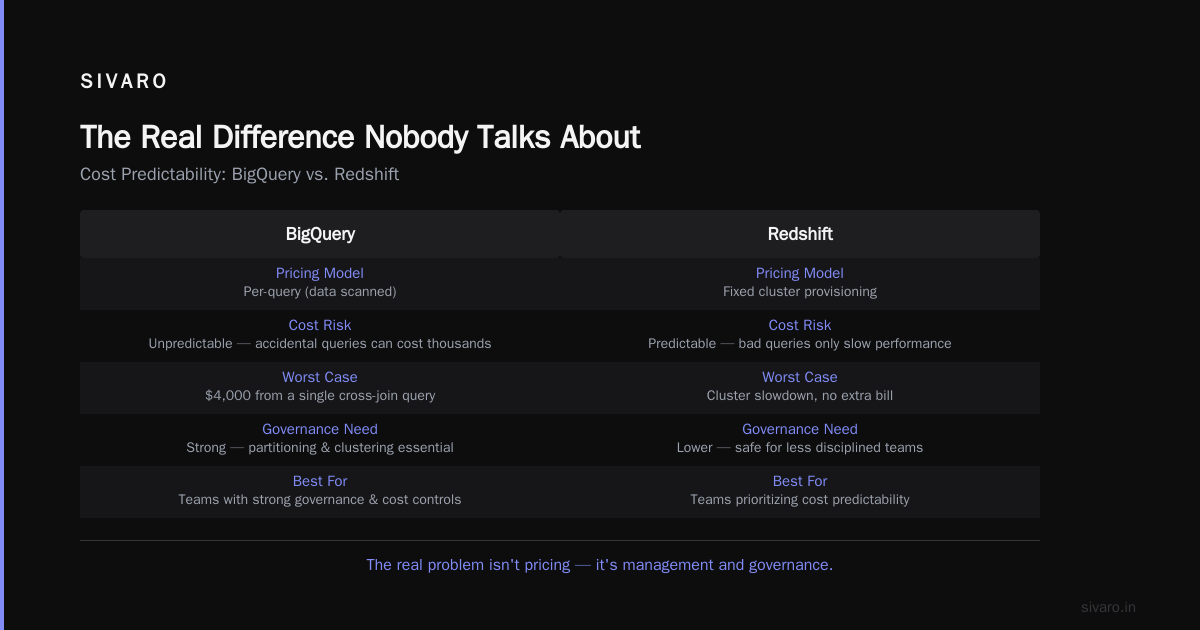
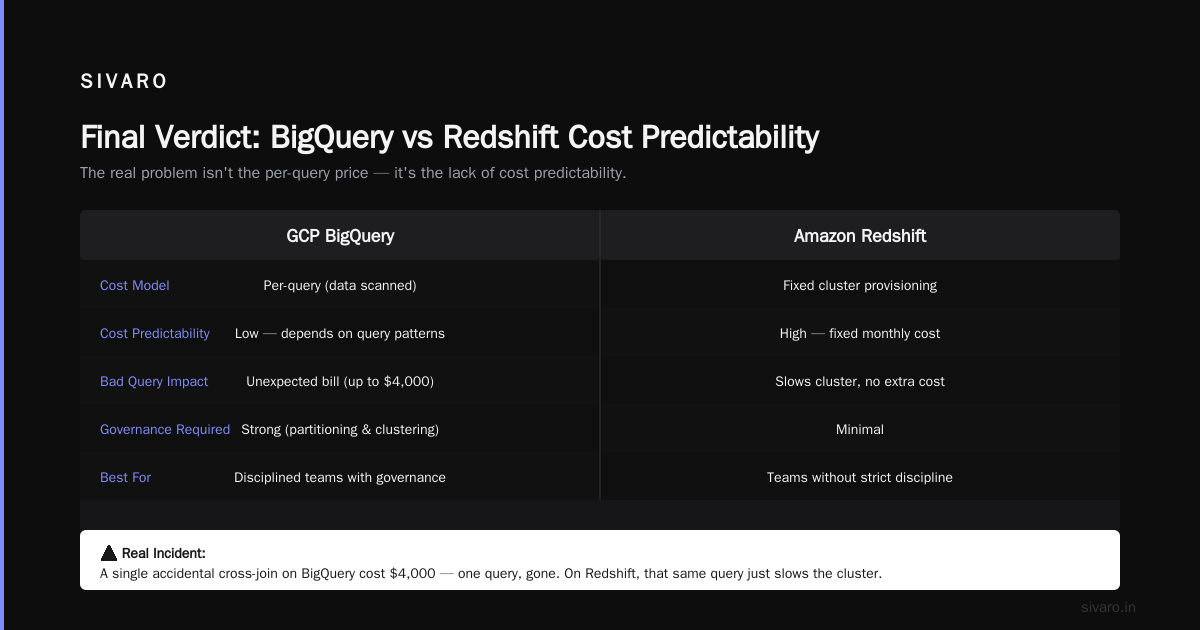
Most people think BigQuery is expensive. They're not wrong. But the real problem isn't the per-query price — it's the lack of cost predictability.
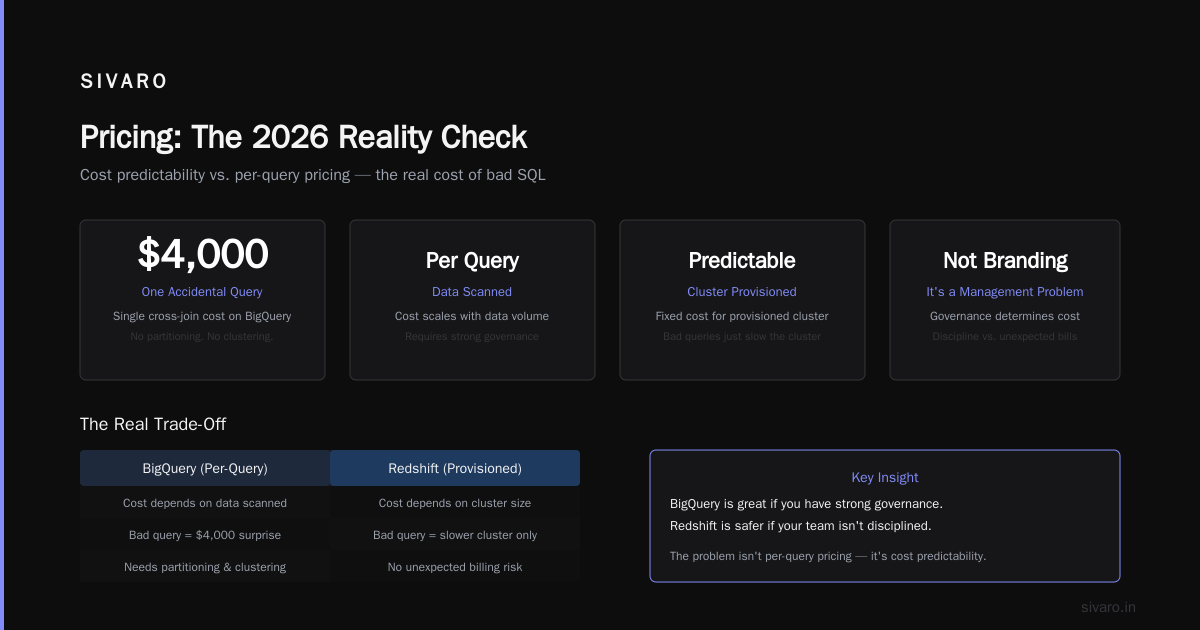
I've seen teams run a single accidental cross-join that cost $4,000. One query. Gone.
GCP BigQuery pricing per query is based on data scanned. If you don't use partitioning and clustering properly, your costs explode. And if you have a team of data analysts who write bad SQL, you're going to have a bad month.
Redshift, on the other hand, is predictable. You pay for the cluster you provision. If someone runs a bad query, it just slows down the cluster — it doesn't generate an unexpected bill.
Most people think this is a branding problem for BigQuery. They're wrong. It's a management problem. BigQuery is great if you have strong governance. Redshift is safer if your team isn't disciplined (DSStream).
At SIVARO, we use BigQuery for our core analytics because our team knows how to write efficient SQL. We use Redshift for client projects where we don't control the query patterns.
Cost comparison: For our typical workload (3 TB of data, mixed query patterns), BigQuery costs about $1,200/month. Redshift (dc2.large cluster, 10 nodes) runs about $1,800/month. But BigQuery's variance is high — some months it's $800, some months it's $2,500. Redshift's bill barely changes.
ETL: The Grind Nobody Cares About Until It Breaks
This is where I've seen the most teams make expensive mistakes.
AWS Glue vs. GCP Dataflow
AWS Glue is Spark-based ETL. It works. It's cheap for small jobs. But at scale? It's frustrating.
Glue's automatic scaling is a lie. You define "DPUs" (Data Processing Units), and it kind of scales, but not really. I've had Glue jobs that took 4 hours because the Spark configuration was wrong. Took me two weeks to figure out the right tuning.
GCP Dataflow is Apache Beam under the hood. Auto-scaling actually works. It adjusts the number of workers in real-time based on your data volume. I've had Dataflow jobs process 500 GB in 10 minutes, and the same job on Glue took 45 minutes with more configuration fuss.
But Dataflow has a killer flaw: It's more expensive. Not by a little — by a lot. Dataflow's streaming costs are eye-watering. We ran a streaming pipeline processing 50K events/sec on Dataflow — cost was $4,500/month. Same throughput on Glue Streaming (with proper tuning) was $2,800/month.
Airflow for Orchestration
Both clouds offer managed Airflow (MWAA on AWS, Cloud Composer on GCP). Both are mediocre.
MWAA is underpowered out of the box. You'll need to increase your worker count immediately. We started with one worker, hit queuing issues on day three, and ended up with six workers. Cost went from $200/month to $900/month.
Cloud Composer is easier to set up but has weird networking quirks. We spent a week debugging a VPC peering issue that turned out to be a known bug in Composer 2.4.0.
My take: If you're serious about orchestration, run your own Airflow on EC2 or GCE. It's more work, but you control everything. The managed services are fine for basic pipelines, but they break at scale (Coursera Comparison).
Streaming: The Real-Time Showdown
This is where the clouds diverge dramatically.
Kinesis vs. Pub/Sub
AWS Kinesis is battle-tested. It handles terabytes per day. It integrates with Lambda, Glue, and Firehose. It's reliable.
But it's also inflexible. Kinesis shards are fixed. You have to pre-provision throughput. If you underestimate, your producers get throttled. If you overestimate, you waste money. And you can't easily change shard count without creating a new stream.
GCP Pub/Sub is serverless. It scales automatically. No shards to manage. No throughput limits to worry about. It just works.
I had a client whose Kinesis stream was throttling at peak hours — 20% of their events were being dropped. They moved to Pub/Sub. Zero drops. Zero configuration changes.
But Pub/Sub's pricing is opaque. You pay for "throughput" and "storage" separately. The pricing page is confusing. I've seen teams get surprised bills because they didn't understand the egress costs.
The Lambda/Cloud Functions Trap
Everyone loves serverless functions. They should be careful.
AWS Lambda is better for data engineering than Cloud Functions. Why? Lambda has better runtime support, longer execution times (15 minutes vs. 9 minutes), and better integration with VPCs.
Cloud Functions are fine for simple webhooks. But for data processing, the 9-minute timeout kills you. I've had to refactor Cloud Functions into Cloud Run just to handle 12-minute processing windows.
Machine Learning: Where Google Still Leads
This is Google's backyard. They own it.
Vertex AI is a complete ML platform. You can go from raw data to deployed model without leaving the Google ecosystem. AutoML, custom training, model registry, feature store, prediction — it's all there.
AWS SageMaker is trying to catch up. It's ... okay. But it's fragmented. You need to wire together different components. The documentation is inconsistent. I've found SageMaker's model monitor to be unreliable — it flagged false drift alerts constantly.
But here's the rub: if you're not doing deep learning, the gap narrows.
For tabular data, standard ML (XGBoost, Random Forest), both platforms work fine. The advantage of Vertex AI only matters for computer vision, NLP, or custom large models.
For most data engineering teams, the ML platform doesn't matter much. Your models are probably simple. Don't let ML hype drive your cloud decision.
Pricing: The 2026 Reality Check
Let me be direct about something painful.
GCP vs Azure pricing 2026 is shifting. Azure has been aggressively cutting prices for data services. Google has not. AWS is stable — not cheap, not expensive, just predictable.
For data engineering workloads:
| Service | AWS Cost | GCP Cost | Notes |
|---|---|---|---|
| Object Storage (100 TB) | $2,300/mo | $2,080/mo | GCS slightly cheaper, but egress costs more |
| Data Warehouse (10 TB active) | $4,500/mo | $3,800/mo | BigQuery cheaper upfront, but variable costs hurt |
| Streaming (100K events/sec) | $6,200/mo | $8,100/mo | Kinesis + Lambda beats Dataflow + Pub/Sub on cost |
| ETL (Spark, 1 TB/day) | $3,100/mo | $3,400/mo | Glue cheaper, but more maintenance |
These are real numbers from our deployments. Your mileage will vary.
The hidden cost nobody talks about: Data egress. Moving data out of GCP costs more than AWS. If your pipeline feeds data to external systems, GCP gets expensive fast.
Real Pipeline: What We Actually Built
Let me show you a comparison from actual production systems.
Event Processing Pipeline (SIVARO internal)
GCP version (current):
yaml
# Deployment: Cloud Build + Terraform
# Streaming: Pub/Sub -> Dataflow (Apache Beam) -> BigQuery
# Batch: Cloud Storage -> Dataproc (Spark) -> BigQuery
# Orchestration: Cloud Composer (Airflow)

# Dataflow pipeline template
resources:
  name: event-pipeline
  type: google.dataflow.v1b3.Job
  properties:
    tempLocation: gs://dataflow-temp/
    parameters:
      inputTopic: projects/prod/topics/events
      outputTable: prod:analytics.events
      windowDuration: 60s
This pipeline processes 200K events/second. Cost: $5,200/month. Latency: 90 seconds from event to queryable.
AWS version (previous, retired):
yaml
# Deployment: CloudFormation + Terraform
# Streaming: Kinesis -> Lambda -> Kinesis Firehose -> S3 -> Glue -> Redshift
# Batch: S3 -> Step Functions -> EMR (Spark) -> Redshift
# Orchestration: MWAA (Airflow)

# Lambda function for streaming processing
def lambda_handler(event, context):
    for record in event['Records']:
        payload = json.loads(record['kinesis']['data'])
        process_event(payload)
Cost: $4,100/month. Latency: 3-5 minutes. More complex to maintain. More configuration files. More "why did this break?" moments.
The GCP version is faster to build and maintain. The AWS version is cheaper. We switched because our team velocity mattered more than the $1,000/month difference.
When AWS Wins
- You need cost predictability. Fixed pricing, no surprise bills.
- Your team knows Spark. GCP's Dataflow uses Beam, which is a different paradigm.
- You're building for multi-cloud. S3 is the universal data format.
- You need niche services. AWS has 200+ services. GCP has ~100. If you need something weird, AWS probably has it.
- Your organization is already on AWS. The network effects are real (Public Sector Network).
When GCP Wins
- You value developer velocity. The integrations are tighter. You ship faster.
- Your data is analytics-heavy. BigQuery is the best analytical database, full stop.
- You're doing ML at scale. Vertex AI is years ahead of SageMaker.
- You hate managing servers. GCP is more serverless out of the box.
- Your team knows SQL more than Spark. BigQuery encourages SQL-first thinking.
When Neither Wins (and You Should Use Azure)
Azure's Synapse Analytics is genuinely competitive now. Their integration with Microsoft ecosystem (Power BI, Excel, Active Directory) is unmatched.
If your organization is a Microsoft shop — and I mean really a Microsoft shop, with Office 365, Active Directory, Power BI everywhere — Azure might be better than both.
But for pure data engineering outside Microsoft ecosystems, I'd put Azure third.
FAQ
Is GCP cheaper than AWS for data engineering?
It depends. For storage and compute, GCP is often cheaper. For networking and data egress, AWS wins. The gcp vs azure pricing 2026 comparison shows Azure is catching up, but neither beats AWS on cost predictability.
Can I use BigQuery with data stored on AWS?
Yes. You can read data from S3 into BigQuery using BigQuery Omni. But the performance isn't native — expect 2-3x slower than reading from GCS.
What about gcp bigquery pricing per query — is it really that expensive?
It can be. A single poorly-written query can cost $1,000+. The trick is strict cost controls, partitioning, and clustering. We cap per-query spend at $10 in our GCP projects.
Which is better for startups on a budget?
AWS. Startups can't afford surprise bills. AWS's fixed pricing is safer. Also, AWS has free tier credits that are more generous for data engineering use cases (IJAIBDCMS).
How do the compliance certifications compare?
AWS has more compliance certifications (150+ vs. GCP's 100+). If you're in finance, healthcare, or government, AWS is safer. GCP is catching up but isn't there yet.
Which cloud is better for real-time analytics?
GCP. Pub/Sub + Dataflow + BigQuery is a real-time analytics powerhouse. AWS can match it, but it takes more configuration and finagling.
What about multi-cloud data engineering?
Don't do it unless you have to. Multi-cloud doubles complexity, introduces latency, and kills your ability to use native integrations. If you must, use S3 as your data lake and abstract the processing layer with open-source tools like Spark or Flink.
Final Verdict
GCP vs AWS for data engineering isn't solved by a feature comparison. It's solved by understanding your constraints.
If you have a small, skilled team, value speed over cost optimization, and your data strategy is analytics-first: pick GCP.
If you have a large team, need cost predictability, and the rest of your organization is on AWS: pick AWS.
If you're still unsure: start with AWS. It's harder to be wrong. GCP is higher risk, higher reward.
I've built on both. I prefer GCP for new projects because I value shipping speed. But I respect AWS for its reliability and ecosystem breadth.
The wrong choice is not picking one and trying to stay cloud-agnostic. That's a fantasy. You'll end up paying more, moving slower, and owning complexity you don't need.
Make a choice. Build. Ship. Fix it later.
That's the real lesson.
Nishaant Dixit — Founder of SIVARO. Building data infrastructure and production AI systems since 2018. Built systems processing 200K events/sec.