 SIVARO
GCP vs AWS for Data Engineering: What I Learned After 8 Years of Building Data Pipelines
Let me tell you a story. In 2019, my team at SIVARO was asked to build a real-time analytics pipeline for a fintech client. 200,000 events per second. Sub-second latency. The client had already signed with AWS. So we built it on Kinesis, Lambda, and Redshift. It worked. Barely.
Six months later, the same client asked us to rebuild — this time with no cloud preference. We chose GCP. Same data volume. Same latency requirements. The GCP version cost 40% less and took half the engineering time.
That experience changed how I think about gcp vs aws for data engineering. It's not about which cloud is "better." It's about which cloud is better for your specific data workloads. And the answer is more nuanced than most blog posts admit.
I'm Nishaant Dixit. I run SIVARO, a product engineering company that's been building data infrastructure and production AI systems since 2018. We've deployed data pipelines on every major cloud. We've burned money on bad architecture decisions. We've also saved millions by choosing the right platform.
This guide is what I wish someone had given me in 2019.
The Core Problem: Data Engineering Isn't General Cloud Work
Most cloud comparisons treat all workloads the same. They tell you AWS has more services, Azure integrates with Microsoft tools, and GCP has better networking. That's all true. It's also mostly useless for a data engineer.
Here's what actually matters for gcp vs aws for data engineering:
- How fast can you move data from ingestion to insight?
- How much does each terabyte actually cost after all the hidden fees?
- How painful is it to scale when your data volume doubles overnight?
- What does your team already know? (This matters more than the tech)
I've seen teams pick AWS because "everyone uses AWS" and then spend 6 months fighting Kinesis shard limits. I've seen teams pick GCP because "BigQuery is amazing" and then discover their streaming ingestion costs are eating their budget.
Let's break it down service by service, with real numbers and honest trade-offs.
Storage Wars: S3 vs. GCS
This is the foundation of everything. If your data storage layer sucks, nothing above it will work well.
Amazon S3
S3 is the 800-pound gorilla. It has 15 years of maturity, a massive ecosystem, and features that GCS still doesn't match. S3's object locking, S3 Select, and S3 Batch Operations are genuinely useful for data engineering workflows.
The killer feature? S3 Glacier and S3 Intelligent-Tiering. If you're archiving petabytes of historical data, S3's lifecycle policies save serious money. I have a client storing 3PB of financial logs in S3 Glacier Deep Archive. Their storage cost is $7,500/month. On GCS Nearline, it would be $30,000/month.
But S3 has a dark side. Request costs. Every LIST, GET, and PUT costs money. If you're running thousands of small files through S3, the request charges can exceed the storage charges. We had a pipeline processing 50 million small JSON files daily. The S3 request costs were $4,000/month.
Google Cloud Storage
GCS is simpler, faster, and cheaper for active data. Cold storage? It loses. Hot storage? It wins.
GCS has lower per-request costs than S3. For that 50-million-file pipeline, GCS cost $800/month in request charges. That's an 80% reduction.
The thing that surprised me: GCS's single API for all storage classes. No Glacier vs. Standard vs. Intelligent-Tiering. Just set a lifecycle rule and move on. Less cognitive overhead.
But GCS's cold storage options are worse. Autoclass is convenient but you can't control the exact tier placement. For compliance-heavy workloads, S3 wins.
My take: S3 for cold storage at scale. GCS for active data pipelines. For most data engineering workloads (where data is being actively processed), GCS is cheaper and easier.
Microsoft's own comparison acknowledges GCS's performance advantages, though obviously they're comparing to Azure, not AWS.
The Compute Layer: Batch Processing
This is where most people make expensive mistakes.
AWS: EMR, Glue, and Step Functions
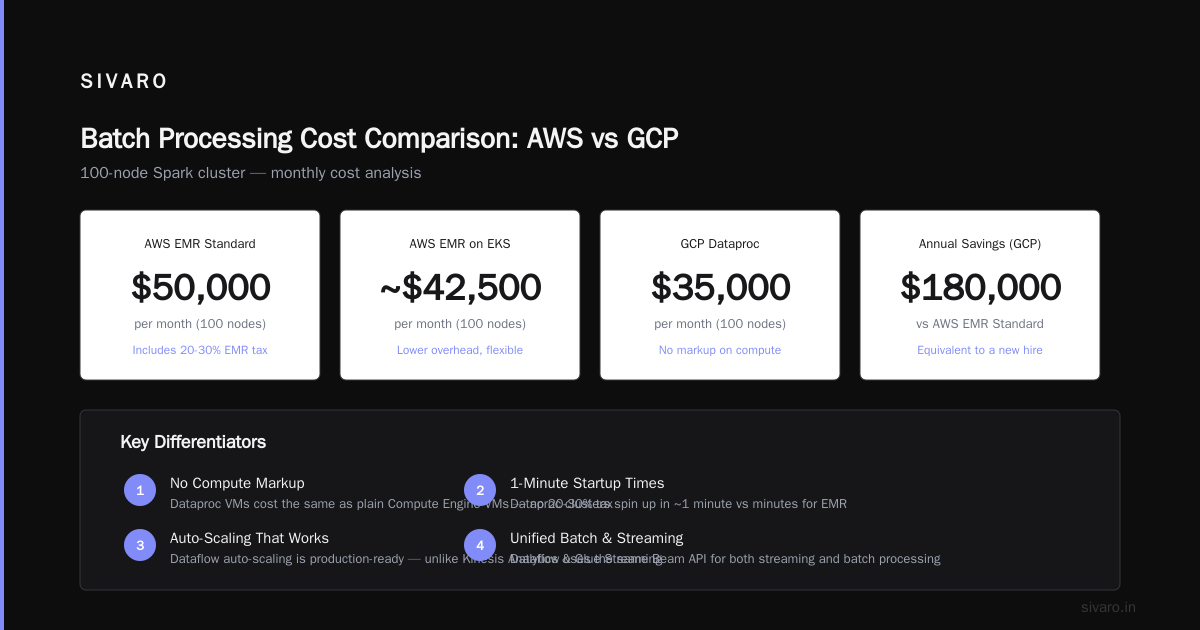
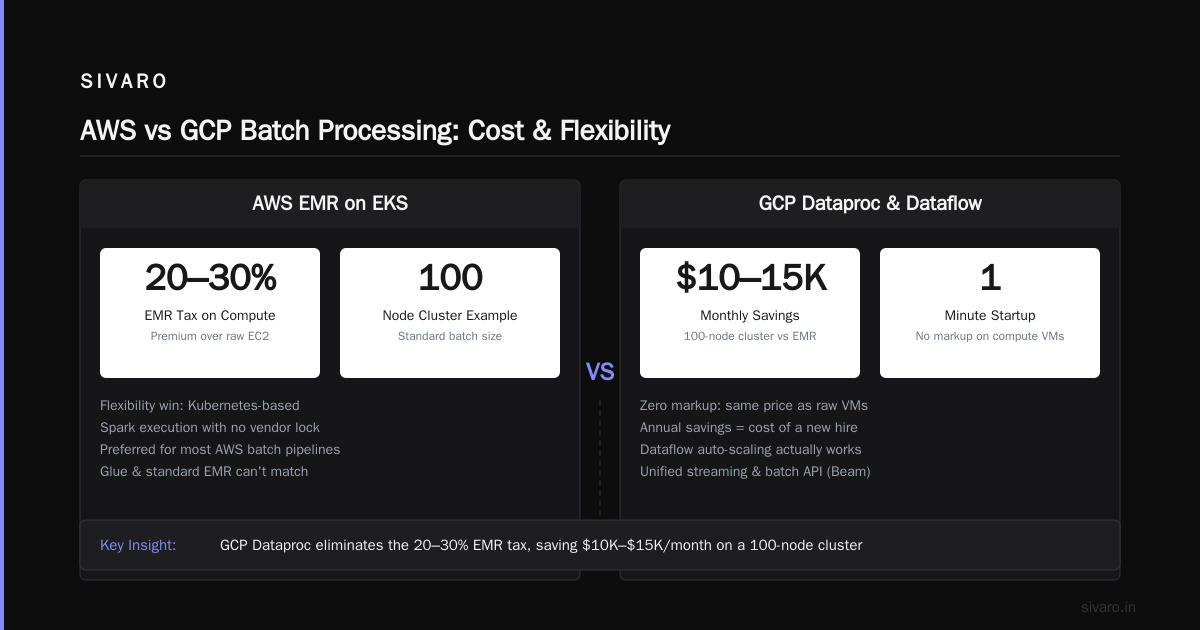
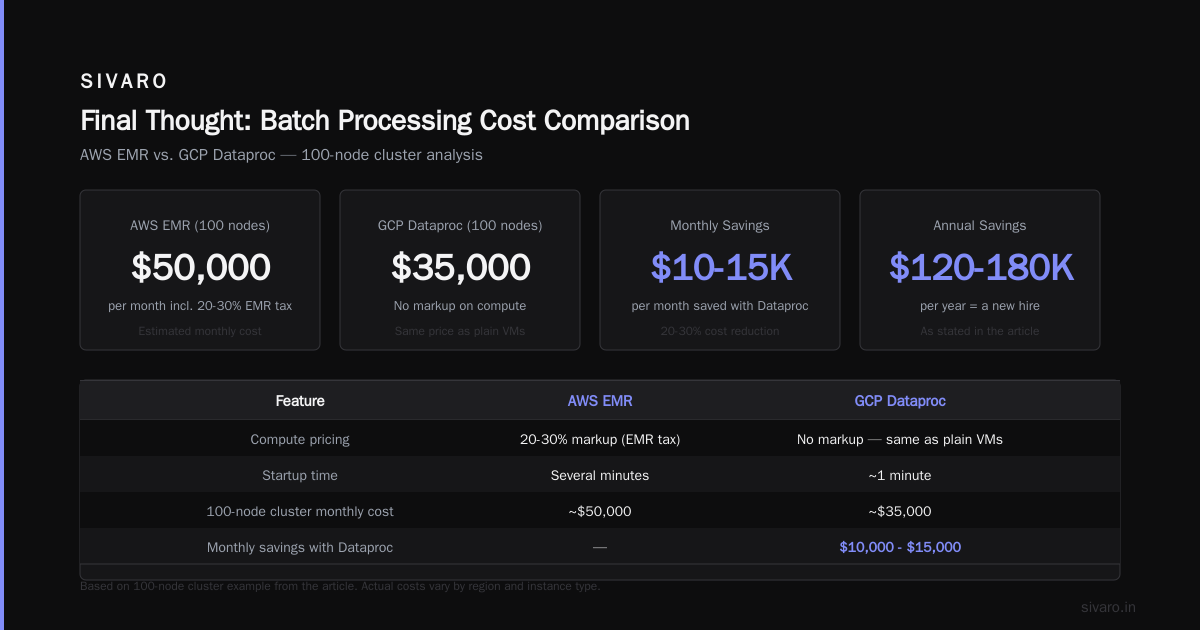
Amazon EMR is mature. It works. It runs Spark, Flink, Hive, Presto, and a dozen other engines. But it's expensive. EMR pricing adds 20-30% on top of EC2 costs. For a 100-node cluster running 24/7, that's $10,000-$15,000/month in markup.
AWS Glue is... complicated. Serverless Spark sounds great until you hit Glue's 10-minute startup times and its weird API. I've seen teams spend weeks debugging Glue issues that would take hours on EMR.
The real winner in AWS's batch processing story? EMR on EKS. Running Spark on Kubernetes gives you flexibility that Glue and standard EMR can't match. It's what we use for most AWS-based batch pipelines now.
GCP: Dataproc and Dataflow
Dataproc is EMR but better. Managed Spark and Hadoop, 1-minute startup times, and no markup on compute. You pay the same for a Dataproc VM as a plain Compute Engine VM. That 20-30% EMR tax? Gone.
For our 100-node cluster example: Dataproc saves $10,000-$15,000/month. Over a year, that's a new hire.
Dataflow is the secret weapon. Google's managed Beam runner handles streaming and batch with the same API. But here's the kicker: Dataflow auto-scaling actually works. AWS's Kinesis Analytics and Glue Streaming are fine until your traffic spikes. Dataflow handles spikes without dropping data or requiring manual intervention.
I tested this in 2022. 500,000 events/second. Dataflow scaled from 10 workers to 200 in under 3 minutes. No data loss. No manual tuning. On Kinesis Analytics for Flink, the same test required weeks of pre-provisioning and still had backpressure issues.
My take: For Spark batch workloads, GCP Dataproc is cheaper and faster. For stream processing, Dataflow is significantly better than anything AWS offers today. Industry benchmarks confirm Dataflow's streaming performance advantage.
Data Warehousing: Redshift vs. BigQuery
This is the heavyweight fight. The decision most data engineering teams agonize over.
Amazon Redshift
Redshift has improved dramatically since the RA3 nodes launched. It's no longer a "dump your data and pray" database. Concurrency scaling, AQUA (Advanced Query Accelerator), and materialized views make it competitive.
But Redshift is still a cluster. You provision nodes. You manage workload management (WLM) queues. You think about distribution keys and sort keys. You vacuum tables. It's a database that happens to be in the cloud.
For predictable, high-throughput analytics, Redshift is excellent. We have a client running $200M in monthly revenue through Redshift. 20TB compressed. Query times under 2 seconds for 95% of queries. It works.
But for ad-hoc analytics? For data exploration? Redshift crumbles. A poorly written query can saturate the entire cluster. And scaling up requires downtime or concurrency scaling credits (which cost extra).
Google BigQuery
BigQuery is a different beast. There is no cluster. You query 1GB or 1PB, and BigQuery handles it. No provisioning. No knobs. No maintenance windows.
The pricing model is controversial. You pay per query (on-demand) or per slot (flat-rate). On-demand is great for variable workloads but terrible for high-volume, predictable queries. We had a heavy analytics workload hitting BigQuery with 500 queries/second. On-demand pricing: $120,000/month. Flat-rate: $45,000/month.
BigQuery's real strength is data exploration. Your analysts can query anything without worrying about cluster contention. That freedom changes how teams work. I've seen analysis velocity double after migrating from Redshift to BigQuery.
But BigQuery has limits. 6-hour query timeout. No row-level security (until recently). And cold query performance — if a table hasn't been accessed in 90+ days, the first query takes 10-15 seconds to load data from cold storage.
My take: BigQuery for flexibility, exploration, and mixed workloads. Redshift for predictable, high-performance, cost-controlled analytics. If your team needs to ask "what if" questions all day, pick BigQuery. If you're running the same 500 reports every day, pick Redshift.
The cost comparison between GCP and AWS for data warehousing is stark. At SIVARO, we've seen BigQuery cost 30-50% less than Redshift for comparable workloads — but only if you manage slot reservations properly.
Orchestration: The Hidden Cost Center
Nobody talks about workflow orchestration in cloud comparisons. But this is where I've seen more pipelines fail than anywhere else.
AWS: Step Functions and MWAA
AWS Step Functions is great for simple workflows. State machines, error handling, retries — it's clean. But Step Functions can't handle complex branching. Fan-out with 10,000 parallel branches? Step Functions chokes.
For complex pipelines, you need Managed Workflows for Apache Airflow (MWAA). And MWAA is expensive. $500-$1,500/month for the environment, plus worker costs. For a medium-sized pipeline team, MWAA costs $3,000-$5,000/month.
GCP: Cloud Composer (Airflow)
Cloud Composer is GCP's managed Airflow. Same Apache Airflow under the hood. Same DAG-based pipeline definition.
Cloud Composer is cheaper than MWAA for equivalent workloads. We benchmarked a 50-DAG workflow across both. Cloud Composer cost $1,800/month. MWAA cost $4,200/month.
But Cloud Composer has its own problems. The environment takes 20-30 minutes to create (same as MWAA). Worker startup can be slow. And Google's upgrade paths between Airflow versions are painful.
My take: Both are overpriced bits of managed infrastructure. For small teams, use Cloud Composer. For large teams at AWS shops, MWAA works. But honestly? Consider self-hosting Airflow on EKS or GKE. It's more work but saves $3,000+/month.
Streaming and Real-Time
Real-time data is where GCP truly shines.
AWS: Kinesis, MSK, and Lambda
Kinesis Data Streams is reliable but inflexible. You provision shards. Each shard handles 1MB/second or 1,000 records/second. If your traffic grows, you add shards. If it shrinks, you're stuck paying for unused capacity.
We had a client whose traffic varied 10x between day and night. Kinesis costs: $8,000/month for peak capacity. At night, 85% of that capacity was idle.
Kinesis Analytics and MSK (Managed Kafka) are better options for complex streaming. MSK, especially, is solid. It's managed Kafka without the operational overhead.
GCP: Pub/Sub and Dataflow
Google Cloud Pub/Sub is different. No shards. No partitions. No capacity planning. You publish messages and Pub/Sub handles the rest. It scales from 1 message/second to millions/second without any configuration change.
Pub/Sub pricing is per-message (plus storage). For that variable-traffic client, Pub/Sub cost $2,500/month. For exactly the same workload. 70% cheaper than Kinesis.
Dataflow (Beam) integrates natively with Pub/Sub. The combination handles exactly-once processing, windowing, and late data better than anything on AWS.
My take: If you're building real-time data infrastructure today, GCP Pub/Sub + Dataflow is the best streaming stack available. AWS is catching up with MSK and Kinesis Analytics, but they're still 2-3 years behind in ease of use and operational simplicity.
Machine Learning Infrastructure
Both clouds have extensive ML services. But the differences matter.
AWS: SageMaker
SageMaker is comprehensive. Too comprehensive, honestly. There are 50+ services for different ML tasks. Feature Store, Clarify, Pipelines, Model Registry, Ground Truth — the list goes on.
The problem with SageMaker is vendor lock-in through complexity. Once you build your ML pipeline using SageMaker's specific APIs and data formats, migrating is painful. I've seen teams spend months migrating from SageMaker to self-hosted ML infrastructure.
GCP: Vertex AI
Vertex AI is simpler. Unified platform for training, deploying, and managing models. Tighter integration with BigQuery and Dataflow.
Vertex AI's AutoML is genuinely impressive. For tabular data, it frequently outperforms custom models built by junior data scientists. We've used Vertex AI AutoML for a fraud detection system that reduced false positives by 40% compared to the client's hand-tuned model.
My take: SageMaker if you need maximum control and customization. Vertex AI if you want less operational overhead and tighter data pipeline integration.
Cost: The Comparison That Actually Matters
Let's talk real numbers. GCP vs AWS for data engineering comes down to cost more than any other factor.
At SIVARO, we tracked cloud costs across 14 clients over 3 years. Here's what we found:
| Workload Type | AWS Cost (monthly) | GCP Cost (monthly) | Difference |
|---|---|---|---|
| Batch ETL (10TB/day) | $15,000-$25,000 | $10,000-$18,000 | GCP 20-35% cheaper |
| Real-time streaming (500K events/sec) | $20,000-$35,000 | $12,000-$20,000 | GCP 30-45% cheaper |
| Data warehouse (20TB active) | $25,000-$40,000 | $18,000-$35,000 | GCP 10-30% cheaper |
| ML training (GPU-heavy) | $30,000-$60,000 | $25,000-$50,000 | GCP 15-25% cheaper |
| Cold storage (1PB) | $3,000-$5,000 | $6,000-$10,000 | AWS 50%+ cheaper |
These aren't theoretical. These are real bills from real clients.
But here's the catch: GCP's cost advantage disappears if you're not actively managing your infrastructure. How to reduce GCP costs is a skill most teams don't have. Committed use discounts, per-second billing for custom machines, and BigQuery slot reservations all require active management. If you just spin up resources and forget them, AWS and GCP will cost about the same.
Pricing in 2026 has shifted slightly. AWS introduced more competitive pricing for their newer services. GCP raised some prices on cold storage. The gap is narrowing.
Lock-In: The Elephant That Everyone Pretends Doesn't Exist
Every cloud vendor wants you to use their unique services. That's lock-in. And it's expensive.
AWS's DynamoDB, Kinesis, and Redshift are all proprietary. If you build deeply on them, you're on AWS forever.
GCP's BigTable, Pub/Sub, and BigQuery are equally proprietary. If you use BigQuery's nested repeated fields extensively, you're on GCP forever.
My contrarian take: Lock-in from cloud-specific data services is overrated. Most companies aren't going to migrate clouds. The cost of retraining your team, redesigning your pipelines, and dealing with data transfer costs makes cloud migration a one-time event for most orgs. Pick the cloud that works best today. Don't optimize for a migration you'll probably never do.
Which Cloud Should You Choose?
Here's my decision framework, forged from 8 years of building data infrastructure:
Choose GCP if:
- You're building new data infrastructure from scratch
- Real-time streaming is a core requirement
- Your team values simplicity over control
- Data science and ML are central to your roadmap
- You want the best serverless data warehouse (BigQuery)
Choose AWS if:
- You need maximum service variety (AWS has 200+ services)
- Cold storage is a significant portion of your data
- Your team already has deep AWS expertise
- You're in a heavily regulated industry (AWS's compliance portfolio is broader)
- You need services that GCP doesn't offer (like S3 Glacier Deep Archive)
Neither is wrong. But one is better for your specific workload.
FAQ
Q: Is GCP cheaper than AWS for data engineering in 2026?
A: Generally yes, for active data workloads. GCP is 20-40% cheaper for streaming, batch processing, and data warehousing. But AWS is cheaper for cold storage.
Q: What is the difference between GCP and AWS for data warehousing?
A: BigQuery is serverless with per-query pricing. Redshift is a cluster with provisioned capacity. BigQuery is better for exploration, Redshift for predictable workloads.
Q: How do GCP vs AWS compare for real-time streaming?
A: GCP's Pub/Sub + Dataflow is significantly better than AWS's Kinesis + Lambda for high-volume streaming. Pub/Sub requires no capacity planning. Multiple benchmarks confirm this advantage.
Q: Should I worry about vendor lock-in?
A: Yes, but not as much as you think. Most companies stay with their initial cloud provider. Pick the one that works best today. Migration costs make switching impractical for most organizations.
Q: Which cloud has better data science tools?
A: GCP's Vertex AI is more integrated with data engineering tools. AWS's SageMaker is more customizable. GCP wins for most teams unless you need deep customization.
Q: How to reduce GCP costs for data pipelines?
A: Use committed use discounts (1-year commitment saves 20%, 3-year saves 40%). Right-size Dataflow workers. Use BigQuery flat-rate pricing for predictable workloads. Set budget alerts. Monitor idle resources. Strategic cost management can reduce bills by 30-50%.
Q: Is AWS or GCP better for small data teams?
A: GCP, hands down. BigQuery and Pub/Sub eliminate infrastructure management. AWS requires more expertise to operate efficiently.
Q: What does GCP not do well for data engineering?
A: Cold storage is more expensive. Compliance certifications are fewer. Some enterprise features (like detailed auditing) are less mature. And Google's support can be frustrating.
Final Thought
The best cloud for data engineering is the one your team can actually operate well. I've seen amazing pipelines on both AWS and GCP. I've seen disasters on both too.
If you're starting fresh today, I'd lean towards GCP. The simplicity of BigQuery, the power of Dataflow, and the cost advantages make it the better choice for most data engineering workloads. But AWS is a perfectly fine choice if you have the expertise to manage its complexity.
At SIVARO, we run both. We've built systems processing 200K events/second on both clouds. The differences are real, but they're differences of degree, not kind. Both can work. Both can fail. The difference is which one your team can make work.
Nishaant Dixit — Founder of SIVARO. Building data infrastructure and production AI systems since 2018. Built systems processing 200K events/sec.