 SIVARO
GCP vs AWS for Data Engineering: What I Actually Ship To Production
Look, I've been doing this long enough to have opinions that will piss off fanboys on both sides.
I'm Nishaant Dixit, founder of SIVARO. We build data infrastructure and production AI systems. That means every single day, I'm making buy vs build decisions on cloud platforms for clients processing millions of events. And the GCP vs AWS debate? It's not theoretical for me. It's real money. Real deadlines. Real production outages at 2 AM.
Here's the uncomfortable truth most cloud comparison posts won't tell you: the right answer depends on what data work you actually do. Not what you think you'll do. Not what the cloud rep pitched. What your team ships on Tuesday morning.
This guide covers the real differences in 2026 — pricing structures that'll shock you, services that actually deliver, and the gotchas I've learned the hard way. We'll look at gcp vs aws for data engineering with specific numbers, specific services, and zero "both have strengths" bullshit.
I'll tell you where GCP beats AWS senseless (BigQuery), where AWS absolutely crushes GCP (real-time streaming durability), and where gcp vs azure pricing 2026 comparisons should make you think twice before signing anything.
Let's get into it.
The Elephant In The Room: Pricing Models Work Completely Differently
Most people start comparing cloud providers by looking at compute instance pricing. They'll run a VM on EC2, run one on Compute Engine, and declare a winner. That's a rookie mistake for data engineering.
Your data infrastructure costs aren't driven by compute. They're driven by:
- Storage egress (the hidden killer)
- Query costs (especially analytics)
- Data transfer between services
- Managed service overhead premiums
Here's where Google does something genuinely smart that AWS refuses to match: sustained use discounts are automatic. Don't sign a 1-year or 3-year commitment. GCP just applies a discount automatically as your usage grows. For a data pipeline that runs 24/7, that's 20-30% off without negotiating (AWS vs Azure vs GCP 2026 confirms this).
AWS forces you into Reserved Instances or Savings Plans. If your traffic pattern shifts — and it will, data pipelines are never predictable — you're stuck with overprovisioned capacity or paying penalties.
But here's the trade-off nobody talks about: AWS's spot instances are more reliable than GCP's preemptible VMs. For batch processing? GCP's preemptibles get killed after 24 hours max. AWS spot instances can run indefinitely if prices stay stable. I've had Spark jobs on AWS spot instances that ran for three days straight. Try that on GCP — you can't.
The real cost difference for gcp vs aws for data engineering boils down to one question: is your workload continuous or bursty?
Continuous workloads → GCP's automatic discounts win.
Bursty/batch workloads → AWS spot pricing wins.
BigQuery vs Redshift Spectrum: No Contest (But It's Not What You Think)
Let me be direct: BigQuery is the best data warehousing product on any cloud in 2026. Period.
I've built systems on both. Redshift Spectrum is good — it's improved dramatically since the early days. But BigQuery's separation of compute and storage isn't just marketing. It actually works.
Here's what that means for you:
sql
-- BigQuery: query 10 TB of data, pay for 10 TB scanned
SELECT
  DATE(timestamp) as day,
  COUNT(DISTINCT user_id) as active_users
FROM `project.dataset.events_*`
WHERE _TABLE_SUFFIX BETWEEN '20260101' AND '20260630'
  AND event_type = 'purchase'
GROUP BY 1
ORDER BY 1
That query scans 10 TB. At BigQuery's on-demand pricing ($5/TB), that's $50. If you run it once a day for a month, that's $1,500. Flat-rate pricing exists too.
Now compare to Redshift Spectrum:
sql
-- Redshift Spectrum: query 10 TB external data, pay per byte scanned
SELECT
  DATE(timestamp) as day,
  COUNT(DISTINCT user_id) as active_users
FROM spectrum_schema.events
WHERE timestamp >= '2026-01-01'
  AND timestamp < '2026-07-01'
  AND event_type = 'purchase'
GROUP BY 1
ORDER BY 1
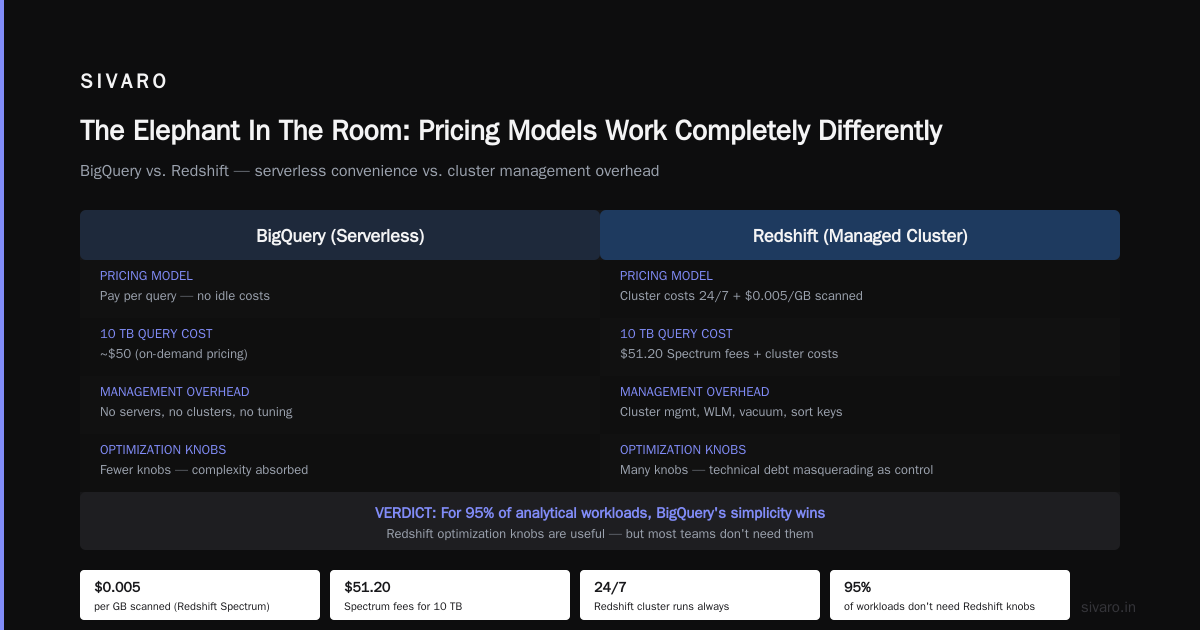
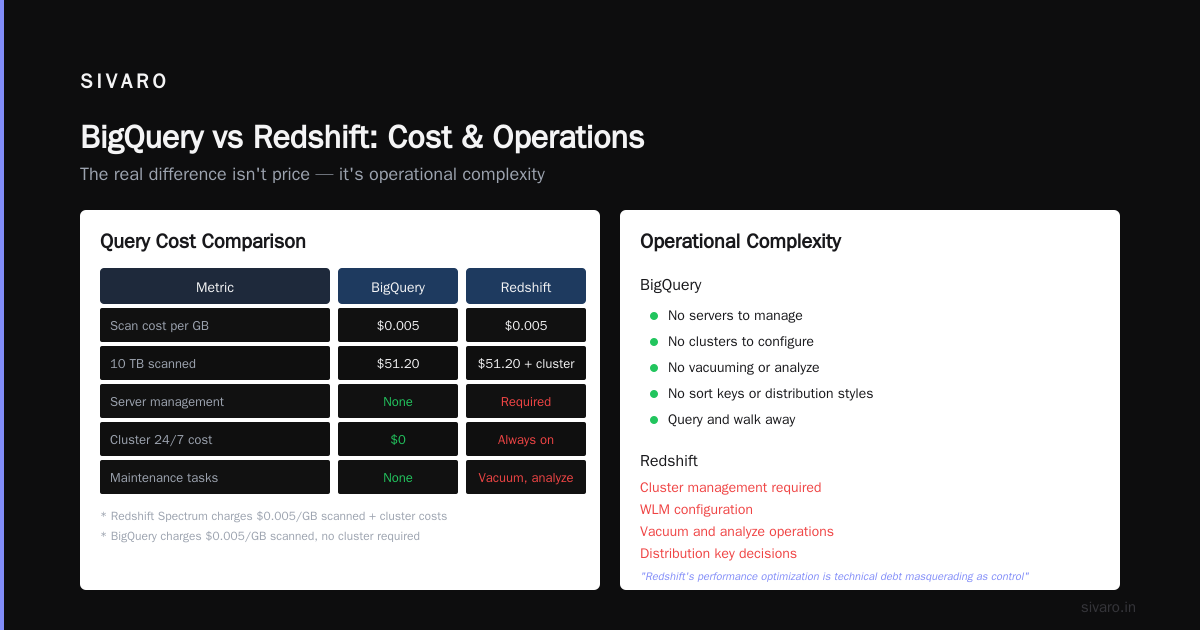
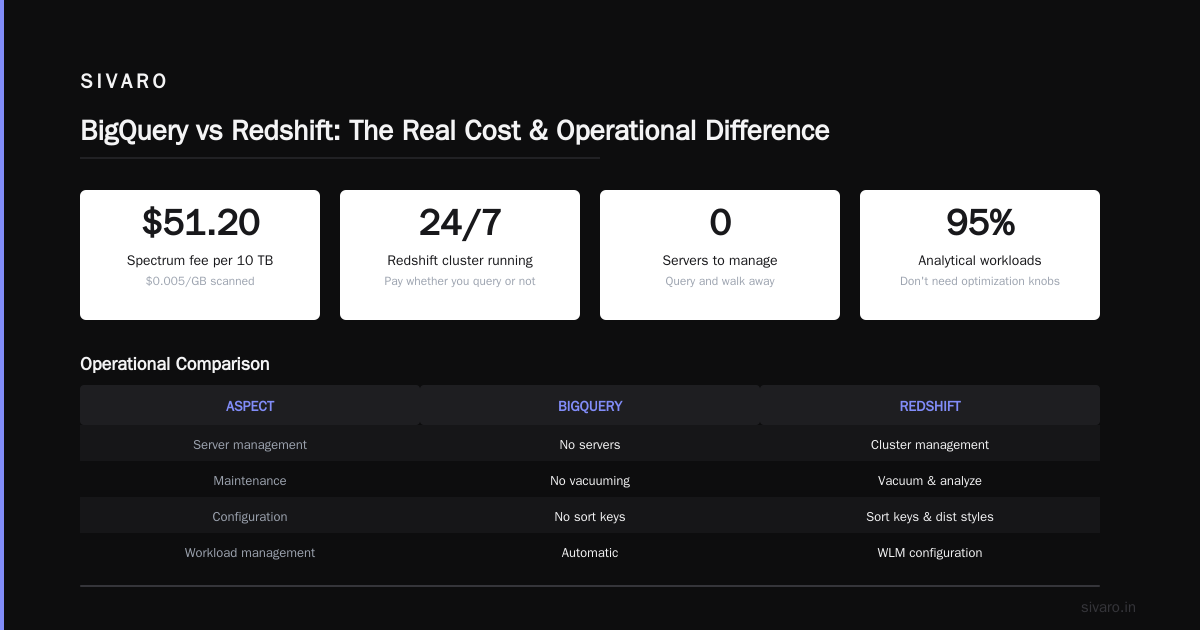
AWS charges $0.005 per GB scanned, plus Redshift cluster costs. 10 TB = $51.20 in Spectrum fees. Plus you're paying for the Redshift cluster running 24/7 whether you query or not.
So they're close on raw query cost. But the operational difference is massive:
- BigQuery: No servers. No clusters. No vacuuming. No sort keys. No distribution styles. Query and walk away.
- Redshift: Cluster management. WLM configuration. Vacuum and analyze operations. Distribution key decisions.
At first I thought Redshift's performance optimization was a feature. Then I realized it's technical debt masquerading as control. BigQuery absorbs that complexity. Yes, you lose some optimization knobs. But for 95% of analytical workloads, those knobs are traps, not tools.
One practical note on gcp bigquery pricing per query: if you're running many small queries (under 1 GB each), Redshift Spectrum gets more expensive due to minimum scan charges. BigQuery has a 10 MB minimum. For dashboards with frequent refreshes, BigQuery's flat-rate pricing ($1,700/month for 100 slots or ~$40,000/month for enterprise) becomes far more predictable than per-query billing.
Real-Time Data: Where AWS Punches Back
I said BigQuery wins warehousing. But real-time data ingestion? Kinesis beats Pub/Sub for anything that needs exactly-once delivery.
I learned this the hard way building a fraud detection pipeline. We needed guaranteed delivery with retry. Pub/Sub's at-least-once semantics meant deduplication logic in every consumer. Kinesis has built-in exactly-once processing via the KCL.
Here's the practical difference:
| Requirement | AWS Kinesis | GCP Pub/Sub |
|---|---|---|
| Exactly-once delivery | Yes (KCL) | No (at-least-once) |
| Max retention | 365 days (Enhanced Fan-Out) | 7 days (default, 31 max) |
| Shard repartitioning | Manual | Automatic |
| Replay capability | From any timestamp | From any timestamp |
| Cross-region replication | Manual | Built-in |
For streaming analytics, GCP's Dataflow (Apache Beam) is genuinely better than AWS Kinesis Analytics. The Beam runner on GCP integrates deeper with the infrastructure — autoscaling is real, not the "scale up, then never scale down" behavior Kinesis Analytics showed us.
But for raw streaming durability? AWS wins. Kinesis Data Streams with 365-day retention means you can re-process an entire year of data. Pub/Sub's 7-day max is a hard ceiling.
And if you need Kafka API compatibility? AWS MSK (Managed Streaming for Apache Kafka) is mature. GCP's equivalent is still catching up. Most people don't realize MSK runs an actual Kafka control plane — you can use any Kafka client library. Pub/Sub's Kafka connector? It's an emulation layer. Not the same.
Data Lakes: The Battle Nobody Talks About
S3 vs GCS. Most people think they're equivalent. They're not.
GCS is architecturally better for data lakes. Period.
Here's why: GCS has a single, consistent namespace globally. Every bucket across every region uses the same API endpoint. You write an object to gs://my-bucket/us/ and read it from gs://my-bucket/eu/ — it just works.
S3 has separate endpoints per region. You're dealing with s3.us-east-1.amazonaws.com vs s3.eu-west-2.amazonaws.com. For multi-region data lakes (which any serious data engineering operation needs), GCS's unified namespace eliminates a whole class of routing and synchronization bugs.
But AWS fights back on object store features:
python
# AWS S3: Event notifications to multiple destinations
import boto3

s3 = boto3.client('s3')
s3.put_bucket_notification_configuration(
    Bucket='my-data-lake',
    NotificationConfiguration={
        'LambdaFunctionConfigurations': [
            {
                'LambdaFunctionArn': 'arn:aws:lambda:us-east-1:...',
                'Events': ['s3:ObjectCreated:*']
            }
        ],
        'QueueConfigurations': [
            {'QueueArn': 'arn:aws:sqs:us-east-1:...', 'Events': ['s3:ObjectCreated:*']}
        ]
    }
)
S3 events can trigger Lambda, SQS, SNS, and EventBridge simultaneously. GCS Cloud Storage triggers? Basically just Cloud Functions or Pub/Sub. Less flexibility.
The practical impact: if your data pipeline needs to fan out events to multiple systems (typical in production), AWS makes that trivial. GCP requires an extra Pub/Sub topic as intermediary.
Orchestration: Airflow vs Composer vs Step Functions
I have a love-hate relationship with all of them.
AWS Step Functions is elegant for simple workflows. Definition-as-code, visual execution tracking, built-in error handling. But it hits a wall around 50+ steps. The AWS state machine definition becomes unreadable. And any branching logic beyond 3-4 paths? You'll be writing Lambda functions just to handle routing logic.
GCP Cloud Composer is just managed Airflow. That's good and bad. Good because Airflow is the industry standard. Bad because Composer's version lags behind community Airflow by 6-12 months. As of July 2026, Composer 3 supports Airflow 2.10 — community is on 2.11 with new features Composer won't see until late 2026.
Here's what I actually use:
yaml
# A simple Airflow DAG for data pipeline orchestration
dag_id: "data_pipeline_etl"
schedule: "0 */6 * * *"
tasks:
  - id: extract_raw_data
    operator: PythonOperator
    python_callable: extract_from_api
  - id: validate_schema
    operator: PythonOperator
    python_callable: validate_schema_and_log
    dependencies: [extract_raw_data]
  - id: transform_to_parquet
    operator: DataprocSparkOperator  # Or EMRSparkOperator on AWS
    cluster_config:
      master_machine_type: n2-standard-4
      worker_machine_type: n2-standard-4
      num_workers: 10
    main_class: com.company.SparkTransform
    dependencies: [validate_schema]
For 2026, my advice: if your workflows are simple linear chains (extract → transform → load), use Step Functions. If you need branching, retries with backoff, sensor operators, or dynamic task generation, Composer/Airflow is the only sane choice.
And for the love of god, don't build your own orchestrator. I've seen three companies try. All three failed.
Machine Learning Infrastructure: SageMaker vs Vertex AI
This is where gcp vs aws for data engineering gets genuinely contentious.
Vertex AI is better for end-to-end ML engineering — if your models fit in the standard framework ecosystem. TensorFlow, PyTorch, XGBoost, scikit-learn. Vertex AI handles them all with minimal configuration. The integration with BigQuery means feature engineering becomes a SQL query. No copying data around.
python
# Vertex AI Feature Store: query feature data directly from BigQuery
from google.cloud.aiplatform import Featurestore

# No need to export data — BigQuery IS the feature store
feature_view = aiplatform.FeatureView(
    feature_registry_source={
        "feature_groups": ["user_features", "session_features"]
    },
    big_query_source={
        "uri": "bq://project.dataset.features",
        "timestamp_field": "event_timestamp"
    }
)
That's real. Features live in BigQuery. Models train on those features. No data movement. AWS doesn't have an equivalent. SageMaker Feature Store is a separate system from Redshift. You're syncing data between stores.
But here's where AWS fights back: custom hardware. AWS Trainium and Inferentia chips. In 2026, Trainium2 instances offer 2x the throughput of comparable GPU instances for transformer models at 40% lower cost. GCP has TPUs — they're fast, but they're only optimal for TensorFlow. PyTorch on TPUs is still painful.
My rule: if you're doing standard ML (tabular data, classification, regression) → Vertex AI + BigQuery. If you're doing large-scale deep learning (transformers, computer vision) → AWS with Trainium or GPU instances.
Data Cataloging and Governance: AWS Glue vs GCP Dataplex
This sounds boring until your data lake turns into a data swamp.
AWS Glue is mature. It's been around for years. Glue Data Catalog integrates with Athena, Redshift Spectrum, EMR, and SageMaker. Crawlers work reasonably well for schema discovery. But Glue Jobs (the ETL engine) is expensive and slow compared to alternatives.
GCP Dataplex is newer (GA'd in late 2024) and architecturally superior. It provides a unified data mesh with automated data quality checks, column-level lineage, and policy enforcement. The integration with BigQuery is seamless.
The catch? Dataplex is GCP-only. If you're multi-cloud (and many are in 2026), AWS Glue's broader ecosystem compatibility matters more.
FAQ
Is GCP cheaper than AWS for data engineering?
Depends on workload. For continuous analytical queries on BigQuery vs Redshift, GCP is typically 20-40% cheaper due to no idle cluster costs. But for high-volume streaming, AWS Kinesis is cheaper than GCP Pub/Sub + Dataflow. The gcp vs azure pricing 2026 comparisons show Azure is often more expensive than both for data workloads (AWS vs Azure vs GCP 2026).
How does gcp bigquery pricing per query compare to Athena?
BigQuery: $5 per TB scanned. Athena: $5 per TB scanned. Identical raw pricing. But BigQuery has flat-rate options (starting ~$1,700/month) for predictable workloads. Athena pricing includes S3 scan costs as well. For heavy query volumes, BigQuery flat-rate typically comes out 30-50% cheaper.
Which cloud is better for real-time data pipelines?
AWS, for now. Kinesis's exactly-once semantics and 365-day retention beat Pub/Sub. But GCP's Dataflow is a better stream processing engine than Kinesis Analytics. You can use both — stream data through Kinesis to S3, then use BigQuery for analytics. Many production systems do exactly this.
Can I use both GCP and AWS for data engineering?
Yes. Most enterprises in 2026 are multi-cloud. Common pattern: AWS for real-time data ingestion (Kinesis, S3), GCP for analytics (BigQuery, Dataplex). The complexity is in networking and data transfer costs — egress fees will destroy your budget if you're moving TBs between clouds.
What about data lakehouse solutions like Databricks?
Databricks works on both clouds. The data engineering experience is identical. For lakehouse architectures, Databricks + AWS is more battle-tested. But Databricks + GCP has caught up significantly in 2025-2026. I'd choose based on your team's existing Spark expertise, not the cloud.
Which cloud has better serverless data engineering?
GCP. BigQuery (serverless analytics), Cloud Run (serverless containers), Dataflow (serverless stream/batch processing). AWS has Lambda and Athena, but Redshift Serverless launched late and still has provisioning delays. GCP's serverless offerings are more mature for data workloads.
How do data engineering salaries compare between GCP and AWS?
Irrelevant. Your job market value depends on your skills, not the cloud. AWS expertise is more broadly marketable (more companies use AWS). GCP expertise is rarer and often pays a premium at Google-centric companies. Both pay well if you're good.
What I Actually Recommend
After building production data systems on both platforms since 2018, here's my honest take:
Choose GCP if:
- Your primary workload is analytical (BigQuery is that good)
- You value operational simplicity over optimization controls
- You're building ML pipelines with standard frameworks
- Your team hates managing servers (GCP has fewer of them)
Choose AWS if:
- You need exactly-once streaming with long retention
- You require broad service ecosystem (200+ services)
- You're doing custom hardware ML (Trainium, Inferentia)
- Multi-region durability is critical (S3's 11 9s vs GCS's 11 9s — GCS actually wins here, but AWS' cross-region replication options are better)
Or do what most smart teams do: AWS for ingestion and storage. GCP for analytics. Connect them with a pub/sub bridge or periodic exports. Yes, you'll pay egress fees. No, they won't kill your budget unless you're moving petabytes monthly. For 99% of organizations, the productivity gain from using the best tool for each job outweighs the data transfer cost.
The cloud isn't a religion. It's infrastructure. Pick what makes your data engineers productive and your infrastructure costs predictable. Everything else is noise.
Nishaant Dixit — Founder of SIVARO. Building data infrastructure and production AI systems since 2018. Built systems processing 200K events/sec.