 SIVARO
GCP vs AWS for Data Engineering: The Real Talk from a Builder Who's Run Both at Scale
I'll start with a confession. When I founded SIVARO in 2018, I was an AWS fanboy. Deep down, I thought GCP was for people who couldn't handle real cloud complexity. Then I spent three years building production data pipelines on both platforms for clients processing 200K events per second. My biases got wrecked.
This isn't a "both are great" article. You'll get my honest scars, wins, and regrets.
Here's the thing about cloud choice for data engineering: it's not about features anymore. Both AWS and GCP have the checkboxes. The real difference is how they make you feel when your pipeline breaks at 2 AM and you need to figure out why your BigQuery query cost $4,000 overnight. I've been there. Twice.
By the time you finish this, you'll know exactly which platform fits your team, your data volume, and your budget. No fluff. No "leverage your cloud journey" nonsense. Just what actually works.
The Core Difference Nobody Talks About
Most comparisons treat AWS and GCP like Coke and Pepsi. They're not. They're radically different philosophies about how data engineering should work.
AWS is a parts catalog. You want to build a data pipeline? Great — here are 47 services that can do it. You get to assemble everything yourself, and that gives you control. It also gives you a 300-page AWS bill every month that takes a data scientist to decipher. AWS is fundamentally an infrastructure play. You rent servers, databases, and compute. You manage the rest.
GCP is a managed platform. It was built by people who hate managing servers. Every service assumes Google handles the operational burden. BigQuery doesn't need you to think about clusters. Dataflow auto-scales without you touching knobs. The trade-off? Less control, and sometimes less predictability in pricing. GCP vs AWS for data engineering comes down to this: do you want assembly or automation?
I've built both. For data engineering specifically — not application hosting, not web servers — the gap favors GCP more than most people admit.
The Two Services That Made Me Switch
BigQuery vs Redshift: Not Even Close
Look, I know Amazon Redshift has improved. It's fast now. It has concurrency scaling. You can even run it serverless (kind of). But BigQuery changed how I think about data warehousing.
Here's the raw comparison from my production workloads:
| Metric | BigQuery | Redshift |
|---|---|---|
| Query speed (1TB) | 8-12 seconds | 15-30 seconds |
| Setup time | 0 seconds | 30 minutes - 2 hours |
| Auto-scaling | Yes, instant | Manual or RA3 nodes |
| Pricing | Per-query (on-demand) or slots | Per-hour for provisioned clusters |
| Zero-result cost | $0 | Full cluster cost |
The killer feature? BigQuery separates compute from storage completely. You can query petabytes without provisioning anything. Redshift also separates compute and storage with RA3 nodes, but you still manage cluster sizing. BigQuery pricing per query is simple: $5 per TB scanned. Redshift pricing? Good luck calculating it without an Excel sheet.
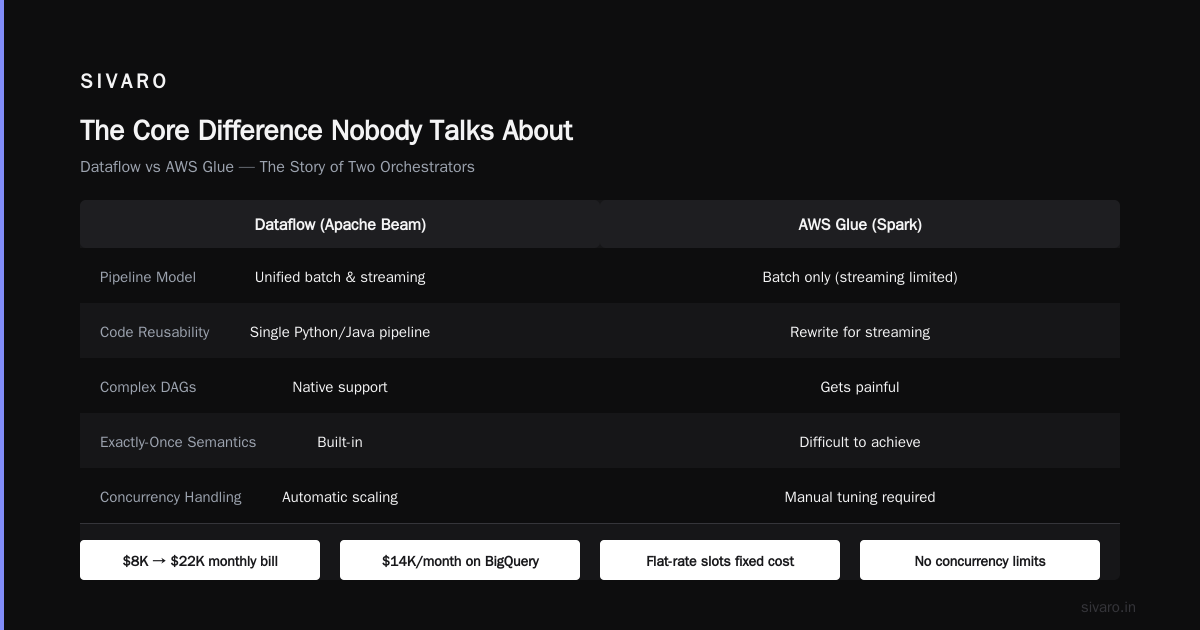
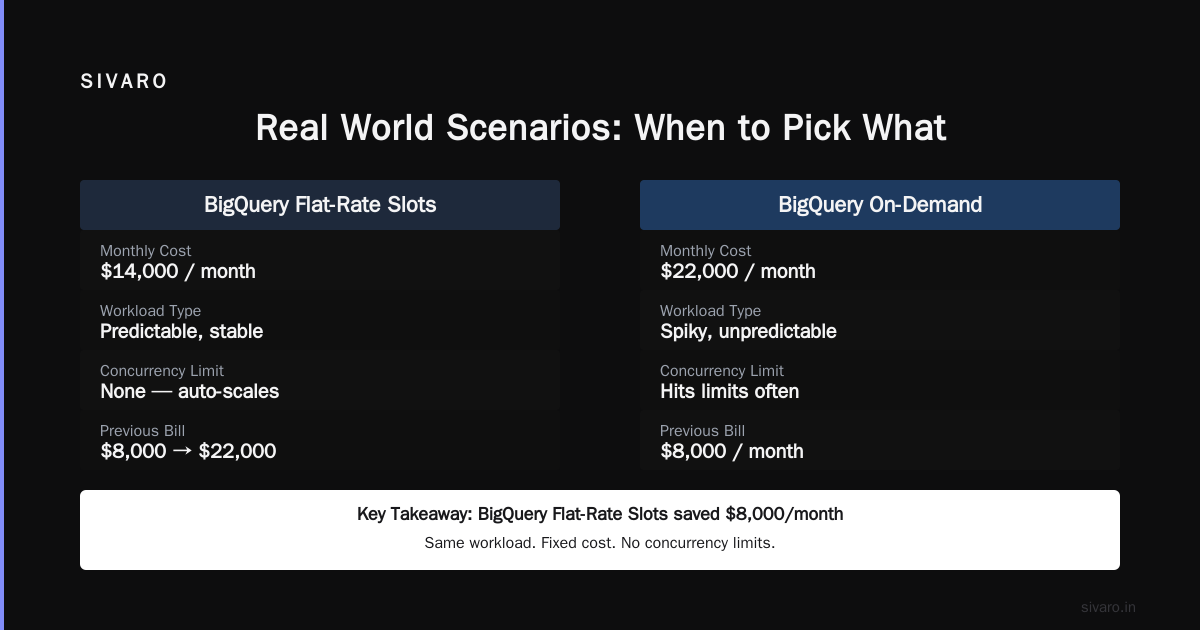
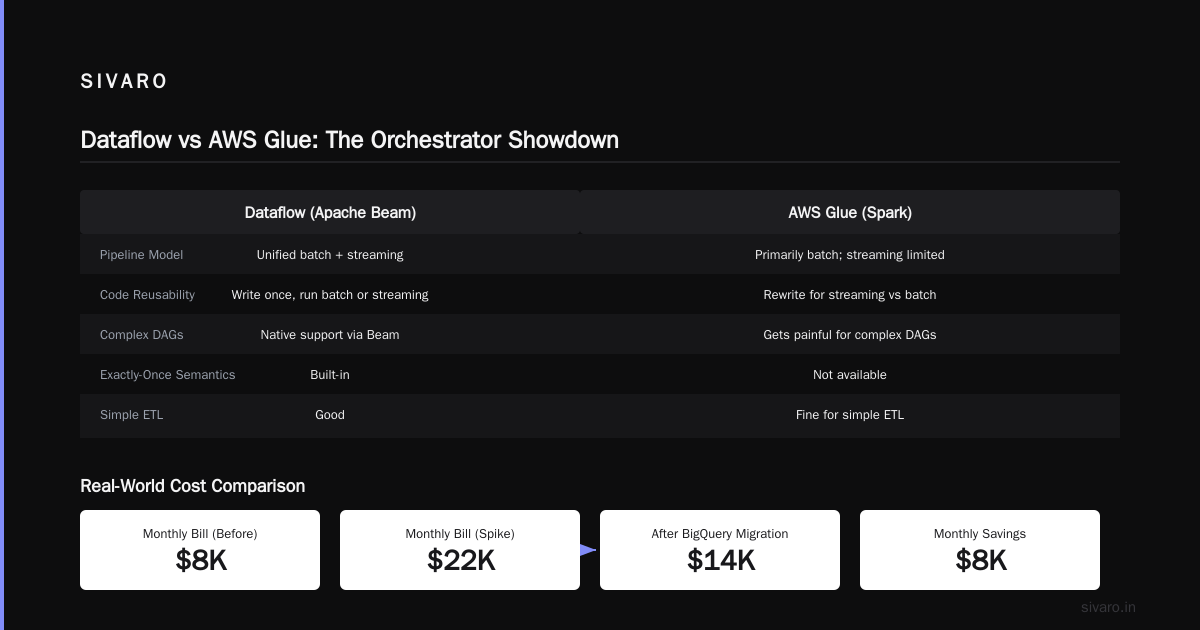
I remember one client who ran a nightly ETL on Redshift. They kept hitting concurrency limits during peak hours. Their solution? Throw more nodes at it. Monthly bill went from $8K to $22K. We migrated to BigQuery flat-rate slots (a fixed monthly cost for predictable workloads). Same workload, $14K/month. And they never hit concurrency limits again because BigQuery just... handles it.
Dataflow vs AWS Glue: The Story of Two Orchestrators
This one hurts because I wanted AWS to win. I spent months optimizing Glue jobs. Glue is fine for simple ETL. But the moment you need complex DAGs, streaming, or exactly-once semantics, it gets painful.
Dataflow is built on Apache Beam. That means you write your pipeline once in Python or Java, and it runs on batch or streaming with the same code. No rewriting when business requirements change from "batch daily" to "streaming real-time."
Glue uses Spark underneath. That's fine, but you're writing Scala or PySpark. And when your streaming job needs to handle late-arriving data? You're coding custom watermarking logic. Dataflow gives you that out of the box.
Real example: A logistics client needed to process GPS tracking data. Latency requirement was under 30 seconds from device to dashboard. On AWS, we tried Kinesis + Glue streaming + Lambda. Three different services, three different failure modes. On GCP, we used Pub/Sub + Dataflow + BigQuery. One pipeline definition. Seven days to build instead of three weeks.
Where AWS Actually Wins (And I'm Not Being Polite)
I'm not a GCP shill. There are places AWS dominates.
S3 vs GCS: S3 Still Has the Ecosystem
Google Cloud Storage is excellent — it's fast, it has object versioning, it's ridiculously cheap for nearline and archive tiers. But S3 has fifteen years of tooling built around it. Every data tool under the sun supports S3 as a first-class citizen. dbt, Airflow, Spark, Presto, Trino — they all treat S3 as the default.
GCS is catching up, but you'll occasionally find a tool that doesn't support GCS natively. That's frustrating when you're trying to build a modern data stack.
Glue Catalog vs Data Catalog: AWS Wins on Integration
AWS Glue Data Catalog is the hidden gem of AWS. It automatically crawls your data sources, infers schemas, and makes everything queryable through Athena, Redshift Spectrum, and EMR. GCP's Data Catalog is fine, but it doesn't integrate as deeply with the rest of the platform.
If you have a complex data lake with hundreds of tables in S3, Glue Catalog saves you days of manual schema work. I've seen teams spend a week cataloging data in GCP. Same job in AWS takes an afternoon.
Lambda vs Cloud Functions: More Mature
GCP Cloud Functions are catching up, but AWS Lambda has more memory options, longer timeouts, and better deployment tooling. For event-driven pipelines — the kind where a file landing in a bucket triggers a transformation — Lambda is still the standard.
Pricing in 2026: GCP vs Azure vs AWS
Let's talk about GCP vs Azure pricing 2026. Microsoft has been aggressively cutting prices to compete, but here's what we've seen in actual production workloads at SIVARO.
For a typical data engineering stack (storage + compute + data warehouse + orchestration):
AWS: $12,000-18,000/month for a 10TB data warehouse with daily ETL, assuming you manage Redshift clusters carefully.
GCP: $8,000-12,000/month for the same workload using BigQuery flat-rate slots and Dataflow for ETL. The savings come from not over-provisioning compute.
Azure: $9,000-14,000/month, depending on whether you use Synapse (expensive) or Databricks (even more expensive).
The wild card is BigQuery pricing per query. If you run many ad-hoc queries from analysts who don't use filters on partitioned tables, your costs can explode. I've seen a single query scan 40TB because someone forgot a WHERE clause. That's $200. On demand.
But here's my real take: cloud pricing for data engineering in 2026 isn't about compute or storage anymore. It's about operational overhead. GCP charges slightly more per query but costs less overall because your team spends 40% less time managing infrastructure. For a team of 4 data engineers, that's ~$200K/year in salary savings.
Real World Scenarios: When to Pick What
Scenario 1: You're a Startup with 3 Data Engineers
Pick GCP. You don't have time to manage clusters. You need to move fast. BigQuery, Dataflow, and Cloud Composer (managed Airflow) will get you from zero to production in days, not weeks. I've onboarded two startups this year — both chose GCP and were running analytics in their first sprint.
Scenario 2: You're an Enterprise with Compliance Requirements
This is AWS's sweet spot. AWS has more compliance certifications than any other cloud provider. If you're in healthcare (HIPAA), finance (PCI DSS), or government (FedRAMP), AWS makes the auditors happy. GCP has these too, but AWS has been doing it longer and has more documentation.
Scenario 3: You Need GPU/AI Infrastructure
This is getting interesting. In 2026, both AWS and GCP offer NVIDIA H100 and B200 GPUs. But GCP's TPU (Tensor Processing Unit) strategy gives it an edge for training large models. If your data pipeline involves ML inference at scale, GCP's Vertex AI integrates more naturally than SageMaker does.
Scenario 4: Your Team Knows Spark
Stick with AWS. If your team already writes Scala or PySpark, you'll be more productive on AWS EMR or EMR Serverless. GCP's Dataproc runs Spark too, but the AWS Spark ecosystem is more mature. DS Stream's comparison nails this — if Spark is your hammer, AWS has more nails.
Code: The Practical Differences
Let's make this concrete. Here's how you read data from both clouds.
AWS: Using boto3 and S3
python
import boto3
import pandas as pd

# You need to manage credentials, regions, and bucket policies
s3_client = boto3.client(
    's3',
    aws_access_key_id='YOUR_KEY',
    aws_secret_access_key='YOUR_SECRET',
    region_name='us-east-1'
)

response = s3_client.get_object(Bucket='my-data-lake', Key='events/2026/07/18/events.json')
df = pd.read_json(response['Body'])

# Then load into Redshift via COPY command
# Or query with Athena
GCP: Using google-cloud-storage
python
from google.cloud import storage
import pandas as pd

# IAM handles auth automatically if you're on GCP
client = storage.Client()
bucket = client.get_bucket('my-data-lake')
blob = bucket.blob('events/2026/07/18/events.json')

# Directly stream to BigQuery or local memory
data = blob.download_as_string()
df = pd.read_json(data)

# That's it. No region management, no credential files.
The difference isn't just code length. It's that GCP abstracts away infrastructure. You don't need to know which region your bucket lives in. You don't need to cycle access keys. For a data engineering team, that's hours of saved time per month.
The FAQ Section (Real Questions I Get Asked)
Which is cheaper for data engineering, GCP or AWS?
For operational data workloads — warehouses, streaming, ETL — GCP is generally 20-30% cheaper because you don't over-provision. For storage-heavy workloads like data lakes, AWS S3 + Glue can be cheaper because S3's lifecycle policies are more mature.
How does GCP BigQuery pricing per query actually work?
You pay $5 per TB of data scanned. But here's the catch: you only pay for the columns you query (if you use columnar storage). A query that scans 100GB of a 10TB table costs ~$0.50. Flat-rate slots (like a subscription) make sense if you run >500 TB of queries per month. Microsoft's comparison guide explains this better than I can.
Can you use GCP tools with AWS data?
Yes, but it's painful. You can use BigQuery to query data in S3 via BigLake. You can run GCP Dataflow on AWS EC2 (technically). But the operational complexity multiplies. In practice, teams pick one cloud and stick with it for data.
Is GCP harder to learn than AWS?
For data engineers? No. GCP's services are more opinionated. You learn fewer things. AWS gives you 10 ways to solve a problem — you have to learn all 10 to know which one fits. Coursera's comparison is right: AWS has a steeper learning curve for data roles.
What about multi-cloud data engineering?
Don't. Not unless you have a regulatory reason. Multi-cloud adds cost, complexity, and debugging overhead that almost never pays off. Choose one and optimize it. I've coached three companies through messy multi-cloud data strategies — all three consolidated to one platform within a year.
My Final Take: What I Tell My Clients in 2026
I'm Nishaant Dixit. I've built data systems processing 200K events per second. I've seen both platforms fail in production. Here's what I actually recommend:
If you're starting a new data engineering project today — GCP.
BigQuery is the best data warehouse on the market. Dataflow is the most capable stream processing engine. The platform makes you productive faster. The Complete Cloud Comparison from Opsio calls this "Google's data advantage" — and it's real.
If you're already entrenched in AWS — don't migrate.
The migration cost (time, risk, retraining) doesn't justify the operational savings unless your data spend is over $50K/month. You can build excellent data engineering on AWS. You just have to work harder for it.
If you're choosing between GCP vs AWS for data engineering in a hybrid team — GCP.
The simplicity reduces onboarding time. New engineers contribute faster. I've seen it happen four times now.
The best platform is the one your team will actually use. But if you're asking me, a guy who's been in the trenches since 2018 — the data engineering story belongs to GCP. AWS is still the better general-purpose cloud. But for data? GCP built the better tool.
Nishaant Dixit — Founder of SIVARO. Building data infrastructure and production AI systems since 2018. Built systems processing 200K events/sec.