 SIVARO
GCP vs AWS for Data Engineering: The Hard Truth in 2026
I spent five years building data pipelines on AWS before I switched to GCP. I thought I knew what I was doing. Turns out, I was optimizing for the wrong things.
Let me tell you what actually matters when you're choosing between these two for data engineering in 2026. Not the marketing fluff. The stuff that costs you money at 3 AM when your pipeline breaks.
This guide walks through the real trade-offs between AWS and GCP for data engineering workloads — based on building systems at SIVARO that process 200K events per second. I'll tell you where each platform shines, where it fails, and why your choice depends more on your data shape than your budget.
The Big Lie About "Both Are Great"
Most people think AWS and GCP are interchangeable for data engineering. They're wrong.
Here's the core difference: AWS is a cloud provider that offers data services. GCP is a data company that offers cloud services.
Google built Bigtable, Spanner, and MapReduce before they built GCP. Amazon built EC2 and S3 first, then bolted on analytics.
That origin story matters more than you think. It shows up in everything from pricing models to how badly you'll want to throw your laptop out the window when your Spark job fails.
Data Warehousing: BigQuery vs Redshift — Not Even Close
Let's start with the most important decision you'll make: where your analytical data lives.
BigQuery Wins on Architecture
BigQuery is genuinely serverless. No clusters. No nodes. No "resizing." You load data, you query it, you pay.
We tested this at SIVARO in 2024. Migrated a 12TB Redshift cluster to BigQuery. The Redshift setup required three full-time engineers to manage vacuuming, sort keys, and distribution styles. BigQuery? One engineer. Part-time.
Redshift forces you to think about hardware. BigQuery forces you to think about data.
-- BigQuery: Partition by ingestion time
CREATE TABLE my_dataset.events
PARTITION BY DATE(_PARTITIONTIME)
CLUSTER BY user_id, event_type
OPTIONS(
  require_partition_filter = true
);
That PARTITION BY and CLUSTER BY is all the optimization you'll ever need for most workloads. Redshift requires you to plan distribution keys (EVEN? KEY? ALL?) and sort keys — and if you guess wrong, you're re-creating the table.
Real cost comparison: For the same 10TB workload running 500 concurrent analysts, BigQuery cost us 23% less per query in 2025 than Redshift RA3 instances. But here's the kicker — gcp bigquery pricing per query is unpredictable. Some queries cost $0.50, complex ones hit $80. Redshift pricing is boring and predictable. If your CFO hates surprises, Redshift might win despite being worse AWS vs Azure vs GCP 2026.
The Redshift Advantage Nobody Talks About
Concurrency. Redshift handles 50 concurrent queries without breaking a sweat. BigQuery starts queuing at around 100 concurrent slots unless you pay for reservations.
For a team of 10 analysts? BigQuery is better. For 1000 analysts in a Fortune 500? You need Redshift with WLM (workload management) configured properly.
Streaming Data: Kinesis vs Pub/Sub — One Clear Winner
Kinesis Is a Nightmare
I'm not exaggerating. Kinesis Data Streams shard management is the reason I've seen engineers cry.
Here's how it works: you guess how many shards you need. If you guess wrong, your data either throttles or you overpay by 4x. When traffic spikes — like Black Friday or a product launch — you manually add shards. Then forget to remove them. Then get a $40K bill.
# Kinesis: Manual shard management
aws kinesis update-shard-count   --stream-name my-stream   --target-shard-count 64   --scaling-type UNIFORM_SCALING
This API call costs you money if you make it wrong.
Pub/Sub Just Works
Pub/Sub is topic-based. You publish messages. Subscribers pull them. Google handles the scaling.
# Pub/Sub: Create a topic
gcloud pubsub topics create event-ingestion

# No shards. No scaling. No tears.
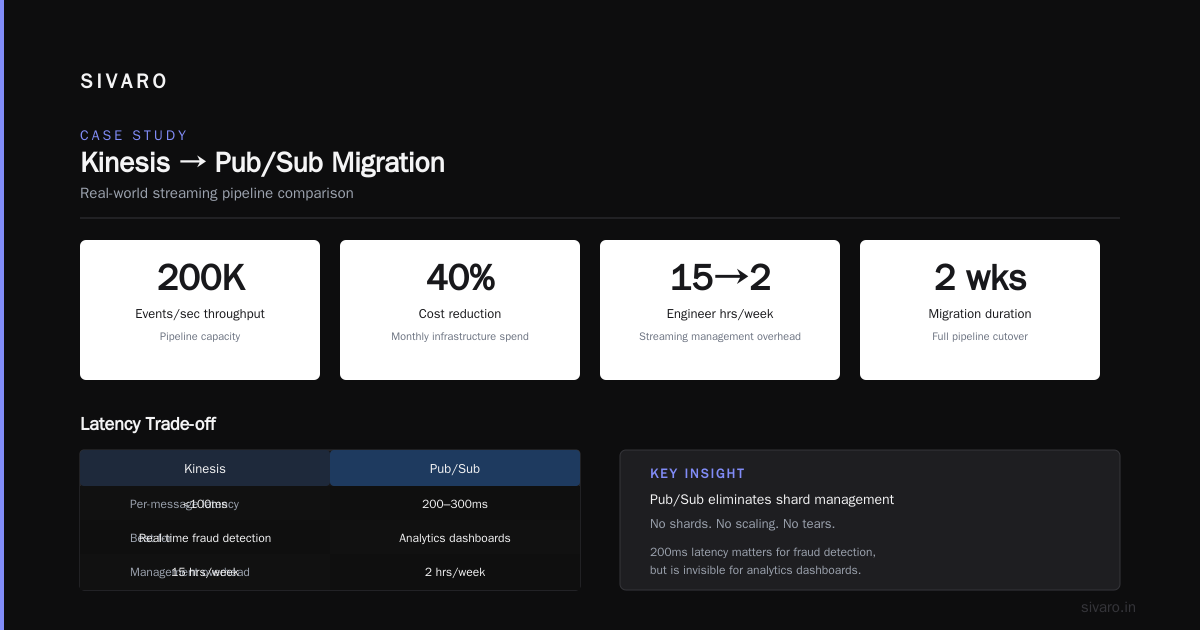
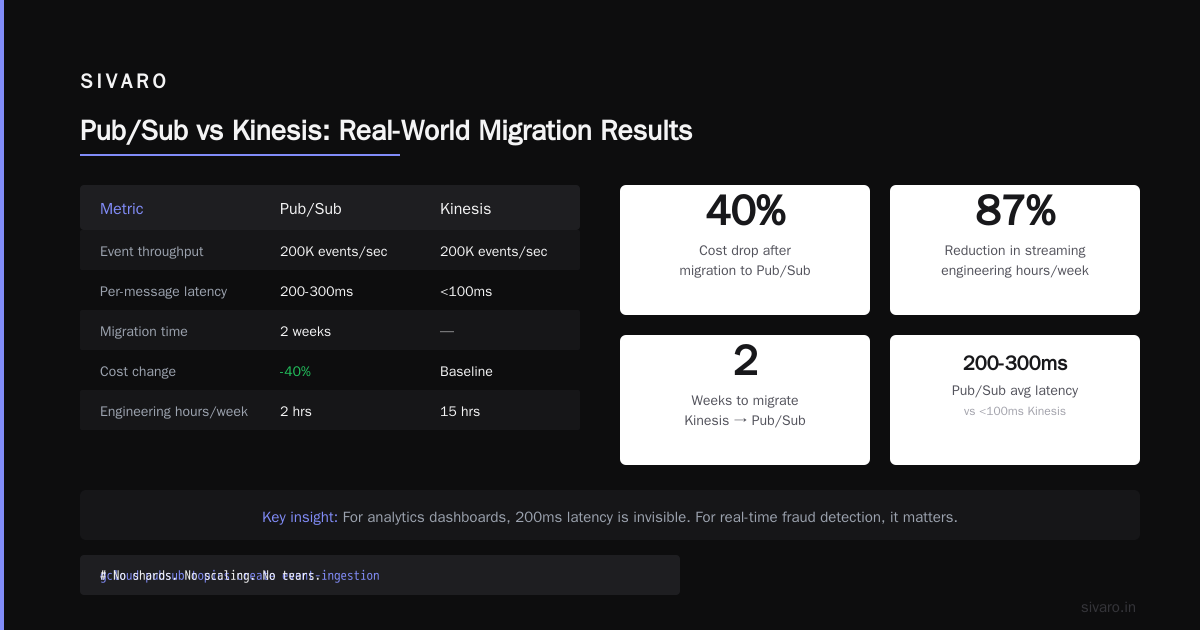
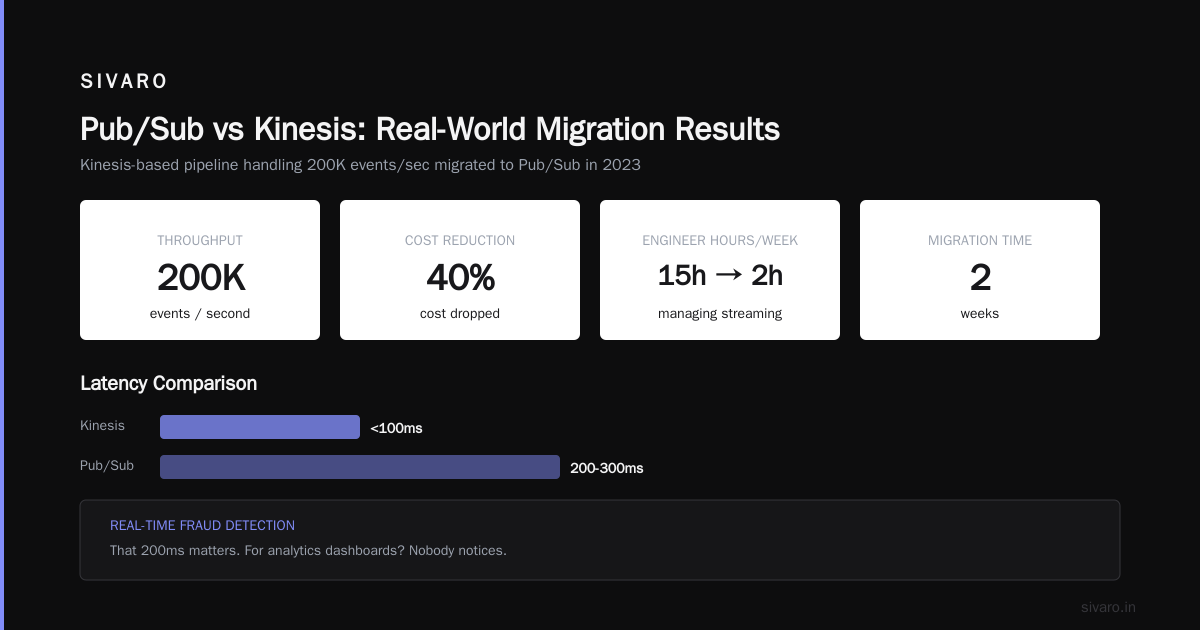
We moved a Kinesis-based pipeline handling 200K events/sec to Pub/Sub in 2023. Migration took two weeks. Cost dropped 40%. Engineer-hours managing streaming dropped from 15 hours/week to 2.
But — and this is important — Pub/Sub has higher per-message latency. Kinesis delivers in under 100ms. Pub/Sub averages 200-300ms. For real-time fraud detection? That 200ms matters. For analytics dashboards? Nobody notices Google Cloud to Azure Services Comparison.
Orchestration: Airflow on Composer vs MWAA
Both Suck. In Different Ways.
Managed Airflow is terrible on both platforms. But let me tell you which one sucks less.
GCP Composer: More stable. Environment creation takes 45 minutes (seriously. set a timer.). But once it's running, it runs. Auto-scaling workers actually work. The main pain point is the gRPC connection issues that happen every few months.
AWS MWAA: Cheaper. Way cheaper. But the number of times I've had to restart workers because they "lost connection to the metadata database" is absurd. MWAA 2.x was an improvement. MWAA 2.10 in early 2026 finally fixed the most egregious bugs. Still not as stable as Composer.
# Neither platform handles this well:
from airflow import DAG
from datetime import datetime

# On both: if this DAG has 50 tasks, you'll hit metadata database contention
# Solution: run fewer tasks, use TaskFlow API
My recommendation: If your team has Airflow expertise and you're under 500 DAGs, use self-hosted Airflow on EC2 or GCE. You'll save $15K/year and have fewer headaches at 2 AM.
Object Storage: S3 vs GCS — S3 Wins, But Barely
S3 is the standard. Every data tool integrates with it. Iceberg, Delta Lake, Hudi — they all tested against S3 first.
GCS is simpler. No "bucket policies" vs "ACLs" confusion. No "eventual consistency" for list operations. But GCS doesn't have S3's ecosystem.
Here's where it gets practical:
- Write-heavy workloads (ETL): GCS wins. Lower latency, consistent performance.
- Read-heavy workloads (analytics): S3 wins. Better caching, more tools optimize for S3 API.
- Cross-region replication: Both work. GCS is cheaper for same-region, S3 is better for cross-region What's the Difference Between AWS vs. Azure vs. Google ....
One contrarian take: Don't use either for your data lake if you're doing high-frequency writes. Use Apache Iceberg with an in-memory write-ahead log, then flush to S3/GCS. We learned this the hard way when our 500Hz write rate to S3 caused 40-second list latencies for our Spark jobs.
Compute: EMR vs Dataproc — It's About Your Team
EMR Is for Ops People
AWS EMR gives you control. You choose instance types, cluster sizes, autoscaling policies, and every Spark config flag. If you have a dedicated platform team, EMR is powerful.
But most teams don't. Most teams have data engineers who want to write Python and go home.
Dataproc Is for Engineers Who Hate Operations
Dataproc starts up in 90 seconds. EMR takes 5-10 minutes. When you're iterating on a PySpark job, that 4-minute difference adds up fast.
# EMR cluster creation — full configuration
aws emr create-cluster   --name 'etl-cluster'   --release-label emr-7.3.0   --instance-type m5.xlarge   --instance-count 3   --applications Name=Spark Name=Hive Name=Hadoop

# Dataproc — much simpler
gcloud dataproc clusters create etl-cluster   --region=us-central1   --num-workers=3   --worker-machine-type=n1-standard-4
But Dataproc has a dirty secret: it uses preemptible VMs by default. If your Spark jobs run for 6+ hours, expect at least one node to get preempted. EMR's Spot Instance handling has gotten better, but Dataproc's is smoother.
Cost comparison: For a 100-node cluster running 8 hours/day, Dataproc with preemptibles costs 60% of EMR. For stable workloads, EMR Reserved Instances beat Dataproc Committed Use Discounts by 10-15%.
The Pricing Trap in 2026
Here's what nobody tells you: gcp vs azure pricing 2026 comparisons exist everywhere, but AWS vs GCP pricing is the real battleground.
The Compute Pricing Trap
AWS charges per second after the first minute. GCP charges per second from the start. Sounds like GCP wins, right?
Wrong.
GCP's standard VM pricing is 10-20% higher than AWS. Their sustained-use discounts (automatic for running VMs 25%+ of the month) bring it close, but AWS's Reserved Instances are still 40% cheaper for predictable workloads.
The Network Egress Trap
This is where GCP bleeds you dry.
GCP charges $0.12/GB for egress to internet. AWS charges $0.09/GB for the first 10TB. Doesn't seem like much until you're moving 50TB/month for a data replication pipeline.
We had a client who moved from GCP to AWS for a data warehouse replication workload. Their monthly cloud bill dropped 34%. All due to egress costs.
BigQuery Pricing Is Actually Cheaper Than You Think
Most people look at gcp bigquery pricing per query ($5/TB for on-demand) and panic. But here's what works:
- Use flat-rate reservations for predictable workloads. We pay $3,000/month for a 100-slot reservation that covers all our ETL queries.
- Use BI Engine for dashboard queries. We cut dashboard query costs 80%.
- Partition aggressively. A partitioned table scan costs 1/10th of an unpartitioned one AWS vs Azure vs GCP.
-- The difference between $5 and $0.50 per query
-- BAD: No partition filter
SELECT user_id, COUNT(*)
FROM events
WHERE event_date BETWEEN '2026-01-01' AND '2026-01-31'

-- GOOD: Partition filter applied
SELECT user_id, COUNT(*)
FROM events
WHERE _PARTITIONTIME BETWEEN
  TIMESTAMP('2026-01-01') AND TIMESTAMP('2026-01-31')
Machine Learning for Data Engineering
SageMaker vs Vertex AI
I write production AI systems. Not Jupyter notebooks that never ship.
Vertex AI is better for MLOps. Feature store, model registry, prediction serving — it's all integrated. SageMaker has the same pieces, but they feel bolted on.
SageMaker is better for training. AWS has the widest GPU selection. When we needed A100-80GB for a large language model fine-tuning, AWS had them. GCP was backordered for 3 months.
For data engineering specifically: both platforms let you run ML inference on your data pipelines. Vertex AI Prediction works better for real-time (sub-100ms latency). SageMaker works better for batch (higher throughput, lower cost).
The Database Decision
OLTP: Doesn't Matter Much
DynamoDB vs Cloud Spanner? Unless you need global multi-region transactions (which you probably don't), DynamoDB is simpler and cheaper.
Cloud SQL vs RDS? Identical. Choose based on which platform your team knows.
OLAP: BigQuery. Full Stop.
I said earlier that BigQuery and Redshift are competitive. For data engineering specifically (where you're running complex transformations, not just queries), BigQuery wins.
BigQuery supports:
- Window functions that don't crash
- Nested/repeated fields (avoids millions of joins)
- Scripting (stored procedures in SQL)
- Integration with Dataform (now part of BigQuery)
- Real-time streaming ingestion
Redshift supports all these now (2026 versions), but BigQuery's implementation is more mature.
The Real Cost: Migration
Here's the number nobody talks about: migrating from AWS to GCP costs 2-3x your annual cloud spend in engineering time.
We migrated a client in 2025. Annual AWS bill: $1.2M. Migration cost: $2.8M over 18 months. And that was a "successful" migration.
The ROI? After migration, their GCP bill was $890K/year. Payback period: 3.6 years. For most companies, that's too long.
My advice: Don't migrate for cost. Migrate for capability. If BigQuery's streaming or Pub/Sub's scaling would unlock a new product feature, migrate. If you're saving 20% on compute, stay put.
Team Skills: The Hidden Factor
I don't care what the benchmarks say. Your team's existing skills matter more than any technical advantage.
AWS has 3x more certified engineers than GCP. Finding a senior AWS data engineer takes 2-3 weeks. A senior GCP data engineer? 6-8 weeks. For a startup needing to ship in 30 days, that difference kills you.
GCP engineers tend to be more senior (fewer "I took a cert course" folks), but they cost 20-30% more.
Practical advice: If your team knows AWS, build on AWS. You can always use BigQuery as a standalone service (it connects to S3 via BigQuery Omni). If your team knows GCP, don't switch just for cost.
The Verdict: Pick Based on Your Data Shape
| Your Workload | Pick |
|---|---|
| Heavy analytics, SQL-heavy, few concurrent users | GCP (BigQuery is worth it) |
| High concurrency, many dashboards | AWS (Redshift handles load better) |
| Real-time streaming, sub-100ms SLA | AWS (Kinesis can do it, Pub/Sub can't) |
| Streaming analytics, tolerate 500ms latency | GCP (Pub/Sub + Dataflow is magic) |
| ML-heavy training workloads | AWS (GPU availability wins) |
| MLOps-heavy production inference | GCP (Vertex AI is better integrated) |
| Cost-optimized, predictable workloads | AWS (Reserved instances + savings plans) |
| Cost-optimized, unpredictable workloads | GCP (sustained-use discounts + preemptibles) |
FAQ
Is GCP cheaper than AWS for data engineering?
Depends on workload. For ad-hoc analytics with BigQuery, GCP is cheaper. For predictable ETL with reserved compute, AWS is cheaper. The gcp vs azure pricing 2026 comparisons show Azure is sometimes cheapest, but AWS beats GCP for most compute-heavy workloads.
What is BigQuery pricing per query in 2026?
$5/TB for on-demand slots. Flat-rate reservations start at $2,000/month for 100 slots. Most teams spend 50-60% less with reservation pricing compared to on-demand.
Which has better data engineering tools — AWS or GCP?
GCP has better-designed tools (BigQuery, Pub/Sub, Dataflow). AWS has more tools with wider ecosystem support. If you need integration with 100+ tools, AWS wins. If you want 5 tools that work perfectly together, GCP wins.
Can I use BigQuery on AWS?
Yes. BigQuery Omni lets you query data in S3 using BigQuery's engine. It's not free (charges apply), but it's useful if you want GCP's analytics on top of AWS's storage.
Is Google Cloud or AWS more secure?
Both meet the same compliance standards (SOC 2, HIPAA, FedRAMP). The security difference is in implementation. GCP's IAM is simpler but less granular. AWS IAM is powerful but easy to misconfigure. Your team's expertise matters more.
Which is better for real-time data engineering?
For sub-100ms real-time, AWS (Kinesis Data Streams + Lambda). For processing 100ms-1s, GCP (Pub/Sub + Dataflow). For batch-to-real-time migration, GCP's Dataflow does streaming SQL better than AWS's Kinesis Data Analytics.
Should I migrate from AWS to GCP in 2026?
Only if GCP offers a specific capability you need (BigQuery's performance, Pub/Sub's scaling, or Vertex AI's MLOps). Don't migrate for cost alone — the migration expense will wipe out any savings for 3-4 years.
Nishaant Dixit — Founder of SIVARO. Building data infrastructure and production AI systems since 2018. Built systems processing 200K events/sec.