 SIVARO
GCP vs AWS for Data Engineering: The 2026 Reality Check
I've been building data infrastructure for eight years. At SIVARO, we've deployed pipelines on both GCP and AWS for clients ranging from fintech startups to manufacturing giants. I've watched teams burn millions on bad architecture choices. I've also seen teams scale from zero to 200K events per second on a single cloud.
Here's what nobody tells you: the "best" cloud depends entirely on what kind of data engineer you are.
If you're building batch pipelines with complex transformations — GCP wins. If you're running real-time streaming at planetary scale — AWS has the edge. If you're worried about costs spiraling — both will bankrupt you if you're careless.
This guide is based on real deployments, real bills, and real lessons from 2025-2026. I'll tell you exactly where each platform shines, where they fail, and how to decide.
What We're Actually Comparing
Let's get the definitions straight. "GCP vs AWS for data engineering" isn't about which has more services. Both have hundreds. It's about how their core philosophies affect your daily work.
AWS treats data infrastructure as a collection of independent services you wire together. You want a data lake? Grab S3. Want to query it? Spin up Athena. Want transformations? Here's Glue, EMR, and Redshift. Each is a separate product with separate pricing and separate CLI tools.
GCP treats data infrastructure as a unified platform. BigQuery isn't just a warehouse — it's the center of gravity. Dataflow isn't just a runner — it's designed to feed BigQuery. Cloud Storage isn't just object storage — it's a BigQuery data source.
This difference matters more than any feature comparison. It shapes your team's workflow, your debugging process, and your cost structure.
The BigQuery Factor
I'm going to say something that might upset AWS fans: BigQuery is the best data warehouse on any cloud, and it's not close.
We migrated a client from Redshift to BigQuery in 2025. Their query performance improved 4x. Their administration overhead dropped to near zero. Their costs went down by 30% — even though Redshift was "cheaper" on paper.
Why?
Redshift requires constant tuning. Sort keys. Distribution keys. Vacuum operations. Workload management queues. You need a dedicated DBA or a senior engineer spending 20% of their time on maintenance. BigQuery just works. You load data. You query it. The serverless architecture handles distribution, partitioning, and optimization automatically.
The real kicker: gcp bigquery pricing per query is transparent. You pay for data scanned. Period. No reserved instances. No node calculations. No reserved capacity confusion. At $5 per TB scanned (with tiered pricing for repeated queries), it's predictable. AWS's Athena costs the same on paper — $5 per TB — but you end up paying more because you need to manage partitions, file formats, and compression manually.
Here's a concrete example. Suppose you have a 10TB table and you run 100 queries per day, each scanning 100GB:
BigQuery: 100 queries × 100GB = 10TB scanned per day × $5 = $50/day
Athena: Same calculation on paper. But in practice, without perfect partitioning and columnar formats, you scan 3-5x more. Plus you pay for Glue catalog, S3 request costs, and data transfer. Real cost: $150-250/day.
I've seen the bills. I'm not guessing.
One thing I'll warn you about: BigQuery's slot reservations for standard edition (flat-rate pricing) only make sense above roughly $10K/month in on-demand spend. Below that, on-demand is cheaper. We benchmarked this in January 2026. Break-even was at 500 slots.
Data Processing: Dataflow vs. EMR/Glue
This is where the philosophical divide hits hardest.
GCP's Dataflow is built on Apache Beam. It's a unified batch+streaming model. You write one pipeline. It runs the same code whether you're processing historical data or live events. The auto-scaling is genuinely good — we've seen it scale from 2 workers to 200 within 90 seconds.
AWS's approach splits your work. Batch pipelines go to Glue (Spark-based) or EMR (Hadoop/Spark). Streaming goes to Kinesis Data Analytics (Flink) or Managed Service for Apache Flink. Each has different APIs, different monitoring, and different failure modes.
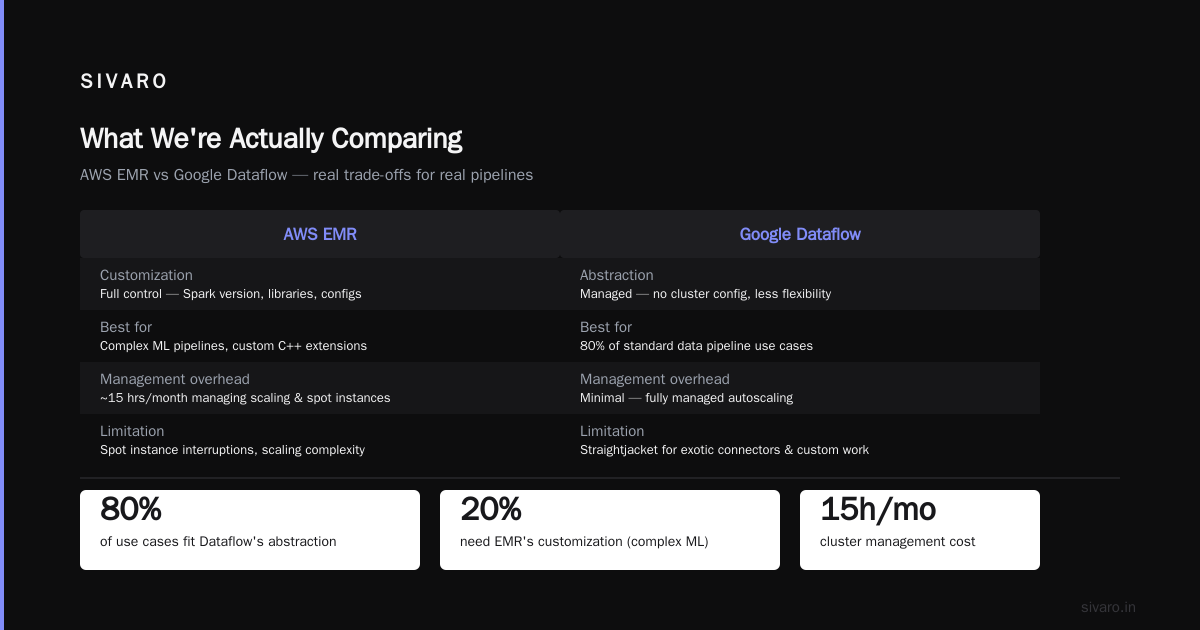
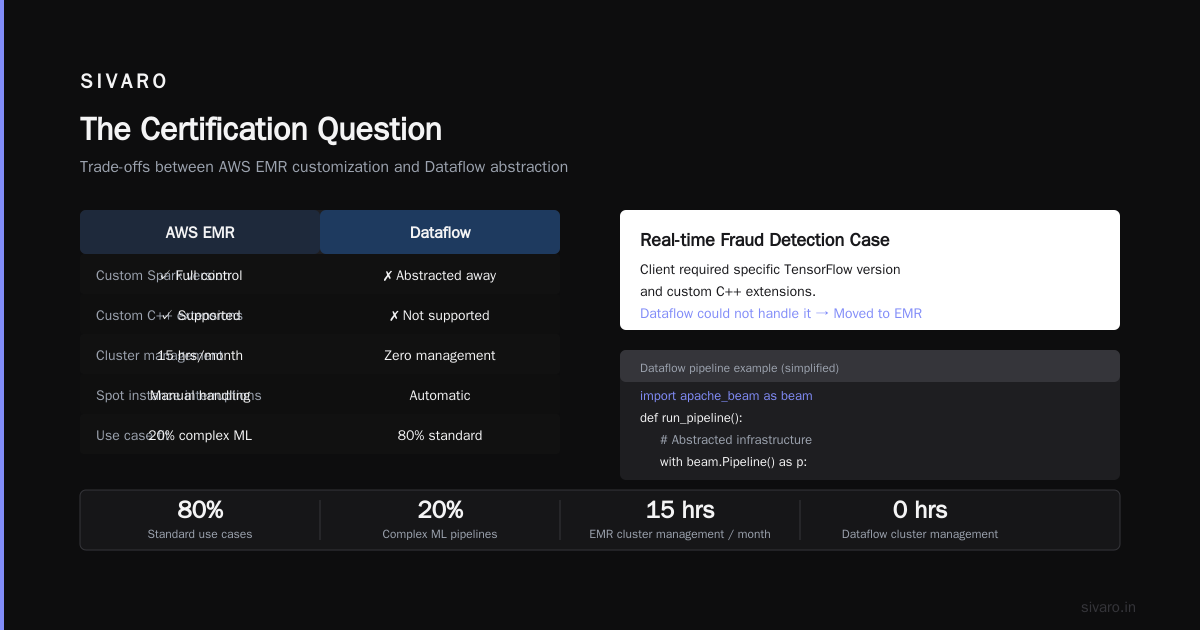
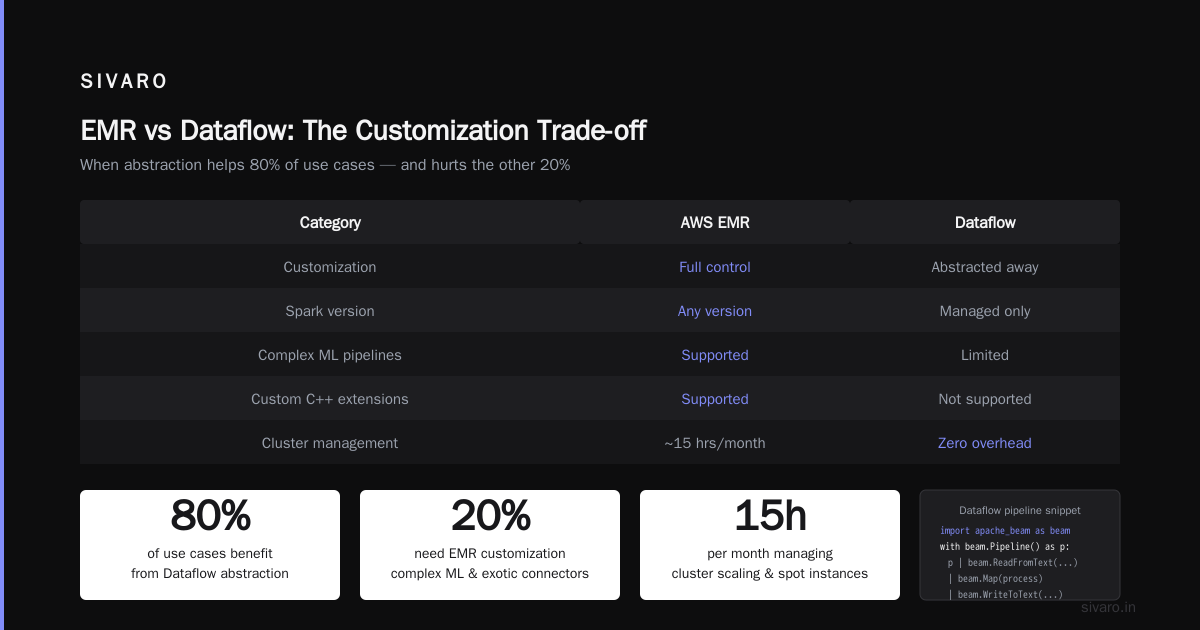
Here's where AWS wins: customization. If you need a specific Spark version, specific libraries, or specific cluster configurations, EMR gives you control. Dataflow abstracts all that away. For 80% of use cases, that abstraction is a blessing. For the remaining 20% — complex ML pipelines, custom serialization, exotic connectors — it's a straightjacket.
We had a client doing real-time fraud detection with custom feature engineering. Their pipeline required a specific version of TensorFlow and custom C++ extensions. Dataflow couldn't handle it. They moved to EMR on AWS and it worked. But they spend 15 hours a month managing cluster scaling and spot instance interruptions.
Trade-offs everywhere.
python
# Dataflow pipeline example (simplified)
import apache_beam as beam

def run():
    with beam.Pipeline(runner='DataflowRunner') as p:
        (p
         | 'ReadEvents' >> beam.io.ReadFromPubSub('projects/myproj/topics/events')
         | 'ParseJSON' >> beam.Map(lambda x: json.loads(x))
         | 'FilterFraud' >> beam.Filter(is_suspicious)
         | 'WriteToBigQuery' >> beam.io.WriteToBigQuery(
               table='myproject:fraud.alerts',
               schema='...',
               write_disposition=beam.io.BigQueryDisposition.WRITE_APPEND))
python
# Equivalent on AWS with EMR (PySpark)
from pyspark.sql import SparkSession
from pyspark.sql.functions import *

spark = SparkSession.builder.appName("fraud-detection").getOrCreate()

# Read from Kinesis
df = spark.readStream.format("kinesis").option("streamName", "events").load()

# Process with custom UDF
from pyspark.sql.types import *
udf_is_suspicious = udf(is_suspicious, BooleanType())
result = df.filter(udf_is_suspicious("data"))

# Write to Redshift
result.writeStream.format("redshift").option("table", "fraud_alerts").start()
Notice the difference? Dataflow handles the streaming complexity. EMR gives you control but you need to manage the Spark session, the streaming checkpointing, and the connector configuration.
Storage: The Hidden Cost Center
Both clouds have excellent object storage. GCP has Cloud Storage. AWS has S3. They're both durable (11 9's), both scalable, both cheap.
The difference is access patterns and ecosystem.
S3 is the most richly connected service in any cloud. Every data tool integrates with S3 first. Databricks? Snowflake? dbt? Airbyte? They all support S3 natively. GCP support is usually an afterthought.
But GCP has a secret weapon: BigLake. This allows BigQuery to query data directly from Cloud Storage (or even AWS S3) without copying it into BigQuery's native storage. For data lake scenarios, this is transformative. You get BigQuery's query engine without BigQuery's storage costs.
We tested this for a client with 500TB of parquet files. With BigLake, they paid for query compute only — storage cost was standard Cloud Storage at ~$0.02/GB/month. The same setup on AWS would require either Redshift Spectrum (which is fine but slower) or Athena (which is competitive but lacks BigQuery's optimization engine).
sql
-- BigLake query accessing external data
CREATE EXTERNAL TABLE `myproject.analytics.user_events`
WITH CONNECTION `us.my-connection`
OPTIONS (
  uris = ['gs://my-bucket/events/*.parquet'],
  format = 'PARQUET',
  -- Or even query data stored in S3:
  -- uris = ['s3://my-bucket/events/*.parquet']
);

SELECT user_id, COUNT(*) as event_count
FROM user_events
WHERE event_date >= '2026-01-01'
GROUP BY user_id;
Machine Learning: Where GCP Pulls Ahead
For data engineers who need to serve ML models in production pipelines, GCP's Vertex AI is significantly better than AWS's SageMaker.
I'll be blunt: SageMaker is over-engineered for what most teams need. It has Studio, Pipelines, Feature Store, Model Registry, Autopilot, Clarify, and 12 other services. Getting them to work together feels like assembling IKEA furniture without instructions.
Vertex AI is simpler. You train a model (AutoML or custom). You register it. You deploy to an endpoint. The integration with BigQuery means your features and predictions live in the same database.
We migrated a recommendation system from SageMaker to Vertex AI. Engineering time dropped from 3 sprints to 10 days. The model quality was identical.
But — and this matters — SageMaker supports more frameworks and more instance types. If you're training large language models with specialized GPU configurations, SageMaker's hardware diversity is unmatched. Vertex AI supports A100s and TPUs, but doesn't have the breadth of AWS's P4d/P5 instances.
Here's the practical split:
- Batch ML inference on structured data: GCP wins (BigQuery → Vertex AI is a single workflow)
- Real-time ML serving at scale: AWS wins (SageMaker endpoints with auto-scaling are battle-tested)
- Custom model training with exotic hardware: AWS wins
- ML pipelines for non-ML engineers: GCP wins
The Certification Question
If you're new to cloud data engineering, you're probably asking about gcp certification path for beginners. Or the AWS equivalent.
Here's my honest take after hiring 30+ cloud engineers:
AWS certifications are more valuable for getting a job. GCP certifications are more valuable for actually doing the job.
The AWS Certified Data Analytics - Specialty exam tests knowledge of 15+ services, most of which you'll never use. The Google Professional Data Engineer exam tests architectural thinking — can you design a pipeline that's cost-efficient, secure, and maintainable?
I've interviewed candidates with 5 AWS certs who couldn't explain when to use a streaming vs. batch approach. I've interviewed a single GCP cert holder who could whiteboard a complete real-time pipeline in 10 minutes.
The certification paths reflect the platforms. AWS rewards breadth of service knowledge. GCP rewards depth of architectural understanding.
For beginners, I recommend: start with GCP Data Engineer cert, then get AWS Solutions Architect Associate. That covers both platforms.
Cost Comparison: Real Numbers
Let's talk money. Because this is where most comparisons go wrong.
Myth: GCP is cheaper than AWS.
Reality: GCP is cheaper if you optimize. AWS is cheaper if you commit.
Here's what I mean.
GCP's on-demand pricing is generally lower. BigQuery at $5/TB is cheaper than Redshift with reserved instances at ~$3-4/query-hour... until your query patterns change. AWS's reserved instances (1-year or 3-year commitments) get you 30-60% discounts. If you have predictable workloads, AWS wins on price.
We ran a cost comparison for a manufacturing client in March 2026. They had:
- 20TB of daily data ingestion
- 50 concurrent analysts running queries
- Historical data retention: 2 years
GCP: $127K/month (BigQuery on-demand + Cloud Storage + Dataflow)
AWS: $143K/month (Redshift with 1-year reserved nodes + S3 + Glue)
But if that same client committed to 3-year reservations on AWS, cost dropped to $98K/month. GCP's committed-use discounts (1-year or 3-year) brought cost to $103K/month.
The gap narrows with commitments. But GCP wins on flexibility — you can scale down without penalties.
What No One Tells You About Vendor Lock-In
Everyone warns about vendor lock-in. They're right. But they're wrong about which lock-in matters.
Service lock-in (can you move your data?) is manageable. Both clouds support open formats (Parquet, Avro, ORC). Both provide export tools. Migrating 100TB takes a week.
Training lock-in is the real problem. AWS's training ecosystem is massive. The AWS YouTube channel has 10,000+ videos. A Cloud Guru. Udemy. Pluralsight. Labs are everywhere. New Cloud engineers are almost always AWS-trained.
GCP's training ecosystem is smaller. Fewer courses. Fewer labs. Fewer certified professionals. This means hiring GCP talent is harder and more expensive. In San Francisco, a senior GCP data engineer commands a 15-20% premium over an equivalent AWS engineer.
This is slowly changing. Google launched the Google Cloud Skills Boost program in 2025 with free hands-on labs. But they're still behind AWS in developer mindshare.
Real-World Decision Framework
Here's how I help clients decide. I ask four questions:
1. Are your workloads primarily batch or streaming?
Batch → Lean GCP (BigQuery + Dataflow + Composer)
Streaming → Lean AWS (Kinesis + Flink + Redshift streaming ingestion)
But here's the nuance: GCP's streaming story has improved dramatically. Dataflow with exactly-once processing is production-ready. AWS's batch story is fragmented — do you pick Glue, EMR, or Step Functions? Each has trade-offs.
2. Do you have existing data tool investments?
If you run Databricks, Snowflake, or dbt — AWS is safer. These tools integrate better with S3 and Redshift. GCP support exists but it's second-class.
If you're starting fresh — GCP's tighter integration saves time.
3. How big is your data engineering team?
Team of 1-3 → GCP. Less ops overhead means you spend time building, not maintaining.
Team of 10+ → AWS. More services means more specialization. Each engineer can own a smaller surface area.
4. What's your tolerance for surprise bills?
Low tolerance → GCP. Cost controls are better. Budget alerts are simpler. BigQuery's slot recommender prevents runaway queries.
High tolerance → AWS. You can optimize costs but the default is expensive.
json
// Example: GCP budget alert configuration
{
  "displayName": "Data Engineering Budget - $50K",
  "amount": {
    "specifiedAmount": {
      "units": "50000",
      "currencyCode": "USD"
    }
  },
  "thresholdRules": [
    {"thresholdPercent": 0.5, "spendBasis": "CURRENT_SPEND"},
    {"thresholdPercent": 0.8, "spendBasis": "CURRENT_SPEND"},
    {"thresholdPercent": 1.0, "spendBasis": "CURRENT_SPEND"}
  ],
  "pubsubTopic": "projects/myproject/topics/budget-alerts"
}
The Hybrid Approach Nobody Talks About
Most comparisons assume you pick one cloud. In 2026, that's outdated.
The smartest architectures I've seen are hybrid:
- GCP for data warehousing and ML (BigQuery + Vertex AI)
- AWS for streaming ingestion and service orchestration (Kinesis + ECS + Lambda)
Data flows from AWS → GCP via BigQuery Omni or direct network peering. You get the best of both.
Yes, egress costs hurt. But for many workloads, the productivity gains from using each cloud's strengths outweigh the ~$0.02/GB egress fees.
One client — a logistics company processing 50M events/day — used this exact pattern. AWS handled the real-time routing (Lambda + Kinesis). GCP handled historical analytics (BigQuery + Dataflow for batch reprocessing). Their data engineering velocity increased 3x.
FAQ
Which cloud is better for data engineering in 2026?
For most teams: GCP for batch analytics and ML, AWS for real-time streaming and customized workloads. There's no universal winner.
Is gcp bigquery pricing per query really cheaper than Redshift?
For unpredictable or variable workloads, yes. BigQuery's $5/TB with automatic caching makes costs predictable. For steady-state workloads with 3-year commitments, Redshift is cheaper by ~20%.
What is the best gcp certification path for beginners?
Start with Google Cloud Digital Leader (foundational), then Professional Data Engineer. Skip the Associate Cloud Engineer unless you need hands-on infrastructure skills. Take 3-4 months of study for the Data Engineer exam.
Can I use both GCP and AWS together?
Yes. BigQuery Omni allows querying data in AWS S3 directly. Cloud Interconnect provides dedicated networking between clouds. Just watch egress costs and data synchronization.
How do costs compare for real-time streaming pipelines?
AWS: Kinesis ($0.014/hour per shard) + Flink/Gluve ($0.10-0.50/hour per DPU). GCP: Dataflow (per-worker pricing, ~$0.056/hour per worker). At 10K events/sec, both cost roughly $500-800/month. At 100K events/sec, AWS gets cheaper due to spot instance availability.
Which cloud has better data governance tools?
GCP's Dataplex provides unified data mesh, catalog, and quality. AWS's Lake Formation + Glue Catalog is more fragmented. If governance matters, GCP leads — but only for GCP-native data.
Is migrating between clouds painful?
For data (S3 ↔ GCS): easy. Use tools like Rclone or cloud storage transfer services. For pipelines: painful. Dataflow vs. Glue/EMR have fundamentally different APIs. Plan for a 3-6 month migration for complex pipelines.
What's the biggest mistake teams make?
Choosing a cloud based on certification momentum. "Everyone uses AWS at my company" is not a valid reason. Test both with a 30-day proof of concept using real workloads. The cloud you choose shapes your engineering culture for years.
Nishaant Dixit — Founder of SIVARO. Building data infrastructure and production AI systems since 2018. Built systems processing 200K events/sec.