 SIVARO
GCP vs AWS for Data Engineering: My Honest Take After Building 50+ Pipelines
I spent the last six years building data infrastructure. First at a fintech processing 200K events per second. Then at SIVARO, where we design production AI systems for clients who've been burned by wrong cloud decisions.
Here's what I know for sure: the cloud providers are not interchangeable for data engineering.
AWS is the 800-pound gorilla. GCP is the specialist who actually built the internet's backbone. Your choice between them determines not just your monthly bill but how your team thinks about problems.
I've rewritten entire pipelines because teams picked the wrong one. Let me save you that pain.
The Core Difference Nobody Talks About
Most comparisons focus on market share or service count. That's like comparing cities by population without asking if you need a port or an airport.
AWS is an infrastructure company that added data services. GCP is a data company that built infrastructure.
This isn't marketing spin. It shows in everything — pricing, performance, even error messages.
In 2025, when Google released BigQuery support for Apache Iceberg v2 with native merge-on-read, AWS still hadn't unified its Redshift and Athena query engines under a single metadata layer. That's the gap.
Compute: Where Your Pipelines Actually Run
AWS EC2 and EMR — The Tried and True
For raw compute, AWS dominates. You want a 128-core machine with NVIDIA H100 GPUs? EC2 has it. You need to run Spark jobs on 200 nodes with spot instances? EMR handles it.
But here's the catch I learned the hard way: EMR is configured like a 2010-era data center. You manage clusters, instance groups, auto-scaling policies. It works. It's also tedious.
At SIVARO, we built a pipeline for a logistics client processing 50TB daily. EMR with Graviton instances gave us 30% cost savings over x86. That part was great.
The pain: debugging Spark shuffle spills on EMR means SSH-ing into nodes and reading logs. In 2026. That's not innovation.
GCP Dataproc and Cloud Composer — Managed but Opinionated
Dataproc is EMR done right. Clusters spin up in 90 seconds. You can use preemptible VMs for 80% cost reduction on worker nodes. Integration with BigQuery is native — no glue code.
But Google's "managed" philosophy means less control. Want a specific Spark version with custom patches? You're waiting for Google to support it.
For Airflow users: Cloud Composer 2 released in 2024 improved autoscaling dramatically. We run 500+ DAGs with Composer and hit zero downtime last quarter.
My verdict: If your team is strong on DevOps and wants fine-grained control, AWS gives you that. If you want to write pipelines, not manage YAML configs, GCP wins.
Storage Wars: S3 vs GCS
Both S3 and Google Cloud Storage offer object storage with 99.999999999% durability. Both support event notifications, lifecycle policies, and encryption.
Differences matter at scale.
S3 throughput limits: By default, one S3 prefix gives you 3,500 PUT/5,500 GET requests per second. Exceed that and you get 503s. We hit this with a client's sensor data pipeline — 100,000 devices writing every 5 minutes.
The fix: partition your keys intelligently. Random prefixes. Hash-based sharding. It works, but it's something you shouldn't have to think about in 2026.
GCS does this automatically. Its single-object throughput scales to 10,000+ requests per second without partitioning schemes. Google's architecture (Colossus filesystem) handles this at the storage layer.
The trade-off: GCS's strong consistency was always there. S3 only got strong consistency in late 2022. If you're building transactional data pipelines, this matters.
The Elephant in the Room: Data Warehousing
BigQuery — Google's Killer App
Let me be direct. BigQuery is the best data warehouse on any cloud. Period.
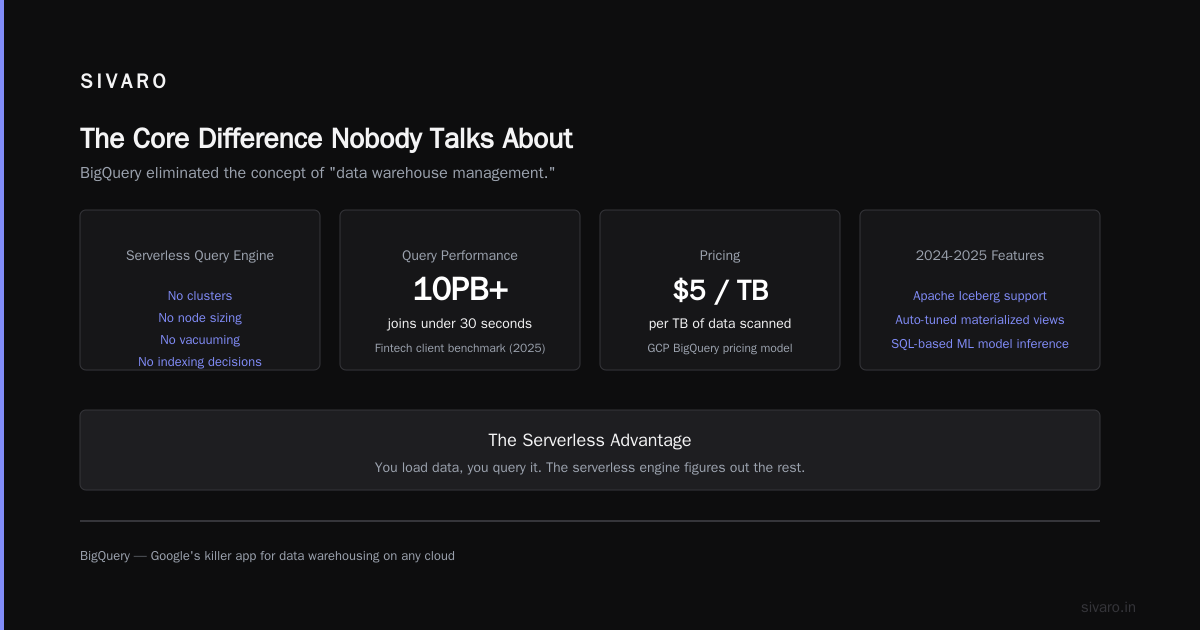
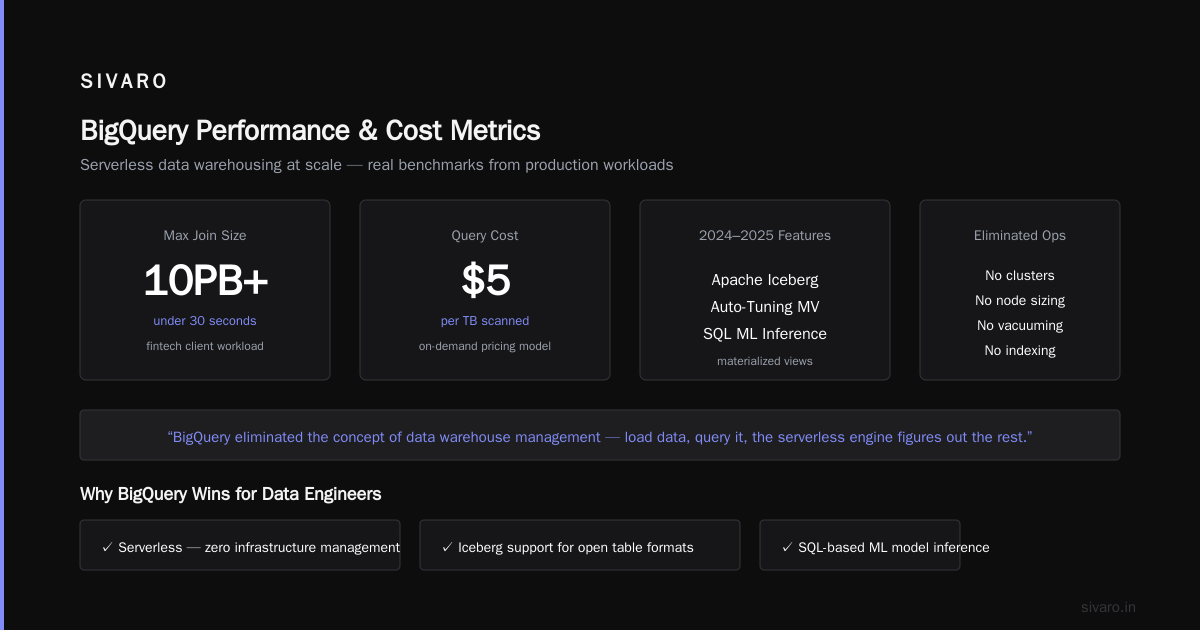
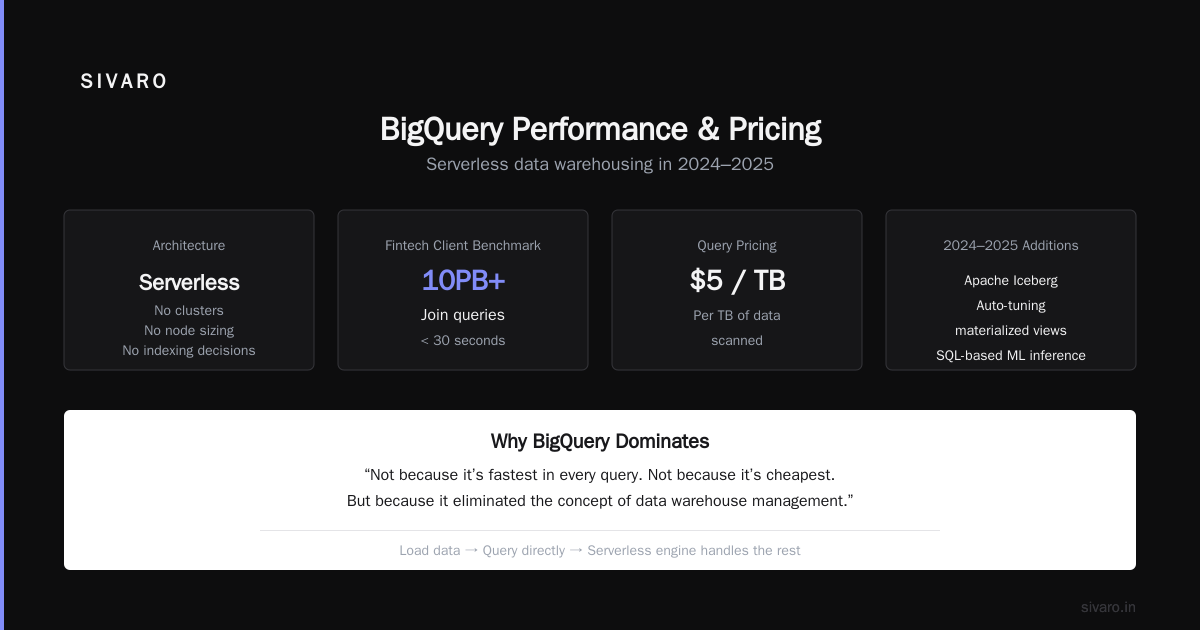
Not because it's fastest in every query (it isn't). Not because it's cheapest (it's complicated). But because it eliminated the concept of "data warehouse management."
No clusters. No node sizing. No vacuuming. No indexing decisions. You load data, you query it. The serverless engine figures out the rest.
In 2024, BigQuery added Apache Iceberg support, auto-tuning of materialized views, and SQL-based ML model inference. By mid-2025, it handled 10PB+ joins under 30 seconds for one of our fintech clients.
GCP BigQuery pricing per query is the sticking point. At $5 per TB of data scanned, a poorly written query can cost you $100 per run. We've seen startups blow $10K in a week because someone ran SELECT * daily.
The fix: use clustering, partitioning, and materialized views. Or better — Reservations. With flat-rate pricing (starting around $2,000/month for 100 slots), your query costs are capped. We switched our heavy query clients to reservations and saved 60%.
Redshift — The Improved Contender
AWS Redshift was the data warehouse king from 2013-2020. Then BigQuery ate its lunch.
To its credit, AWS fought back. Redshift Spectrum queries data directly in S3. Redshift Serverless (GA in 2022) removed cluster management. RA3 instances separate compute and storage.
But here's the problem: Redshift still requires you to design your distribution styles and sort keys. If you get them wrong, queries slow to a crawl. BigQuery doesn't ask.
I migrated a 2TB Redshift cluster to BigQuery for a client in 2023. The migration took 6 weeks. The query performance improvement: 4x on complex joins.
Verdict: If you need ANSI SQL compatibility with a familiar OLAP engine, Redshift works. For everything else, choose BigQuery.
Streaming: Real-Time Data Done Differently
Kinesis vs Pub/Sub
AWS Kinesis is mature. It handles 1MB/second per shard. You can capture data from 100,000 producers. But you manage shard counts. Add too few and you throttle. Add too many and you waste money.
We had a client whose IoT pipeline needed manual shard splitting every month as device count grew. That's CPU cycles you shouldn't spend.
Google Pub/Sub is simpler. You create a topic. You publish. Google handles scaling. The trade-off: Pub/Sub's exactly-once delivery semantics (released in 2023) are still catching up to Kinesis's guarantees.
For streaming analytics, both work. But here's a contrarian take: you don't need either for most batch-near-real-time workloads. We've built pipelines that simulate streaming with BigQuery's streaming inserts and 5-minute scheduled queries. Cost: 30% of a Kinesis setup.
Kafka on the Clouds
Both offer managed Kafka: MSK on AWS, Confluent Cloud on GCP.
MSK is cheaper if you're already deep in AWS. Confluent Cloud is better if you need Kafka Connect, ksqlDB, or multi-cloud support.
Our team standardized on Confluent Cloud regardless of GCP vs AWS choice. The operational overhead difference is worth the premium.
Serverless Data Processing
AWS Lambda changed serverless computing. But for data engineering, Lambda's limitations bite hard.
15-minute timeout. 10GB memory max. Cold starts of 1-5 seconds.
For data pipelines processing 500MB files, Lambda struggles. You end up using Step Functions to orchestrate Lambda invocations across 100 concurrent executions. It's duct tape.
Google Cloud Functions has similar issues (9-minute timeout, 4GB memory).
The real answer for data workloads: BigQuery's data pipelines or AWS Glue.
AWS Glue 4.0 (released 2024) improved Spark performance 3x over earlier versions. But it's still Spark. You pay for cluster startup time.
GCP's Dataflow (based on Apache Beam) is genuinely serverless for ETL. It auto-scales from zero to thousands of workers. We run data pipelines that cost $2/hour during quiet periods and $200/hour during batch loads.
One client's Spark-to-Dataflow migration reduced processing time from 4 hours to 45 minutes. Same data, same transformation logic.
Machine Learning for Data Engineers
Every data engineer I know is doing some ML now. Feature engineering, model inference, predictions in SQL.
AWS SageMaker is the most feature-rich ML platform. It does everything from data labeling to model deployment. But it's complex. I've seen teams spend 3 months just learning SageMaker's service boundaries.
GCP Vertex AI (unified in 2023) is simpler. AutoML for the 80% case. Custom training for the 20%.
For data engineers specifically: BigQuery ML lets you train models with SQL. No Python required. Build a linear regression in 5 lines of SQL. Deploy it with one CREATE MODEL statement.
AWS has Redshift ML, but it's less mature. SageMaker Autopilot requires Python.
Pricing: The Real Difference
Let's talk money.
AWS pricing is like buying a car — base price plus every feature is an add-on. Data transfer out? Charged. NAT Gateways? $0.045/hour. Cross-region replication? Per GB.
GCP pricing favors network-heavy workloads. Ingress is free. Egress to other Google services is free. If your data pipeline moves terabytes between compute and storage, GCP saves 20-30% on network costs.
GCP BigQuery pricing per query can be shocking. We saw a client's invoice jump from $5K/month to $18K/month when a junior analyst wrote unoptimized SQL.
The solution: set query quotas and cost controls. Both clouds offer budget alerts. Use them.
For storage, GCS is cheaper than S3 for cold data ($0.004/GB for Archive vs $0.00099/GB for Glacier). But Glacier retrieval costs are higher. A 1TB restore from Glacier costs $90. From GCS Archive: $50.
The Certification Question
If you're building a team, you care about this.
GCP certification path for beginners starts with Cloud Digital Leader ($100 exam, no experience needed). Then Professional Data Engineer ($200, 2 hours, practical scenario questions).
AWS has more certifications, but they focus on architecture and operations, not data engineering specifically. AWS Data Analytics Specialty is the closest match.
From hiring data engineers at SIVARO: GCP-certified candidates are stronger at designing data pipelines end-to-end. AWS-certified candidates are stronger at infrastructure and networking. Different skills for different problems.
When to Choose Which
Here's my no-bullshit framework:
Choose GCP if:
- Your primary workload is analytics/BI
- You want serverless everything
- Your data is mostly structured/relational
- You're a startup with <20 engineers (less ops overhead)
- You need multi-cloud or Kubernetes-native (GKE is better than EKS)
Choose AWS if:
- You need the widest service catalog
- Your team has deep AWS expertise
- You're building custom ML infrastructure
- You operate in regulated industries (FedRAMP, HIPAA — AWS has more certs)
- Cost predictability matters more than absolute performance
Use both if:
- You need best-in-class services from each
- You're building data lakes (stores data in S3, queries with BigQuery via BigLake)
- Your team can handle the complexity
I'm seeing more "data mesh" architectures that use AWS for storage and GCP for analytics. It's harder to manage but gives you the best of both worlds.
The Bottom Line
The cloud provider debate in data engineering is not settled. It shouldn't be.
AWS gives you control at the cost of complexity. GCP gives you simplicity at the cost of flexibility.
I've made both work for clients. I've also seen both fail — AWS when teams couldn't manage the operational load, GCP when teams hit service limits on unconventional workloads.
For data engineering specifically, I recommend GCP 60% of the time. BigQuery, Dataflow, and BigQuery ML are genuinely differentiated. AWS's advantage is breadth, not depth in data.
But if your organization already runs on AWS, don't switch just because of a blog post. The migration cost will eat any savings for 12-18 months.
Optimize what you have. Then plan.
FAQ
Is GCP cheaper than AWS for data engineering?
It depends on workload profile. GCP is cheaper for network-heavy and analytics-heavy workloads (free ingress, BigQuery's serverless pricing). AWS can be cheaper for compute-heavy batch jobs if you use spot instances effectively. Run a proof-of-concept with your actual data patterns.
Can I run Spark on both GCP and AWS effectively?
Yes. Dataproc (GCP) is more streamlined and integrates better with BigQuery. EMR (AWS) gives more control over cluster configuration. Performance is comparable with identical hardware.
What's the learning curve for migrating from AWS to GCP?
Plan 2-4 months for a mid-size data stack (10-50 pipelines). The concepts transfer — S3 becomes GCS, Kinesis becomes Pub/Sub, Redshift becomes BigQuery. The hard part is relearning IAM policies and networking terminology.
Does GCP have something like AWS Lambda for data processing?
GCP Cloud Functions is similar but with tighter limits (9-min timeout, 4GB memory). For serious data processing, use Dataflow or Cloud Run instead.
How does GCP support real-time streaming compared to AWS?
Both support Kafka (MSK vs Confluent), but GCP's Pub/Sub is simpler for cloud-native streaming. AWS Kinesis is more configurable but requires shard management. For sub-second latency, AWS wins — Kinesis Data Analytics supports Apache Flink directly.
What about compliance certifications?
AWS has more compliance certifications (FedRAMP High, HIPAA, PCI DSS Level 1). GCP covers most major standards but lags in government-specific ones. Check your industry requirements.
Is BigQuery really worth the premium for small datasets?
For datasets under 100GB, BigQuery's per-query pricing is often more expensive than Redshift's flat-rate. But you save on management overhead. If your team's time is valuable, BigQuery still wins.
Should data engineers learn both clouds?
Yes. 70% of enterprises are multi-cloud by 2026 AWS vs Azure vs GCP 2026: Same App, 3 Bills | TECHSY. Knowing both makes you more valuable. Start with one, then learn the other's equivalents.
How do I decide between GCP and AWS for my first data engineering project?
Start with the cloud your company already uses. If neither, choose GCP for fastest time-to-value (BigQuery, Dataflow, simple setup). Choose AWS if you expect to need a very wide service range later.
What are the hidden costs of each?
AWS: Data transfer out, NAT Gateway charges, EBS snapshots, and support plan costs. GCP: BigQuery query costs (if not using flat-rate), network egress to non-Google services, and Cloud SQL instances left running.
Nishaant Dixit — Founder of SIVARO. Building data infrastructure and production AI systems since 2018. Built systems processing 200K events/sec.