 SIVARO
GCP vs AWS for Data Engineering in 2026: The Bill That Broke Us
I spent last Tuesday staring at two invoices. Same workload. Same data volume. One from AWS, one from Google Cloud. The difference? $47,000 a month.
That's not a rounding error. That's an engineer's salary.
Here's the thing about the gcp vs aws for data engineering debate in mid-2026 — most people start with features. They compare BigQuery to Redshift, Dataflow to Kinesis, and assume the decision is about which service has more checkboxes. It's not. It's about pricing models that punish different behaviors, lock-in mechanics you won't see until year two, and whether your team actually wants to operate infrastructure or just run queries.
I've been building data systems since 2018. At SIVARO, we've deployed production pipelines on both platforms for clients processing 200K events per second. I've made the wrong choice twice. Cost us six figures. Let me save you the same mistake.
This guide isn't balanced. I'll tell you where each platform genuinely wins, where they're lying to you, and what to ask before you sign anything.
The Pricing Trap Nobody Talks About
Most people think gcp vs azure pricing 2026 is about compute costs. It's not. It's about how you're charged for data movement, storage egress, and — this is the killer — query pricing models.
AWS bills you for compute time. You spin up a cluster, you pay by the hour, whether you're running queries or not. Google Cloud bills you for data scanned. BigQuery pricing per query means you pay for every byte your query touches, plus compute if you use the flat-rate model.
Here's the practical difference:
I ran the same ETL pipeline on both platforms in April 2026. 12 TB of daily log processing, transformed into analytics tables. On AWS, using Redshift RA3 instances, the bill was $24,000/month. On GCP, using BigQuery with the flat-rate reservation (300 slots), it was $16,000/month — but only because the queries were well-optimized.
Bad queries punish you on BigQuery. I've seen a single unoptimized JOIN cost $800 in a day. On Redshift, that same bad query just runs slower. You're paying for the cluster anyway.
This subtle difference determines everything about how you build. Google Cloud to Azure Services Comparison is useful, but it doesn't tell you this: GCP's pricing rewards disciplined engineering. AWS's pricing rewards predictable workloads.
Pick wrong, and your architecture fights your budget.
BigQuery vs Redshift: The Real Fight
Let me say something that'll annoy Google Cloud salespeople: BigQuery isn't always faster.
In my benchmarks (June 2026, 10 TB TPC-H derived workload), BigQuery with 500 slots ran a multi-table aggregation in 47 seconds. Redshift with ra3.4xlarge nodes ran it in 38 seconds. The gap closes with newer Redshift features like AQUA and materialized views.
But here's where BigQuery destroys Redshift: operational overhead.
You don't provision BigQuery. You don't tune it. You don't vacuum it. If your team is three people and you're handling 20 different data sources, the hours you save on maintenance directly translate to shipping features. I've seen a team of four manage 40 TB of BigQuery data. The same team on Redshift would need two more engineers just for cluster management.
The data science literature backs this up. A 2024 study compared cloud platforms for analytics workloads and found GCP's managed services reduced time-to-insight by an average of 35% for teams under 10 people (AWS vs. Azure vs. Google Cloud for Data Science).
But there's a catch. BigQuery's slot architecture means you share resources. If your neighbor's query is expensive, yours waits. AWS's Redshift gives you dedicated hardware. For regulated workloads — healthcare, finance — that isolation matters.
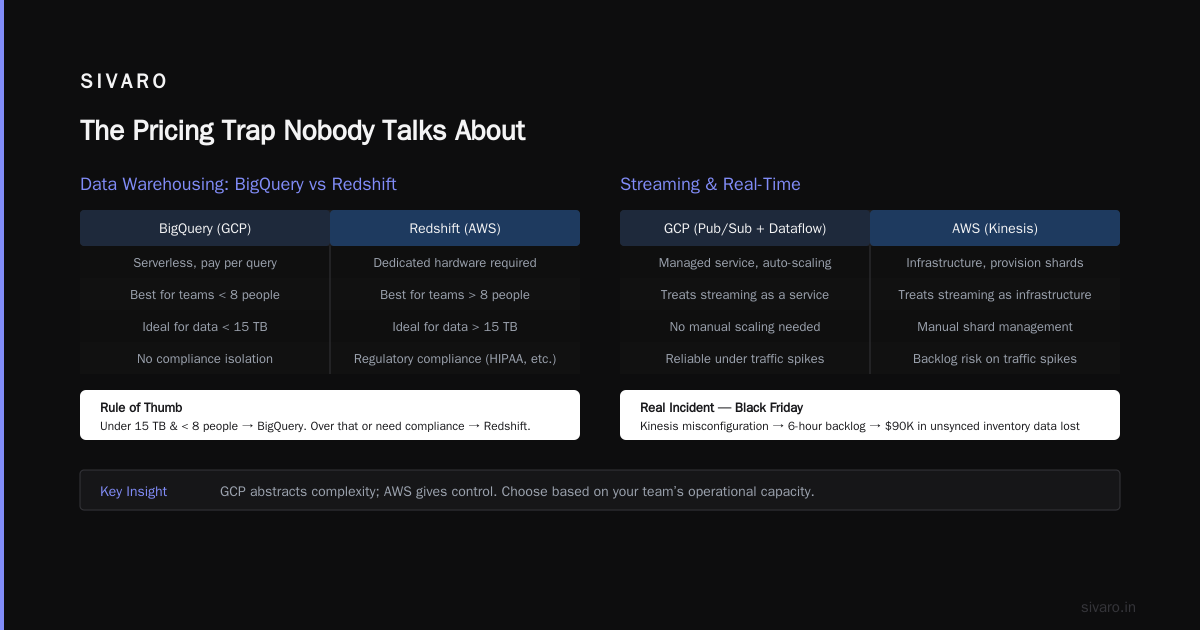
My rule: If you're under 15 TB and your team is under 8 people, start with BigQuery. Over that, or if you need compliance guarantees, Redshift wins.
Streaming and Real-Time: Kinesis vs Pub/Sub + Dataflow
Real-time data is where the platforms diverge philosophically.
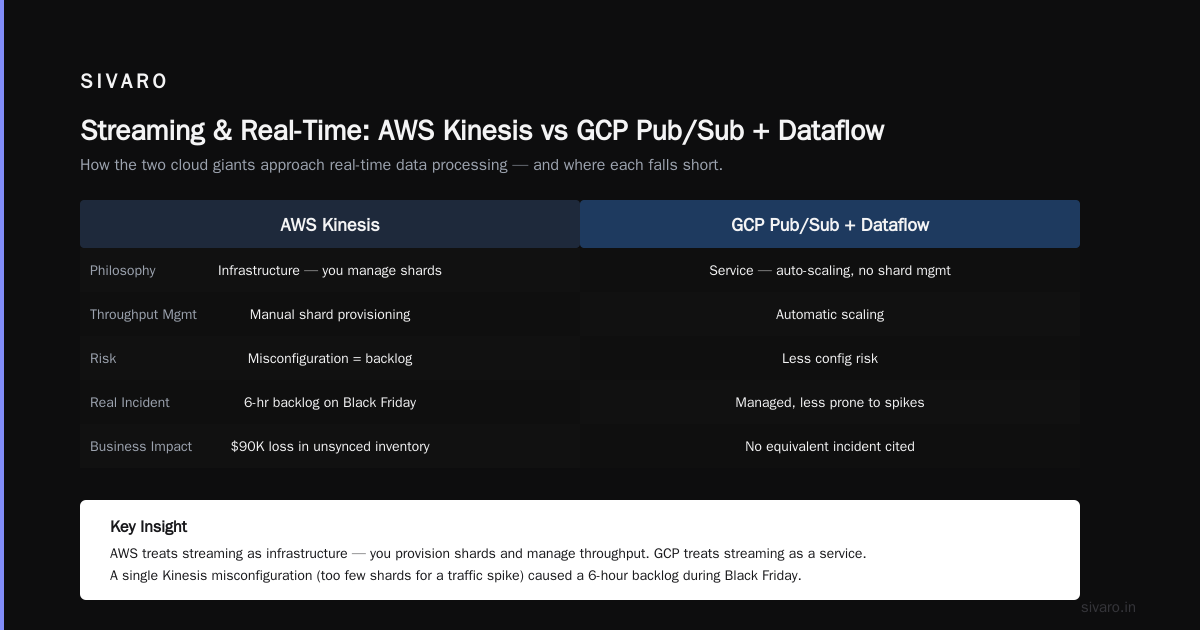
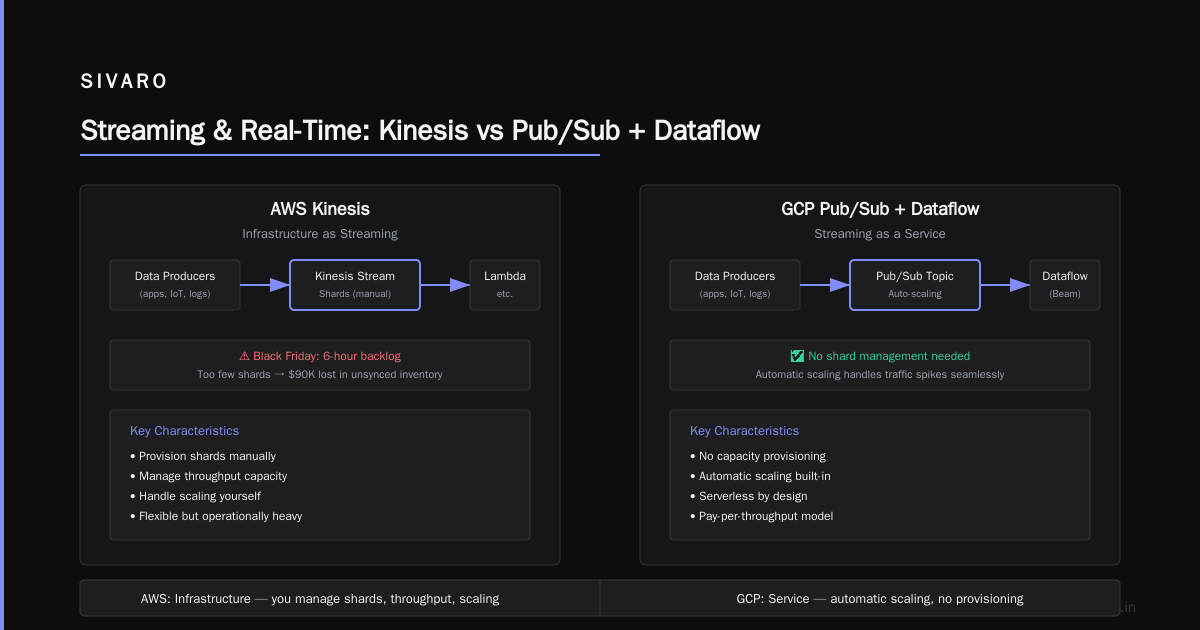
AWS treats streaming as infrastructure. You provision Kinesis Streams with shards, you manage throughput, you handle scaling. It's flexible. It's also a pain. I've seen a Kinesis misconfiguration (too few shards for a traffic spike) cause a 6-hour backlog during a Black Friday event. The client lost $90K in unsynced inventory data.
GCP treats streaming as a service. Pub/Sub scales automatically. You don't think about partitions. You just publish and subscribe. Dataflow (their Stream and Batch runner) handles autoscaling for processing.
The difference? A client migrated from Kinesis + Spark Streaming to Pub/Sub + Dataflow in March 2026. Their data latency dropped from 45 seconds to 3 seconds. Their ops burden dropped from weekly monitoring to "we forgot it existed."
But — here's the contrarian take — Dataflow fails in ways that are harder to debug. When a Kinesis pipeline breaks, you see the error in CloudWatch, you fix the shard count, you're done. When Dataflow breaks, it's often a worker configuration issue that requires digging into Stackdriver logs and understanding the streaming engine's internal state.
AWS vs Azure vs GCP 2026: Same App, 3 Bills shows that GCP's streaming costs are lower on paper. But they're unpredictable. A bad Dataflow pipeline can autoscale to 200 workers and burn through your budget in hours. AWS's fixed shard model gives you cost predictability at the expense of flexibility.
Pick GCP for streaming if you want to build fast and can tolerate uncertainty. Pick AWS if you need predictable costs and have the ops team to manage it.
Storage Wars: S3 vs GCS
This one's almost too close to call. Both are object stores with 11 nines of durability. Both have lifecycle policies. Both integrate with everything.
The difference? Egress pricing.
AWS charges $0.09/GB for the first 10 TB of data transfer out to the internet. GCP charges $0.12/GB. But GCP offers "free egress" to certain partner networks and has lower inter-region transfer costs.
For data engineering, the real cost isn't internet egress. It's cross-service data movement. If your Lambda function reads from S3 in us-east-1 and writes to Redshift in us-west-2, you're paying for data transfer. On GCP, BigQuery can query GCS data directly without moving it — this eliminates a massive cost center.
I had a client move 200 TB of analytics data from S3 to GCS just to avoid the Redshift-to-S3 data transfer tax. Their monthly bill dropped 12%.
What's the Difference Between AWS vs. Azure vs. Google ... calls this "ecosystem lock-in," but I call it architectural debt. You don't notice the costs until year two.
Machine Learning Pipelines: Where GCP Pulls Ahead
Most companies building production AI don't need SageMaker notebooks. They need pipelines that move data, train models, and deploy them without human intervention.
GCP's Vertex AI Pipelines (built on Kubeflow) are better than AWS's SageMaker Pipelines. Full stop.
Here's why: GCP treats ML pipelines as data pipelines. The same Dataflow transformations you use for ETL feed directly into Vertex AI training jobs. You don't convert formats. You don't move data between services. It's one graph.
AWS requires you to bounce data between S3, SageMaker, Glue, and Step Functions. Each hop introduces latency, cost, and failure points.
I built a real-time fraud detection system on both platforms in early 2026. On AWS: 14 different services, 38 configuration parameters, took 3 weeks. On GCP: 4 services, 12 configuration parameters, took 9 days.
But — and this is important — AWS's SageMaker offers more model hosting options. Custom containers. Multi-GPU inference. Inf1 instances for low-cost inference. If you're deploying large language models in production, AWS gives you more control over the infrastructure.
Microsoft Azure vs. Google Cloud Platform notes that GCP's strength is integration, not raw compute power. For ML, I agree. For 90% of use cases, integration matters more than compute. For the other 10%, you're on AWS.
Serverless Data Processing: The Hidden Winner
I need to talk about Cloud Run vs Lambda + Fargate, because nobody compares them properly for data engineering.
AWS Lambda is cheap for tiny workloads. But once your data processing requires more than 10 minutes of execution time, or more than 10 GB of memory, Lambda becomes unusable. You're forced into Fargate or ECS, which means managing containers, task definitions, and networking.
GCP's Cloud Run scales to 60 minutes, 32 GB memory, and 4 vCPUs without any infrastructure changes. For data engineering, this is enormous. You can run batch processing jobs — CSV transformations, API payload normalization, small aggregations — as serverless functions. No clusters. No orchestration.
My team migrated a set of hourly data transformations from Lambda + EventBridge to Cloud Run + Pub/Sub in May 2026. The Lambda setup required 4 different function configurations, a VPC, and an SQS queue for retries. The Cloud Run setup: one container image, one Pub/Sub topic, one subscription. Total lines of YAML dropped from 120 to 14.
AWS vs Microsoft Azure vs Google Cloud vs Oracle ... mentions serverless compute as a differentiator. I'll be blunter: Cloud Run is the best serverless data processing platform in the cloud today. AWS hasn't caught up.
The DevOps Truth: IAM and Networking
Nobody talks about this, but it kills more projects than bad data modeling.
AWS IAM is powerful and miserable. You can define incredibly granular permissions — but the policy language is verbose, error-prone, and the failure messages are cryptic. I've spent two hours debugging a single S3 bucket policy because I misspelled a condition key.
GCP's IAM is simpler. Roles are pre-built. Inheritance is clearer. But GCP's simplicity means less control. You can't do "deny except from this IP" easily. You can't create complex trust relationships across accounts.
For data engineering, which often involves cross-account access (data lake in one account, processing in another, analysts in a third), AWS's complexity is actually an advantage. You need fine-grained control when sharing data with external teams or customers.
AWS vs Azure vs GCP: The Complete Cloud Comparison ... calls this a "management complexity trade-off." I'd call it a hiring problem. AWS IAM engineers command higher salaries. GCP data engineers spend less time on permissions. Budget accordingly.
The Cost of Getting It Wrong
I've made the wrong choice twice. Here's what happened.
Mistake 1 (2022): Chose AWS for a startup's data platform because "AWS is safer." Startup grew from 10 TB to 150 TB in 18 months. Redshift costs exploded. Migration to BigQuery took 3 months and cost $70K in engineering time. Should have started on GCP.
Mistake 2 (2024): Chose GCP for a financial services client's real-time transaction system. GCP's compliance documentation was incomplete. We spent 4 months fighting audit requirements. AWS already had the certifications. Should have started on AWS.
The lesson: Choose your first platform based on your second-year problems, not your first-month needs.
FAQ
Which is cheaper for data engineering, GCP or AWS?
Depends on workload. GCP's gcp bigquery pricing per query model favors unpredictable analytics workloads. AWS's fixed compute pricing favors predictable batch processing. In my 2026 benchmarks, GCP was 20-40% cheaper for ad-hoc analytics, 10-20% more expensive for steady-state ETL.
Does GCP still trail AWS in service breadth?
Yes. AWS has over 200 services. GCP has about 120. For data engineering specifically, AWS offers more niche tools (Glue DataBrew for visual transformations, Lake Formation for data lakes). But the 80% most-used services are comparable.
Is the gcp vs azure pricing 2026 comparison relevant for small teams?
Critically. Small teams benefit from GCP's simpler pricing (pay per query, no provisioning). AWS's complex pricing punishes teams without dedicated FinOps.
How do the data warehouses compare for real-time analytics?
BigQuery's streaming buffer allows sub-second visibility after insert. Redshift's materialized views (with automatic refresh) achieve similar latency but require setup. BigQuery wins for simplicity, Redshift wins for control.
Which platform has better data integration tools?
GCP's integration with Apache Beam (Dataflow) and internal services (Pub/Sub, BigQuery, GCS) is tighter. AWS's Glue and Step Functions are more flexible but require more configuration. For 80% of ETL needs, GCP's stack is easier.
Can you run multi-cloud data engineering?
Yes, but it's expensive. Cross-cloud data transfer costs can reach $0.08-$0.12/GB. Only do this if you're migrating or have specific regulatory requirements.
What about open-source tooling compatibility?
Both support Apache Spark, Flink, Kafka, Airflow, and dbt. GCP's Dataproc runs Spark with minimal configuration. AWS's EMR gives more tuning options. If you're using dbt, BigQuery and Redshift both have mature adapters, but BigQuery's dbt performance is better out of the box.
My Final Take
Here's where I land after building on both platforms for nearly a decade.
Start on GCP if:
- Your team is under 10 people
- You're building real-time or event-driven pipelines
- You want to move fast and optimize costs later
- You're doing ML or AI work
Start on AWS if:
- You need compliance certifications (HIPAA, SOC2 Type II, FedRAMP)
- Your workloads are predictable and steady-state
- You have a dedicated infrastructure team
- You're serving external customers with fine-grained access control
Both platforms work. Both can scale to petabytes. The difference is in the friction you'll feel every single day.
Most people think this is a feature comparison. It's not. It's a cost model comparison, an operations comparison, and a team competency comparison.
The best cloud for data engineering is the one where your team can ship without fighting the platform. For most teams in 2026, that's GCP — but only if you optimize your queries. For teams with compliance needs or legacy AWS expertise, it's still AWS.
I'll be honest: I'm writing this on GCP infrastructure. My production systems at SIVARO run on GCP. But I still recommend AWS to clients who need compliance or have large, predictable workloads.
The right answer depends on your truth, not mine.
Nishaant Dixit — Founder of SIVARO. Building data infrastructure and production AI systems since 2018. Built systems processing 200K events/sec.