 SIVARO

GCP Certifications: Which One Should You Take? [2026 Guide]
![GCP Certifications: Which One Should You Take? [2026 Guide]](/sections/gcp-certifications-which-one-should-you-take-2026-guide/0.png)
I remember sitting across from a CTO in early 2025. He’d spent 18 months having his team chase the Google Cloud Professional Data Engineer cert. Guess what? They built a pipeline that collapsed under 50K events/sec. The cert taught them theory, not reality.
So here’s the blunt truth: GCP certifications are a signal, not a skill. They prove you can pass a test — they don’t prove you can ship production systems. But if you pick the right one for your role, they open doors. Pick the wrong one, and you’re wasting time and money.
This guide answers gcp certifications which one should i take — not with generic advice, but with real trade-offs. I’ll walk you through the certifications that matter in 2026, which ones I’d skip, and how they connect to actual engineering work. We’ll also cover practical tools like a gcp pricing calculator tutorial and the best gcp services for data engineering — because certification without hands-on cost awareness is dangerous.
Why Certifications Matter (and Why They Don’t)
Most people think a certification guarantees competence. They’re wrong.
I’ve interviewed candidates with “Google Cloud Certified Professional Cloud Architect” who couldn’t explain why a regional load balancer costs 10x a global one. I’ve also hired people with zero certs who rebuilt our streaming pipeline in four days.
Certs do one thing well: they get your resume past HR filters. That’s it.
But in 2026, with the cloud market tightening (check the AWS vs Azure vs GCP 2026 comparison — GCP is gaining enterprise share), Google is pushing certification hard. They’ve redesigned exams to be more practical. Less multiple-choice theory, more scenario-based questions.
Still, treat certifications as a means to an end. Don’t let them define your learning path.
The GCP Certification Hierarchy — 2026 Edition
Google divides certs into three tiers:
- Fundamentals (Cloud Digital Leader) — for sales, product, non-technical folks. Useful? Only if you’re not an engineer.
- Associate (Cloud Engineer) — the entry point for practitioners.
- Professional (Architect, Data Engineer, ML Engineer, DevOps Engineer, Security Engineer, Network Engineer) — the serious ones.
- Specialty (Machine Learning Engineer, Cloud Developer) — narrow verticals.
My take: skip fundamentals. Go straight for Professional. The Associate cert is a stepping stone, but if you have a year of hands-on GCP, you’ll survive the Professional exams with focused study.
The real question: which Professional cert should you pick?
Cloud Engineer vs Data Engineer vs ML Engineer — Which Path?
Let’s break the three most common GenAI-era certs.
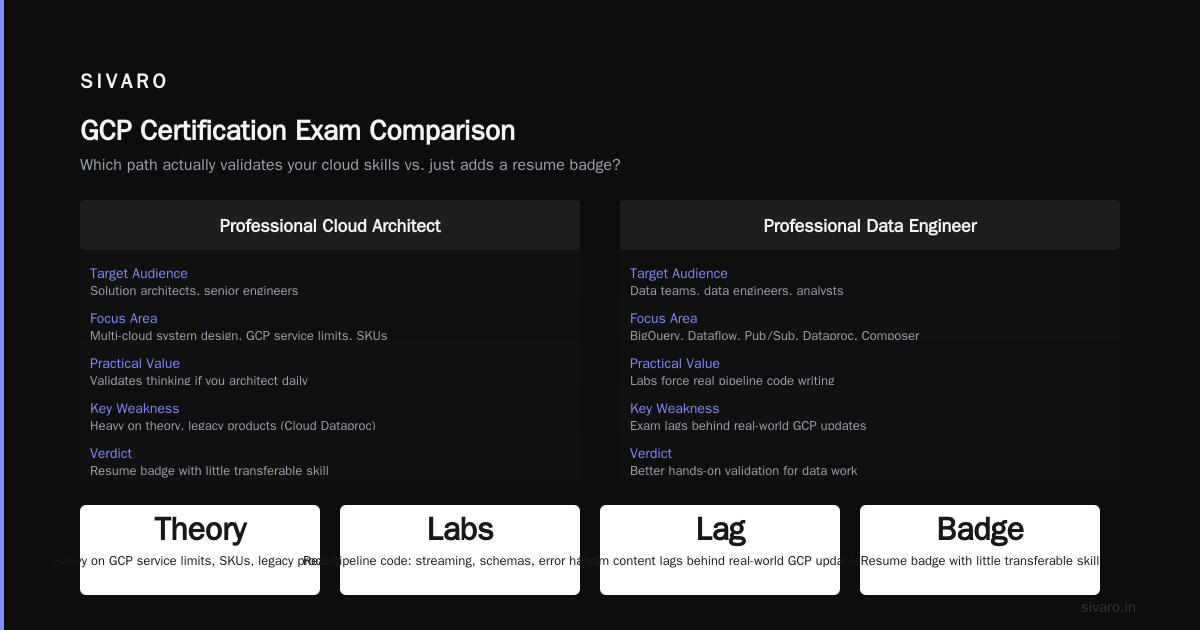
Professional Cloud Architect
This is the most popular cert. It covers high-level design: networking, security, migration, cost optimization.
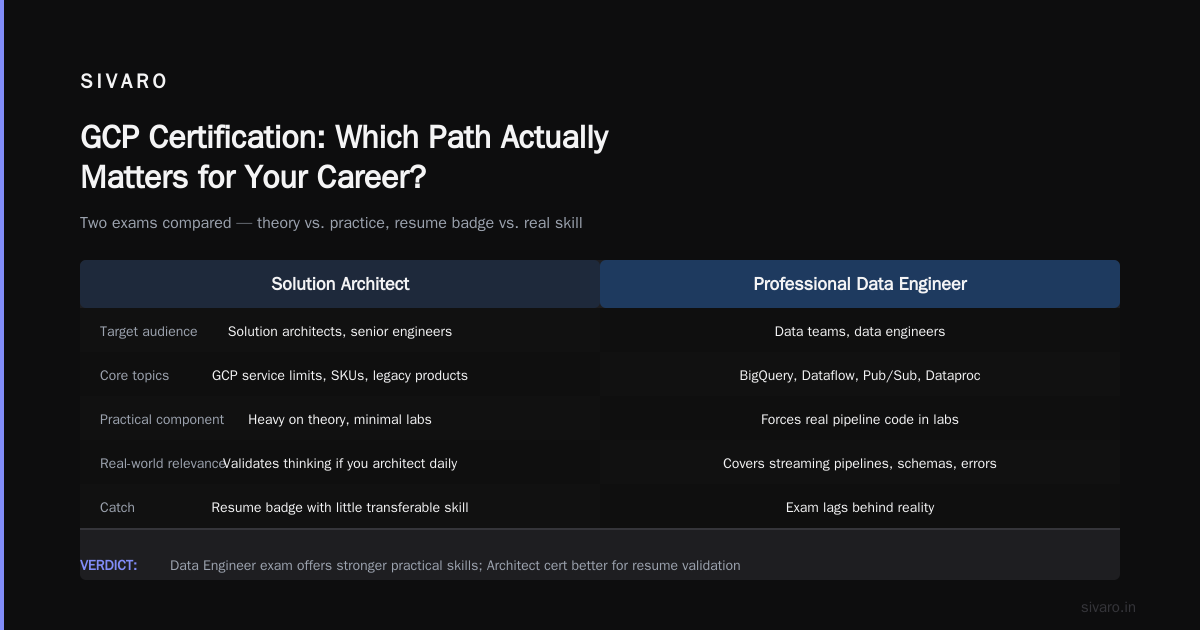
Who should take it? Solution architects, senior engineers who design multi-cloud systems.
But here’s the catch: the exam is heavy on theory you’ll rarely use. You need to memorize GCP service limits, SKUs, and legacy products (remember Cloud Dataproc? It still shows up).
If you actually architect systems daily, this cert validates your thinking. If you don’t, it’s a resume badge with little transferable skill.
Professional Data Engineer
This is the one I see most data teams chase. It covers BigQuery, Dataflow, Pub/Sub, Dataproc, Composer, and ML basics.
It’s better than the Architect exam in one way: the labs force you to write real pipeline code. You build streaming pipelines, set up schemas, handle errors.
But — and this is critical — the exam lags behind reality. In 2025, Google deprecated Cloud Data Fusion features. The exam still tests them.
Best for: Data engineers, analysts moving into engineering, anyone building batch or streaming pipelines.
If this is your path, you’ll want to master the best gcp services for data engineering — we’ll get there.
Professional Machine Learning Engineer
This cert is hard. Really hard. It requires you to understand model training, deployment, MLOps, and Vertex AI end-to-end.
I took it in early 2025. The exam covers AutoML, custom training, Kubeflow Pipelines, and model monitoring. It’s 85% Vertex AI.
Who should take it? ML engineers who build and deploy models. Not data scientists who only do notebooks.
The exam changed in late 2025 to include more GenAI content (Gemini API, embedding models). That’s a good sign — it’s staying current.
But if you don’t actually deploy models to production, skip it. The cert will make you dangerous — you’ll think you know ML engineering, but you won’t have debugged a serving latency issue under load.
Best GCP Services for Data Engineering
If you’re going for the Data Engineer cert, focus on these services. They’re the ones you’ll actually use in production.
| Service | When to Use | Cost Gotcha |
|---|---|---|
| BigQuery | Analytics, ad-hoc queries, ELT | Slot-based pricing can explode if you don’t use reservations |
| Dataflow | Stream and batch pipelines | Workers idle cost money — autoscaling helps but isn’t perfect |
| Pub/Sub | Event ingestion, decoupling | Topic count matters less than throughput pricing |
| Composer | Orchestration (Airflow) | Environment cost is fixed — small pipelines pay for idle |
| Dataproc | Spark/Hive workloads | Preemptible VMs save 80% but can fail mid-job |
I’ve written extensively about these in my SIVARO notes. The key lesson: never run Dataflow without setting maxWorkers lower than default. We saw a 4x cost overrun because a job scaled from 2 to 200 workers on a Sunday.
For the exam, you’ll also need to know Cloud Storage (GCS), Cloud SQL, and Spanner. But in the real world, Spanner is overkill unless you’re at global scale.
The GCP Pricing Calculator Tutorial (You Need This)
Certs don’t teach you cost management. That’s a problem. You can ace the Data Engineer exam, then design a pipeline that burns $50K/month.
Here’s a short gcp pricing calculator tutorial that I give every new engineer at SIVARO.
- Go to cloud.google.com/products/calculator.
- Add the services you plan to use. Don’t guess — look at your actual specs.
- For BigQuery, always use flat-rate pricing (slots) if you run >1TB/month. On-demand is ~$5/TB, but slots cut that 50% for consistent workloads.
- For Dataflow, estimate processing time * worker count * worker cost. Use the “streaming” or “batch” toggle — it changes the price by 30%.
- Include networking egress. GCP charges for data leaving — and it adds up fast.
- Export the estimate as a PDF and share with your team.
bash
# Example: Quick BigQuery cost estimation using bq command
# Estimate bytes processed for a query
bq query --format=json 'SELECT COUNT(*) FROM `project.dataset.table`' --dry_run
Output gives you totalBytesProcessed. Multiply by $0.0065 per GB (on-demand, us-central1). You’ll see exactly how much that query costs.
python
# Python snippet to estimate Dataflow cost
def estimate_dataflow_cost(workers, worker_hours, machine_cost_per_hour=0.25):
    """
    machine_cost_per_hour for n1-standard-2: ~$0.25
    Adjust based on region and machine type.
    """
    cost = workers * worker_hours * machine_cost_per_hour
    return cost

print(estimate_dataflow_cost(workers=10, worker_hours=24))
# => $60.0
sql
-- BigQuery cost logging for your own monitoring
SELECT
  query,
  total_bytes_processed / 1e9 AS gb_processed,
  (total_bytes_processed / 1e9) * 0.0065 AS cost_estimate
FROM `region-us.INFORMATION_SCHEMA.JOBS_BY_PROJECT`
WHERE creation_time > TIMESTAMP_SUB(CURRENT_TIMESTAMP, INTERVAL 1 DAY)
  AND job_type = 'QUERY'
ORDER BY cost_estimate DESC;
This isn’t exam content, but it’s essential for anyone who holds a GCP cert. Google won’t teach you this. Learn it or pay the price.
Case Study: What We Chose at SIVARO (and Why)
At SIVARO, we run production AI systems processing 200K events/sec. We’re a Google Cloud shop migrated from AWS in 2022 (the AWS vs Azure vs GCP 2026 piece by TECHSY nailed the differences — GCP’s networking is cheaper for high-throughput data).
Our team’s certification mix:
- Data Engineers: Professional Data Engineer. Non-negotiable for new hires.
- ML Engineers: Professional ML Engineer. Required after 6 months.
- DevOps: Professional DevOps Engineer. Few of us have it — we found the Architect + Kubernetes cert more useful.
We stopped requiring Professional Cloud Architect. Why? Too generic. It didn’t help our engineers debug a slow Dataflow window or a Pub/Sub backlog.
The lesson: align your cert with your daily work. Don’t chase a badge.
FAQ
1. Which GCP certification is easiest to pass?
The Cloud Digital Leader is the easiest (no coding). For technical roles, the Associate Cloud Engineer is the least difficult Professional-level. But easy doesn’t mean valuable — most hiring managers ignore it.
2. Can I get a job with just a GCP certification?
In 2026, no. Certifications supplement experience, they don’t replace it. I’ve seen people pass the Data Engineer exam and still can’t write a Dataflow pipeline. Practical projects (open-source, GitHub) matter more.
3. How long does it take to prepare for a Professional cert?
Depends on your experience. If you’ve used GCP for 6+ months, budget 60-80 hours of study. If you’re new, double that. The official Google Cloud skills boost labs help, but they’re sandbox — not production.
4. Do I need to know Terraform for the Architect exam?
Yes. Exam questions cover infrastructure-as-code. Terraform is preferred over Deployment Manager now. Study resource creation, state management, and modules.
5. What’s the best resource for the Data Engineer cert?
The official Google Cloud Professional Data Engineer sample questions + a mock exam from a reputable provider (like Tutorials Dojo). Skip outdated books — they reference Cloud Dataflow v1beta3 APIs that don’t exist anymore.
6. How often do GCP certifications change?
Google updates exams every 18-24 months. The Data Engineer exam was refreshed in Q4 2025 to include BigQuery ML and Dataplex. The ML Engineer exam added GenAI content. Always check the latest exam guide before studying.
7. Should I take the Google Cloud Certified Associate Cloud Engineer first?
Only if you’re starting from zero. Otherwise, go straight for Professional. The Associate cert covers basics you’ll learn in 2 months of work.
8. Does the certification expire?
Yes, after 2 years. Recertification requires retaking the exam (no recertification credits). Google doesn’t make money on subscriptions — they make money on exam fees.
Conclusion
The answer to gcp certifications which one should i take isn’t a single cert — it’s the one that matches your actual job.
- Architect = generalists designing systems.
- Data Engineer = pipeline builders.
- ML Engineer = model deployers.
- DevOps Engineer = reliability engineers.
Don’t chase the hardest cert for ego. Chase the one that makes your Monday morning work more effective.
And once you get it, don’t stop. Use the gcp pricing calculator tutorial I gave you to understand costs. Master the best gcp services for data engineering through real projects. Build something that survives a load test. That cert will look good on LinkedIn, but it’s the system that handles 200K events/sec that earns your reputation.
Nishaant Dixit — Founder of SIVARO. Building data infrastructure and production AI systems since 2018. Built systems processing 200K events/sec.