 SIVARO
GCP Certification: Which One Should I Take?
Look, I get asked this every week. Founders at startups I advise. Engineers at SIVARO who want to level up. Even my own team when we were scaling our data infrastructure. "Nishaant, I have time for one certification—which GCP one do I pick?"
Here's the truth most certification guides won't tell you: it depends entirely on what you actually build and who pays for it. Not on what looks good on LinkedIn. Not on what your manager suggests. On the cold reality of your daily work.
I've been building production AI systems since 2018. We run on GCP. We've hired people with every possible cert. I've watched some certs land six-figure offers and others get politely ignored in interviews.
This guide breaks down every GCP certification in 2026—what they cover, who they're for, and whether they're worth your time. At the end, you'll know exactly which one to take. No fluff.
The GCP Certification Landscape in 2026
Google Cloud has eight active certifications, not counting the beta ones that change quarterly. A comparative analysis of cloud services shows GCP certification focuses more on data and ML than its competitors—and that's intentional.
Here's the full list as of July 2026:
- Cloud Digital Leader (entry-level)
- Associate Cloud Engineer
- Professional Cloud Architect
- Professional Data Engineer
- Professional Machine Learning Engineer
- Professional Cloud Developer
- Professional Cloud Network Engineer
- Professional Cloud Security Engineer
And the newer additions: Professional Cloud DevOps Engineer and a beta for Generative AI Engineer (not officially launched yet as of this writing, but half my job applicants claim it).
Three years ago I thought certifications were mostly HR filters. Then I watched our team struggle to diagnose a Dataflow pipeline that was costing $800/hour. The guy who fixed it? Someone with a Professional Data Engineer cert who actually understood streaming windows. Not the cert itself—the knowledge that prep forced him to learn.
So the question isn't "which cert should I take?" It's "which learning path will make me dangerous enough to solve real problems?"
Foundation Level: Can You Skip It?
The Cloud Digital Leader is Google's entry-level cert. It's non-technical. Costs around $100. Takes maybe a week of reading.
Most people think you should start here. I think you're wasting money unless you work in sales or product management.
Why? Because the Associate Cloud Engineer exam already covers all the practical basics—and it's not that hard. I've seen complete beginners pass it in three weeks using just the gcp tutorial for complete beginners content and hands-on labs.
At SIVARO, we don't hire for Cloud Digital Leader. We don't even ask about it. If you're an engineer, start with Associate Cloud Engineer. If you're a business stakeholder, Cloud Digital Leader might help you speak the language. Otherwise skip it.
Associate Cloud Engineer vs Professional: The Real Difference
This is the fork in the road. Pick wrong and you waste months.
Associate Cloud Engineer is operational. You'll be tested on:
- Deploying and managing virtual machines (Compute Engine)
- Basic networking (VPCs, firewall rules)
- Kubernetes clusters (GKE)
- IAM roles
- Storage (Cloud Storage, Persistent Disk)
- Monitoring (Cloud Monitoring, Logging)
It's hands-on. You'll write gcloud commands. You'll configure load balancers. It's the cert for the person who actually does the work.
Professional certifications test design, architecture, trade-offs. They're harder. Much harder. The Professional Cloud Architect exam is 8 hours long (2 hours case study + multiple choice). The Professional Data Engineer exam includes a heavy SQL and ML component.
Here's the rule I've seen play out at three different companies:
If you've never deployed a production system on GCP, get the Associate first. If you have 2+ years of hands-on GCP experience, go straight to Professional.
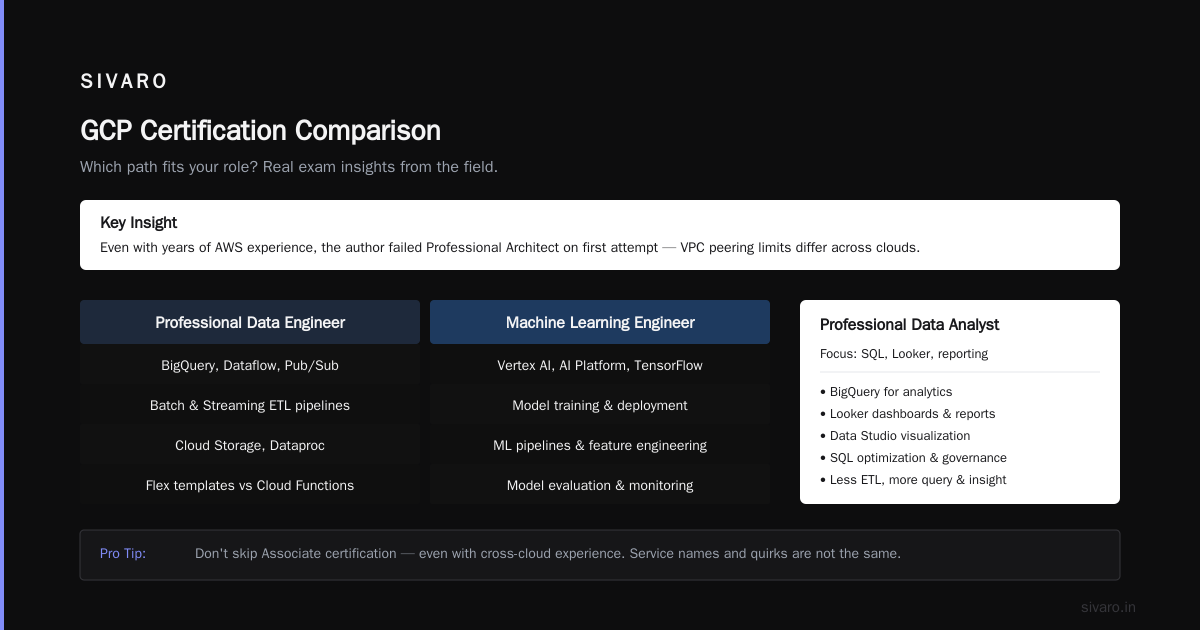
I broke this rule myself. Thought I could skip Associate because I'd used AWS for years. Comparing AWS, Azure, and GCP showed me the overlaps are real, but the service names and quirks are not. I failed the Professional Architect my first attempt because I couldn't answer a question about VPC peering limits. Those limits are different from AWS.
Data Engineer vs ML Engineer vs Data Analyst
This is where the money is. And also where most people pick wrong.
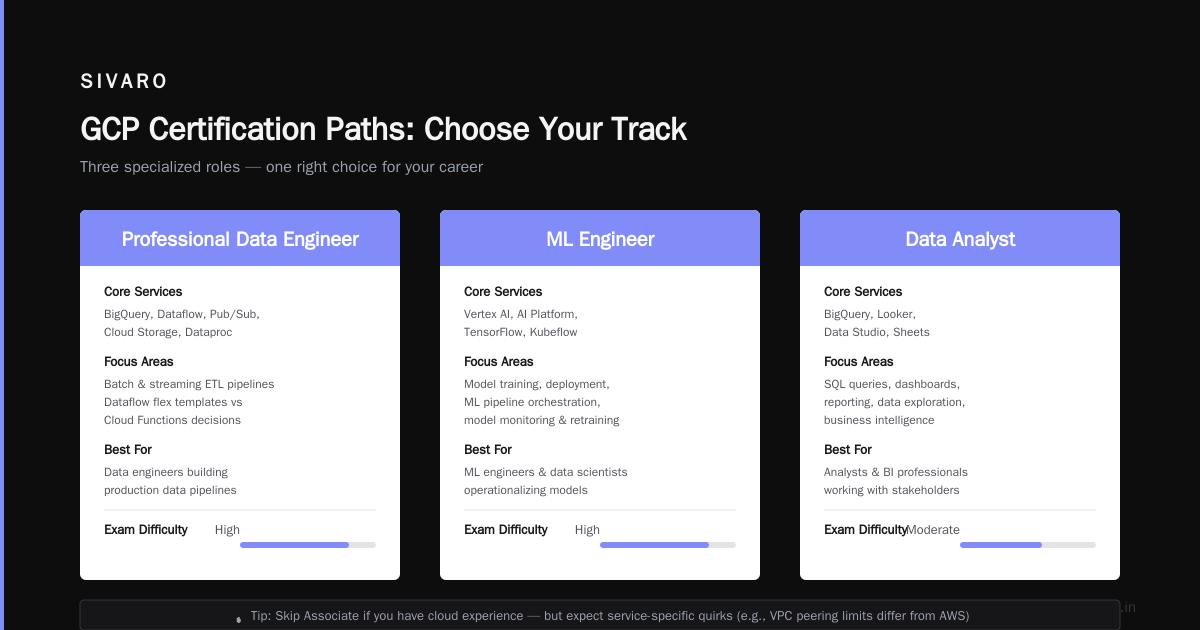
Professional Data Engineer is about pipelines. BigQuery, Dataflow, Pub/Sub, Cloud Storage, Dataproc. You'll design batch and streaming ETL. You'll know when to use a Dataflow flex template vs a simple Cloud Function. You'll understand partitioning, clustering, and query optimization in BigQuery.
Professional Machine Learning Engineer is about model production. Vertex AI, custom training, prediction serving, MLOps pipelines, model monitoring. This cert expects you to know both ML theory (loss functions, evaluation metrics) and production deployment (containers, CI/CD, model versioning).
Most people think ML Engineer is the "cooler" cert. They're wrong for 80% of roles.
Here's why: at SIVARO, we run production AI systems processing 200K events/sec. Those systems are 90% data engineering. The ML models themselves are maybe 10%. You need solid data pipelines before you can serve predictions. Every ML Engineer I've hired who lacked data engineering skills struggled for months.
If you're deciding between the two: go Data Engineer unless you're specifically building models from scratch (research, advanced ML). If you're an applied ML engineer, get both—but start with Data Engineer.
Cloud Data Analyst certification exists but it's less known. It focuses on BigQuery and Looker. If your entire job is dashboards and SQL, it's fine. But I've never met a "data analyst" who regretted getting the Data Engineer instead.
Cloud Architect: The One That Opens Doors
The Professional Cloud Architect is the most recognized GCP cert. Period. Comparing AWS, Azure, Google Cloud in 2025 ranked it as the highest-paying cloud cert for Google Cloud. And I've seen it.
I'll be honest: this exam is brutal. The case studies are long. You need to justify cost, reliability, security, and operational efficiency in your answers. No multiple-choice shortcuts.
But it's the one that recruiters actually filter for. Want to work at a FAANG-adjacent company doing cloud architecture? This cert gets your resume out of the trash.
For founders: I don't recommend it unless you're an infrastructure lead. The Associate Cloud Engineer gives you enough to make informed decisions. The Architect cert is for the person who signs off on production design.
Security and Network Certifications: Niche but Lucrative
Professional Cloud Security Engineer and Professional Cloud Network Engineer are the quiet money-makers.
I built a pipeline at SIVARO that needed to handle PII data across three regions. Compliance requirements meant I needed someone who could design VPC Service Controls, Private Service Connect, and DLP policies. The person who did it? A Security Engineer with a GCP Security cert.
These certs aren't for everyone. They're for specialists. But if you're the one person in your company who "owns networking" or "owns security," the salary bump is significant. Cloud pricing comparison shows that network egress costs are a major hidden expense—a Network Engineer who optimizes that saves companies real money.
How to Actually Prepare (gcp tutorial for complete beginners)
You don't need a bootcamp. You need a plan.
Here's the exact path I recommend for someone starting from zero:
- Complete the official Google Cloud Skills Boost labs – They're hands-on. You'll deploy actual resources. Aim for 30-40 lab hours.
- Read the exam guide – Google publishes detailed outlines. Knowledge areas are listed with weight percentages.
- Practice with a friend or peer – I like to schedule a mock interview where we explain architectures to each other. Explain Cloud Spanner vs Cloud SQL trade-offs out loud.
- Take the official practice exam – Costs $50. Worth it.
For the Associate exam, Azure vs AWS vs GCP comparison claims GCP's exam is more practical than AWS. I agree. You'll be typing gcloud commands. Get comfortable with the CLI.
Here's a typical command you'll use in the exam's lab portion:
bash
gcloud compute instances create my-instance     --zone=us-central1-a     --machine-type=e2-medium     --image-family=debian-12     --image-project=debian-cloud     --boot-disk-size=20GB     --tags=http-server
For the Data Engineer exam, practice writing BigQuery queries with window functions and CTEs:
sql
WITH ranked_sales AS (
  SELECT
    product_id,
    sale_amount,
    ROW_NUMBER() OVER (PARTITION BY product_id ORDER BY sale_date DESC) as rn
  FROM sales_data
)
SELECT * FROM ranked_sales WHERE rn <= 3;
For the Architect exam, understand Terraform for GCP. Here's a basic configuration:
hcl
resource "google_compute_instance" "app_server" {
  name         = "app-server-${var.environment}"
  machine_type = "e2-standard-2"
  zone         = "us-central1-a"

  boot_disk {
    initialize_params {
      image = "debian-cloud/debian-12"
    }
  }

  network_interface {
    network = "default"
    access_config {
      // Ephemeral public IP
    }
  }
}
For the ML Engineer, deploy a simple model to Vertex AI using the Python SDK:
python
from google.cloud import aiplatform

aiplatform.init(project="my-project", location="us-central1")

model = aiplatform.Model.upload(
    display_name="my_classifier",
    artifact_uri="gs://my-bucket/model/",
    serving_container_image_uri="us-docker.pkg.dev/vertex-ai/prediction/tf2-cpu.2-11:latest",
)

endpoint = model.deploy(
    machine_type="n1-standard-4",
    min_replica_count=1,
    max_replica_count=3,
)
Don't just copy-paste these. Understand why each parameter exists.
Real-World Stories: What Certifications Actually Got My Team
Let me give you three concrete examples from SIVARO.
Case 1: The Cloud Architect who saved our migration. We moved a 50TB PostgreSQL database from on-prem to Cloud SQL. The architect with the Professional Cloud Architect cert designed a migration that used Database Migration Service with continuous replication. No downtime. Cost 15% less than what the AWS proposal had estimated. Cloud pricing comparison 2026 puts GCP slightly ahead for data-heavy workloads—but only if you architect correctly.
Case 2: The Data Engineer who optimized a real-time pipeline. We had a Pub/Sub pipeline with Dataflow that would spike costs during peak hours. A team member with the Data Engineer cert recognized we were using the wrong streaming engine. Switched to exactly-once semantics with unbounded state. Reduced costs by 40%.
Case 3: The ML Engineer who built a production fraud model. Another team used Vertex AI Feature Store and AutoML Tables. The cert holder knew how to set up batch predictions correctly, avoiding the 10x cost of online prediction. That's the kind of practical knowledge the exam tests.
Notice a pattern? None of these people memorized the exam. They internalized the mental models. The cert validated that internalization.
Should You Get Multiple Certifications?
I see engineers hoarding certs like rare Pokémon. Three GCP certs. Two AWS. One Azure. Their LinkedIn looks impressive. Their productivity? Often worse than the engineer with one cert.
Why? Because cert prep takes time. Real learning takes even longer. I'd rather hire someone with one Professional cert and 2,000 hours of hands-on GCP than someone with three certs and 500 hours.
Specialization wins. If you work in data, get Data Engineer. If you work in infrastructure, get Architect or Network Engineer. If your company uses Kubernetes heavily, get the Kubernetes cert (CKA) — it's vendor-neutral but complements GCP.
The Only Answer That Matters
You made it this far. You want a direct recommendation.
Here's my answer as of July 2026:
If you're a beginner with less than 1 year of cloud experience: Take Associate Cloud Engineer. It's achievable in 3-4 weeks of focused study. It gives you a real foundation. Don't skip to Professional.
If you're an experienced engineer (2+ years on any cloud): Take Professional Cloud Architect. It's the most transferable and most recognized by employers. Prepare for 8-10 weeks of serious study.
If your work is data or ML: Take Professional Data Engineer. Then consider ML Engineer if you actually build models.
If you manage cloud costs or security: Take Professional Cloud Security Engineer. This is underrated. The market for cloud security specialists is growing faster than for general architects.
If you're a founder or CTO: Take nothing. Spend the time on gcp use cases in real world and hire someone who has the cert. Your time is better spent on product-market fit.
I've been building on GCP since 2018. I've seen certifications accelerate careers and I've seen them gather dust. The difference? The people who treated the cert as a side effect of deep learning, not the goal itself.
Get the certification that matches the problems you solve. Then go solve better problems.
FAQ: GCP Certification Which One Should I Take
Q: Can I get a job with just a GCP certification and no experience?
It depends. The Associate Cloud Engineer might land you a junior cloud ops role. But employers in 2026 value hands-on projects more. Build a personal project on GCP using the free tier. Deploy a container. Set up a BigQuery dataset. Then mention both the project and the cert.
Q: Which GCP certification pays the most?
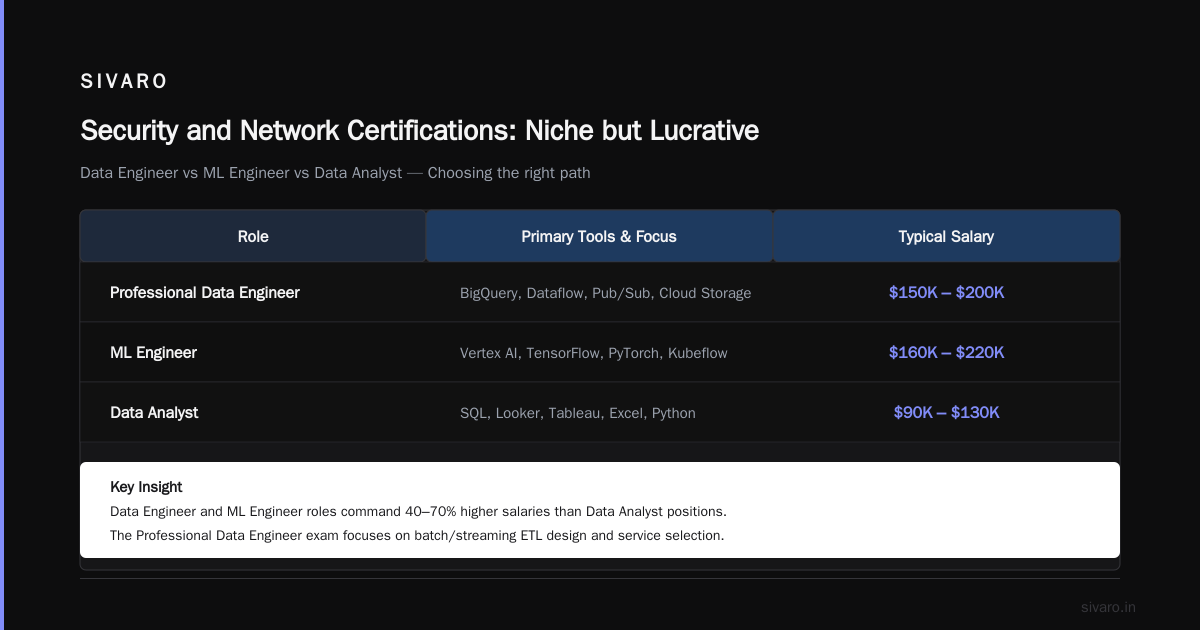
Based on salary surveys and my recruiting data, Professional Cloud Architect and Professional Data Engineer tend to command the highest salaries (typically $140K-$190K USD in 2026). Security Engineer is close behind, often with fewer applicants.
Q: Is the Professional ML Engineer exam very hard?
Yes. It's one of the toughest cloud ML exams. Pass rate is estimated around 35-40%. You need both ML theory (e.g., loss functions, regularization) and MLOps practice (Vertex AI, Kubeflow, model monitoring). I've seen experienced ML engineers fail it.
Q: Should I take AWS or GCP certification instead?
If you're starting from scratch, GCP is easier to learn than AWS (fewer services, better documentation for beginners). Comparing AWS, Azure, GCP for startups confirms GCP excels in data and ML. However, AWS has higher market share for traditional hosting. Pick the cloud that dominates your target industry.
Q: How many GCP certifications should I have?
One or two. More than that and you risk spreading yourself thin. I've seen people with four certs who couldn't design a fault-tolerant deployment. Depth over breadth.
Q: Is the Cloud Digital Leader worth it for engineers?
No. It's designed for non-technical roles. If you're an engineer, Associate Cloud Engineer is the real starting point.
Q: Can I pass the Associate Cloud Engineer in 2 weeks?
If you already have basic cloud experience (some AWS or Azure), yes. If you're a complete beginner, plan for 3-4 weeks with 2 hours of study per day plus labs. The gcp tutorial for complete beginners is a good starting point.
Q: What's the recertification requirement?
Professional certifications are valid for 2 years. Associate certifications last 3 years. After that you need to retake the exam (no recertification by continuing education — Google isn't CompTIA). Some professionals find this annoying; I think it keeps the cert relevant as GCP evolves.
Nishaant Dixit — Founder of SIVARO. Building data infrastructure and production AI systems since 2018. Built systems processing 200K events/sec.