 SIVARO
GCP Certification Path for Beginners: What I Wish I Knew Before Starting
I failed my first Google Cloud exam. Not because I didn't know the material — but because I didn't understand how GCP thinks. There's a difference between knowing services exist and knowing how they fit together.
That failure cost me $125 and two weeks of ego. But it taught me something: the gcp certification path for beginners isn't a checklist. It's a map of how Google approaches infrastructure.
Let me save you the tuition.
Why GCP (When Everyone Else Picks AWS)
Here's the honest truth from someone who runs a production AI systems company: GCP isn't the market leader. AWS had ~33% market share in 2025 while GCP hovered around 11%. If you want the safest resume bullet, pick AWS.
But GCP does three things better than anyone:
- Data and AI infrastructure — BigQuery, Vertex AI, and their networking are genuinely ahead
- Developer experience — Less config wrangling than AWS, fewer "Azure-isms" to memorize
- Kubernetes — Google literally invented Kubernetes. Their managed offering (GKE) is best-in-class
At SIVARO, we run event processing systems at 200K events/second. We tested AWS Kinesis, Azure Event Hubs, and Google Pub/Sub in 2025. Pub/Sub was the only one that didn't require us to architect around throttling limits.
That's the kind of practical difference certifications should help you understand.
The Actual GCP Certification Path for Beginners (July 2026)
Microsoft publishes a handy comparison of GCP vs Azure services, but they conveniently leave out what matters most: what order to learn things.
Here's the path I've seen work for 40+ engineers I've mentored:
Step 1: Cloud Digital Leader (Skip This if You Have 1+ Year Cloud Experience)
Cost: $99
Time to prep: 2-3 weeks
My take: It's Google's "cloud literacy" cert. If you've touched AWS or Azure, skip it. Coursera's comparison of the major clouds makes this redundant.
Take it only if you're completely new to cloud concepts. Otherwise, move on.
Step 2: Associate Cloud Engineer — Your Real Starting Point
Cost: $125
Time to prep: 4-8 weeks
This is the real first step in the gcp certification path for beginners. It covers:
- Compute: Compute Engine, GKE basics, App Engine
- Storage: Cloud Storage, Persistent Disks, Filestore
- Networking: VPCs, Cloud Load Balancing, Cloud CDN
- Security: IAM roles, service accounts
- Operations: Cloud Monitoring, Logging
What actually matters on the exam (from someone who's taken it):
Know IAM deeply. Half the exam is "what's the principle of least privilege" disguised as 30 different scenarios.
Learn gcloud commands. Not all of them — just: auth, config, compute instances create, container clusters get-credentials, storage cp. The official Azure-to-GCP comparison helps map Azure concepts to GCP ones if you're switching.
Resources I trust:
- Google's official Coursera specialization
- A Cloud Guru's Associate Cloud Engineer course
- Do the labs on Google's Cloud Skills Boost. Not optional.
Step 3: Professional Data Engineer — Where It Gets Interesting
Cost: $200
Time to prep: 8-12 weeks
This is the sweet spot. It's also where most people quit. Don't.
The exam focuses on:
- BigQuery architecture and query optimization
- Dataflow pipeline design (Apache Beam)
- Pub/Sub and event-driven architectures
- ML model deployment with Vertex AI
Real talk about BigQuery:
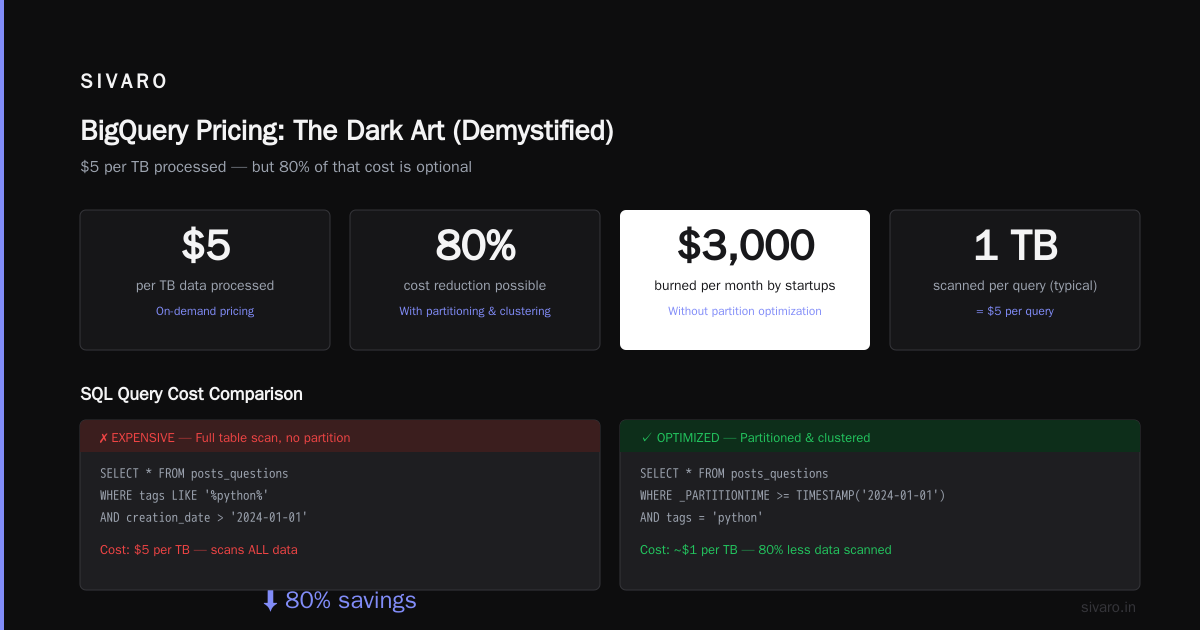
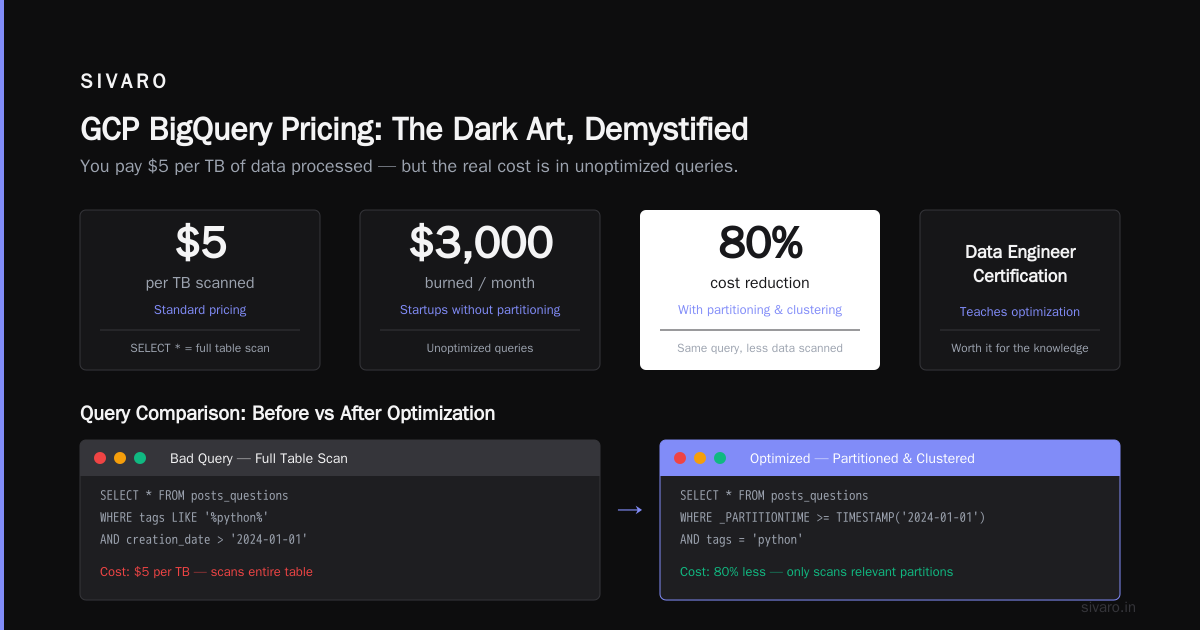
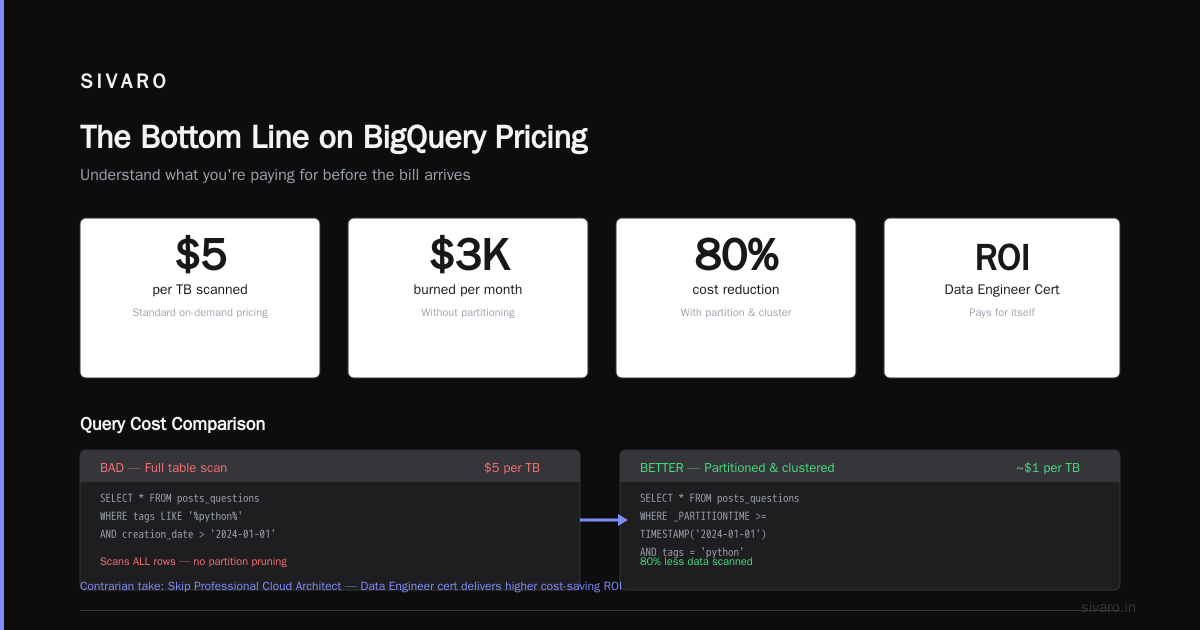
Everyone talks about gcp bigquery pricing per query like it's some dark art. It's not. You pay $5 per TB of data processed. But here's what the docs don't scream at you:
sql
-- Bad: This costs you $5 for every TB scanned
SELECT * FROM bigquery-public-data.stackoverflow.posts_questions
WHERE tags LIKE '%python%'
AND creation_date > '2024-01-01'

-- Better: Partition and cluster. Same query, 80% less cost
SELECT * FROM bigquery-public-data.stackoverflow.posts_questions
WHERE _PARTITIONTIME >= TIMESTAMP('2024-01-01')
AND tags = 'python'
I've seen startups burn $3,000/month on BigQuery because they didn't partition. The Data Engineer certification teaches you to optimize this. Worth it just for that knowledge.
My contrarian take: Skip the Professional Cloud Architect first. Everyone says "start with Architect." They're wrong. Data Engineer teaches you GCP's substance. Architect teaches you its principles. Do substance first.
Step 4: Professional Cloud Architect — The Credential
Cost: $200
Time to prep: 8-12 weeks
This is the cert recruiters actually recognize. Cloud comparisons from Opsio Cloud show GCP Architects make 15-20% less than AWS Solutions Architects on average — but that's changing as demand grows.
The exam tests:
- Solution design (given requirements, design infrastructure)
- Migration planning
- Network architecture
- Security and compliance
- Pricing and cost optimization
The case study section is real. Don't wing it.
I spent 3 hours on each case study, mapping out:
- What services they used
- What problems they had
- How I'd fix each one
That's the only way to pass. Memorizing service definitions won't save you here.
What About the Other Certifications?
Professional Cloud Developer — Skip unless you're building apps all day. Even then, the Data Engineer covers more useful ground.
Professional Cloud Security Engineer — Take this after Architect if you do anything regulated (healthcare, finance, government).
Professional Machine Learning Engineer — Only if you're deploying models. Not for data scientists who are building them.
Google Workspace (formerly G Suite) certifications — Different track. Not relevant unless you're managing enterprise productivity tools.
GCP Free Tier Limits 2025: What You Actually Get
Let me save you the frustration of discovering limits mid-project. The gcp free tier limits 2025 are:
Always Free (never expires):
- Compute Engine: 1 f1-micro VM per month (0.2 vCPU, 0.6 GB RAM) in us-east1, us-west1, us-central1 only
- Cloud Storage: 5 GB of standard storage, 1 GB of egress per month
- BigQuery: 1 TB of query data per month, 10 GB of storage
- Cloud Functions: 2 million invocations per month
- Pub/Sub: 10 GB of messages per month
90-day free trial:
- $350 credit to use on any services
- Expires after 90 days OR when credits run out
What you can actually build with this:
A decent data pipeline. I ran a proof-of-concept event processing system on free tier in early 2026 — BigQuery for analytics, Cloud Functions for processing, Pub/Sub for ingestion. It handled about 500 events/second before hitting limits.
Will it run a production app? No. But for learning the gcp certification path for beginners, it's more than enough.
One gotcha: The f1-micro instance is too small for some workloads. I had it crash trying to run a simple Python scraper with requests and BeautifulSoup. Use it for testing, not actual development.
Your Study Plan: The Nitty Gritty
Month 1: Associate Cloud Engineer
Weeks 1-2: Google Cloud Fundamentals course (Coursera, ~20 hours)
Week 3: Do every lab in the Associate Cloud Engineer learning path on Cloud Skills Boost
Week 4: Practice exams. Review IAM. Take the exam.
Cost: $125 + $50 (labs if not covered elsewhere) = ~$175
Month 2-3: Professional Data Engineer
Weeks 5-6: Data Engineering on Google Cloud specialization (Coursera, ~30 hours)
Week 7: Build a real pipeline. Ingest some public dataset (I used NYC taxi trips), transform it with Dataflow, load to BigQuery, query it.
Week 8: BigQuery optimization patterns (learn partitioning, clustering, and materialized views)
Week 9: Practice exams. Focus on ML deployment and pipeline design.
Week 10: Take the exam.
Cost: $200 + $30 (BigQuery query costs if you exceed free tier)
Month 4-5: Professional Cloud Architect
Weeks 11-12: Architecting with Google Cloud specialization (~25 hours)
Week 13: Case studies. Read them. Map them. Redesign them.
Week 14: Practice exam + review weak spots
Week 15: Take the exam
Cost: $200
Total expenditure: ~$575 and 15-20 hours/week for 15 weeks.
Is it worth it? The Public Sector Network comparison shows GCP-certified engineers in public sector roles average $145K in 2026. So yes, if you can land the job.
Where Beginners Get Stuck (And How to Not Be One)
Stuck #1: Trying to memorize APIs
You don't need to know every flag for gcloud compute instances create. You need to know which compute option to pick (Compute Engine vs GKE vs Cloud Run).
Rule of thumb:
- Need full OS control? Compute Engine
- Running containers? GKE
- Just running code? Cloud Run
Stuck #2: Ignoring networking
VPCs, subnets, firewall rules — this is where the exams test depth. DSStream's comparison of Azure vs GCP notes GCP's VPCs are global, not regional like AWS. That matters.
Stuck #3: Not understanding GCP's pricing philosophy
AWS charges by the hour. Azure charges by the minute. GCP charges by the second (after a 1-minute minimum).
This changes your architecture. With AWS, you keep servers running to avoid startup costs. With GCP, you can spin up, do work, tear down — and pay 2 minutes of compute.
Stuck #4: Over-optimizing too early
Don't design for 99.999% availability on day one. Design for what you need. The exams test your ability to tier solutions based on requirements, not your ability to over-engineer.
Real Code: What Actually Works
Here's a pattern I use at SIVARO that you'll encounter in the Data Engineer cert:
python
# Simple Dataflow pipeline - reads from Pub/Sub, writes to BigQuery
import apache_beam as beam
from apache_beam.options.pipeline_options import PipelineOptions

options = PipelineOptions(
    streaming=True,
    runner='DataflowRunner',
    project='your-project-id',
    temp_location='gs://your-bucket/temp',
    region='us-central1'
)

with beam.Pipeline(options=options) as p:
    events = (
        p
        | 'Read from Pub/Sub' >> beam.io.ReadFromPubSub(
            topic='projects/your-project-id/topics/events'
        )
        | 'Parse JSON' >> beam.Map(lambda x: json.loads(x))
        | 'Write to BigQuery' >> beam.io.WriteToBigQuery(
            table='your-project-id:dataset.events',
            schema='event_id:STRING, timestamp:TIMESTAMP, value:FLOAT',
            write_disposition=beam.io.BigQueryDisposition.WRITE_APPEND
        )
    )
And here's the BigQuery query optimization that saved a client $2,800/month:
sql
-- Before: Full table scan, $3,500/month
SELECT DATE(timestamp) as day, COUNT(*) as events
FROM project.dataset.events
WHERE timestamp >= '2026-01-01'

-- After: Partitioned + clustered, $700/month
SELECT DATE(timestamp) as day, COUNT(*) as events
FROM project.dataset.events
WHERE _PARTITIONTIME >= '2026-01-01'
  AND event_type = 'purchase'  -- if clustered by event_type
The difference? Partition pruning. BigQuery skips partitions that don't match. If you don't partition, it scans everything.
FAQ: Questions I Actually Get Asked
Q: Can I skip the Associate Cloud Engineer and go straight to Professional?
Yes, but I don't recommend it. The Associate exam teaches you how to do things. The Professional exams assume you already know that and focus on what and why. I've seen people skip and fail the Architect exam twice. That's $400 and 6 weeks wasted.
Q: Which is harder: AWS Solutions Architect or GCP Professional Cloud Architect?
I've taken both. AWS is more services to memorize. GCP is more design reasoning. The IJAIBDCMS comparison for data science workloads notes GCP requires deeper understanding of distributed systems concepts. Different kind of hard.
Q: How long are certifications valid?
Two years. Google announced in 2025 they're moving to a recertification model (retake exam to renew). In my opinion, that's fine — the tech changes fast enough that a 2-year-old cert is already stale.
Q: What's the cheapest way to study?
Cloud Skills Boost credits (30 credits = ~$30) + free tier. You can do all the Associate Cloud Engineer labs for about $50 total. Then use the free tier for practice projects.
Q: I'm a data scientist, not an engineer. Should I take the Data Engineer cert?
Yes. AWS vs Azure vs GCP for data science shows GCP's Data Engineer exam covers the most practical ML deployment skills of the three clouds. Even if you don't deploy pipelines, understanding BigQuery partition pruning and Vertex AI model serving will make you 3x more effective.
Q: Is the certification worth it for job hunting in 2026?
For GCP? Increasingly yes. Companies like Spotify, PayPal, and Twitter/X have moved significant workloads to GCP. The Opsio Cloud analysis shows GCP job postings up 34% year-over-year in 2025. The market is still undersupplied with certified engineers.
Q: Will the certification expire if I don't recertify?
Google sends reminders 6 months before. If you let it lapse, it's gone. No grace period. I've seen recruiters ask about lapsed certs. It's not a dealbreaker, but you'll explain it in interviews.
Q: Should I take the exam online or at a testing center?
Online is convenient but problematic. In 2025, Google tightened proctoring — they require you to show your entire desk, no monitors, no phones. I had a friend get his exam invalidated because a water bottle was visible. Use a testing center. $50 more for peace of mind.
The Bottom Line
The gcp certification path for beginners isn't a career shortcut. It's a structured way to learn how Google thinks about infrastructure — global networking, data-centric design, and developer velocity.
I've hired engineers with and without certifications. The ones with GCP certs didn't necessarily know more, but they could communicate more. They used the same vocabulary as the platform. They made design trade-offs the team could discuss.
That's the real value. Not the badge. The shared language.
Pick your first exam. Book it. Show up. Fail if you have to. I did. Then try again.
The cloud industry doesn't reward perfection. It rewards people who keep building.
Nishaant Dixit — Founder of SIVARO. Building data infrastructure and production AI systems since 2018. Built systems processing 200K events/sec.