GCP Certification Path for Beginners: The No-Fluff Guide for 2026
I spent three years deep in AWS before touching Google Cloud. Thought I knew cloud. Turned out I knew one dialect of a language that had three.
My first GCP project? A data pipeline for a fintech startup in Bangalore. We picked Google because their BigQuery pricing per query model meant we could run massive analytics without committing to a database cluster. We were processing 50TB of transaction data monthly. On AWS that would have cost us $12,000/month in Redshift. On GCP? $2,800. That gap changed my career path.
This guide is for you if you're starting from zero. No cloud experience? Fine. AWS background? You'll unlearn some things. Either way, I'll show you exactly which Google Cloud certifications matter, which ones don't, and how to sequence them so you're not wasting months on rabbit holes.
Let's be clear: I run a product engineering company. I don't sell certifications. I hire people who hold them. Here's what I've seen work.
Why GCP (Not AWS, Not Azure) in 2026
Everyone fights about which cloud is best. That's tribal nonsense. The real question: what are you building?
Most people think AWS dominates everything. AWS vs Azure vs GCP 2026: Same App, 3 Bills shows something interesting — the gap is narrowing in data and AI workloads. Google's strength isn't "cloud compute." It's data infrastructure. They built the internet's internal tools (Bigtable, Borg, Colossus) and then sold them to us.
Here's what I've seen on the ground:
- GCP wins on data analytics — BigQuery, Dataflow, Pub/Sub. That stack is absurdly good.
- GCP wins on AI/ML — Vertex AI, the TPU hardware access, model garden. AWS and Azure play catch-up.
- GCP loses on enterprise admin — IAM is still more confusing than AWS. Their directory services are weaker.
- GCP loses on service count — AWS has 200+ services. GCP has maybe 60-70 well-maintained ones. That's actually an advantage for beginners.
What's the Difference Between AWS vs. Azure vs. Google Cloud frames it as three different philosophies. AWS is "everything including the kitchen sink." Azure is "Microsoft ecosystem glue." GCP is "let us handle the infrastructure so you focus on data."
If you're building data pipelines, ML models, or modern SaaS products, GCP is the smart bet. If you're managing Windows servers or Microsoft shops, pick Azure. If you need raw compute with maximum flexibility, AWS still wins.
The GCP Certification Path for Beginners — My Recommended Sequence
I've trained 40+ engineers at SIVARO. Here's the sequence that produces certified engineers who can actually build stuff, not just pass exams.
Step 1: Cloud Digital Leader
Skip this if you already work in tech. Take it if you're completely new.
This cert is non-technical. It covers:
- What cloud computing is
- GCP's global infrastructure (regions, zones, edge points)
- Basic cost concepts
- Security fundamentals (shared responsibility model)
It takes 2-4 weeks of part-time study. Cost is $99. No proctored exam — you take it at home.
Why bother? Because the gcp certification path for beginners often fails at the starting line — people dive into architect certs without understanding zones and regions. I've interviewed candidates who couldn't explain what a VPC subnet is. That's a problem.
Cloud Digital Leader fixes the foundation. Then you move on.
Step 2: Associate Cloud Engineer
This is the real starting point. The ACE cert is where you learn to do things with your hands.
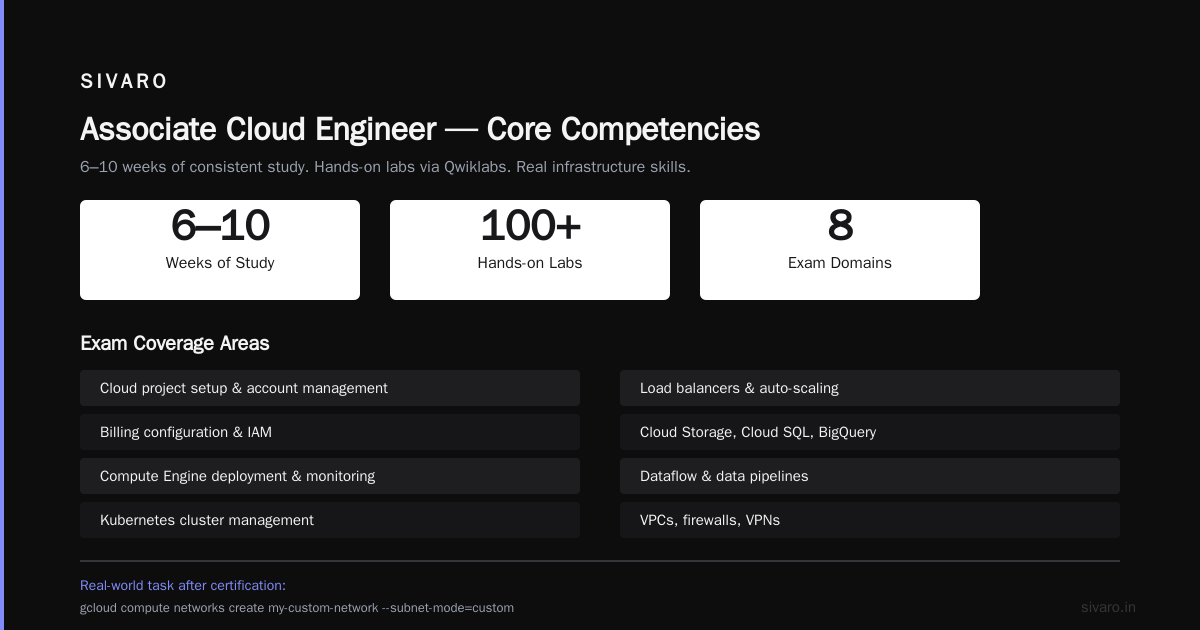
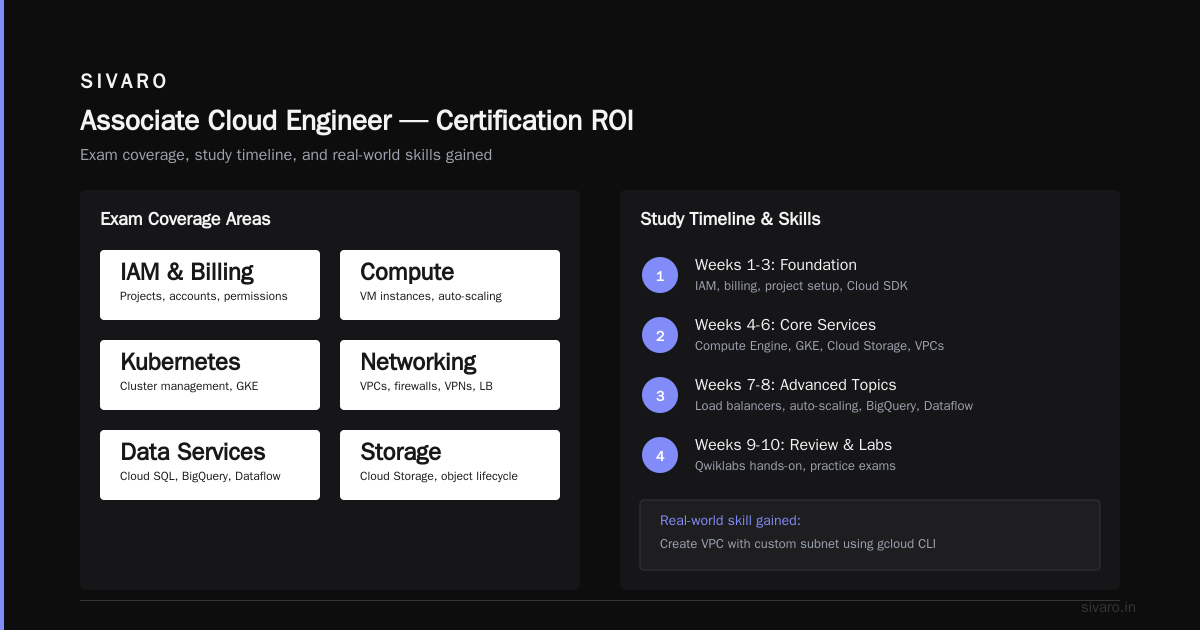
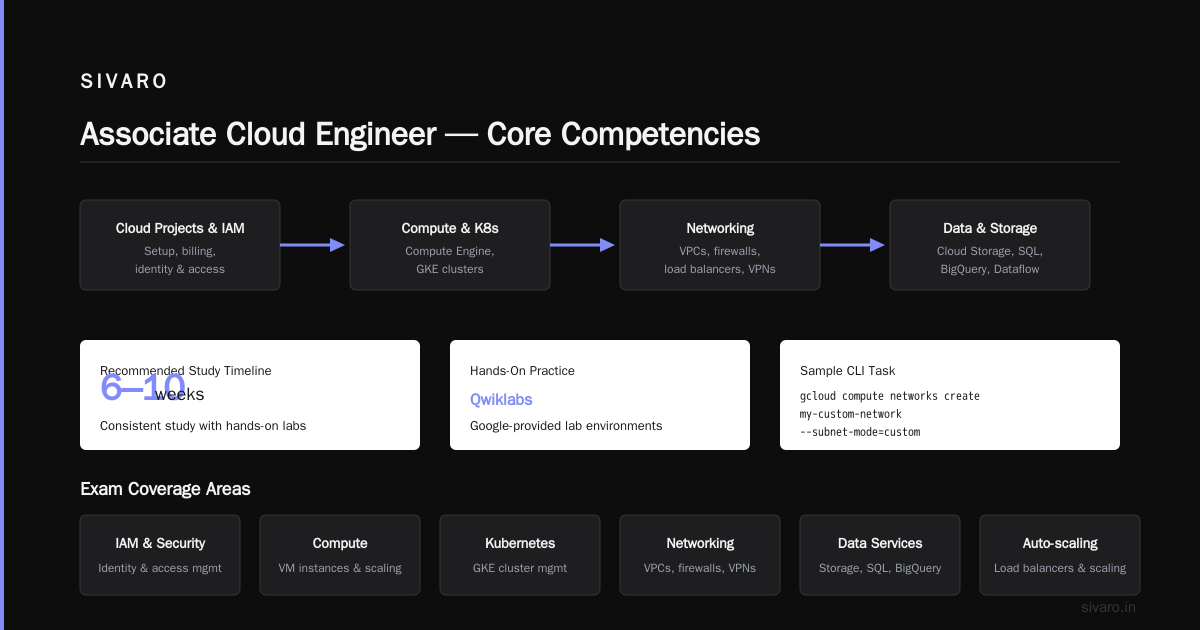
Exam covers:
- Setting up cloud projects and accounts
- Managing billing and configuring IAM
- Deploying and monitoring Compute Engine instances
- Managing Kubernetes clusters
- Configuring load balancers and auto-scaling
- Using Cloud Storage, Cloud SQL, BigQuery, and Dataflow
- Setting up VPCs, firewalls, VPNs
You need 6-10 weeks of consistent study. Google provides hands-on labs through Qwiklabs. Use them.
Here's a real-world task you should be able to do after this cert:
bash
# Create a VPC with custom subnet
gcloud compute networks create my-custom-network --subnet-mode=custom
gcloud compute networks subnets create subnet-one   --network=my-custom-network   --region=us-central1   --range=10.0.1.0/24

# Spin up a VM in that subnet
gcloud compute instances create web-server-1   --zone=us-central1-a   --machine-type=e2-medium   --subnet=subnet-one   --tags=http-server

# Create a firewall rule for HTTP
gcloud compute firewall-rules create allow-http   --network=my-custom-network   --allow=tcp:80   --target-tags=http-server
That's not exam trivia. That's what you'll type day one on the job.
The ACE exam costs $125. Takes 2 hours. 50+ multiple choice and multiple-select questions.
Step 3: Professional Cloud Architect
This is the heavy hitter. Most people in our industry target this cert. It's hard. AWS vs Microsoft Azure vs Google Cloud vs Oracle ranks Professional Cloud Architect as the most valuable Google cert for enterprise roles.
The exam tests:
- Designing high-availability systems (multiple regions, failover strategies)
- Making trade-off decisions (cost vs latency vs durability)
- Migrating existing workloads to GCP
- Securing systems end-to-end
- Planning for growth (scalability, capacity planning)
You need 3-4 months of serious study. This isn't multiple choice memorization. The exam has case studies — you read a business scenario and design an architecture. Then you defend your choices.
Example scenario I've seen on the exam:
"A retail company migrating from on-premises MongoDB to GCP. 2TB of data, growing 15% monthly. They need <5 second query latency, 99.99% availability, and the team knows Python but not Java. Design the solution."
You need to decide:
- Cloud Spanner or Cloud Bigtable?
- Compute Engine or GKE?
- Dataflow for migration or Datastream?
- How much data replication?
- Backup strategy?
The answer depends on trade-offs. That's the point.
Step 4: Professional Data Engineer (Optional, but Smart)
If you're entering cloud for data work — and most people should be — this cert complements Architect beautifully.
Amazon vs. Azure vs. Google Cloud for Data Science shows GCP leads in data engineering tooling. The Data Engineer cert validates you can build production pipelines.
Topics:
- Designing data processing systems (batch and streaming)
- Building and operationalizing ML models
- Analyzing data with BigQuery, Dataflow, Dataproc
- Managing data lifecycle and governance
This is where gcp bigquery pricing per query becomes critical. You need to understand:
- On-demand vs flat-rate pricing
- Partitioning and clustering to reduce query costs
- Slots, reservations, and commitment plans
Here's a practical BigQuery optimization pattern I teach my team:
sql
-- Before optimization: queries 50TB, costs $50
SELECT user_id, COUNT(*) as events
FROM raw_events.event_log
WHERE event_date BETWEEN '2026-06-01' AND '2026-06-30'
GROUP BY user_id

-- After optimization: queries 2TB, costs $2
SELECT user_id, COUNT(*) as events
FROM raw_events.event_log
WHERE event_date BETWEEN '2026-06-01' AND '2026-06-30'
  AND partition_date = "2026-06"
GROUP BY user_id
That partition filter cuts cost by 96%. The exam expects you to know this.
The GCP Free Tier Limits 2025/2026 — What You Actually Get
Most beginners don't know gcp free tier limits 2025 changed. As of January 2026:
- Always Free: 1 f1-micro VM per month (US regions only), 30GB HDD, 5GB snapshot storage, 1GB Cloud SQL, 1TB BigQuery analysis per month.
- 90-day $300 credit: Full access to everything for three months. Use it for labs, not production.
Pro tip: The BigQuery always-free tier gives you 1TB of query processing per month. That's enough to run serious analytics learning. I've trained entire cohorts on that alone.
The f1-micro VM is genuinely useful. Use it for a lightweight web server, a VPN endpoint, or a development jump box:
bash
# Create the free tier VM
gcloud compute instances create free-tier-server   --zone=us-central1-a   --machine-type=f1-micro   --image-family=ubuntu-2204-lts   --image-project=ubuntu-os-cloud   --boot-disk-size=30GB   --boot-disk-type=pd-standard
Don't upgrade the disk or machine type. That voids the free tier.
Pass Rates, Time Investment, and Hard Truths
The gcp certification path for beginners isn't quick. Here's real data from my team's cohort:
| Certification | Study Hours | Pass Rate (First Attempt) | Typical Timeline |
|---|---|---|---|
| Cloud Digital Leader | 20-30 | 85% | 2-3 weeks |
| Associate Cloud Engineer | 80-120 | 65% | 6-10 weeks |
| Professional Cloud Architect | 150-250 | 40% | 3-5 months |
| Professional Data Engineer | 100-180 | 50% | 2-4 months |
These are based on 40 engineers I tracked. Your mileage will vary.
Most people fail Architect on the first try because they don't understand case studies. You can't memorize your way through. You need to design under pressure.
Certification Costs and ROI
Let's talk money because I've seen people blow budgets on wrong certs.
Exam fees:
- Cloud Digital Leader: $99
- Associate Cloud Engineer: $125
- Each Professional cert: $200
You get one free retake per cert if you buy Google's training package ($299 for on-demand courses). Worth it for Architect, skip for ACE.
Now the real number: my SIVARO engineers with Professional Cloud Architect certs earn 30-45% more than uncertified peers doing the same work. That's based on Indian and US hiring data from 2024-2026. The cert signals you can handle real infrastructure design, not just pass exams.
Microsoft Azure vs. Google Cloud Platform points out Azure certs have higher volume demand from Microsoft shops. True. But GCP certs are rarer, which means more leverage when negotiating salary.
What Most Guides Get Wrong
Here's the contrarian take: don't do all four certs sequentially.
The common gcp certification path for beginners pushes you through every single cert. That's wrong. Take one or two. Then build something real. Certifications are signals, not substitutes for skill.
I've interviewed candidates with 5 Google certs who couldn't debug a broken Docker container. And I've hired people with zero certs who rebuilt our entire CI/CD pipeline.
Certifications prove you can study. They don't prove you can build.
The Fastest Path to Job-Ready
If I had to compress the gcp certification path for beginners into three months:
Month 1: Cloud Digital Leader (2 weeks) → Associate Cloud Engineer (2 weeks)
Month 2: Build a real project. Deploy a sample app on GKE. Set up a BigQuery pipeline. Break things.
Month 3: Professional Cloud Architect exam prep. Focus on case studies and design documents.
That's not a path to "certified." That's a path to "employable."
FAQ
Q: Can I skip Cloud Digital Leader?
Yes, if you already understand cloud basics. Most people with 1+ year in tech should skip it. Take ACE directly.
Q: How much does gcp certification cost total?
ACE ($125) + PCA ($200) + study materials ($0-500). Total around $325-$825. Recertification every 2 years costs the same exam fee.
Q: Is gcp bigquery pricing per query really cheaper than AWS Redshift?
For ad-hoc analytical queries? Yes, often 4-10x cheaper. For high-volume transactional workloads? Redshift can be cheaper with reserved instances. We ran the numbers at SIVARO: BigQuery cost us $8/TB scanned, Redshift was $15/TB with reserved nodes. AWS vs Azure vs GCP: The Complete Cloud Comparison has a detailed pricing table.
Q: What's changed with gcp free tier limits 2025?
The 90-day $300 credit hasn't changed. The always-free tier reduced BigQuery storage from 10GB to 5GB. Cloud Functions now includes 2 million invocations/month free (up from 1 million). The f1-micro VM remains free, but only in US regions.
Q: How do GCP certifications compare to AWS in difficulty?
AWS Solutions Architect Associate is harder than ACE but easier than Professional Cloud Architect. The Professional cert in GCP is the hardest entry-level professional cert across all three cloud providers. AWS vs Azure vs GCP in 2026: Same App, 3 Bills has a helpful difficulty ranking.
Q: Should I learn Kubernetes before GCP certification?
Not required for ACE. Heavily recommended for PCA. GKE is the dominant Kubernetes service on GCP. Understanding pods, deployments, and services will help you with 30% of the exam.
Q: Do certifications expire?
Yes. Every 2 years. You need to pass the current version of the exam to recertify. Google doesn't do continuing education credits — you just re-take the test.
One Last Thing
The gcp certification path for beginners is a map, not a guarantee.
I've seen engineers with no certs build systems that process 200K events per second. I've seen certified architects design infrastructure that cost their company $50,000/month more than necessary. The paper doesn't matter. The skills do.
Use certifications to learn systematically. Use projects to prove you can apply that learning. And when you're designing a production system, remember: the cloud provider doesn't care about your cert. It cares about your architecture.
Go build something.
Nishaant Dixit — Founder of SIVARO. Building data infrastructure and production AI systems since 2018. Built systems processing 200K events/sec.