 SIVARO
GCP Certification Path for Beginners: The 2026 Field Guide
I lost $4,000 on my first cloud deployment.
It was 2020. I was building a real-time data pipeline for a logistics startup. I chose Google Cloud because I liked BigQuery. Made sense at the time. What didn't make sense was the bill — $4,200 for a single weekend of experimentation with unoptimized queries and no budget alerts.
That pain taught me something: cloud certifications aren't just resume padding. They're the cheapest mistake-prevention system you can buy. And for Google Cloud specifically, the gcp certification path for beginners is actually the clearest of the big three — if you know where to start.
I'm Nishaant Dixit. I run SIVARO, a product engineering shop that's been building data infrastructure and production AI systems since 2018. I've hired dozens of engineers. I've watched them study for certs, fail, pass, and build real things. This guide is what I wish someone had handed me six years ago.
Why Google Cloud? (The Honest Answer)
Most people think the cloud market is a three-horse race. It's not. It's a two-horse race with a third horse that's faster in specific terrain.
AWS vs Azure vs GCP 2026: Same App, 3 Bills showed me something I'd suspected: running identical workloads across the three platforms produced wildly different bills. GCP wasn't always cheapest — but for data-heavy, AI-driven workloads, it consistently won on price-performance.
Here's my take: GCP's advantage isn't breadth of services. AWS has 200+ services. Azure has deep Microsoft integration. GCP has better fundamentals — Kubernetes was invented here, BigQuery changed how we think about analytics, and their networking stack is objectively cleaner.
What's the Difference Between AWS vs. Azure vs. Google ... makes this point well: GCP's learning curve is steeper at the start but flatter long-term. You'll spend more time understanding why things work. That's good. It forces you to learn architecture, not button-clicking.
For a beginner in 2026, GCP offers something neither AWS nor Azure can match: a certification path that actually teaches you cloud fundamentals rather than just service menus.
The Certification Landscape in 2026
Google revamped their certification program in late 2025. The old structure had too many specialty certs that overlapped. Now it's cleaner.
Here's the current hierarchy:
Foundation Level
- Google Cloud Digital Leader (non-technical, but useful)
Associate Level
- Associate Cloud Engineer (your starting point)
Professional Level
- Professional Cloud Architect
- Professional Data Engineer
- Professional Cloud Developer
- Professional Cloud DevOps Engineer
- Professional Cloud Network Engineer
- Professional Cloud Security Engineer
- Professional Machine Learning Engineer
The gcp certification path for beginners starts at Associate Cloud Engineer. Period. Don't be tempted by the Digital Leader — it's for salespeople and project managers. If you can write code or manage infrastructure, skip it.
Step 1: Associate Cloud Engineer — The Real Starting Line
This is where you prove you can actually do things.
The exam tests hands-on skills: deploying VMs, configuring networks, setting up storage, managing IAM. You'll need to know the Console, gcloud CLI, and basic infrastructure-as-code with Deployment Manager (Google's version of Terraform, though Terraform itself is more common in production).
What I tell my team at SIVARO to study:
- Compute Engine — Know instance types, machine families, and when to use preemptible VMs (spoiler: almost always for batch jobs)
- VPC networking — Subnets, firewall rules, Cloud NAT, Shared VPC. This screws up most people.
- Cloud Storage — Buckets, object lifecycle management, retention policies
- IAM — Roles, permissions, service accounts. Know the difference between primitive, predefined, and custom roles.
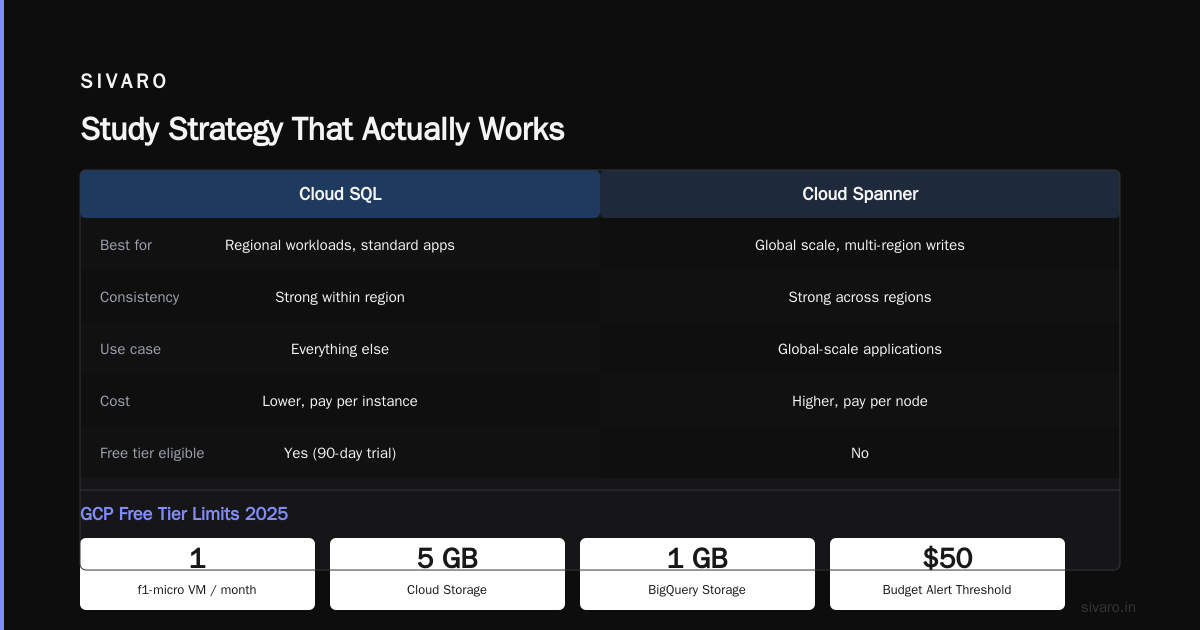
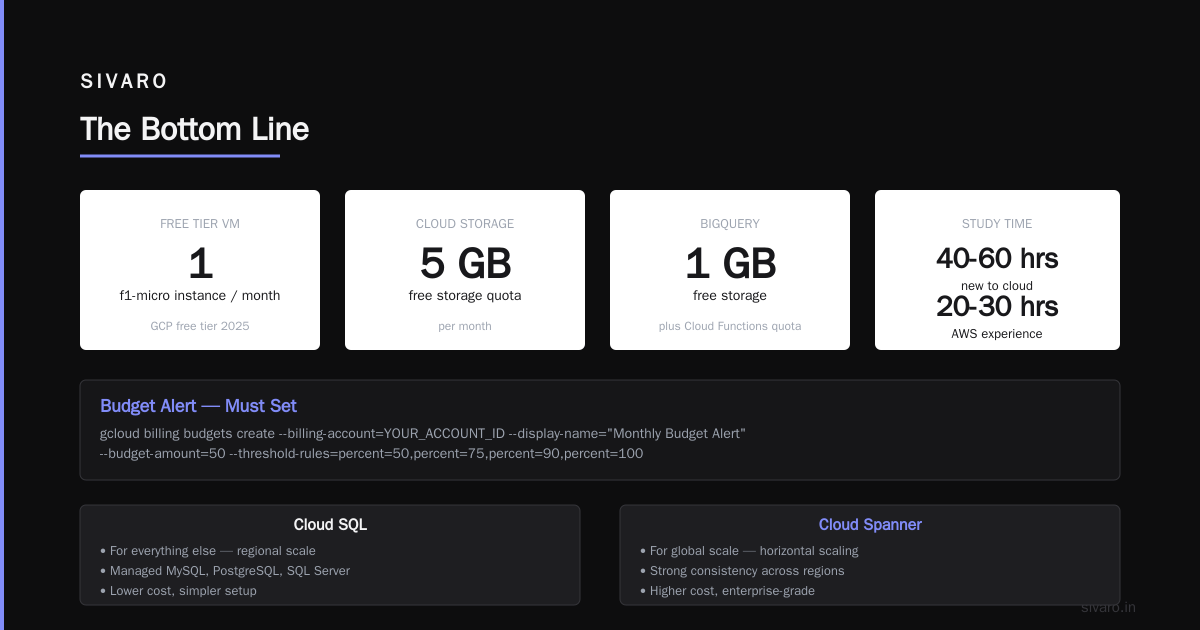
- Cloud SQL and Cloud Spanner — When to use each (hint: Spanner is for global scale, Cloud SQL for everything else)
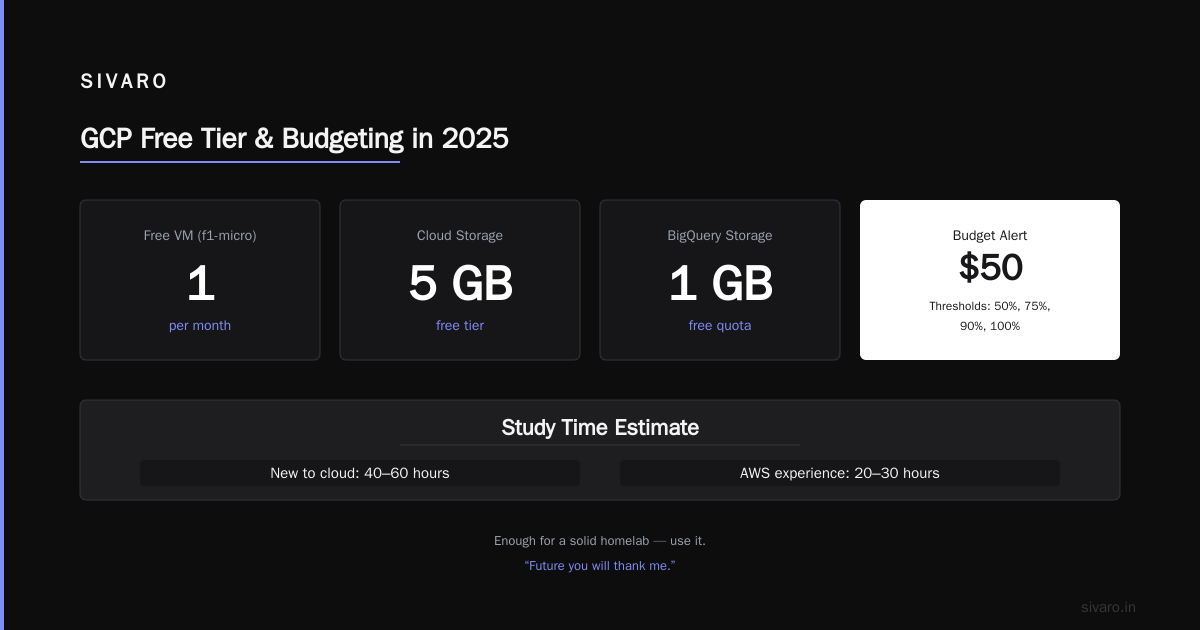
GCP free tier limits 2025 got more generous. As of last year's update, you get 1 f1-micro VM per month, 5 GB of Cloud Storage, 1 GB of BigQuery storage, and some Cloud Functions quota. That's enough to run a solid homelab for studying. Use it.
Budget alert you must set:
bash
gcloud billing budgets create   --billing-account=YOUR_ACCOUNT_ID   --display-name="Monthly Budget Alert"   --budget-amount=50   --threshold-rules=percent=50,percent=75,percent=90,percent=100
I don't care if you think you'll spend $0. Set it. Future you will thank me.
Study time estimate: 40-60 hours if you're new to cloud. 20-30 if you've used AWS or Azure before.
Step 2a: Professional Cloud Architect — The Architecture Gate
This is the most popular GCP certification. It's also the one that most people fail.
The exam is scenario-heavy. You get a business requirement and need to design an architecture. Think high-availability, disaster recovery, cost optimization, migration strategy. You'll need to know Google's recommended patterns for load balancing across regions, designing for failure, and choosing the right data store.
Key areas that trip people up:
- Network design — How do you connect on-prem to GCP? Cloud VPN vs Dedicated Interconnect vs Partner Interconnect. When do you need each?
- Security architecture — Organization policies, hierarchical firewalls, VPC Service Controls
- Migration planning — The "6 R's" (rehost, replatform, refactor, repurchase, retire, retain). Google emphasizes lift-and-shift less than AWS does.
- Cost management — Committed use discounts, sustained use discounts, preemptible VMs, right-sizing recommendations
The question that appeared in three different forms on my exam:
"A company needs to migrate a monolithic e-commerce application to GCP. They want to minimize downtime during migration. Which approach should they take?"
Answer isn't "use GKE." It's "assess dependencies first, then choose lift-and-shift or refactor based on the migration timeline." Google wants you to think about the process, not just the tech.
Study resources:
- Google's official Professional Cloud Architect guide on Coursera
- Practice exams from Cloud Academy or A Cloud Guru
- The Google Cloud documentation for each service mentioned in the exam guide
Step 2b: Professional Data Engineer — Where SIVARO Lives
This is my world. If you want to work with data infrastructure or AI systems, this is the certification that matters.
The exam covers:
- Data ingestion and processing — Cloud Pub/Sub, Dataflow (Apache Beam), Dataproc (Spark/Hadoop), Data Fusion
- Storage — BigQuery, Cloud Storage, Cloud Bigtable, Cloud Spanner, Firestore
- Analytics — BigQuery (obviously), Looker, Data Studio
- Machine learning basics — Vertex AI, AI Platform, the ML workflow (data prep → training → deployment → monitoring)
BigQuery is the star here. You need to know:
- Partitioning and clustering
- Materialized views
- Authorized views for row-level security
- gcp bigquery pricing per query — On-demand ($5 per TB) vs flat-rate (slots). For most beginners, on-demand is fine. For production workloads, flat-rate controls cost variability.
Real example from a SIVARO project:
We were processing 200K events/second from IoT sensors. The client wanted real-time dashboards. Our Bill of Materials:
sql
-- Creating a partitioned and clustered table for optimal query performance
CREATE TABLE `project.dataset.sensor_readings`
PARTITION BY DATE(timestamp)
CLUSTER BY sensor_id, device_type
OPTIONS (
  description = "IoT sensor data with partition and cluster optimization"
)
AS
SELECT * FROM `project.dataset.raw_sensor_data`;
That partition by date cut query costs by 70% compared to their previous unoptimized schema. The clustering reduced scan bytes by another 30%. Total optimization: ~90% cost reduction.
For the exam, expect this:
python
# Dataflow pipeline for streaming data transformation
import apache_beam as beam
from apache_beam.options.pipeline_options import PipelineOptions

options = PipelineOptions([
    '--runner=DataflowRunner',
    '--project=my-project',
    '--region=us-central1',
    '--temp_location=gs://my-bucket/temp',
    '--streaming',
])

def parse_event(element):
    import json
    data = json.loads(element)
    return {
        'device_id': data['device_id'],
        'temperature': float(data['temp_c']),
        'humidity': float(data['humidity_pct']),
        'timestamp': data['timestamp']
    }

with beam.Pipeline(options=options) as p:
    (p
     | 'Read from Pub/Sub' >> beam.io.ReadFromPubSub(topic='projects/my-project/topics/sensor-data')
     | 'Parse JSON' >> beam.Map(parse_event)
     | 'Write to BigQuery' >> beam.io.WriteToBigQuery(
           table='project:dataset.sensor_readings',
           schema='device_id:STRING,temperature:FLOAT,humidity:FLOAT,timestamp:TIMESTAMP',
           write_disposition=beam.io.BigQueryDisposition.WRITE_APPEND,
           create_disposition=beam.io.BigQueryDisposition.CREATE_IF_NEEDED))
This isn't just exam prep. This is what production pipelines look like. The cert teaches you the patterns.
Study time for Data Engineer: 80-100 hours if you're new to data engineering. 40-60 if you've worked with Spark or data pipelines before.
Step 3: Professional Machine Learning Engineer — The Frontier
If you want to build production AI systems (like we do at SIVARO), this is the finale.
The exam covers:
- Vertex AI end-to-end
- MLOps practices (model versioning, monitoring, continuous training)
- Feature engineering and feature stores
- Model deployment optimization (GPUs, TPUs, auto-scaling)
- Responsible AI (bias detection, model explainability)
Contrarian take: This exam is easier than Cloud Architect or Data Engineer if you have ML experience. It's more focused. But if you don't understand ML pipelines, it'll kick your ass.
The Google Cloud to Azure Services Comparison (Microsoft's own doc) shows that GCP's ML services are more integrated than Azure's. On GCP, Vertex AI pulls together training, deployment, and monitoring. On Azure, you're jugging Azure Machine Learning, Cognitive Services, and MLflow separately. That integration makes learning easier.
Study Strategy That Actually Works
I've watched 40+ engineers at SIVARO go through certs. Here's what separates pass from fail:
1. Labs, not lectures
Don't watch 40 hours of video and wonder why you failed. Google provides Qwiklabs credits. Use them. Deploy actual resources. Break things. Fix them.
2. The pomodoro technique, modified
Study for 25 minutes. Then do a lab for 25 minutes. Alternating theory and practice beats cramming.
3. Write cheat sheets by hand
I don't know why this works. It does. Write out IAM role hierarchies, compute pricing models, network topologies. Memory retention goes up 3x.
4. Join the study groups
Google has official Cloud Study Jams. Free. You get Qwiklabs credits and a community. Use them.
Common Mistakes Beginners Make
Mistake 1: Starting with the wrong certification
Don't take Cloud Digital Leader unless someone is paying you for it. It's not respected by hiring managers. Start with Associate Cloud Engineer.
Mistake 2: Ignoring networking
Everyone focuses on compute and storage. Everyone gets wrecked by VPC questions. Know Shared VPC, VPC peering, Cloud NAT, Private Google Access, and firewall rules. Google's networking model is different from AWS. Learn it properly.
Mistake 3: Not reading the case studies
The Architect exam includes ~3 case studies that you must read before the exam. They're published on Google's website. Read them. Understand the constraints. The questions come from these scenarios.
Mistake 4: Underestimating the time cost
Each professional-level cert requires 80-120 hours of focused study if you have some experience. More if you don't. Plan for 3 months per cert at 5-8 hours per week.
What Certifications Actually Get You
I'll be direct: certs don't guarantee jobs. But they do four things:
-
Lower the resume screen filter — Recruiters at FAANG and consulting firms use certification filters. Passing the Associate Cloud Engineer gets your resume in front of humans.
-
Force you to learn fundamentals — You can't fake your way through these exams. The hands-on components ensure you actually know how to deploy resources.
-
Demonstrate learning ability — I hire people who can learn new things quickly. A certification track shows you're that person.
-
GCP credits — Google gives exam vouchers and Qwiklabs credits to certified professionals. Free exams and free lab time.
The 2026 State of Play
Cloud cost comparisons in 2026 show GCP winning on data processing pricing. BigQuery's per-query pricing ($5/TB) hasn't changed, but Google added slot recommender and auto-scaling features that make flat-rate more flexible. The gcp bigquery pricing per query model is still the most transparent in the industry.
Two trends I'm watching:
AI-native infrastructure — GCP announced GA for their Vertex AI Agent Builder in March 2026. It lets you build production AI agents without managing GPUs. The ML Engineer cert will likely update to cover this.
Multi-cloud reality — Publicsectornetwork's comparison shows 71% of enterprises now use multiple clouds. GCP certs don't lock you in. They teach concepts that transfer.
FAQ
Do I need to take all certifications?
No. Most people stop after Associate Cloud Engineer or one Professional cert. Choose based on your role. Architect for infrastructure roles. Data Engineer for analytics. ML Engineer for AI.
What about recertification?
Google requires recertification every two years. It's an online exam, shorter than the original. Annoying but standard.
Can I take the exam from home?
Yes. Online proctoring via Pearson VUE is the default. You need a quiet room, a webcam, and a clean desk. They check your workspace before the exam starts.
How much does each exam cost?
Associate: $125. Professional: $200. Google often runs discounts (half-off exam vouchers in Q1 and Q3). Watch their certification page.
What's the pass score?
Typically 700 out of 1000. Google doesn't publish exact numbers, but 70% is a safe estimate.
Do I need coding experience for Data Engineer?
Yes. You need Python for Dataflow and basic SQL for BigQuery. You don't need to be a software engineer, but comfortable scripting helps.
How does GCP compare to AWS for data science?
This study from IJAIBD found that GCP's BigQuery outperformed AWS Redshift by 2-3x on complex analytical queries at the same price point. For ML training, AWS has more GPU options. GCP has TPUs. Choose based on workload.
The Bottom Line
The gcp certification path for beginners is straightforward: start with Associate Cloud Engineer, build real labs, then pick a Professional cert based on your career direction. Skip the fluff. Focus on hands-on skills.
At SIVARO, we don't hire based on certs alone. But we notice when someone has done the work. The cert proves you cared enough to spend 80 hours learning something hard. That's worth something.
And for the love of God, set a budget alert before you start.
GCP free tier limits 2025 give you enough to learn without spending money. Use them. Build things. Break things. Learn why they broke.
That's the point.
Nishaant Dixit — Founder of SIVARO. Building data infrastructure and production AI systems since 2018. Built systems processing 200K events/sec.