 SIVARO
GCP Certification Path for Beginners: My 2026 Blueprint
Cloud certifications are a trap. Most people think they're a shortcut to a six-figure job. They're not. They're a structured way to learn what you'd otherwise piece together from blog posts and YouTube outages.
I'm Nishaant Dixit. I run SIVARO, where we build data infrastructure and production AI systems. We've been through the Google Cloud certification meat grinder — some of our engineers have them, some don't. The ones who treat certs as learning frameworks, not trophies? They're the ones who actually deliver.
This isn't a fluffy "get certified in 30 days" guide. I'll show you the exact path, the traps, and the hard trade-offs. By the end, you'll know whether Google Cloud certifications are right for you — and exactly which ones to take.
What's Actually Different About Google Cloud in 2026
Let me be blunt. Google Cloud isn't AWS. It's not trying to be.
AWS built for infrastructure people. Azure built for enterprises already using Microsoft. Google Cloud? It was built by people who run the world's largest data processing systems internally. That shows.
The AWS vs Azure vs GCP 2026 comparison from TECHSY nails it: Google's strength is data and machine learning. Their weakness is enterprise sales and support. Pick GCP if you're doing heavy data work. Pick AWS if you need every service under the sun. Pick Azure if your CIO is a Microsoft shop.
I've seen teams burn months trying to run Kubernetes on AWS EKS. On GCP with GKE? They're up in hours. Google literally invented Kubernetes. That's not marketing — that's history.
The Biggest Misconception About GCP Certifications
Here's what nobody tells you: the certifications test Google's way of doing things. Not cloud fundamentals. Not industry best practices. Google's specific opinions.
That's not necessarily bad. Google's opinions on data architecture are better than most. But if you're coming from AWS, you'll fail the Associate Cloud Engineer exam because you don't know their specific IAM quirks — not because you're a bad engineer.
The Google Cloud to Azure Services Comparison from Microsoft is actually useful here. It shows the mapping, but the mapping is leaky. BigQuery is not Redshift. Cloud Run is not Azure Container Instances. The abstractions are different.
Your Real Certification Path (Not Google's Suggested Order)
Google has a recommended path. Ignore it. They're trying to sell you multiple exams. Here's what actually works:
Step 1: The Foundation (Skip It)
Cloud Digital Leader. Don't bother. It's for salespeople and project managers. If you're technical enough to read this article, you're above this exam.
Step 2: Associate Cloud Engineer — Your First Real Test
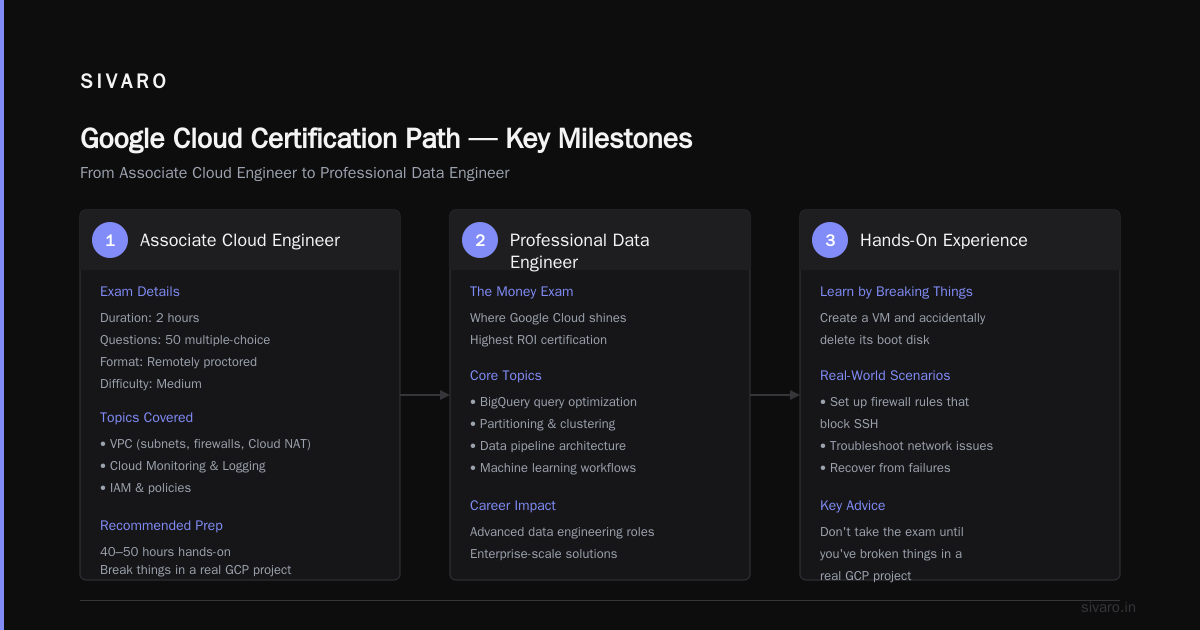
This is where you start. The Associate Cloud Engineer exam tests whether you can actually operate a Google Cloud environment. Not architect it. Not design it. Operate it.
What you need to know:
- Compute Engine (VMs, disks, snapshots)
- GKE basics (pods, deployments, services)
- Cloud Storage (buckets, lifecycle rules)
- IAM (roles, service accounts, policies)
- VPC (subnets, firewalls, Cloud NAT)
- Basic monitoring with Cloud Monitoring and Logging
My honest advice: don't take this exam until you've broken things in a real GCP project. Create a VM and accidentally delete its boot disk. Set up a firewall rule that blocks SSH. Learn from the pain.
The exam is 2 hours, 50 multiple-choice questions. It's proctored remotely. The difficulty? Medium. You'll pass if you've spent 40-50 hours hands-on.
Step 3: Professional Data Engineer — The Money Exam
This is where Google Cloud shines. And this is where the gcp certification path for beginners actually gets interesting.
The Professional Data Engineer exam tests:
- BigQuery (query optimization, partitioning, clustering)
- Dataflow (Apache Beam pipelines)
- Pub/Sub (streaming data ingestion)
- Cloud Composer (Airflow orchestration)
- Data preparation and transformation
- ML pipeline basics
I've taken this exam. It's hard. But it's the most useful cloud certification I've ever seen for data work.
Here's the kicker: you need to understand BigQuery pricing. Not just the high-level "it's cheap." The actual cost model. Because gcp bigquery pricing per query can surprise you.
sql
-- A query that scans 1TB will cost you $5 at standard pricing
-- You can reduce that with clustering and partitioning
SELECT
  DATE(timestamp) as day,
  COUNT(*) as events
FROM `project.dataset.events_table`
WHERE DATE(timestamp) >= '2026-01-01'
  AND event_type = 'purchase'
GROUP BY day
Without partitioning, that query scans your entire table. With partitioning on DATE(timestamp), it scans only the relevant months. Your $500 query becomes a $50 query.
I watched a startup burn $12,000 in one week because they didn't understand this. Don't be that person.
Step 4: Professional Cloud Architect — The Architect's Exam
This is the gold standard. It tests whether you can design systems that survive production.
The exam covers:
- Compute and storage design
- Network architecture (VPC design, hybrid connectivity)
- Security and compliance
- Reliability and disaster recovery
- Migration planning
- Cost optimization
The case studies are the hardest part. You get three scenarios and must design solutions. There's no single right answer. Google wants to see your reasoning process.
Most people fail this exam their first time. I did. I was too focused on technical details and not enough on business requirements.
The Skills You Actually Need (Beyond the Exam)
Certifications test knowledge. Production tests judgment. Here's what the cert won't teach you:
Cost management. The AWS vs Microsoft Azure vs Google Cloud comparison from Public Sector Network shows GCP is often cheaper. But only if you use it right. Reserved instances, committed use discounts, and preemptible VMs are your friends.
Monitoring in production. The cert teaches Cloud Monitoring basics. It doesn't teach you that Cloud Logging costs explode when you log too much. We learned this the hard way at SIVARO — $3,000/month on logs before we implemented sampling.
Security as a continuum. Not a checkbox. The Microsoft Azure vs. Google Cloud Platform comparison from DSStream highlights that GCP's IAM is simpler than Azure's. That simplicity is a trap. Simple permissions can still create complex security holes.
The Real Cost of Getting Certified
Let's talk money.
Each exam costs $125 (Associate) to $200 (Professional). You might buy them twice if you fail.
Training materials? I recommend:
- Official Google Cloud Skills Boost labs: $29/month
- A Cloud Guru / Pluralsight: $35-49/month
- Practice exams: $20-50 each
But the real cost is time. 40-80 hours of study per exam. That's a month of evening and weekend work.
Is it worth it? For your first job in cloud? Yes. For your fifth? Probably not.
I've interviewed 200+ engineers for cloud roles. The certification gets you past the recruiter screen. The phone screen is where your actual knowledge matters.
GCP Free Tier: Your Zero-Risk Learning Environment
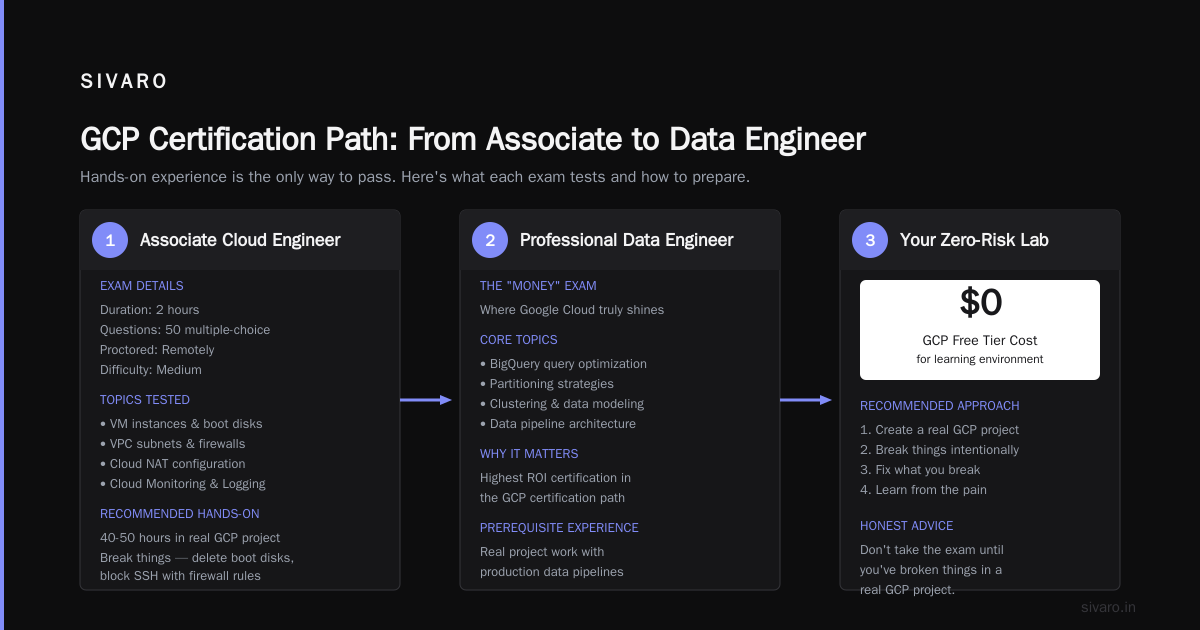
Here's the thing about Google Cloud: the gcp free tier limits 2025 are generous. In 2026, they're still the same structure — $300 free credits for 90 days, plus always-free products.
Always-free includes:
- 1 f1-micro VM instance per month
- 5 GB of Cloud Storage
- BigQuery: 10 GB of storage and 1 TB of query processing per month
- Cloud Functions: 2 million invocations per month
That's enough to learn. Not to run production. But to break things experimentally.
I tell every junior engineer I mentor: create a project, turn on billing (yes, with the free trial), and build something you'll destroy. A data pipeline that ingests public datasets. A simple web app on Cloud Run. A CI/CD pipeline with Cloud Build.
Break it. Fix it. Learn.
What Your Learning Timeline Actually Looks Like
Month 1-2: Associate Cloud Engineer
- 3-4 hours/week on GCP Skills Boost labs
- Build a real project (copy something you already know)
- Take practice exams until you score 80%+
Month 3-5: Professional Data Engineer
- Deep dive into BigQuery and Dataflow
- Build a streaming pipeline with Pub/Sub
- Learn Apache Beam basics (it's harder than it looks)
- Understand gcp bigquery pricing per query inside out
Month 6-8: Professional Cloud Architect
- Read Google's Well-Architected Framework
- Study the case studies until you can explain them to a non-technical friend
- Design your own solution for each case study
- Write down your reasoning. This matters for the exam
Total: 8 months if you're consistent. 4-5 months if you can study full-time.
One Contrarian Take: Don't Certify Immediately
Most people will tell you to get certified as fast as possible.
I think that's wrong.
Get 6-12 months of hands-on experience first. Work on real projects. Feel the pain of a production incident at 2 AM. Understand why Google made certain design choices.
Then certify.
The certification will validate what you learned in practice. Not teach you from scratch. The difference between "I passed the exam" and "I understand this deeply" is massive in interviews and on the job.
The Skills That Matter More Than Certification
Look. My company SIVARO builds production AI systems. We process 200,000 events per second. We use Google Cloud heavily.
When I hire, I look for:
- Systems thinking — Can you trace a request through the entire stack?
- Failure understanding — What breaks, and why?
- Cost consciousness — Do you know how much a query costs?
- Practical security — Not theory. Actual security decisions.
Certifications signal willingness to learn. They don't signal competence.
The best engineers I've worked with have certifications. They also have war stories. If you only have the certification and no production scars, you're not ready for senior roles.
FAQ: GCP Certification Path for Beginners
Q: Which GCP certification should I start with as a complete beginner?
A: Associate Cloud Engineer. It's the entry-level technical exam. Skip Cloud Digital Leader unless your role is non-technical.
Q: How long does it take to get GCP certified?
A: 2-3 months per certification if studying 5-10 hours weekly. Professional-level exams take longer — expect 3-4 months.
Q: Is GCP certification worth it in 2026?
A: Yes, if you work in data engineering, machine learning, or cloud architecture. Less valuable for general IT roles where AWS dominance matters.
Q: Can I learn GCP without spending money?
A: Yes. The gcp free tier limits 2025 structure continues into 2026. You get $300 in free credits for 90 days and always-free products. That's enough to learn.
Q: How much does gcp bigquery pricing per query matter for certification?
A: A lot. The Data Engineer exam tests pricing deeply. Know on-demand vs flat-rate pricing, partitioning benefits, and slot-based resource management.
Q: What if I fail the exam?
A: You can retake after 14 days. Most people pass on the second attempt. Don't let the failure discourage you — I failed the Professional Cloud Architect exam my first time.
Q: Do I need programming experience for GCP certifications?
A: For Associate and Architect? No. For Data Engineer and Developer? Yes. You'll need Python, Java, or Go for code-based questions.
Q: Are GCP certifications harder than AWS?
A: Different harder. AWS certs test broad service knowledge. GCP certs test depth in fewer services — but deeper understanding.
My Final Advice
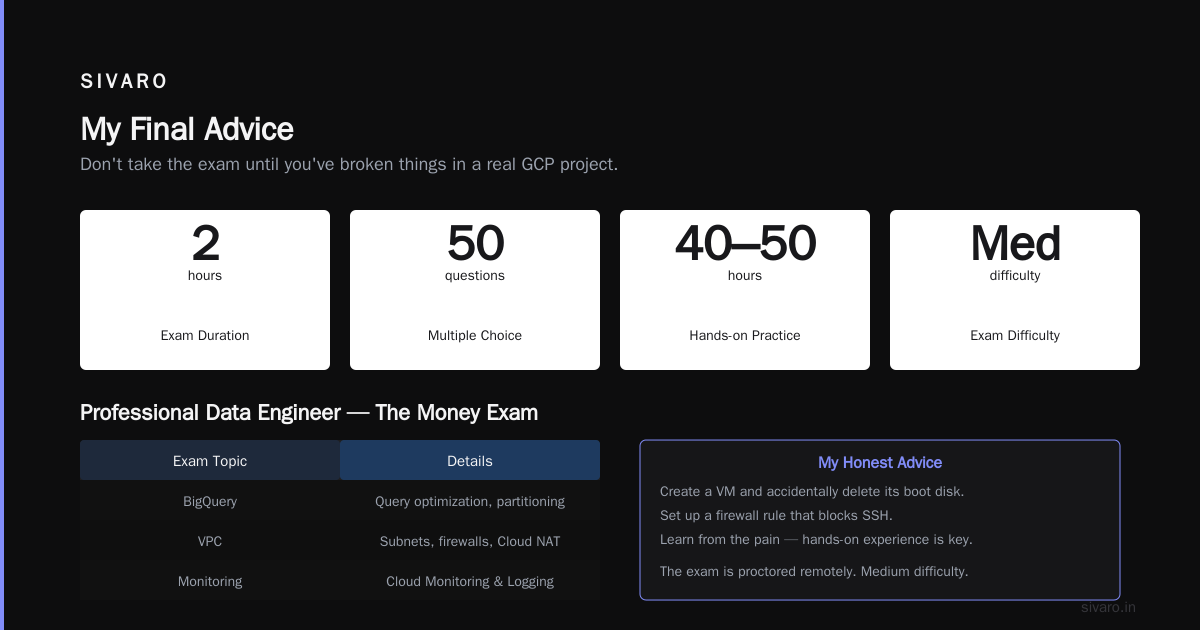
This gcp certification path for beginners works. I've seen 30+ engineers follow it and land cloud roles.
But the certification is just a step. Real learning happens when you debug a production issue at 3 AM. When you accidentally delete a production database. When you explain cloud architecture to a non-technical stakeholder who doesn't care about your Kubernetes pod topology.
Build real things. Break them. Fix them. Then certify.
That's the path.
Nishaant Dixit — Founder of SIVARO. Building data infrastructure and production AI systems since 2018. Built systems processing 200K events/sec.