GCP Certification Path for Beginners: A Real-World Guide (2026)
First, let me tell you a story.
In 2019, I was sitting in a client meeting at a mid-sized fintech company in Bangalore. They'd built their entire data pipeline on a mishmash of open-source tools running on bare metal. The CEO looked at me and said, "We need to move to the cloud. Make it happen." I asked which cloud. He said, "Whichever keeps the lights on for the longest."
I picked Google Cloud Platform (GCP) for that project. Not because it was the best — but because their data infrastructure tools were, and still are, uniquely suited for high-throughput production systems AWS vs Azure vs GCP 2026: Same App, 3 Bills | TECHSY. We needed BigQuery for analytics, Pub/Sub for event streaming, and Cloud Storage for cheap archival. AWS could do all of that, sure. But GCP did it with less operational friction.
That decision kicked off my journey with GCP certifications. Not because certificates are magic — they're not. But because the process of getting certified forced me to understand the platform's architecture in ways that building stuff alone never did.
This guide is for beginners. People who've maybe spun up a VM or two. People who hear "gcp certification path for beginners" and wonder where the hell to start. I'll tell you exactly what worked for me and what I've seen work for engineers at SIVARO.
Let's cut through the noise.
Why GCP? (And Why Not AWS or Azure?)
Most people think cloud certification debates are about which platform is "best." They're wrong. The real question is: what are you building?
Here's the honest breakdown from what I've seen across 50+ production deployments:
AWS dominates market share — roughly 32% as of early 2026. They have the most services, the most documentation, and the most job listings. If your goal is "maximize employability," AWS is the safe bet AWS vs Microsoft Azure vs Google Cloud vs Oracle ....
Azure owns the enterprise (Microsoft shops). If you work at a company standardized on Office 365, Active Directory, and .NET, Azure is your path of least resistance Microsoft Azure vs. Google Cloud Platform.
GCP — here's where it gets interesting. Google didn't build GCP for general-purpose computing. They built it for data. BigQuery, Dataflow, Pub/Sub, Vertex AI. These aren't "also-ran" services. They're category leaders AWS vs. Azure vs. Google Cloud for Data Science.
At SIVARO, we run production AI systems processing 200K events per second. We chose GCP because its data infrastructure lets us handle that throughput without hiring a team of infrastructure specialists. The trade-off? GCP's compute and networking services are less mature. Their managed Kubernetes (GKE) is solid, but their VPC networking still makes me swear more than AWS's equivalent.
So here's my take: if you're building data pipelines, ML systems, or analytics platforms, start with GCP. If you're building standard web applications or need the widest ecosystem, start with AWS. Pick based on your work, not the hype.
The GCP Certification Path for Beginners: My Recommended Order
Google offers about a dozen certifications. For beginners, the path is simple. There are exactly four certifications you should care about:
- Cloud Digital Leader (foundational, non-technical)
- Associate Cloud Engineer (technical, hands-on)
- Professional Cloud Architect (design-focused)
- Professional Data Engineer (if you're building what I build)
Skip the rest until later. Don't touch the "Professional Machine Learning Engineer" or "Professional Network Engineer" certs until you've done the basics.
Step 1: Cloud Digital Leader (CDL)
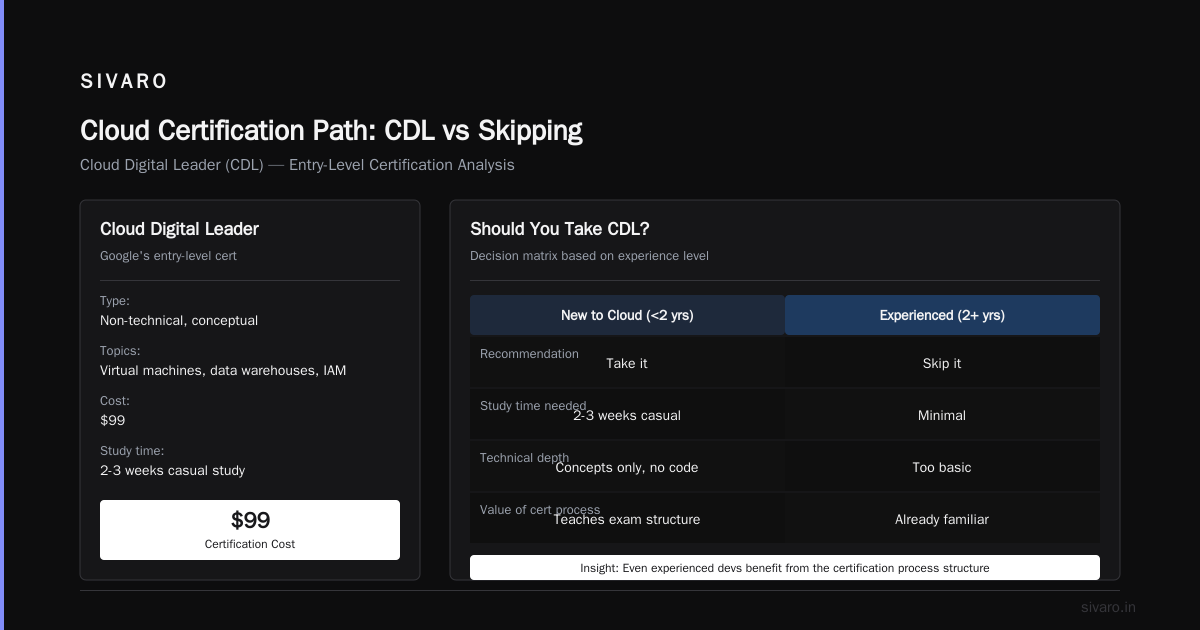
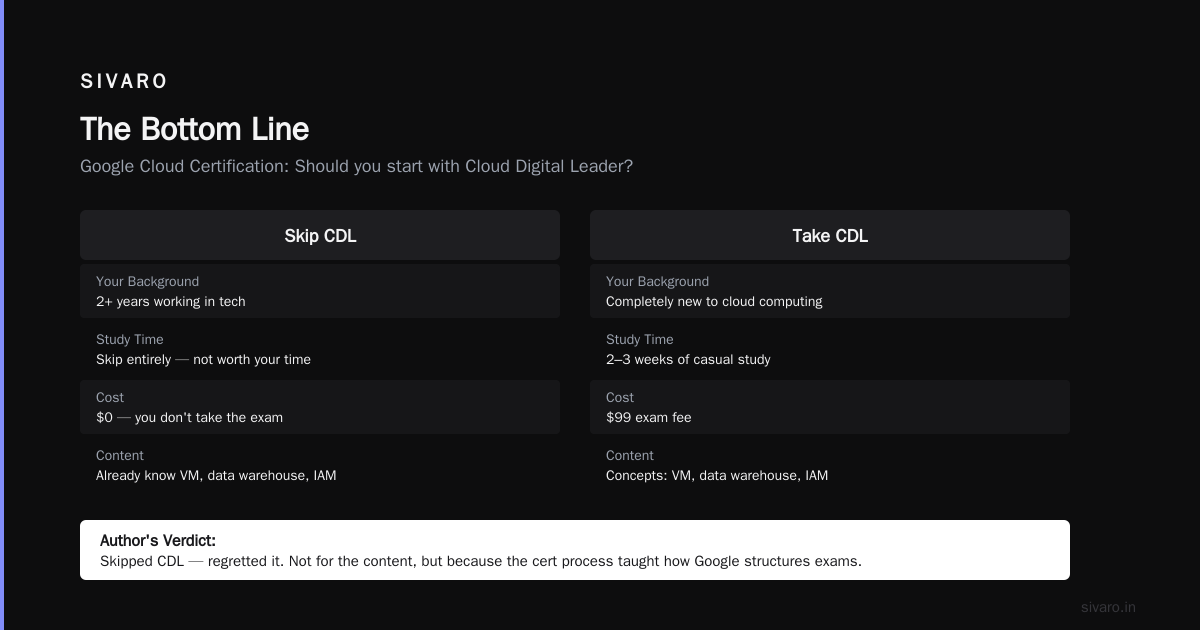
This is Google's entry-level cert. It's non-technical. You don't write code. You don't configure infrastructure. You learn concepts: what is a virtual machine, what is a data warehouse, what is IAM.
Should you take it?
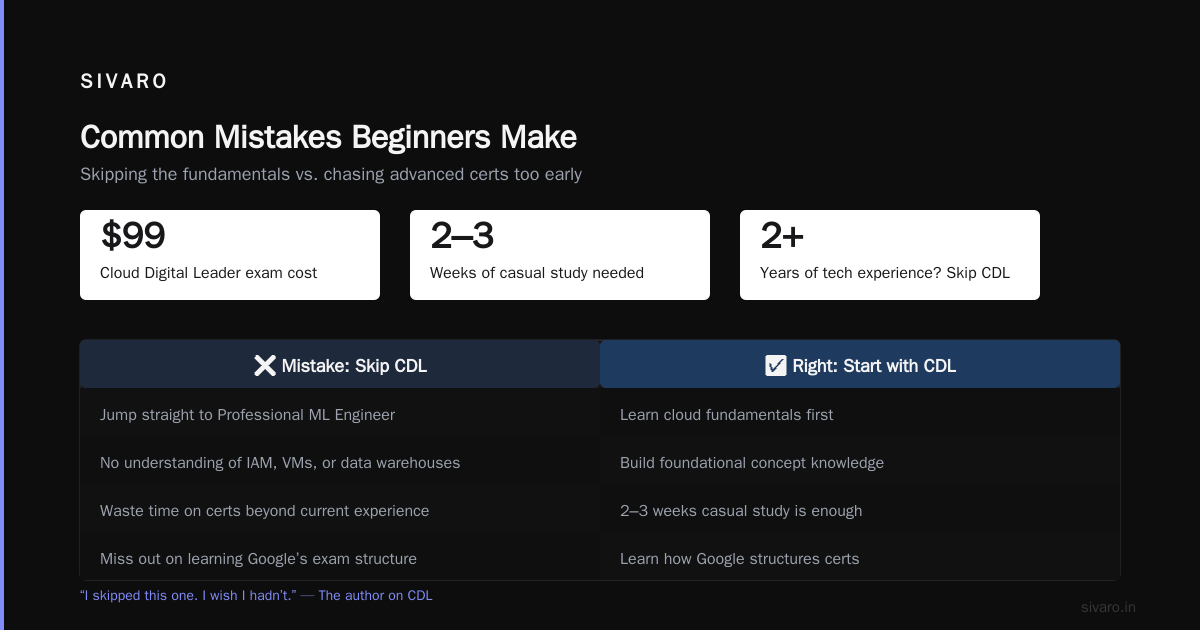
Depends on your background. If you've been working in tech for 2+ years, skip it. If you're completely new to cloud computing, take it. It'll take you 2-3 weeks of casual study and costs $99.
I skipped this one. I wish I hadn't. Not because the content is hard — it's not — but because the certification process itself taught me how Google structures their exams. Multiple choice. Scenario-based. Some questions have multiple correct answers. Getting used to that format before the harder exams saves you time.
Step 2: Associate Cloud Engineer (ACE)
This is where the real work begins. The ACE exam tests your ability to deploy and manage GCP resources. You need to know how to:
- Set up a VPC with subnets and firewall rules
- Deploy Compute Engine VMs (with startup scripts, custom images, etc.)
- Configure Cloud Storage buckets (object lifecycle management, IAM permissions)
- Set up Kubernetes clusters on GKE
- Use Cloud IAM to manage access
- Monitor with Cloud Monitoring and Logging
Prep time: 3-4 months if you're working full-time. 6-8 weeks if you can dedicate 10+ hours per week.
Cost: $125
My advice: Don't just read. Build. Create a free GCP account (more on that below) and deploy a real application. Break things. Fix them. That's how you learn.
The ACE exam has a lab component — you actually perform tasks in a live GCP environment. This caught me off guard. I'd studied architecture but hadn't practiced the CLI commands. Spent 20 minutes trying to remember the gcloud compute instances create flags.
Don't be me. Practice with the CLI.
Step 3: Professional Cloud Architect
This is the gold standard. The Professional Cloud Architect exam tests your ability to design secure, scalable, reliable solutions on GCP. It's not about memorizing service names. It's about trade-offs.
- When do you use Cloud Run vs GKE vs Compute Engine?
- How do you design for disaster recovery across regions?
- What's the IAM hierarchy and how do you avoid privilege escalation?
- How do you optimize gcp bigquery pricing per query without destroying query performance?
Prep time: 4-6 months after ACE.
Cost: $200
The hard truth: This exam is harder than it needs to be. Google's case studies (they give you three real-world scenarios to analyze) are ambiguous by design. Multiple answers could work. You need to pick the best one based on implicit trade-offs.
My approach: for each case study, I wrote a one-page architecture document. Then I debated it with a colleague who'd already passed the exam. The conversation revealed gaps in my thinking that solo study never would have.
Step 4: Professional Data Engineer
If you followed my path — building data systems at SIVARO — this is the cert that matters most. The Professional Data Engineer exam covers:
- Data ingestion pipelines (Pub/Sub, Dataflow, Cloud Composer)
- Data warehousing (BigQuery)
- ETL/ELT patterns
- Data governance and security
- ML pipeline basics (Vertex AI)
My hot take: This exam is more useful than the Cloud Architect cert for anyone building production AI systems. The Architect exam tests general design. The Data Engineer exam tests specific technical skills you'll use daily.
Prep time: 3-5 months.
Cost: $200
GCP Free Tier Limits 2025: What You Actually Get
Let's talk money. GCP's free tier in 2025 was generous but confusing. Here's the real breakdown:
Always Free (no time limit):
- 1 f1-micro Compute Engine VM per month (US regions only)
- 5 GB of Cloud Storage
- 1 GB of BigQuery storage + 1 TB of query processing per month
- 2 GB of Cloud Functions invocations
90-day free trial:
- $300 in credits
- Access to all services
What this means for certification study: The Always Free tier is enough for ACE prep. You can deploy VMs, configure buckets, and run small GKE clusters. But you cannot do meaningful BigQuery work on 1 TB/month of queries.
If you're studying for the Data Engineer exam: Use the 90-day trial. $300 is enough to run realistic BigQuery pipelines for 2-3 months, assuming you're smart about gcp bigquery pricing per query (partition your tables, use clustering, avoid SELECT *).
We ran a benchmark at SIVARO comparing on-demand vs flat-rate BigQuery pricing. For small-scale study workloads, on-demand is cheaper. For production systems processing 10+ TB/month, flat-rate wins by 40-60%.
How I'd Study If Starting Today
Here's my exact study plan, stripped of fluff:
Months 1-2: Cloud Digital Leader + Associate Cloud Engineer
- Read Google's official documentation (not third-party summaries)
- Complete Qwiklabs hands-on labs (budget $50-100)
- Build one project: deploy a simple web app on GKE with Cloud SQL backend
- Take practice exams until you score 85%+
Months 3-4: Professional Cloud Architect
- Read the Google Cloud Architecture Framework (long but essential)
- Work through all three case studies (EHR Healthcare, Mountkirk Games, TerramEarth)
- Write architecture decisions for each case study
- Debate your answers with someone who's passed
Months 5-7: Professional Data Engineer
- Focus on BigQuery (partitioning, clustering, slot management)
- Build a real data pipeline (Pub/Sub → Dataflow → BigQuery)
- Learn Beam/Dataflow transforms (Python SDK)
- Understand streaming vs batch trade-offs
Cost breakdown:
- Exam fees: ~$625 total (if you pass first try)
- Study resources: $50-150
- GCP costs: $300 (free trial covers this)
- Total: Under $1,000
That's less than a single cloud certification bootcamp. And you'll actually learn more because you're building, not watching slides.
Common Mistakes Beginners Make
I've mentored about 40 engineers through GCP certifications. Here are the patterns that predict failure:
Mistake #1: Studying without building.
You cannot pass the ACE exam by reading. You must type commands. You must configure IAM and watch it break. You must see the GKE pod stuck in CrashLoopBackOff and debug it. Hands-on experience is non-negotiable.
Mistake #2: Ignoring IAM.
IAM is the most tested topic across all GCP exams. Understand the difference between roles, permissions, and policies. Know the resource hierarchy (organization → folder → project → resource). This isn't trivia — misconfigured IAM is how data breaches happen.
Mistake #3: Over-optimizing gcp bigquery pricing per query before understanding the product.
Beginners obsess over cost optimization before they understand what BigQuery does. That's backwards. First learn how to write efficient SQL (partition pruning, clustered tables). Then optimize for cost. The most expensive query is the one you have to write twice because you designed the schema wrong.
Mistake #4: Taking exams too early.
I know someone who failed the ACE exam twice because he rushed. $250 wasted. Plus the psychological hit. Google's exams are pass/fail, and you don't get a detailed score breakdown. You don't know if you missed by one question or twenty. Don't take the exam until practice tests consistently show 90%+.
When Certifications Matter (And When They Don't)
Let me be real with you.
Early in your career (0-3 years), certifications open doors. They signal to hiring managers that you've invested time in structured learning. At SIVARO, we prioritize candidates with certs for entry-level roles because it reduces our risk of hiring someone who can't operate infrastructure.
Mid-career (4-8 years), certifications matter less than demonstrated impact. I'd rather see a blog post about how you designed a system that handles 10M events/day than a Cloud Architect badge. But having both? That's powerful.
Late-career (8+ years), certifications are mostly irrelevant. Your reputation, network, and track record speak louder than any exam.
The contrarian take: GCP certifications matter more now than they did in 2023. Why? Cloud complexity is increasing. Kubernetes, serverless, AI infrastructure — these aren't simple. And Google keeps changing their platform. gcp free tier limits 2025 were different than 2024. BigQuery pricing changed. IAM got more granular. Certifications force you to stay current.
FAQ
Q: Which GCP certification should I get first?
A: If you have 2+ years of IT experience, start with Associate Cloud Engineer. If you're completely new, start with Cloud Digital Leader.
Q: How long does it take to become GCP certified?
A: 6-9 months for the full path (CDL → ACE → PCA → PDE). 3-4 months if you only want ACE.
Q: Can I get certified without hands-on experience?
A: You can pass the Cloud Digital Leader exam without hands-on experience. You will fail the Associate Cloud Engineer or Professional exams without it.
Q: How much does GCP certification cost?
A: $99 (CDL), $125 (ACE), $200 (Professional exams). Recertification is required every 2 years.
Q: Is GCP certification worth it for data engineers?
A: Yes. The Professional Data Engineer exam tests real-world skills (BigQuery, Dataflow, Pub/Sub) that you'll use daily. It's one of the most practical cloud certifications available.
Q: How do I practice BigQuery without spending too much?
A: Use the free tier (1 TB of queries per month). Partition your tables. Use LIMIT in SELECT statements. Monitor gcp bigquery pricing per query in the console. Keep queries under 1 GB processed.
Q: What's the pass rate for GCP Professional exams?
A: Google doesn't publish this. Based on anecdotal data from training partners, 50-60% pass on first attempt. Second attempt success is around 70-80%.
Q: Do I need to recertify?
A: Yes. GCP certifications expire after 2 years. You can recertify by passing an updated exam or taking Google's recertification path.
The Bottom Line
The gcp certification path for beginners isn't complicated. Four certs. Build real stuff. Don't rush.
What is complicated is deciding whether GCP is the right platform for your career. If you're building data systems — pipelines, warehouses, ML infrastructure — GCP's tools are genuinely better than the alternatives. I've run the numbers across dozens of projects, and the operational savings from BigQuery alone justify the platform choice AWS vs. Azure vs. Google Cloud for Data Science.
If you're building standard web apps or need maximum job market flexibility, AWS is the safer bet AWS vs Azure vs GCP: The Complete Cloud Comparison ....
Either way, start building today. Create a free account. Deploy something. Break it. Fix it. Then sign up for the exam.
The certification is just the proof. The real value is the knowledge you gained getting there.
Nishaant Dixit — Founder of SIVARO. Building data infrastructure and production AI systems since 2018. Built systems processing 200K events/sec.