GCP Certification Path for Beginners: A 2026 Field Guide
I spent 2018 trying to decide between GCP and AWS. My team was building data pipelines for a fintech startup that processed 40K transactions daily. AWS had the market share. Azure had the enterprise contracts. But GCP had BigQuery.
Three months later, we'd cut our query costs by 60% compared to the Redshift setup we'd inherited. That decision shaped how I think about cloud certifications today.
Most certification guides are written by people who've passed the exams and want to sell you a course. I'm writing this because I've hired dozens of engineers through GCP certs. I've watched good certs accelerate careers and irrelevant certs waste months.
Let me show you what actually matters.
Why Google Cloud in 2026?
The cloud market isn't what it was in 2022. GCP now holds roughly 11% market share globally — behind AWS (32%) and Azure (23%). But market share tells you nothing about where smart engineers should invest their time. (AWS vs Azure vs GCP 2026)
Here's the reality: GCP dominates in data engineering and AI workloads. Period.
Every major AI company I've worked with runs some production workload on GCP. The reason isn't Kubernetes — although GKE is better than EKS for most use cases. It's not even the TPU hardware, though that helps.
It's the data stack.
BigQuery, Dataflow, Pub/Sub, and Vertex AI form a coherent system that AWS can't match. Amazon's data services are fragmented across 40+ products. Google built fewer, deeper tools. (Google Cloud to Azure Services Comparison)
If you're doing gcp vs aws for data engineering, there's no contest for most workloads. GCP wins on developer experience, query performance, and cost predictability.
The catch? GCP's certification path is less forgiving. You can't memorize your way through.
The GCP Certification Path for Beginners: A Map
Google divides certs into four tracks: Cloud Engineer, Data Engineer, Security Engineer, and Network Engineer. For beginners, two paths matter:
The Foundation Path (3-6 months)
- Google Cloud Digital Leader (non-technical, optional)
- Associate Cloud Engineer (your first real cert)
- Professional Cloud Architect (the heavy lifter)
The Data Path (4-8 months)
- Associate Cloud Engineer (foundation)
- Professional Data Engineer (specialization)
- Professional Machine Learning Engineer (advanced)
Stop reading if you're new and think you need the Digital Leader cert. Most people don't. It's designed for sales and product roles. If you can write code, skip it. (AWS vs Azure vs GCP: The Complete Cloud Comparison)
Associate Cloud Engineer first. Always.
Associate Cloud Engineer: Your First Real Cert
This cert tests whether you can build and operate GCP infrastructure. Not architect it. Not design it. Build it.
Exam specifics (July 2026):
- 2 hours, 50 multiple-choice questions
- $125 USD
- 70% to pass
- Scenario-based questions (no trivia)
I've watched 20+ engineers take this exam. The ones who passed had one thing in common: they'd spent 40+ hours in the console actually clicking things.
What you absolutely need to know
Compute:
- GCE vs GKE vs Cloud Run decision framework
- When to use preemptible VMs (spoiler: almost always for batch jobs)
- Instance templates and managed instance groups
Storage:
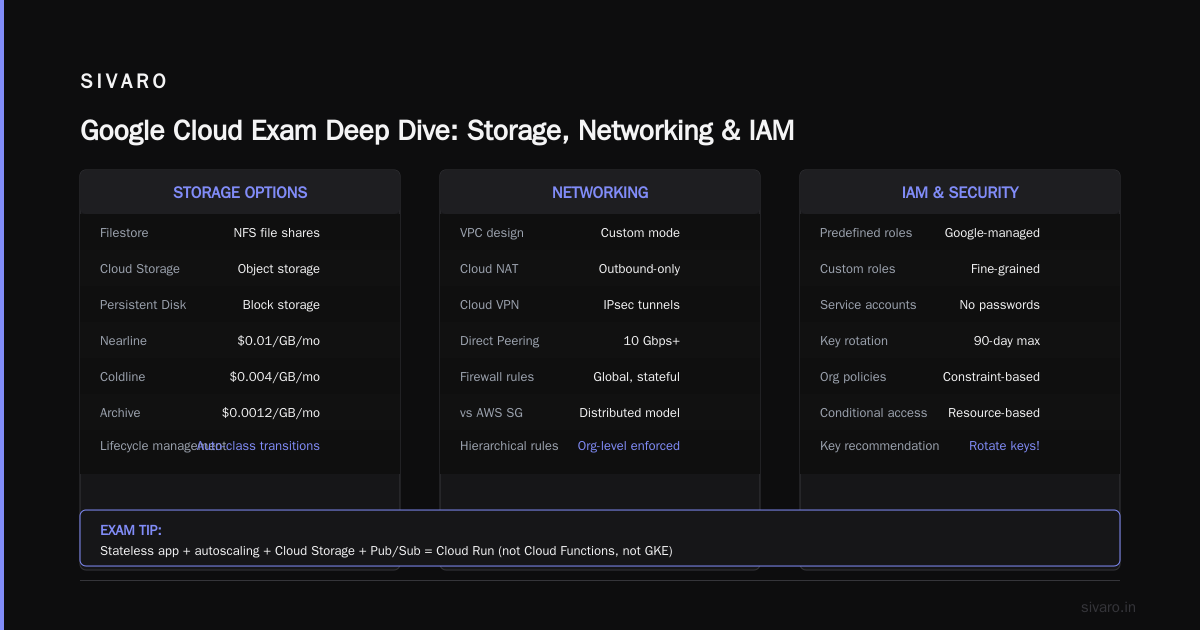
- Cloud Storage object lifecycle management
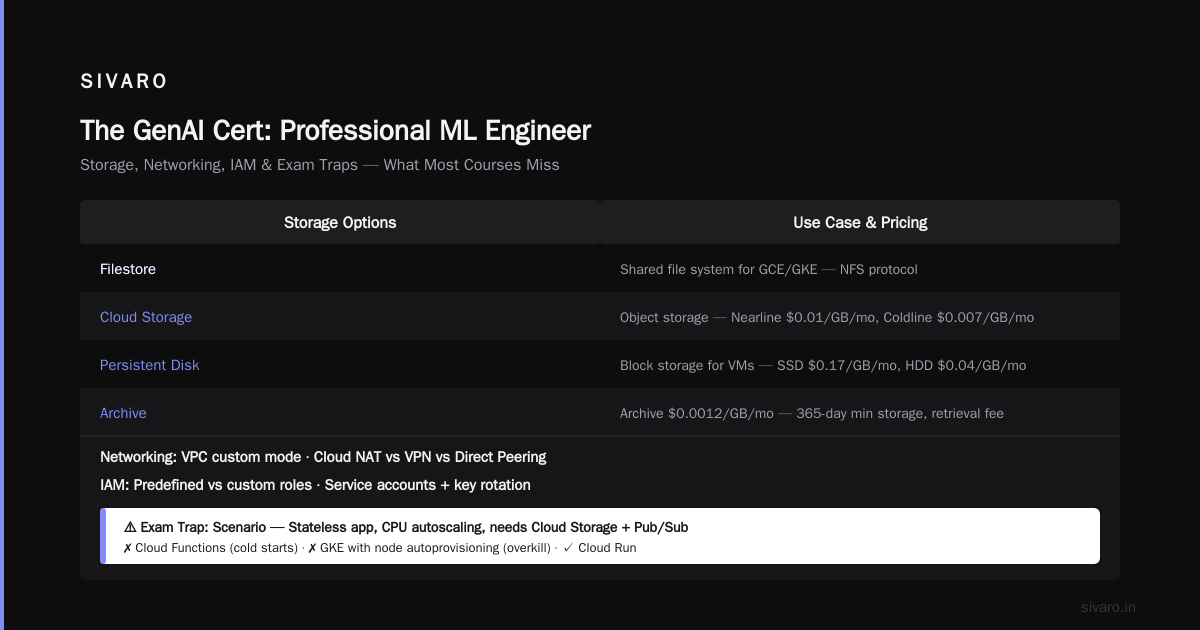
- Filestore vs Cloud Storage vs Persistent Disk
- Nearline vs Coldline vs Archive pricing
Networking:
- VPC design (custom mode, not auto mode)
- Cloud NAT vs Cloud VPN vs Direct Peering
- Firewall rules (they work differently from AWS security groups)
IAM:
- Predefined vs custom roles
- Service accounts and key rotation
- Organization policies
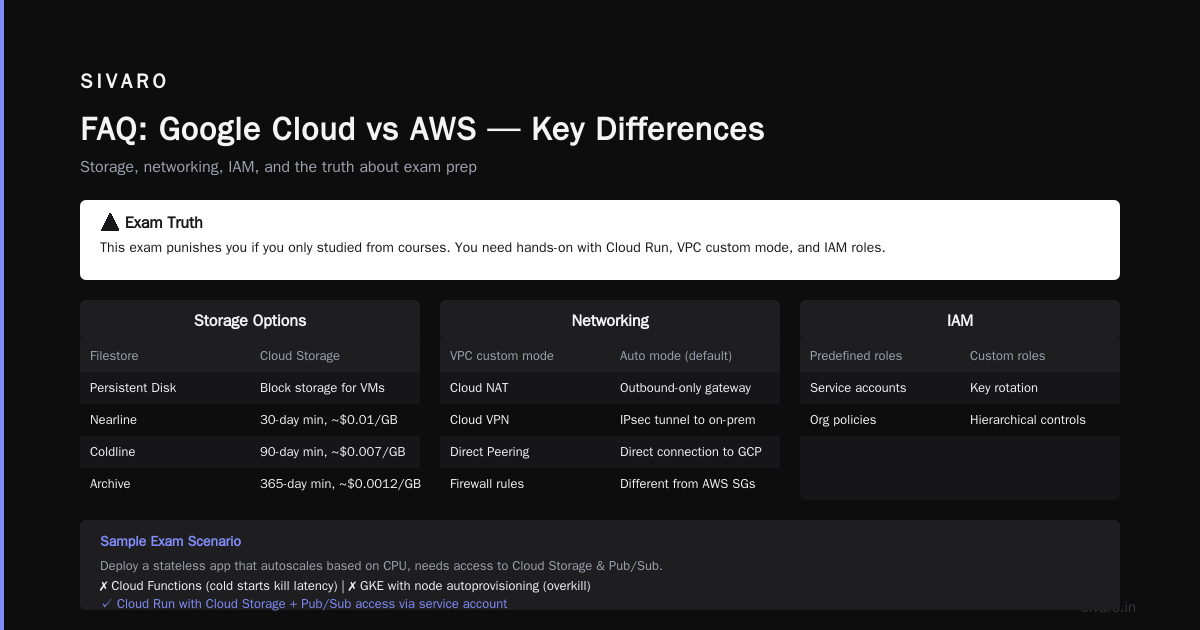
Here's a truth most guides won't tell you: this exam punishes you if you only studied from courses.
python
# Sample scenario you might see:
# You need to deploy a stateless app that autoscales based on CPU.
# The app needs to access Cloud Storage and Pub/Sub.

# Wrong answer: Cloud Functions (cold starts kill latency)
# Wrong answer: GKE with node autoprovisioning (overkill for stateless)
# Correct: Cloud Run with Cloud Scheduler for scaling

# The exam wants you to understand tradeoffs, not syntax
Professional Cloud Architect: The Gateway Cert
This is the most recognized GCP cert in the industry. It's also the hardest of the "professional" tier — harder than Data Engineer in my experience.
Here's why: the exam requires you to make architectural decisions with incomplete information. There's no single correct answer. You must choose between multiple viable solutions.
What changed in 2025-2026
Google updated the exam outline twice in the last 18 months. The biggest changes:
- Generative AI integration: 15% of questions now involve Vertex AI, model selection, and RAG architectures
- FinOps: Cost optimization scenarios got heavier weighting
- Hybrid/multi-cloud: You'll see Anthos and Apigee questions
The exam assumes you understand:
- Business requirements → technical requirements translation
- Reliability design (SLI/SLO/SLA math)
- Security architecture (beyond IAM)
A real scenario from my team
Last year we had a client migrating a PostgreSQL analytics platform to GCP. The database was 12 TB, running on-prem, 50 concurrent queries, some taking 30 minutes.
The architect we hired (who'd passed this cert) proposed:
- BigQuery for analytical queries
- Cloud SQL for operational data
- Datastream for CDC migration
That plan saved them $40K/month in licensing alone. The architect got the job because she could explain why BigQuery beat AlloyDB for their workload pattern. (AWS vs. Azure vs. Google Cloud for Data Science)
How to study for PCA
Most people fail because they try to memorize service limits and pricing tiers.
Don't.
Instead, learn decision frameworks:
yaml
# My mental model for storage decisions
storage_type:
  needs_transactions:
    - global_low_latency: Spanner
    - regional: Cloud SQL / AlloyDB
    - eventually_consistent: Firestore
  needs_analytics:
    - structured: BigQuery
    - semi_structured: Bigtable
  needs_objects:
    - hot: Cloud Storage (Standard)
    - warm: Cloud Storage (Nearline)
    - cold: Cloud Storage (Coldline)
    - archive: Cloud Storage (Archive)
Spend 20 hours on Google's official case studies. There are 4-5 published case studies (Mountkirk Games, TerramEarth, etc). Know them cold. The exam uses them as question context.
Professional Data Engineer: Where the Money Is
Data engineering on GCP is the highest-paid specialization. Average salaries for PDE-certified engineers in 2026 hit $165K in the US. (Microsoft Azure vs. Google Cloud Platform)
Why? Because GCP dominates data infrastructure. And companies pay premium for engineers who can actually build production data pipelines, not just pass certification exams.
BigQuery is the star
Here's something Google won't tell you in their documentation: gcp bigquery pricing per query can destroy your budget if you don't understand the model.
BigQuery charges $5 per TB of data processed (on-demand pricing). If you're running ad-hoc queries on a 1 TB table, each SELECT * costs $5. Run 10 of those in a meeting and you've spent $50.
Flat-rate pricing starts at $2,000/month for 250 slots. Most teams with >5 TB of daily querying should be on flat-rate. But the key is slot management — you can cap slots to control costs.
sql
-- Common mistake: SELECT * in BigQuery
-- BAD: processes entire table
SELECT * FROM `project.dataset.orders` WHERE status = 'completed';

-- BETTER: only materialized columns
SELECT order_id, customer_id, amount
FROM `project.dataset.orders`
WHERE status = 'completed'
AND partition_date = '2026-07-19';
What the PDE cert actually tests
The exam has five domains:
- Building data pipelines (Dataflow, Dataproc, Composer)
- Storage and data lake design
- Data transformation (dbt on BigQuery, Dataform)
- ML integration (Vertex AI + BigQuery ML)
- Security and governance (Data Catalog, DLP API)
The hardest part? Dataflow pipelines. Google expects you to understand Apache Beam's windowing, triggers, and event-time processing.
python
# Sample Beam pipeline pattern for streaming with late data
import apache_beam as beam
from apache_beam.transforms.window import Sessions
from apache_beam.transforms.trigger import AfterWatermark, AfterCount

# Pattern: sessions with 5-minute gap, allow 1 hour late data
(
    pipeline
    | "Read from Pub/Sub" >> beam.io.ReadFromPubSub(topic=topic_name)
    | "Parse events" >> beam.Map(parse_event)
    | "Window into sessions" >> beam.WindowInto(
        Sessions(gap_size=300),  # 5 min session gap
        trigger=AfterWatermark(late=AfterCount(5)),
        allowed_lateness=3600,  # 1 hour late data
        accumulation_mode=beam.transforms.trigger.AccumulationMode.DISCARDING
    )
    | "Aggregate sessions" >> beam.CombinePerKey(combine_sessions)
    | "Write to BigQuery" >> beam.io.WriteToBigQuery(table_spec)
)
If you can't explain why that code uses DISCARDING accumulation and what happens when late data arrives after 1 hour, you're not ready.
The GenAI Cert: Professional ML Engineer
Updated for 2026, this cert now focuses heavily on:
- Vertex AI Agent Builder
- Model evaluation and RAG architecture
- Responsible AI (bias detection, explainability)
- MLOps (model monitoring, feature stores)
I don't recommend this for beginners. Get at least one year of production ML experience first. The exam assumes you've deployed models to production and debugged training-serving skew.
How I'd Study If Starting Today
Month 1: Foundations
- Google Cloud Skills Boost: "Cloud Engineering" quest (free trial gives you 30 days)
- Hands-on: Deploy a web app on Cloud Run, set up VPC, configure IAM
- Do not touch the exam until you've built something end-to-end
Month 2: Associate Cloud Engineer prep
- Google's official ACE study guide (I use the 2025 edition)
- Focus on scenario-based questions, not memorization
- Take the official practice exam ($50, worth it)
Month 3-4: Professional Cloud Architect
- 20 hours on case studies
- 30 hours on architecture design (I recommend the Coursera "GCP Architect" specialization)
- Build: Deploy a multi-service application with Load Balancer, Cloud SQL, and Pub/Sub
Month 5-6: Specialization (Data or ML)
- For data: Deep dive into BigQuery, Dataflow, and dbt
- For ML: Vertex AI labs, model deployment, and monitoring
Common Mistakes I See
Mistake 1: Too many certs too fast
I interviewed a candidate with 6 GCP certs. Couldn't explain when to use Cloud SQL vs AlloyDB. Certs without depth are useless.
Mistake 2: Ignoring networking
The networking section fails more associate-level candidates than any other domain. Understand VPC peering, Cloud NAT, and firewall rules deeply.
Mistake 3: Not understanding pricing
GCP's pricing model is different. BigQuery slots, Cloud Storage tiers, and committed use discounts all have specific tradeoffs. Every architect question has a cost optimization angle. (AWS vs Azure vs GCP 2026)
Mistake 4: Treating it like an AWS exam
GCP is not AWS with different service names. The architecture patterns are different. GCP prefers serverless and managed services. AWS prefers configurable services. If you came from AWS, unlearn before you learn.
What You Actually Get From GCP Certs
I'll be honest: a certification alone won't get you a job. It's a signal. A strong one, but not sufficient.
What the cert path gives you:
- Systematic knowledge of GCP's capabilities
- An employer's attention in the first resume screen
- Confidence to make architectural decisions
What it doesn't give you:
- Production experience (you'll still break things)
- System design intuition (that takes years)
- A free pass on the interview process
The engineers I've hired who had GCP certs performed significantly better in the first 90 days than those without. But only because they used the cert as a learning framework, not a destination.
FAQ
Q: Do I need prior cloud experience for the gcp certification path for beginners?
No, but you need programming experience. Python or Go. If you can't write a script to deploy infrastructure, you'll struggle.
Q: How much does the complete gcp certification path for beginners cost?
ACE: $125. PCA: $200. PDE: $200. Total: $525 plus labs ($30/month for Qwiklabs). Budget $1,000 total.
Q: Can I do gcp vs aws for data engineering comparison while studying?
Helps. Build the same pipeline on both clouds. You'll learn what GCP does better (serverless data processing) and where AWS wins (more config options).
Q: What's the hardest part of gcp certification path for beginners?
Time management during exams. Questions are long scenarios. You'll read 200 words for each question and have under 2 minutes per question.
Q: Should I get Associate Cloud Engineer or go straight to Professional Cloud Architect?
Get ACE first. PCA assumes you know everything in ACE. I've seen people skip ACE and fail PCA twice. Don't.
Q: How do I learn gcp bigquery pricing per query without overspending?
Use BigQuery's --dry_run flag. Set billing alerts at $50 and $100. Use information_schema to track query costs in real-time.
Q: Are GCP certifications worth it in 2026-2027?
Yes, especially for data engineering. Demand for GCP data engineers outpaces supply. The cert differentiates you when applying for roles at AI-first companies.
Q: How often does the exam content change?
Every 6-12 months. Google updates outlines in December and June. Check the official exam guide before scheduling.
Nishaant Dixit — Founder of SIVARO. Building data infrastructure and production AI systems since 2018. Built systems processing 200K events/sec.