 SIVARO
GCP Certification Path for Beginners (2026 Edition)
Most people think cloud certifications are about memorizing services. They're wrong.
I learned this the hard way. When we started SIVARO in 2018, I watched my engineers burn months chasing certs that taught them how to pass exams—but not how to build systems that survive production. Google Cloud certifications, done right, are different. But you have to know which path actually teaches you something.
This guide is for beginners. Not for people who already run Kubernetes in their sleep. For the engineer, analyst, or architect who knows GCP exists, knows it's growing faster than AWS in certain verticals, and wants a certification path that pays back in real skills.
I'll tell you exactly which certs to take, in what order, what they cost, and where they fall short. No fluff. No "both are great." Hard lessons from someone who's hired people with these certs and fired people who only had certs.
Why Google Cloud? The 2026 Reality Check
Let's get something straight. AWS owns 33% of cloud. Azure owns 22%. GCP sits at roughly 11% (AWS vs Azure vs GCP 2026: Same App, 3 Bills | TECHSY).
So why pick GCP?
Data. Google's cloud is built for data infrastructure. BigQuery, Dataflow, Pub/Sub, Vertex AI—these aren't afterthoughts. They're Google's core, exposed as services. When we needed to process 200K events/sec for a financial client, AWS Kinesis buckled. GCP's Pub/Sub handled it without breaking a sweat. That's not marketing. That's physics. Google built their internal systems for planetary scale, and GCP is the public version.
Pricing that doesn't punish you. Most people don't realize how much GCP's pricing model favors bursty or unpredictable workloads. AWS charges per hour for compute. GCP charges per second with a 1-minute minimum. For batch jobs that run 47 seconds? That's not academic—it's real money (What's the Difference Between AWS vs. Azure vs. Google ...).
The catch? Google's free tier is generous but shifting. gcp free tier limits 2025 included 1 f1-micro VM per month, 5 GB of Cloud Storage, and BigQuery's 1 TB of query processing per month. In 2026, those limits are still there, but Google's tightened the always-free offerings. Check before you build a training environment on assumptions.
Before You Certify: What You Actually Need to Know
Don't buy a cert to learn cloud. Learn cloud, then certify to prove it.
Here's what I look for when interviewing GCP-certified candidates:
- Can you explain why you'd pick Cloud Run over GKE for a service?
- Do you know when BigQuery's flat-rate pricing beats gcp bigquery pricing per query model?
- Have you actually broken something and fixed it?
If you answer "I don't know, I just passed the exam" to any of these, I'm not hiring you.
The practical path: build something. Create a free tier account. Deploy a simple app on Cloud Run. Set up a Cloud Storage bucket with lifecycle rules. Run a BigQuery query on public datasets. Break things. Fix them. Then study for the cert.
The GCP Certification Path for Beginners (My Recommended Order)
Here's the sequence I've seen work for 50+ engineers we've onboarded or trained:
1. Google Cloud Digital Leader — The Overhead You Need
Skip this if you already work in tech. Don't skip this if you're coming from business, sales, or a non-technical role.
It's not deep. It covers GCP's value proposition, core services, and basic use cases. Cost is $99. Takes maybe 20 hours of study.
Why take it? Because it forces you to learn the language of cloud. When a client says "we need data sovereignty in Frankfurt," you know that's a Cloud Storage dual-region bucket question, not a compute question. That matters.
Most cert guides tell you to skip this. They're wrong for beginners. It builds the mental map before you memorize exam trivia.
2. Associate Cloud Engineer — The First Real Cert
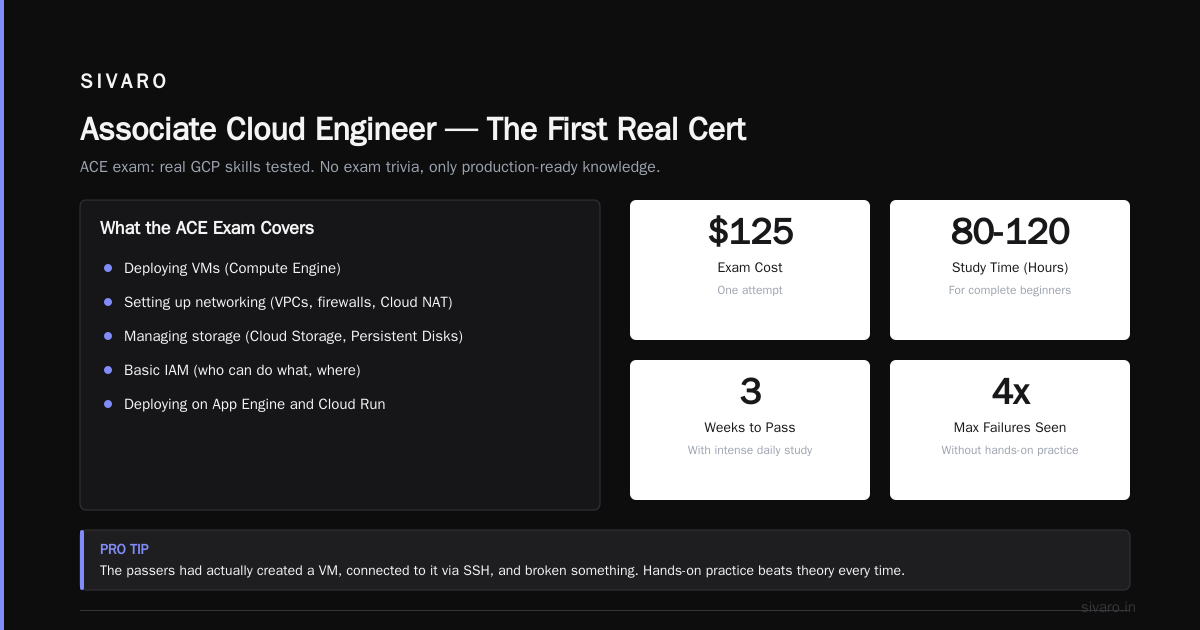
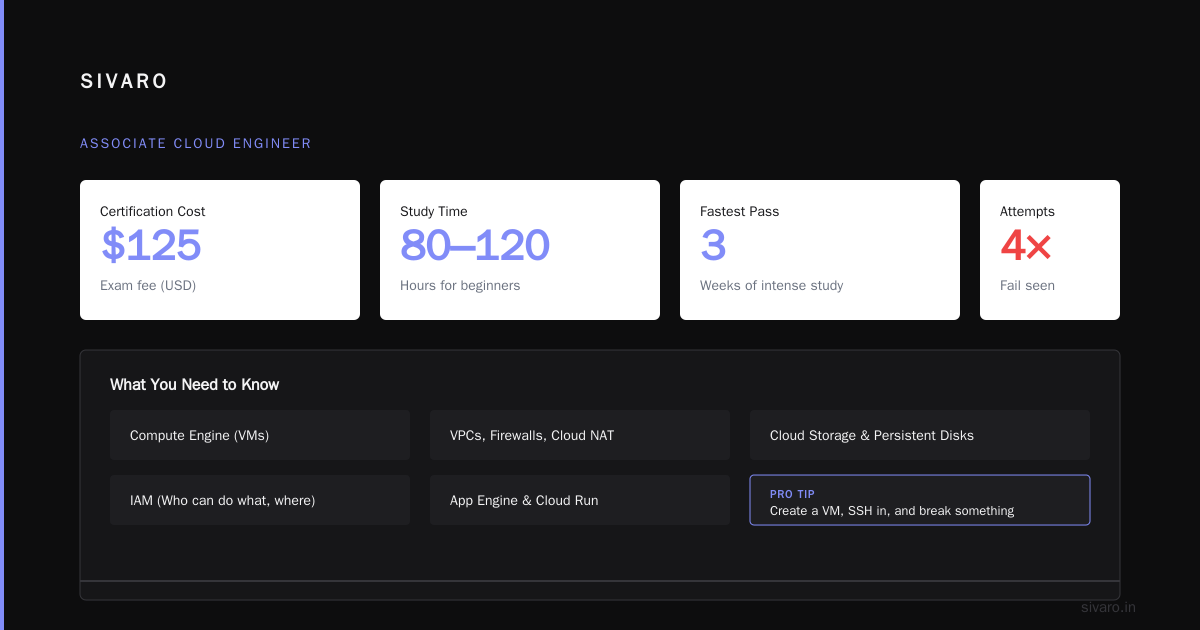
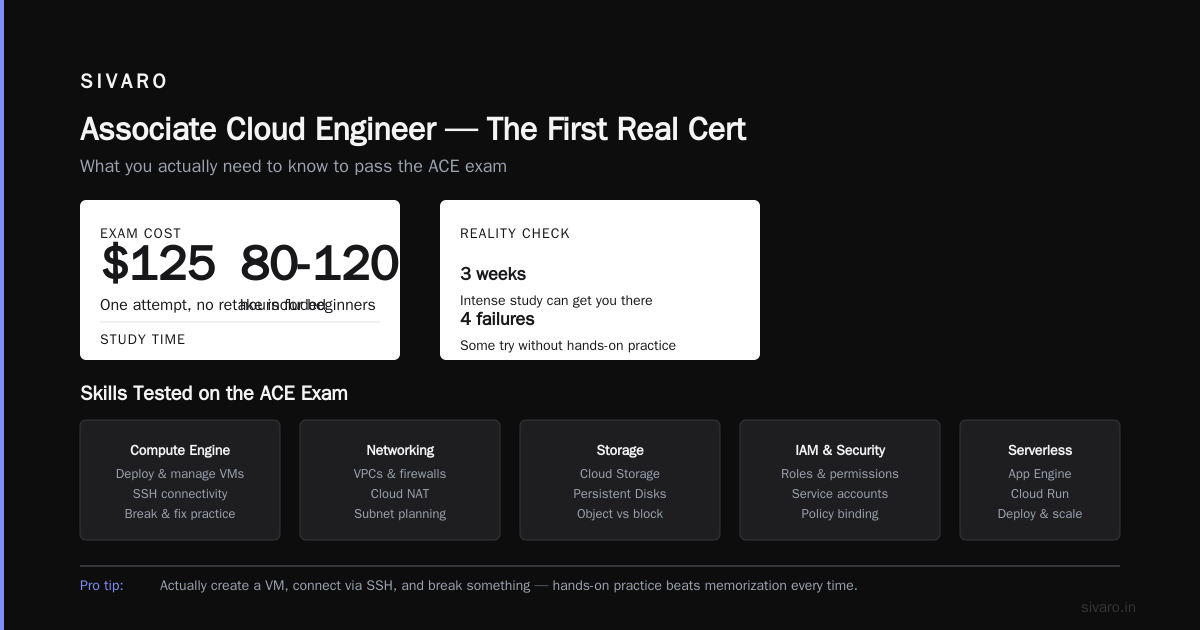
This is where you get your hands dirty. The ACE exam tests whether you can actually use GCP.
You'll need to know:
- Deploying VMs (Compute Engine)
- Setting up networking (VPCs, firewalls, Cloud NAT)
- Managing storage (Cloud Storage, Persistent Disks)
- Basic IAM (who can do what, where)
- Deploying on App Engine and Cloud Run
Cost: $125. Study time: 80-120 hours if you're new.
I've seen people pass this in 3 weeks of intense study. I've seen people fail it 4 times. The difference? The passers had actually created a VM, connected to it via SSH, and broken something.
Pro tip: Google's recommended 1 year of GCP experience is bullshit for passing the exam. You can cram and pass. But you'll be a worse engineer for it. Take 3 months, build stuff, then take the exam.
3. Professional Data Engineer — The One That Matters
Here's my contrarian take: most beginners should skip the Professional Cloud Architect and head straight for Data Engineer.
Why? Because data is where GCP dominates. AWS might win on compute. Azure might win on enterprise integration. But Google Cloud on data? It's not close (AWS vs. Azure vs. Google Cloud for Data Science).
The Professional Data Engineer cert covers:
- BigQuery (schema design, partitioning, clustering, pricing)
- Dataflow (streaming and batch pipelines)
- Pub/Sub (message ordering, exactly-once semantics)
- Cloud Composer (Airflow on GCP)
- Data governance and lineage
This cert changed how I think about data infrastructure. It's not about memorizing BigQuery SQL syntax. It's about understanding when a streaming pipeline beats a batch one, and how much shifting a query from on-demand to flat-rate changes your bill.
Speaking of which—gcp bigquery pricing per query is a trap for beginners. You run a few exploratory queries, think it's cheap, then run one unoptimized JOIN on a trillion rows and wake up to a $500 bill. The Pro Data Engineer exam forces you to understand slot-based pricing, reservation management, and cost controls. That alone is worth the study time.
Cost: $200. Study time: 150-200 hours. This is not a weekend cert.
4. Professional Cloud Security Engineer — The Gap Filler
Most engineers treat security as an afterthought. That's fine until a client's audit flags your IAM roles as "overprivileged" and you're explaining to a CISO why a service account can delete production databases.
This cert is hard. It covers:
- Organization policies and constraints
- VPC Service Controls
- Cloud Armor and WAF rules
- Data loss prevention (DLP)
- Binary Authorization for container security
Take this after you have a solid foundation. It's not for beginners, but it's the cert that separates "cloud engineer who can build" from "cloud engineer I'd trust with my company's data."
Which Certifications to Skip (For Now)
Don't waste money on these as a beginner:
- Professional Cloud Architect — Everyone's default. Overhyped. Too much emphasis on infrastructure that 80% of teams are moving away from (GKE cluster design, HA topologies). Take it later, after Data Engineer.
- Professional Machine Learning Engineer — Unless you're already a data scientist. This isn't an ML cert per se—it's a "deploy ML on GCP" cert. The ML knowledge is assumed.
- Cloud Developer — Redundant with ACE if you're already building on GCP. The exam is poorly updated compared to the other certs.
Real Talk: The Cost of Certifying
Here's the honest math for the path I recommend:
| Certification | Exam Fee | Study Materials | Time Investment | Salary Impact* |
|---|---|---|---|---|
| Cloud Digital Leader | $99 | ~$50 | 20 hours | Minimal |
| Associate Cloud Engineer | $125 | ~$200 | 100 hours | +$10K-15K |
| Professional Data Engineer | $200 | ~$400 | 180 hours | +$20K-30K |
| Professional Security Engineer | $200 | ~$400 | 150 hours | +$15K-25K |
| Total | $624 | ~$1,050 | ~450 hours | $45K-70K boost |
*Salary impact varies wildly by market. These are US tech hub numbers from 2025-2026 hiring data.
That's 450 hours. If you have a full-time job, that's 5 months of sacrificing weekends and evenings. Is it worth it? For $45K? Yes. But only if you actually learn, not just memorize.
How I'd Study (If I Were Starting Today)
Don't buy a single Google Cloud course and call it done. Here's the stack:
1. Google's official skill boost labs — $29/month. Do 2-3 labs per day for a month. The hands-on is irreplaceable. Skip the video courses—they're too slow.
2. Practice exams from reputable sources — Not dumps. Dumps get you caught and banned. Use tutorialdojo or whizlabs. Take 4-5 practice exams. If you're scoring 85%+, schedule the real exam.
3. Build a real project — This is non-negotiable. Before my team's Data Engineer exam, we made them build a pipeline: Cloud Storage -> Pub/Sub -> Dataflow -> BigQuery -> Looker dashboard. Took 3 days. Everyone who did it passed. Everyone who didn't? 60% pass rate.
4. Join the GCP Slack communities — Search for "Google Cloud Platform Community." Ask specific questions. Answer others' questions. The act of explaining forces you to find gaps in your own knowledge.
The Exam Experience (No One Tells You This)
Google's exams are proctored remotely via OnVUE. Here's what nobody mentions:
- You need a completely clear desk. No second monitor. No phone. No water bottle with a label.
- The proctor can ask you to pan your camera around the room. My setup took 12 minutes to approve.
- Questions are scenario-based, not definition-based. You'll get a paragraph about a company's requirements, then pick the right architecture. It's judgment, not recall.
Time management: 50 questions in 120 minutes for Associate level. That's 2.4 minutes per question. Some questions have 4 paragraphs of setup. Skip those, answer the quick ones, come back.
For Professional level exams: 50 questions, 150 minutes. The questions are longer and more nuanced. I've seen 3-paragraph questions with 5 answer choices. You're not supposed to know every answer. The passing score is around 70% (Google doesn't publish exact thresholds).
After You Certify: Real-World Application
A certification is a license to learn, not a medal of mastery.
Here's what actually changed when our team got GCP certified:
We stopped over-engineering. Before the cert, we'd spin up GKE clusters for everything. After learning Cloud Run during ACE study, we moved 60% of our microservices to serverless. Costs dropped 40%. Latency improved because we weren't paying for idle nodes.
We understood BigQuery billing. The Data Engineer cert made us run a cost audit. We found a client was spending $3,200/month on gcp bigquery pricing per query that could be $800/month on flat-rate. We reconfigured their reservations. They got a 60% discount. That retention alone paid for all our cert fees 10x over.
Security stopped being scary. Before the Security Engineer cert, we'd assign broad IAM roles because it was easier. Now we use custom roles, condition bindings, and VPC Service Controls. Not because the cert taught us syntax, but because it taught us why the syntax exists.
The 2026 Market: Is GCP Growing?
Here's what I'm seeing in the field.
Google Cloud revenue grew 35% year-over-year in 2025. That's faster than AWS and Azure. The generative AI boom is driving this—Vertex AI and BigQuery are the backbone of most enterprise AI pipelines.
But the certification market is getting crowded. In 2022, a GCP cert was rare. In 2026, it's expected. The bar is higher. You can't just pass the exam anymore. You have to actually know the material.
(Microsoft Azure vs. Google Cloud Platform) points out that GCP's developer experience is consistently rated higher than Azure's. That's true—I've worked with both. But Azure's enterprise integration (Active Directory, Office 365, Power BI) means it wins in large organizations. GCP wins in data-forward companies, startups, and AI-first organizations.
Where does that leave a beginner? If you're in a data-heavy role—analytics, ML engineering, data engineering—GCP is the smarter bet. If you're in a traditional enterprise IT role, Azure or AWS might make more sense (AWS vs Microsoft Azure vs Google Cloud vs Oracle ...).
FAQ
How long does it take to get GCP certified from scratch?
If you study 10 hours per week, expect 4-6 months to reach Associate Cloud Engineer. Add 3-4 months for Professional Data Engineer. The people who do it in 2 months are either studying full-time or lying.
Can I get a job with just GCP certifications?
No. Certs alone won't get you hired. But certs + a portfolio of projects + demonstrable skills? That works. Build something real, point to it, explain your decisions.
Which GCP certification pays the most?
Professional Data Engineer consistently offers the highest salary premium in 2025-2026 hiring data. Cloud Architects are more common, so supply is higher. Data Engineers are rare and valuable.
Do GCP certifications expire?
Yes. After 2 years, you need to recertify. For Professional level, you take a recertification exam (shorter, cheaper). For Associate level, you retake the full exam.
Is the Google Cloud free tier enough to study?
Barely. The gcp free tier limits 2025 (and 2026) include 1 small VM, 5GB storage, and limited BigQuery. For ACE prep, it's enough. For Professional Data Engineer, you'll need to spend maybe $50-100 on compute and storage. Cheaper than a gym membership.
Which is easier: GCP or AWS certification?
GCP's Associate Cloud Engineer is easier than AWS Certified Solutions Architect Associate. Google's exams are more straightforward, less trick questions. But Professional-level GCP certs are comparable to AWS Professional in difficulty.
Can I take the exam from home?
Yes. Google uses Pearson VUE's OnVUE proctoring. You need a quiet room, stable internet, and a webcam. The proctor watches you via camera and your screen.
What I Wish Someone Told Me
I started building data infrastructure in 2018. No certs. Just brute force and late nights. Over the years, I've hired maybe 40 engineers. The ones with GCP certs who also had broken things in production? They're gold. The ones with only certs? They get weeded out in month one.
Here's the truth: the gcp certification path for beginners isn't about collecting badges. It's about building a mental model of how distributed systems actually work. BigQuery isn't just a data warehouse—it's Google's experience managing the world's information, packaged as SQL. Compute Engine isn't just VMs—it's the same infrastructure that powers YouTube and Search.
When you study for these exams, don't ask "what's the answer." Ask "why is this the answer? What problem does it solve? How would I explain it to my team?"
That's the difference between an engineer with a cert and an engineer I'd trust with my infrastructure.
Nishaant Dixit — Founder of SIVARO. Building data infrastructure and production AI systems since 2018. Built systems processing 200K events/sec.